Alexander Chapoton House Local Historic District
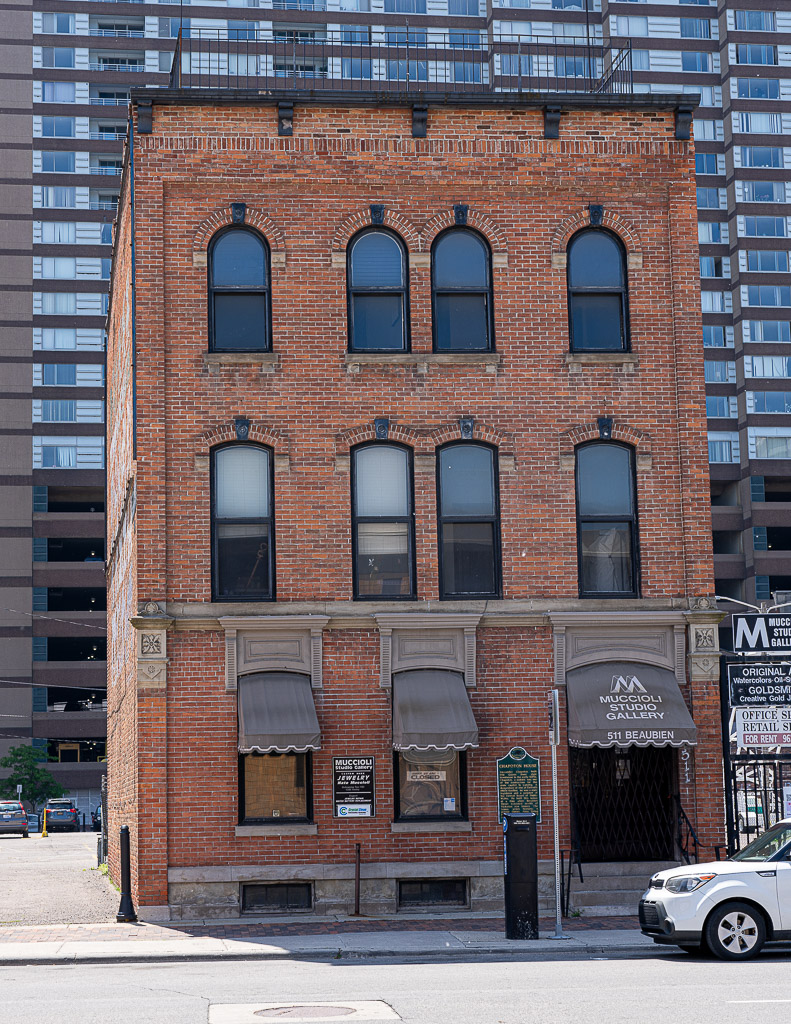
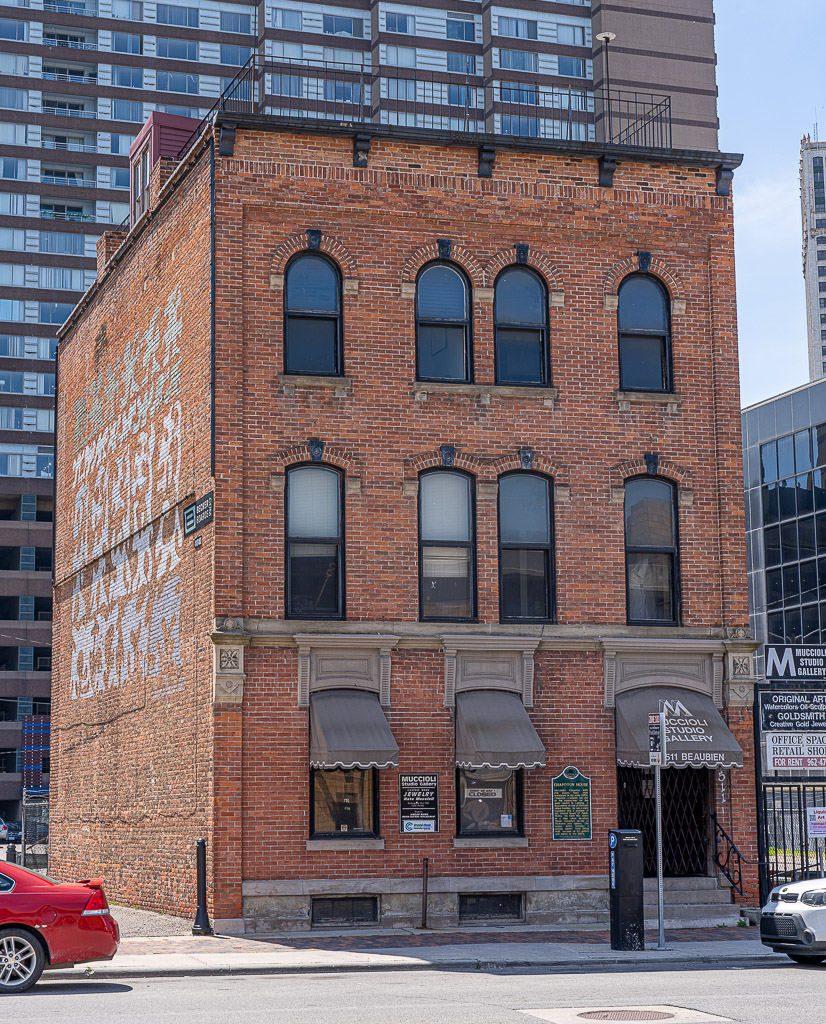
The proposed Alexander Chapoton House Historic District consists of one building at 511 Beaubien Street. It is on the west side of Beaubien to the north of East Larned in downtown Detroit, and is in the second block north of East Jefferson Avenue, a major east-west thoroughfare. It is surrounded by parking lots on its north, south, and west sides. The three-story Victorian townhouse has undergone restoration and is currently being used as a gallery on the first story, artist studios in the basement, and commerical offices on the second and third stories. The Chapoton House is listed on the National Register of Historic Places. You can read details about the Alexander Chapoton House Historic District in the Proposed Alexander Chapoton House Local Historic District Final Report (local copy), which I recommend highly to anyone interested in Detroit's history.
HISTORY: [+ expand]
The Alexander Chapoton House is significant as one of the last well-preserved vestiges of nineteenth century residential development in downtown Detroit. It is also important as an interesting and, for Detroit, rare example of a middle-class High Victorian row-house.
Alexander Chapoton was a direct descendent of one of Detroit's oldest families. His ancestor Dr. Jean Baptiste Chapoton came to the city in 1719 to serve as surgeon to the garrison at Fort Pontchartrain. Chapoton's father was a mason and Alexander succeeded him in business, inheriting a substantial fortune in real estate. He augmented this with additional land acquisitions while increasing his stature as an important contractor. He was appointed as one of three commissioners to supervise the erection of the present state capitol in Lansing, served in the state legislature, served on the Detroit Board of Public Works and conducted a brisk contracting business erecting many commercial blocks and residences in Detroit. He brought his son, Alexander Jr., into partnership with him to carry on the business after his retirement. He lived his entire adult life in the same house on Congress Street in downtown Detroit where he died in 1893 and left a large estate which included considerable downtown real estate as well as 511 Beaubien and its now vanished neighbors on both sides.
While the exact year in which the Chapoton House was built is not certain, it can be assumed that it was built in the late 1870s because of its appearance and the fact that there is no permit for the construction of the house issued after 1880, the first year the City of Detroit kept records of building permits. However, an alteration permit was issued to Alexander Chapoton (Sr.) on August 10, 1886, the valuation of the improvements being the quite substantial sum of $1,800.
In the late 1870s, when Chapoton built number 511 as a rental property, Beaubien Street was part of the old downtown residential area extending northward from Jefferson Avenue. Over the years, the old French ribbon farms had been subdivided into house lots and built up. Beaubien Street took its name from the family whose farm it traversed. In the 1830s the Beaubien family had subdivided the southern portion of its ancestral acres to accommodate the eastward growth of the city. In the 1860s the first substantial construction occurred, although it was not really until the post Civil War boom of the 1870s that the tract was densely settled. The three-story brick building now 511 Beaubien replaced a wooden outbuilding previously on the site, and, in fact, buildings existed on the site prior to 1835, the year John R. Williams registered the plat for the partition of the Beaubien Farm. By 1880, the southern end of Beaubien Street was almost entirely filled with closely-built, brick duplexes and short blocks of rowhouses sited at the edge of the sidewalk. These urban house types, which were necessitated by the high land values adjacent to downtown and the riverfront, were soon eclipsed in popularity by the detached single- or two-family dwelling that has dominated residential construction in Detroit down to the present. As the business district spread out in the twentieth century, this unique rowhouse neighborhood, like the few other similar sections that had existed in Detroit, were redeveloped for commercial and industrial purposes. The lower Beaubien streetscape, however, remained partially intact into the 1960s. At this time, much of Beaubien Street was cleared for new construction, and, in 1976, for widening. Only number 511 and a few rehabilitated buildings to the north survive today as reminders of an earlier period of residential development downtown and of Detroit's brief experiment with the rowhouse as a dwelling type. The present owners acquired the house after it was a rooming house for several decades.
ARCHITECTURAL DESCRIPTION :
The Alexander Chapoton House is a brick, three-story-with-basement, flat-roofed, townhouse built at the edge of the sidewalk. Originally part of a complete streetscape of attached and free-standing Victorian rowhouse type structures, it now shares its block between Larned and Congress Streets in the central business district of Detroit with a modernized parking garage. The surrounding neighborhood is filled with small office and commercial buildings, mostly built in the twentieth century, and many parking lots and garages.
The house that Chapoton built at 511 Beaubien for investment is an interesting example of a speculative dwelling. The assymmetrical facade with its mismatched lower and upper stories derives its architectural distinction entirely from stock elements applied to the flat facade. The metal and wood cornice was removed a few years ago, but has been replicated from a historical photograph of a similar structure that once stood nearby.
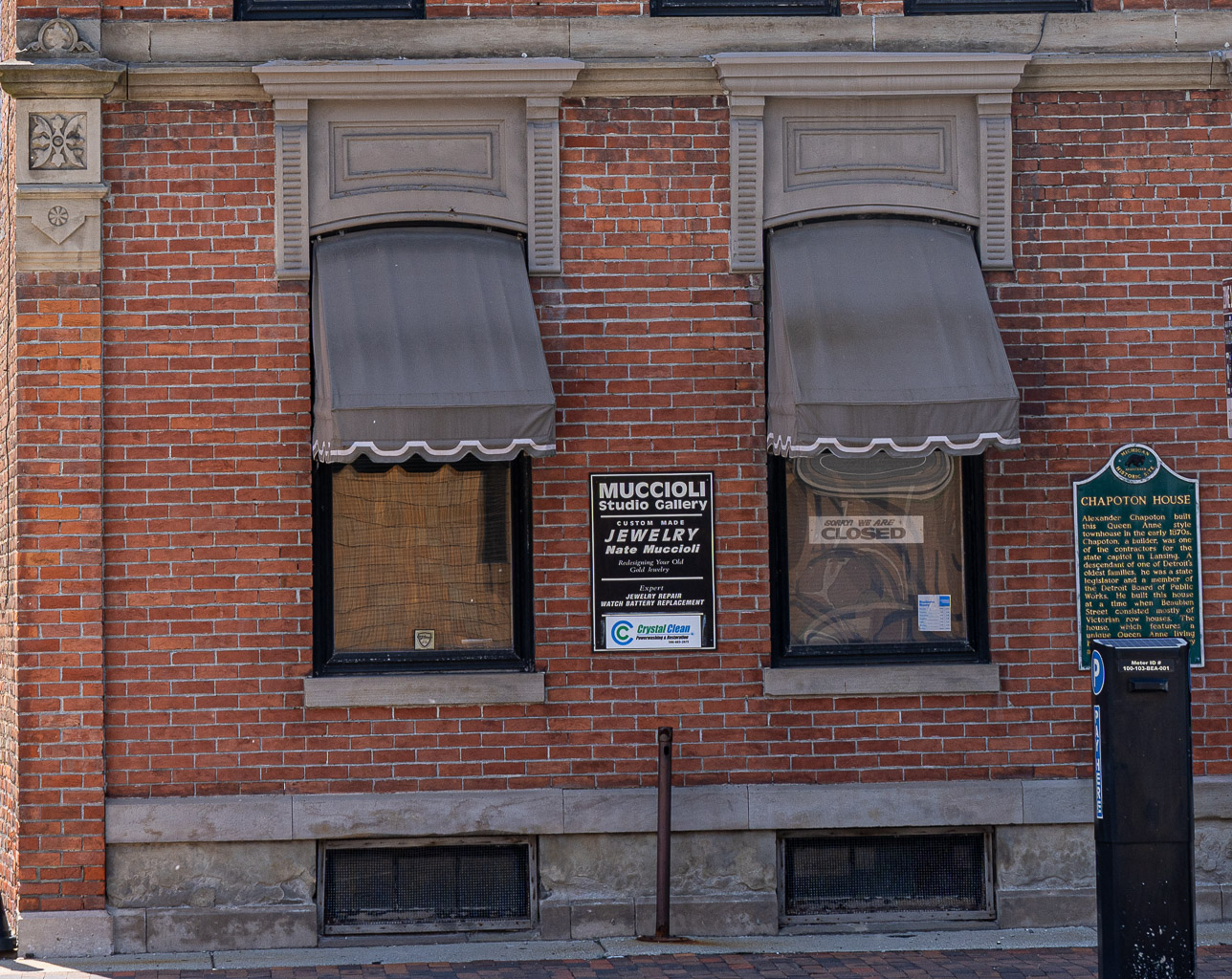
Above the low, stone-faced basement the first story is divided into three bays (1st and 2nd photos below). The double-door entrance at the north side is balanced by a pair of segmentally-arched, one-over-one, sash windows. The windows and the doorway are surmounted by massive arched, moulded, cast-iron panels that extend to the broad, moulded belt course separating the first and second stories. The belt course extends across the front and terminates in projecting decorative blocks ornamented with stylized floral motifs (3rd photo below).
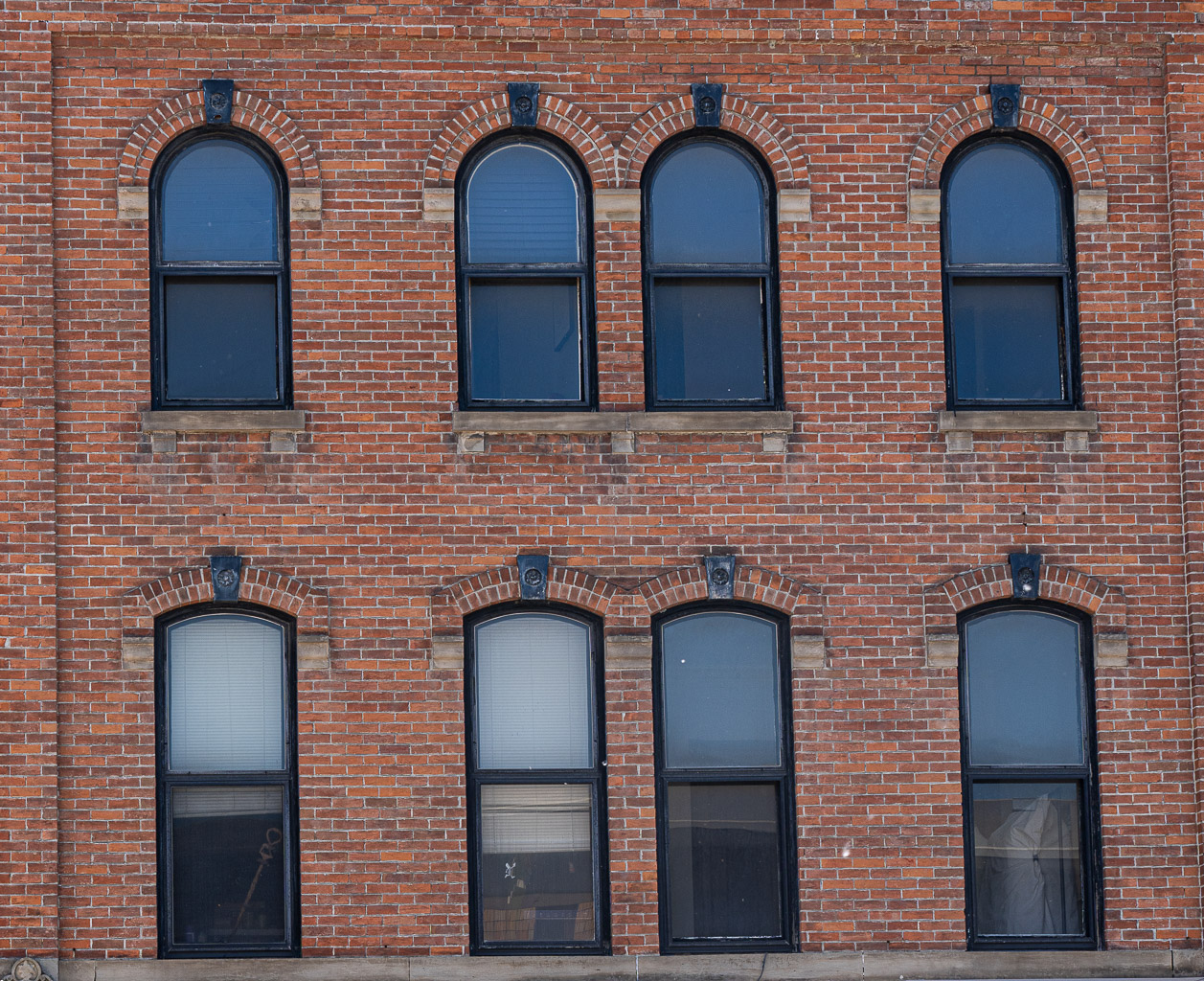
The upper two floors are each divided into four bays of one-over-one. sash windows that are not aligned with the first story fenestration. The center windows are paired on both the second and third floors. The second floor windows are topped with segmentally-arched brick hood moulds with label stops and keystones while the third floor windows have semi-circular brick hood moulds (4th photo below).
Only the front elevation is of architectural note, although both the north side of the house, which faces a small alley, and the rear or west side have six-over-six sash windows set in unarticulated segmentally-arched openings.
The interior has been little altered since the major alteration in 1886. The floor plan is an interesting adaption of a modest townhouse format to accommodate a fashionable Victorian living hall. The entrance leads through a panelled vestibule and an inner set of half-glazed double doors into a broad, "L" shaped hall that wraps around two sides of the front parlor to the left of the front door. An open well staircase angles around the corner of the inside wall of the hall and continues in a straight run along the east side of the back hall.
The rear portion of the house is divided into two nearly equally large rooms with the dining room on the right and the kitchen on the left with its wainscoting of vertical tongue-and-groove boards. The second and third floors are similar in general plan to the first.
The spacious bath and nine bedrooms are reminders that many house holders at that period not only had large families but also took in boarders.
The interior contains all of its original trim. Throughout the house, the same pine and oak millwork is used. The five panel doors have beveled, raised center panels and many retain their simple flat spool-shaped knobs. The door and window casings are faced with simple reeded bands that intersect at corner blocks incised with a circle motif. The doors on the upper floors have integral awnning-type two-light transoms. The windows on the first and second floor front rooms have flat plaster cornice mouldings that repeat the reeded banding of the door casings.
The most notable interior architectural features are the staircase and the parlor mantel. The closed-stringer stair has a square, panelled newell capped with a bulbous finial. The molded, oval handrail is supported by closely-spaced, turned balusters. The parlor is the only room in the house with a fireplace. The mantel is of slate painted to simulate inlaid black marble and is incised with simple, Eastlake-influenced snowflake and line patterns. Although it may have once burned coal, the fireplace was fitted with an elaborate, cast-iron fireplace cover at an early date. Throughout the house, other ornate cast-iron heating grilles are located on the walls just above the baseboard.
More photos and more description of this building can be found at HistoricDetroit.org.