General Motors Research Laboratory / Argonaut Building Local Historic District
The General Motors Research Laboratory / Argonaut Building Local Historic District contains the single building at 460 W Baltimore St. You can read details in the General Motors Research Laboratory / Argonaut Building Historic District Final Report (local copy), which I recommend highly to anyone interested in Detroit's history.
HISTORY: [+ expand]
The General Motors Research Laboratory is significant for its association with the automobile industry, specifically General Motors Corporation, and for is association with two famous GM employees. Renowned architect Albert Kahn designed the building for General Motors+ use as a research and engineering facility. As the home of GM Research, it was the place where hundreds of patents and products were developed from 1928 to 1956 when it was replaced by the new GM Technical Center in Warren, Michigan. The significant events connected to the General Motors Research Laboratory deal with innovative product developments and marketing that affected broad sections of American culture. These events are discussed under the individuals associated with them.
General Motors real estate division, Argonaut Realty Corporation, commissioned a laboratory building from Albert Kahn Associates, to be located on the southeast corner of the intersection of Milwaukee and Second Avenues. The archival drawings are dated June 15, 1928. However, these drawings are actually change orders to the final construction set and the construction may have already begun at the time these were produced. The building is listed in the Detroit City Directory of 1927-1928 as a GM research lab. Argonaut Realty commissioned an addition built in 1936 and added an entrance at 485 Milwaukee. The archival drawings for the original building and the addition clearly indicate that the buildings were designed for GM's internal use only. The buildings served as the main research buildings for General Motors until the completion of the Warren Technical Center in 1956. When the research division moved out, the building became the home of Argonaut Realty, and is listed as such in the 1958 City Directory. Argonaut Realty moved again when GM completed it's renovation of the Renaissance Center and consolidated its divisions in downtown Detroit between 2000 and 2003. The Argonaut Building has been vacant since that time.
Albert Kahn, Architect (1869-1942)
Architect Albert Kahn was renowned for his work in civic, industrial, educational, and commercial architecture in the greater Detroit area. He was largely responsible for designing the early factories and offices used by the Detroit-based automotive companies. His work ranged from the functional assembly plant typically devoid of ornament to Classical Revival structures drawing heavily on Greco-Roman styles and motifs. Kahn was the foremost developer of the modern factory at the beginning of the twentieth century: reinforced concrete structures with utilitarian lines yet clad in brick and with modest ornamentation to add visual warmth and human scale. His plants featured abundant natural light and ventilation, an innovation at the time. During the same period, Kahn was working with a repertoire of historic styles for his non-factory work. He favored specific architectural styles for specific purposes, as in his use of Classical Revival styles for banks (i.e. the Detroit Trust Company, 1915) and Arts and Crafts style for domestic architecture. For the General Motors Research Laboratory, an office and research laboratory, he choose a blend of modern and historic stylistic features he had previously used for numerous office and public buildings in Detroit. Kahn4s work on the General Motors Research Laboratory included the original 1928 structure and the 1936 addition. Special features of the General Motors Research Laboratory, specific to its purpose as an automotive research facility, included a reinforced concrete structure and oversized freight elevators designed to allow automobiles to move through the eleven-story building, including onto the roof, and to dampen the vibrations of the various testing equipment. A large number of Kahn Buildings are already listed in the National Register, including Hill Auditorium (Ann Arbor), and the Fisher and GM Buildings (1928 and 1922 respectively), both within one block of the General Motors Research Laboratory.
Area of Significance .Commerce .Automotive Industry
General Motors is a collection of automotive and automotive-related manufacturers formed in the early part of the twentieth century for efficiency in product development, production, and marketing. It was incorporated on September 16, 1908, bringing together more than thirty companies by 1920. The company dominated U.S. auto sales for decades, due in large part to the products developed in the General Motors Research Laboratory from 1928 to 1953. One of the original Big Three. automobile companies, GM remains one of the largest corporations in the world.
Typically, GM Research, housed in the General Motors Research Laboratory, would develop a product or process until one of the GM product lines (Oldsmobile, Buick, Pontiac, Cadillac, Chevrolet) was ready to refine the product and bring it to market. The multiple GM lines apparently shared engineering labs in the Research Laboratory. The 1936 drawings for the Research Laboratory addition clearly show design labs for each of the GM car divisions. The Research Laboratory may also have been the Cadillac Engineering Building' referred to in several sources, as Cadillac was GM's premier line and typically received innovations first. In addition to engineering research, the General Motors Research Laboratory housed GMs Art and Colour Department that was responsible for body styling, colors, and interior trim. Until the Warren Tech Center was opened, all GM car lines were styled in the Research Laboratory. Whether in engineering or styling, in-house competition was encouraged.
Numerous advances in automotive engineering were developed, in whole or in part, in the General Motors Research Laboratory. One example, the Hydra-matic Transmission, illustrates the role the General Motors Research Laboratory played as an incubator for new technology and demonstrates GM's typical development process.
The Hydra-matic Transmission
Of the many products perfected in the General Motors Research Laboratory, the development of the mass-produced, fully automatic transmission arguably had the most influence on the lives of everyday consumers. The manual shifting of gears on a running engine not only required skill but also a certain amount of strength. Furthermore, the act distracted a driver from the act of driving . a sometimes dangerous situation. The automatic transmission made driving easier and safer, and therefore broadened GM's, and the industry's, consumer base.
Earl A. Thompson, an independent engineer from the West Coast of the United States, brought his first synchronized. transmission to Cadillac in 1924. Thompson was hired as an outside contractor at Cadillac, the GM division that sponsored his research. By 1928 Thompson and Cadillac had created four versions of the synchronized transmission. The most marketable, from the standpoint of price and efficiency, was made standard on the 1929 Cadillac. This transmission was known as the Synchromesh. The primary advantage of Thompsons system was that it brought gears up to the same speed when shifting, making for an easier transition and less grinding .. Thompson was named assistant chief engineer at Cadillac. Further refinements of his transmission appeared on the entire GM line in 1931. However, despite the improvements to shifting, the clutch and manual shifting were still required.
Early in 1932, Thompson and Cadillac Engineering committed to the development of a fully automatic transmission. The project was code-named the Military Transmission,. a name designed to reduce the number of curiosity seekers from the other GM lines that shared research space in the General Motors Research Laboratory. (Internal competition was taken as seriously as competition from Ford or Chrysler.) Thompson's first prototype transmission had only two forward gears, but eliminated the clutch except when launching the vehicle or shifting to reverse.
In 1934, Thompson's team developed a four-speed version of his 1932 transmission. This transmission shifted from first to second and from third to fourth, with the second-to-third shift being manual. Thompson continued to pursue a fully automatic transmission. In 1935 he achieved a four-speed automatic transmission, but then Cadillac was forced to cut its research budget in response to Depression-era slow sales. GM Research claimed the project and Earl Thompson. The transfers. were administrative, from one product line to another, with the work itself remaining in the General Motors Research Laboratory.
The same year, Oldsmobile began work on a semi-automatic transmission based on Thompson's earlier prototypes. Oldsmobile's Automatic Safety transmission was offered late in 1937 model year as an option labeled the Safety Transmission .. It was a self-shifting design, with four speeds, but the clutch was still required to engage the engine or to shift into neutral and reverse. The operator also had to use a lever for third.
In the meantime, Thompsons work in the General Motors Research Laboratory, under GM Research, led to the development of the fluid coupling controller that, in conjunction with the Automatic Safety Transmission, would create the first fully automatic power transmission. In May 1939 GM formed the Detroit Transmission Division, located in a separate building in Detroit, to refine and manufacture Thompsons Hydra-matic, a shortened version of hydraulic-automatic. Thompson left GM to start his own manufacturing company, but remained as consultant until the Hydra-matic was on the market. Oldsmobile, as first marketer of the Safety Transmission, introduced the Hydra-matic with the 1940 model year.
The Hydra-matic would continue to evolve. During World War II, modified Hydra-matics were installed in the M5 and M18 Hellcat tanks, among other U.S. military vehicles. After the war, the transmission was used even by GM's rivals eager to supply the American consumer with a simpler, quieter drive. In recognition of the Hydra-matic's success, the name of the Detroit Transmission Division was changed to the Hydra-matic Division in 1962 (but later changed again to GM Powertrain). The HM. for Hydra-matic designation of GM's transmission parts numbers would remain until the 1990s.
Significant Person .Harley J. Earl (1893-1969)
Harley Earl was the first professional automobile stylist. He inaugurated the Art and Colour department at GM in 1927, a year before the General Motors Research Laboratory was constructed. Although the timing is suggestive, no documentation has been found to date indicating Earl worked in what is now Building A. However, he certainly worked in Building B, constructed in 1936. His name is assigned to an eleventh floor corner office on the archival drawings, adjacent to a space labeled Art and Colour Department .. The drawings clearly indicate the tenth and eleventh floors of the 1936 addition were for this division, and include turntables for clay modeling and a large photo studio.
Earl was born in Hollywood, California, and worked in his father s car body customizing business. His clients included early movie stars Tom Mix and Fatty Arbuckle. His work at the Earl Automobile Works, with its streamlined styling and low-slung profiles, began to receive notice with the 1918 Los Angeles Auto Show. Earl Automotive client Don Lee, the distributor for Cadillac, bought the company in 1919 to order to expand his customizing business. Through Lee, the younger Earl met Lawrence P. Fisher, president of GM.s Cadillac division.
Alfred P. Sloan, elected President of GM in 1923, was already aware that the first generation of automobiles was reaching market saturation. In order to continue its growth, GM needed to move away from the type of strictly utilitarian cars Henry Ford had made famous with his black Model T. Sloans goal of A car for every purse and purpose. was to be met by creating an entire family of automobiles that incorporated engineering and aesthetic changes each model year, leaving consumers always wanting the next new thing. When Fisher brought Earl to GM as a consultant in 1926, his first assignment was to wfill that ugly $1700 gap between the most expensive Buick and the Olympian Caddy ..
Earles first design, for the 1927 La Salle, was a radical departure from GM's previous model. Prior to Earl, all car bodies were constructed of flat metal panels and based on wood carriage construction. The body sat entirely above the axles, creating a high center of gravity. By contrast, the LaSalle's body was seamless and lower, full of curves, and looked as though it was already moving at full speed. The new look and sheer beauty of the La Salle was a great success, and in June of 1927 Alfred Sloan announced the creation of the Art and Colour Department. He also convinced Earl to remain in Detroit as the department head.
The concept of planned obsolescence reached its maximum potential with Earls designs. Earl developed a system whereby the Cadillac models of a given year would receive the latest styling innovations. Subsequent years would see these innovations trickle down to the other GM lines, with Chevrolet, as the least expensive line, getting these changes last. Therefore, not only was the public immediately able to discern differences among the GM lines, but what year a given car was produced This appealed to the snobbery of class distinctions and created the consumers need for the newest model.
Earl introduced the practice of full-sized clay modeling, which allowed a more expressive design. In Earlas vocabulary, that meant a form that emphasized horizontal lines and created an impression of speed. Key to his success was the development of eighty-eight-inch wide strip steel, which allowed the use of large sheets of steel without welding. Throughout his career, his cars typically had a lower center of gravity, lower roof (real or illusionary), and more sculptural form than those of the competition. Other Earl innovations, developed in the General Motors Research Laboratory studios, include the tail fins on the 1948 Cadillac, the body of the 1953 Corvette, and the Motorama (a traveling collection of GM concept cars). He was also the first car designer to recruit women, recognizing the growing role of women drivers and their influence on car buying decisions.' He devoted the entire 1958 Motorama to experimental cars designed by women.
By the time Earl retired from GM in 1959, after thirty-two years as head of the design department, he was responsible for the look of all GM products, from the Greyhound busses to the new Frigidaires. While Earl's designs were deliberately fleeting, encouraging the exchange of last year's model for the newest, Earl made a lasting contribution to American product design.
Significant Person .Charles F. Kettering (1876-1958)
Charles Kettering was a Dayton, Ohio, native and associate of Orville and Wilber Wright. He was a 1904 graduate of Ohio State's engineering school. As a co-founder of Delco Electronics (with Edward A. Deeds), Kettering developed the first electric self-starting system for automobiles. This made hand cranking obsolete and allowed large numbers of women to drive independently. He also developed an electric lighting system. GM installed both of these systems on the 1912 Cadillac; they were so successful GM bought out Delco and made Kettering vice-president of their new GM Research Corporation in 1920.
During his career at GM, Kettering directly oversaw the research conducted in the General Motors Research Laboratory, constructed in 1928. Famous GM products such as the Hydra-matic transmission, the Olds Rocket 88. engine, and leaded gasoline were developed, in whole or in part, in the General Motors Research Laboratory under his supervision. Kettering's own office was apparently in the GM Building across the street.
Kettering's name is on over three hundred patents in diverse areas, including: the electronic cash resister, the spark plug, Freon, safety glass, the automatic transmission, and an incubator for premature infants. He is often compared to Thomas Edison and was well known for his commitment to practical education. and philanthropy. Alfred P. Sloan and Kettering founded the Memorial Sloan-Kettering Cancer Center in New York City. Kettering retired from GM Research in 1957 but continued as a consultant until his death.
Description:
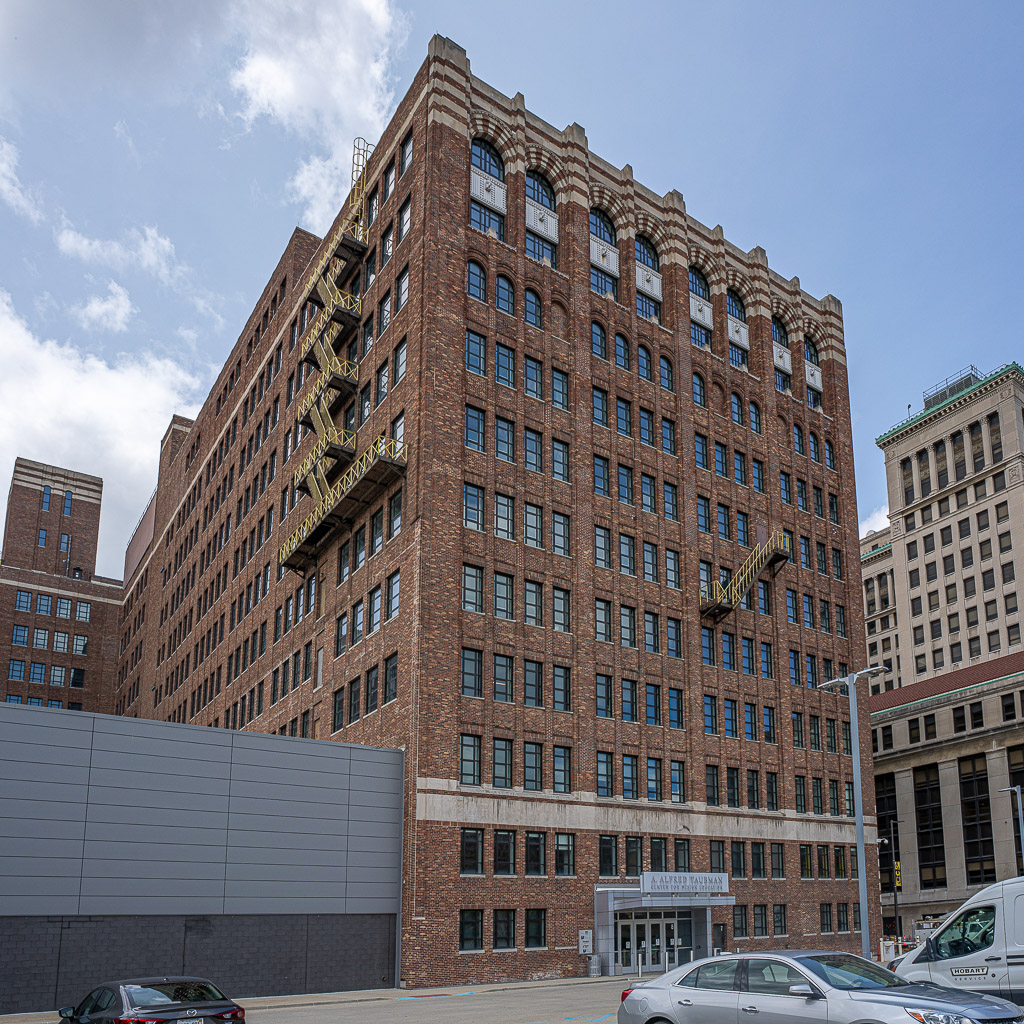
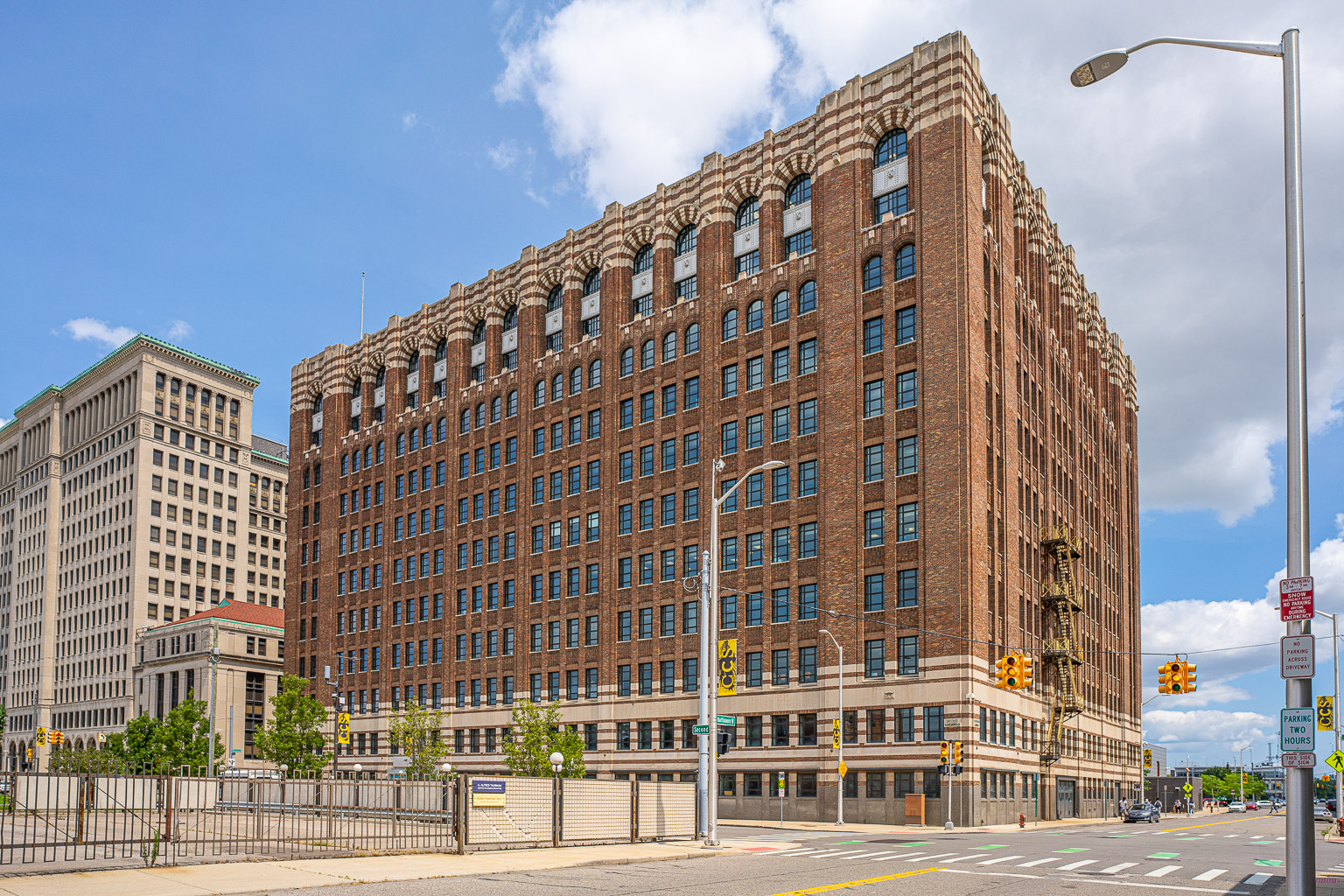
The General Motors Research Laboratory is an eleven-story commercial building clad in brick and limestone, designed by Albert Kahn. It was built in two stages, Building A in 1928 at 421 Second Avenue, and Building B in 1936 at 485 W. Milwaukee. The two parts form an +L+shape that, along with a 1963 parking structure, take up an entire city block. Building A has eight structural bays on both the Milwaukee and Second Avenue facades. Building B has seven bays on Milwaukee, and is four bays deep. The inside corner of the +L+ is an open courtyard that provides access to loading docks and the 1963 parking garage, which wraps around the south and east facades of Building B. Both parts of the building are of the same red-brown brick with limestone, brick, and cast iron ornament. Gray granite clads the north and west sides up to the middle of the first floor level. This is topped with alternating bands of brick and limestone up to the middle of the third floor. The banding is repeated at the eleventh floor and parapet.
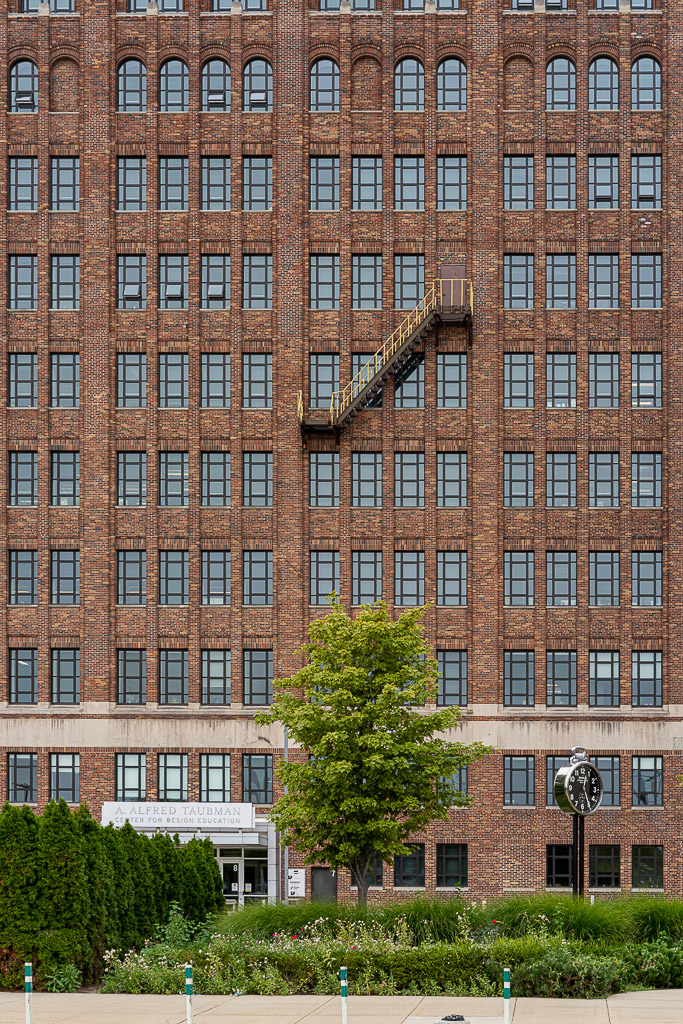
The corners of the building have wide brick piers. Narrower piers divide the window bays. The window bays are slightly recessed from the face of the piers. Above the third floor, the spandrel panels below each window are of brick laid to create vertical ribs. In the top two floors, the spandrel panels are of ornamental cast iron with decorative medallions.
The existing windows at all floors are single-glazed, operable, double-hung aluminum sash. At the eleventh and ninth floors, the windows have round arched tops. At the tenth and eleventh floor, pairs of windows are mulled together. The existing sash were installed in 1973. Archival photographs and drawings show the original windows were a narrow metal industrial-style sash.
With the exception of the west elevation (Second Avenue) storefronts, the original window openings have not been altered. The ground floor of the west elevation and the two western bays of the north and south elevation originally had two-story, rectangular storefront window openings, and housed a Pontiac dealership. The storefronts were divided into four windows probably at the time the addition was constructed; the same granite, brick, and limestone used on the original and addition facades separate the new windows.
The roof is not visible from the ground. With the exception of the projecting dome of the eleventh floor photo studio the roof is flat. There are several elevator housings and mechanical penthouses.
North Elevation -- Milwaukee Street
The General Motors Research Laboratory is directly across Milwaukee Street from the former General Motors Building. The north elevation of the General Motors Research Laboratory contains the main ground level entrances, one each for the 485 and 495 addresses. The original drawings and archival photographs show metal canopies at these entrances; the canopies are now gone. The doors have been replaced and the configuration has changed. The new doors are metal and glass. The doors at 485 appear to date to the 1973 window sash replacement, as they are of the same dark bronze aluminum. The doors at 495 are of stainless steel from an undetermined date. The original doors appear (from photographs) to have been of wood.
At the fifth floor level, there was formerly a skywalk linking the General Motors Research Laboratory to the GM Building. A skywalk was originally installed in 1940, shortly after the completion of Building B. A later replacement has now been removed. There are three garage door openings and three other minor entrances on the north elevation. All of the openings are original, but the doors are not.
East Elevation -- Cass Street
With the exception of the southern bay, the east elevation of Building A lacks the limestone banding and arched windows found at the other elevations. This elevation also contains a fire escape (from the sixth floor down) and numerous applied mechanical/electrical ducting. There is a one-story loading dock at the inside corner of the L. formed by the meeting of the east elevation and part of the south elevation of Building A. A parking garage covers the lower five floors of the east elevation of Building B. The upper floors of Building B are identical in design and materials to the north and west elevations.
South Elevation -- Baltimore Street
The six western bays of the south elevation are identical in design and materials to the north and west elevations. This section also contains a fire escape (from the sixth floor down) and a garage door opening similar to those at the north elevation. The fire escape and openings are original; the doors are not.
The east half of the south elevation is the utility courtyard, with two loading docks, mechanical equipment, and the entrance to the parking garage. This portion also lacks the limestone banding and arched windows found at the other sections. There are numerous applied mechanical/electrical ducts.
West Elevation -- Second Avenue
Although the most prominent facade, there are no longer any doors on the west elevation. As discussed above, the original storefronts were infilled. Archival drawings and photos dating from 1929 show two sets of double doors with large canopies.
Landscaping
The landscaping consists of street trees in the public right of way on Milwaukee Avenue. There are no historic landscape features.
Interiors
The structural system of the building is unusual for a building of this height. The structure is reinforced concrete, typically used only for structures up to about eight stories due to the inefficiencies in weight, construction, and cost. In 1929, taller buildings would have been (and still are) constructed out of steel.
Architect Albert Kahn had over twenty years. experience with reinforced concrete by 1928, and chose the General Motors Research Laboratory's massive structure to allow for vehicle traffic at the interior. As the building was intended as a testing lab for General Motors+ automobiles, all floors were designed for the static and dynamic load of automobile traffic and engine testing equipment. The eleventh floor of Building B housed the photography studio where cars were photographed for marketing materials. The roof was also used for photographing new cars and models under development. It offered natural light and secrecy from spying competitors.
Several large freight elevators were installed to move the cars up and down the building. These elevators still exist. The cabs and trim of the original passenger elevators were replaced at an undetermined time. Another existing bank of passenger elevators was installed at the former location of one of the freight elevators.
The ground level and basement of Building A is currently being used for automotive storage or preparation. The basement of Building B is used for maintenance equipment. Upper floors of Building A were entirely converted to offices by the time GM left the building in 2000. The offices are a combination of individual and open plan offices, all with modern finishes. The floors are carpeted or have vinyl tile. The walls are of plaster, gypsum board, or demountable partitions. Lighting is provided by fluorescent fixtures flush with the dropped acoustical tile ceilings. At areas where the dropped ceiling has been removed, the original ceiling, which is the exposed underside of the concrete floor above, is visible. Archival drawings and photographs indicate that, except for select public. areas, the original ceilings were simply painted, with the concrete beams left exposed.
Building B retains some floors or partial floors devoted to research. These remaining research areas typically have unfinished concrete floors, wood, or linoleum finishes. The walls are of painted plaster or brick. The ceilings are as described above. Exposed fluorescent fixtures hung on posts or chains from the ceiling provide the lighting.
Stylistic Influences
The designs of the original 1928 structure and the 1936 addition are very similar. The buildings are divided horizontally into base, shaft, and capital, as commonly found in early skyscrapers. The gray granite plinth and limestone banding to the third floor create the base. The capital, formed by the top floors and parapet, repeats the banding of the base and adds round-arched windows and ornamented cast iron spandrel panels. The banding is a stylization of the rusticated masonry featured prominently in Italian Romanesque architecture and frequently imitated during the late 1920s. Brick piers form the shaft and window bays; the vertical emphasis makes the buildings seem taller. The verticality, simplified ornamentation, and vertically detailed top floor are reminiscent of Eliel Saarinen's second-place design for the Chicago Tribune Tower design competition of 1922. The sophisticated reinforced concrete structure of the buildings were an extension of Albert Kahn's ground-breaking factories.
The General Motors Research Laboratory was GM's research and engineering building, and is less elaborate than the former General Motors Building directly across the street, also designed by Albert Kahn. The relationship of high-style classicism for a major building and the brick-and-stone Romanesque for a subsidiary building had occurred before in Kahn.s work, at the Detroit Athletic Club whose Florentine Palazzo clubhouse stood across the street from the Romanesque DAC garage (demolished). This Romanesque manner seems to have been used by Khan for buildings of less that first importance, examples being Vinton Building and Griswold Building, as well as the DAC garage. The Romanesque sources and coloristic use of brick and stone may be a latter day reflection in Kahn.s work of Richardson or Ruskin, both of whom would have been familiar to him in the early days of his architectural career.
See also Wikipedia and HistoricDetroit.org.