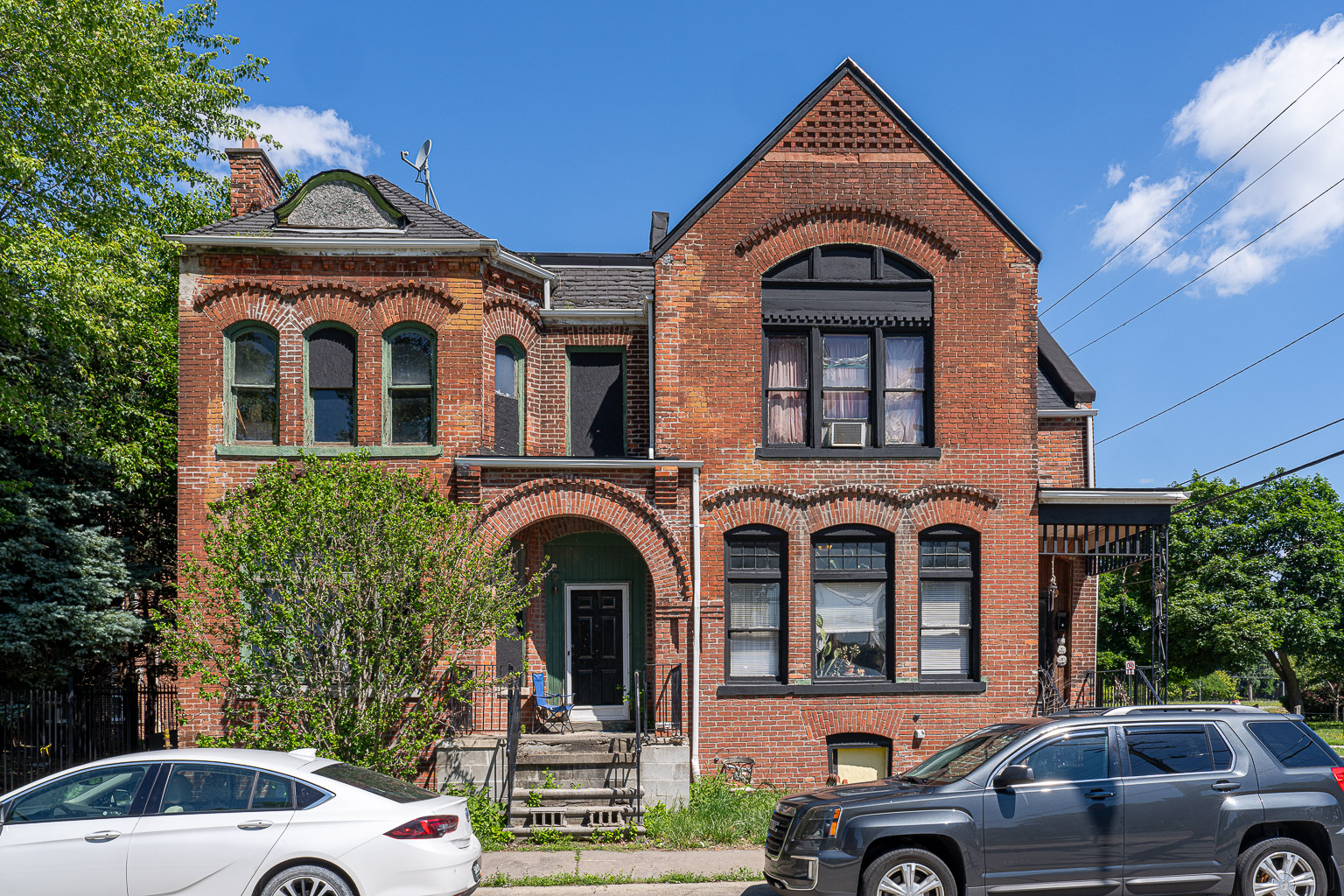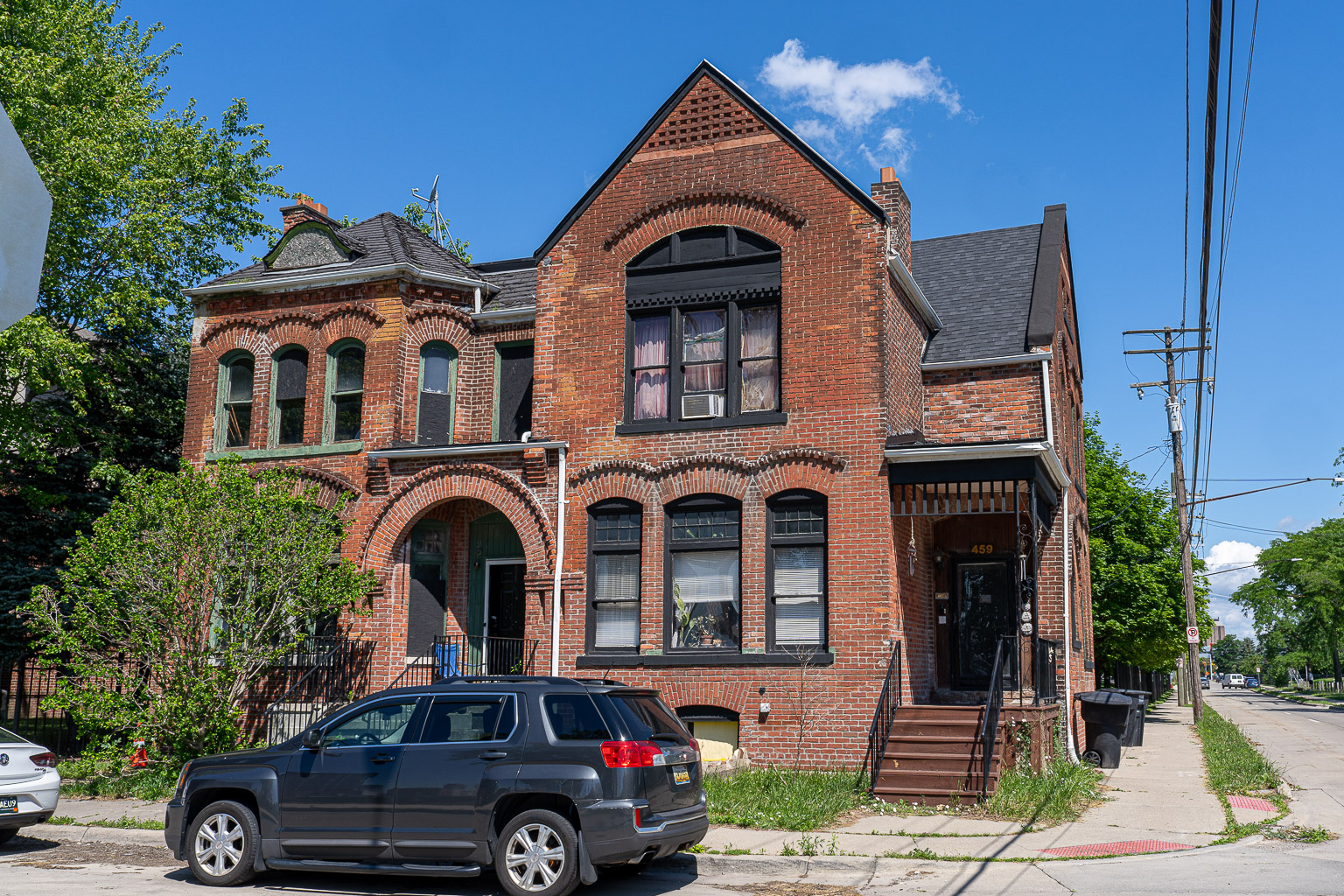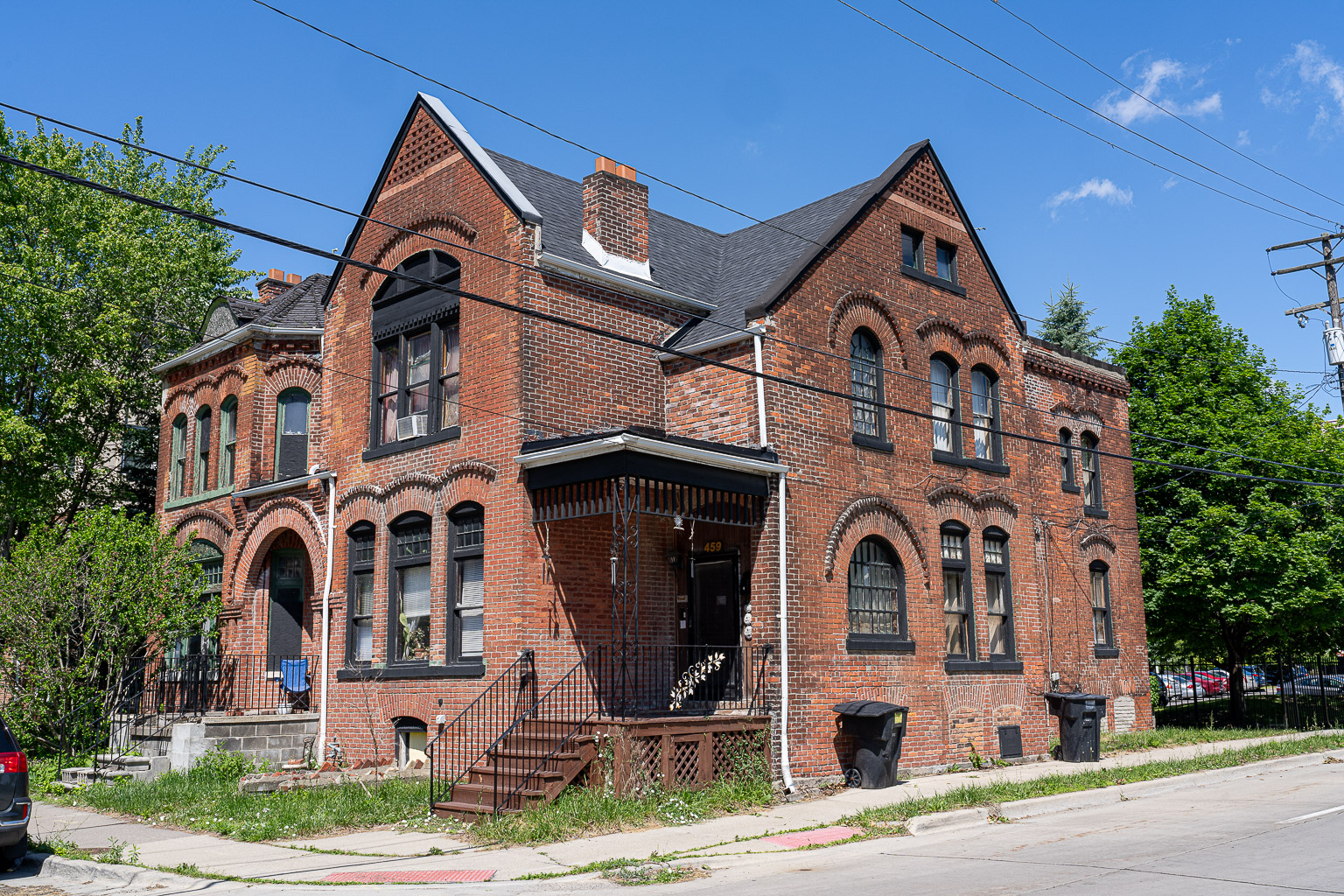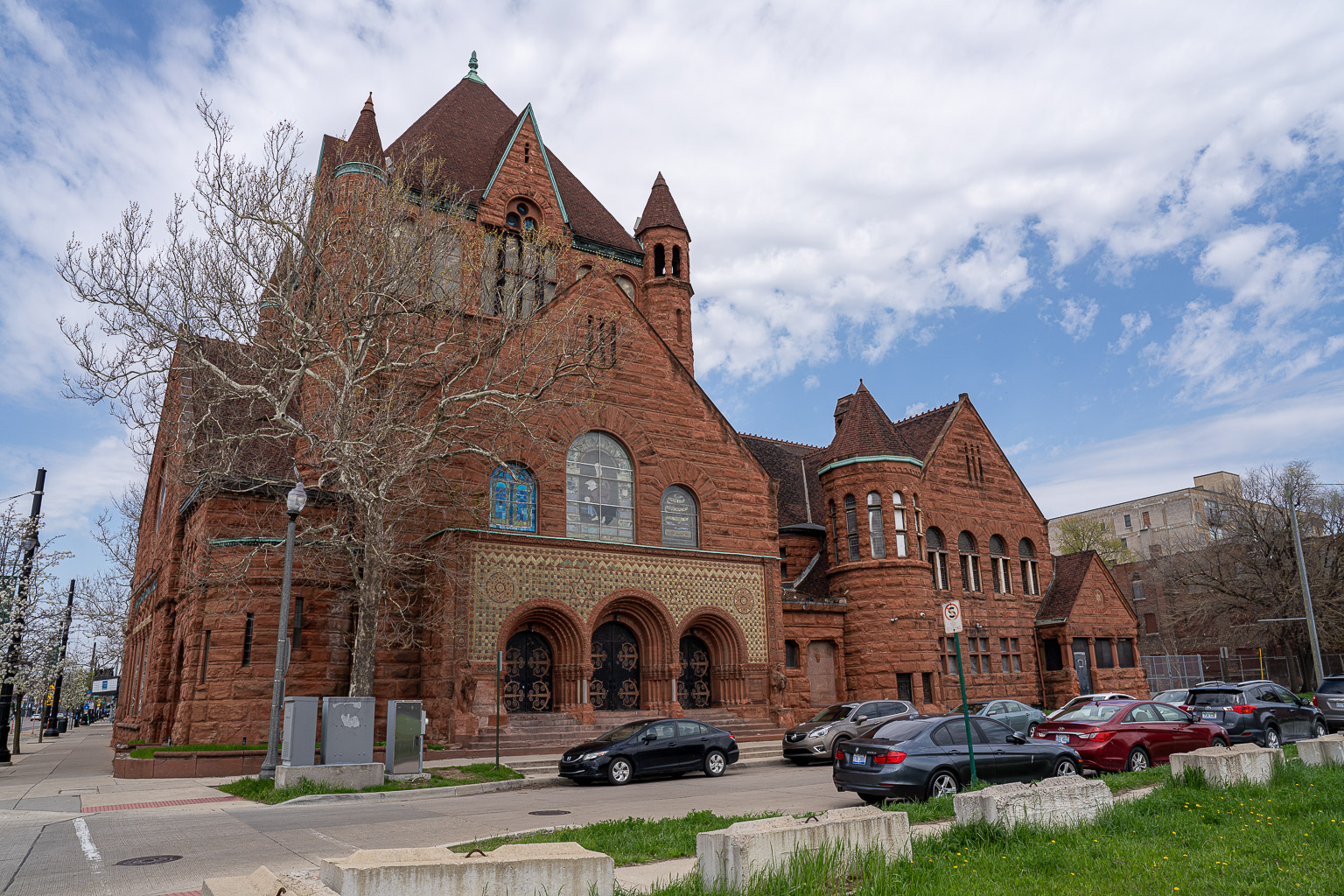
Brush Park Local Historic District
You can read details about the Brush Park Local Historic District in the Brush Park Local Historic District Final Report (local copy), which I recommend highly to anyone interested in Detroit's history.
The proposed historic district is located east of Woodward Avenue between the Central Business District and the Medical Center. The area's buildings are mostly residential, although there is commercial and institutional development along Woodward and also in other locations in the area. The district adjoins a public housing development on the east.
Contents:
HISTORY: [+ expand]
The area of the proposed Brush Park historic district encompasses the farm which once belonged to the well-known Brush family of Detroit. Not only the Brush Farm, but also the adjoining Park Lots of the Governor and Judges Plan and the L. Beaubien Farm maintain street names closely associated with the family.
Late in the eighteenth century, the Brush holdings came into the possession of John Askin, an Irish trader, by inheritance from his wife's family. Askin's youngest daughter, Adelaide, married Elijah Brush; the couple inherited the farm, which ran from the river to about where Grand Boulevard is today. Elijah Brush's son, Edmund Askin Brush, directed the subdivision of the farm during the second half of the nineteenth century. Some downtown sites remained in the hands of the Brushes and their descendantsinto the 1960's as investments; north of Grand Circus, the land was subdivided for residential purposes.
Within the proposed district, the earliest street is Winder, opened in 1852, and named for Col. John Winder, prominent in the court system in Detroit and a landholder. All the other streets in the district -- except Watson and several one-block streets between Brush and Beaubien -- are named for Brush family members. Adelaide, opened in 1853, is named, of course, for Adelaide Brush, wife of Elijah. Watson was opened in 1854, and named for a family friend, Joseph Watson, who had served with Edmund Brush on the Territorial Land Board. Edmund Place and Erskine were both opened in 1867; Edmund named for the son of Elijah who was subdividing the land, and Erskine honoring the Askin family in a variant spelling. Alfred, named for Alfred Erskine Brush, son of Edmund, was opened in 1869, and Eliot, named for another son, followed in 1871. Mack Avenue, the northern boundary of the proposed district, was originally named Rowena, after the wife of Alfred E. Brush, and was opened in 1878.
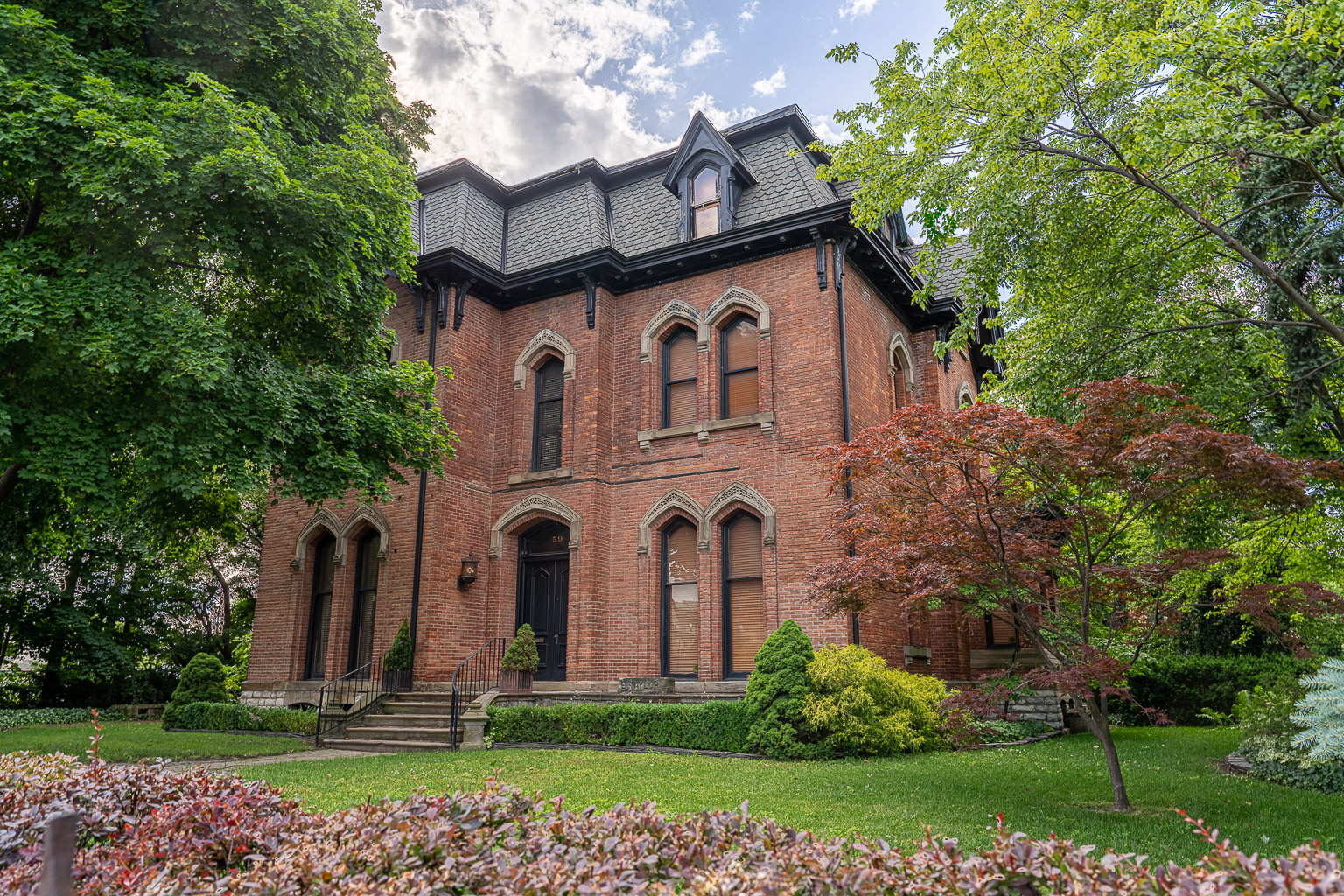
While the dates of the street openings are suggestive of the development pattern of the area, too much dependance cannot be placed upon those dates as far as building dates are concerned. While 59 Alfred appears to have been built shortly after the opening of Alfred Street, for example, the record shows Rowena opened in 1878, yet no houses remain on the street dating for twenty years or so after that.
The Brush family developed their land carefully, taking pains to create a desirable area. The land was held until surrounding areas were well on the way to complete development, and restrictions were placed on the lots requiring houses of a high standard of quality. The standard lots were large for the time -- fifty feet wide -- and expensive.
Since the Brush family owned the Park Lots adjacent to Woodward as well as the Brush Farm, the development of the streets in the proposed district were developed through the two areas without differentiation. On Woodward, the development of large and elaborate mansions parallelled similar housing built at the same time on streets such as East Jefferson and West Fort. Adjacent residential streets provided an area for those whose wealth was not sufficient to permit one of the larger houses on a main avenue, and also for those who preferred to live in a somewhat less prominent location. East of Beaubien, the L. Beaubien farm was developed in a far more typical form for the period, with a mix of wooden and brick dwellings of many levels of pretentiousness -- everything from a simple workman's "shotgun" house, one story tall on cedar posts, to elaborate row housing attracting white collar workers places to live near their bosses. As was typical at the time, this area also contained commercial buildings here and there, functioning as "corner stores".
Some of the notable Detroiters who lived in the area include J. L. Hudson; Michigan Supreme Court Justice James V. Campbell; Delos E. Rice, founder of the Fulton Iron Works; Emma A. Thomas, one of Detroit's leading music teachers, for whom Thomas School on East Ferry was named; David Whitney; and his daughter, Grace Whitney Evans, who owned the house later rented to Hudson. Also in the neighborhood were Simon Heavenrich, who operated a well-known dry goods store; Christian Traub, of the well-known jewelers; and Dexter M. Ferry of the seed company.
Reflecting the differing character of the area east of Brush, the City Directory lists such persons in that area as Henry Minnard, a traveling agent, at 17 Napoleon Street; Otto Thon, a candymaker, at 19 Division Street; Labell Altman, a bank clerk at 145 Alfred, and Willis Stonehouse, a horseshoer, at 11 Benton Street.
By the turn of the century, families of means began to move to the newly developed Boston-Edison and Indian Village areas, and the character of the Brush Park area began to change. This period of the neighborhood's existence is memorialized in Russell J. McLauchlin's Alfred Street, an account of his childhood in a still-substantial neighborhood. Also before the turn of the century, the area became a center of residence for the Jewish community, and new institutions supplemented those already established. As the century moved into its teens, the expansion of industry which so significantly changed Detroit brought change to this area as well. A number of apartment buildings date from the period 1915-1920, reflecting a move to provide housing for the factory workers pouring into Detroit; these apartments generally replaced large houses of an earlier date. In some cases, formerly grand houses were added onto at the back, filling the rear yard and converting the property to apartment use. Other houses were converted to apartment or rooming-house use, and by the 1930's, many blacks had moved into the area. By the 1960's the physical condition of the neighborhood was very poor. The ensuing years have seen an effort to rehabilitate some old houses into modern apartments, while filling the increasing number of vacant lots with "infill" housing at subsidized rents. This effort, known as the Woodward East Project, was beset by difficulties and is at present inactive. Several old houses have been purchased by private parties for rehabilitation in recent years.
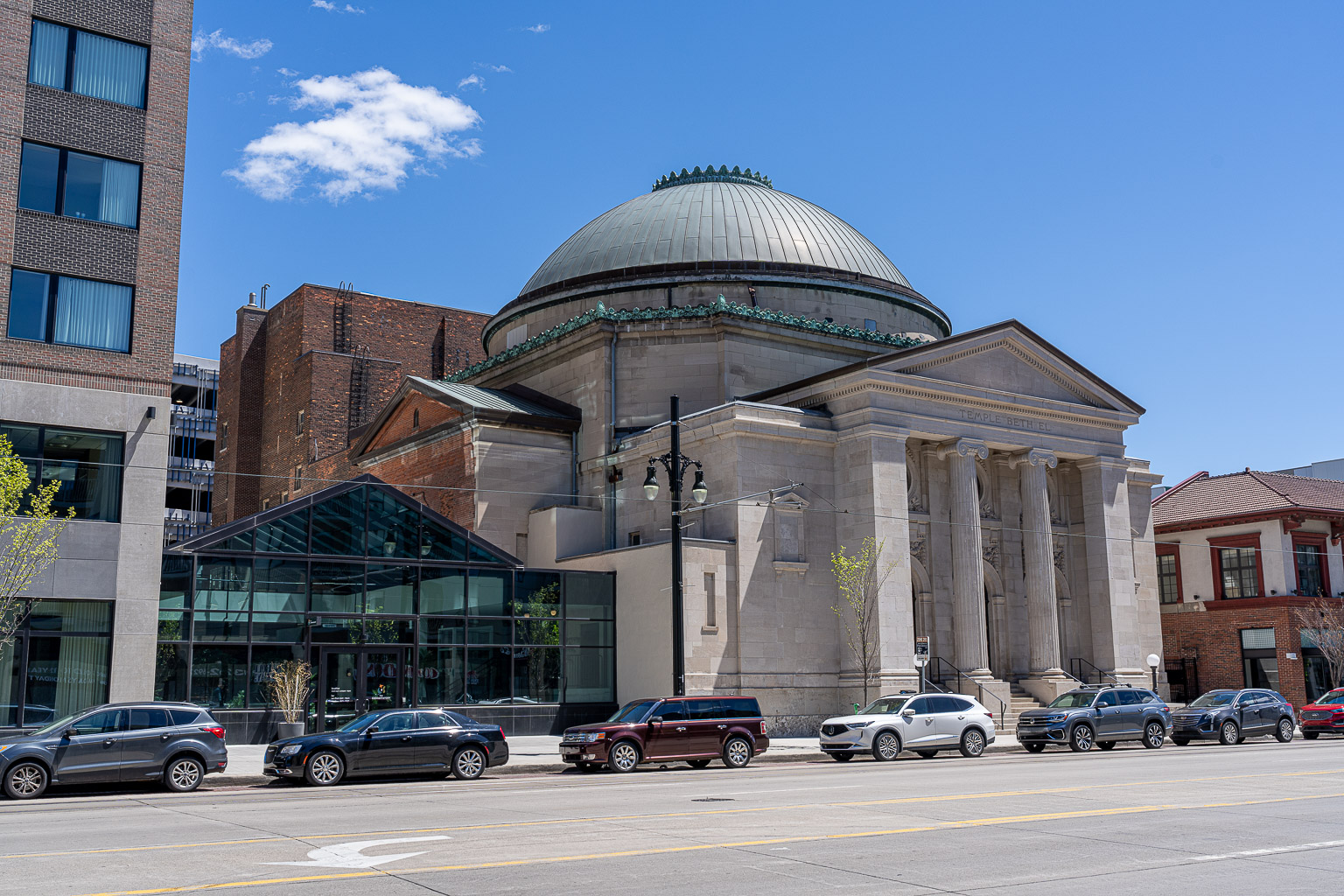
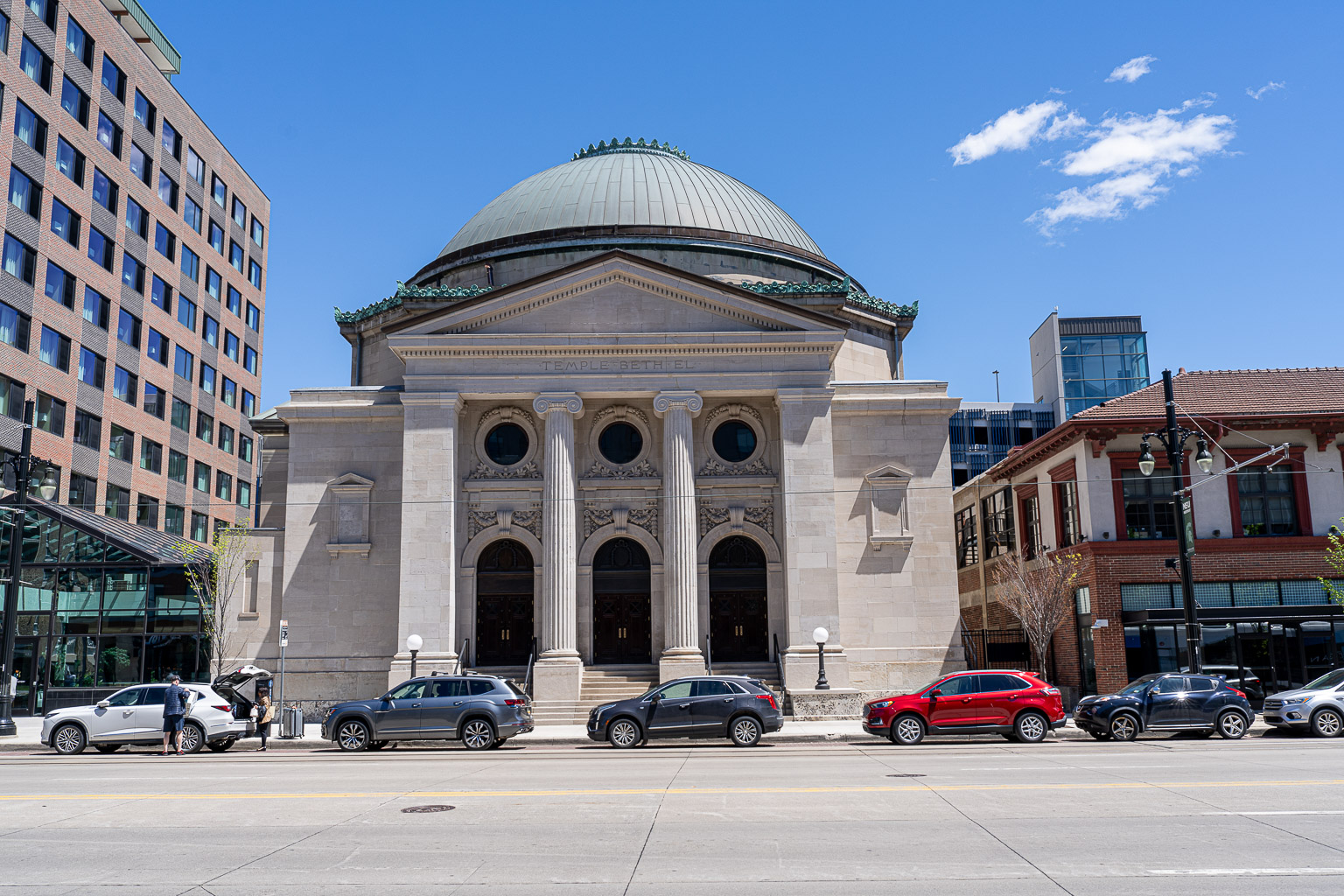
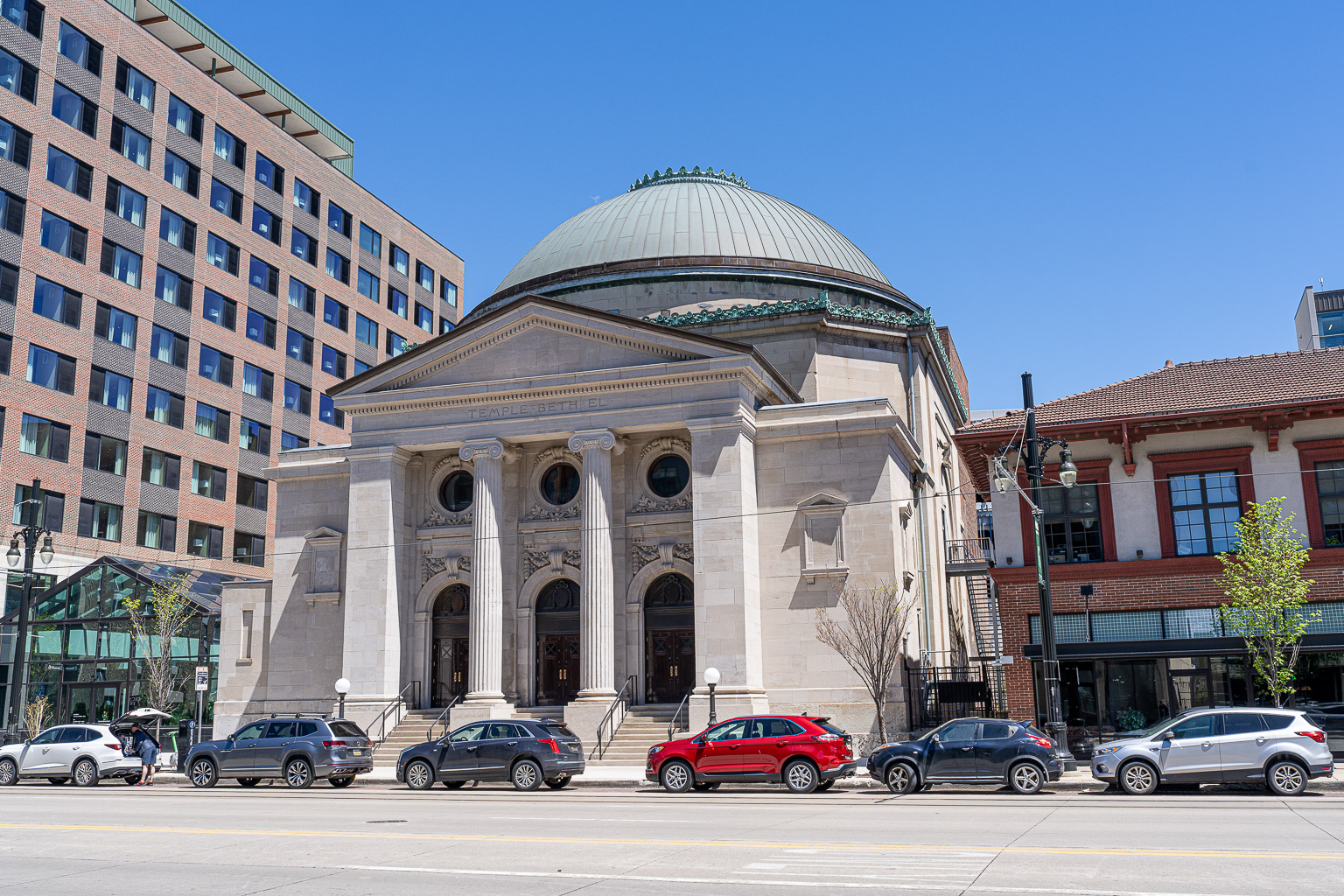
The Woodward Avenue frontage has long since lost its residential character, all of the houses having been replaced with commercial or institutional buildings. A number of important nineteenth century churches remain, however, including First Presbyterian, the Church of Christ (formerly First Unitarian) and Woodward Avenue Baptist (now closed). The Bonstelle Theatre reflects a later period in the neighborhood's life, since it was built in 1902 as Temple Beth El to serve the Jewish population of the area. Just a few years later, the architect of the temple, Albert Kahn, became the most famous Jewish resident of the area when he built the house at Mack and John R. now occupied by the Urban League.
Numerous religious institutions are located within the area as well as on Woodward. One of the most prominent was St. Patrick's Catholic Church at Adelaide and John R., founded as a chapel in the far suburbs in the 1860's and designed by Gordon W. Lloyd. St. Patrick's served as the Cathedral of the Roman Catholic diocese for a number of years after the Cathedral of SS. Peter and Paul on Jefferson was transferred to the Jesuits as part of the founding of the University of Detroit. Known during its cathedral years as SS. Peter & Paul Cathedral, the church reverted to its original name of St. Patrick's after the cathedral transferred elsewhere.
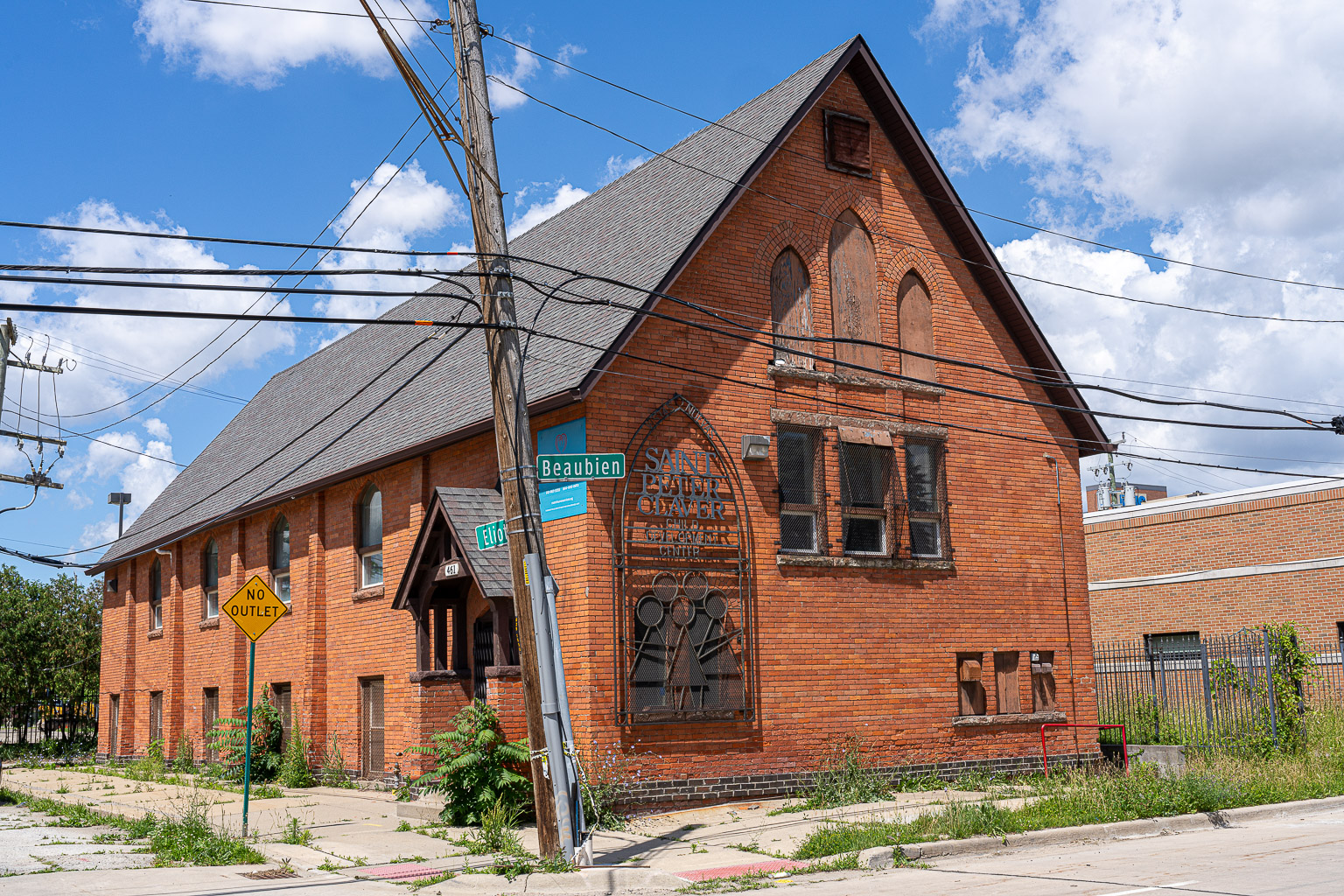
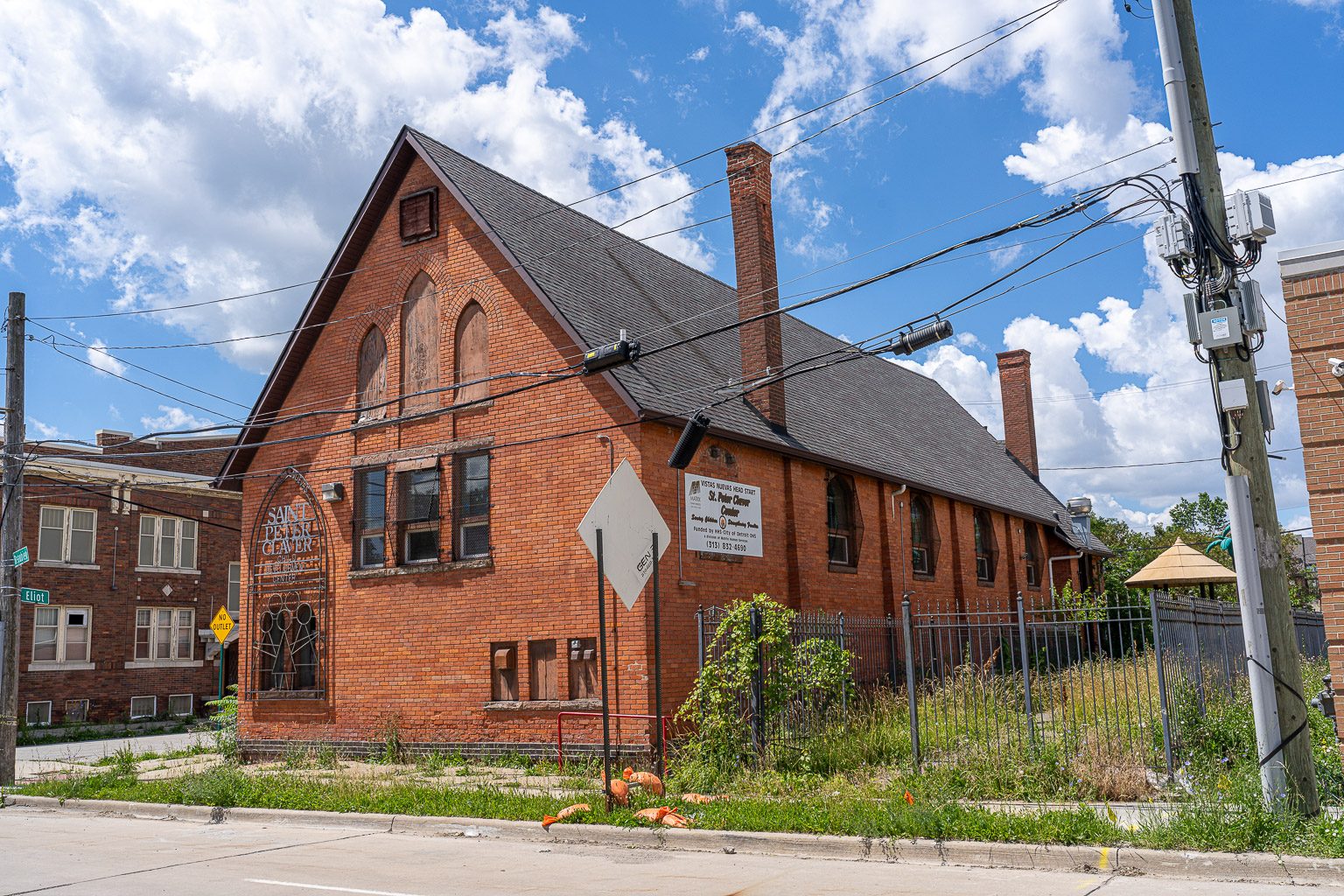
Another Catholic institution of note was St. Peter Claver, established to serve the black community in the former St. Mary's Episcopal Church at Eliot and Beaubien. Though the parish functions of this congregation have since been transferred to Sacred Heart Church, the St. Peter Claver Community Center remains an active community service organization. Other black religious groups were located in the area as well; the Olivet Baptist Church, for example, took over the building originally built for Congregation Beth David, and located just outside the proposed district on Winder.
PHYSICAL DESCRIPTION: The Brush Park area consists of normal rectangular city blocks; the east-west streets often jog at Brush Street, due to the areas east and west of Brush having been separately subdivided. Woodward Avenue has always been a strong boundary to the west; the Fisher Freeway has created another strong separation to the south, leaving a group of houses facing the freeway on the south side divorced from the neighborhood they were once part of. On the east, Beaubien divides the neighborhood from public housing, and the character difference is very strong. On the north, the clearance of the area north of Mack (formerly Rowena Street) for the Medical Center has also provided a strong boundary.
Buildings in the area represent dates ranging from the 1850's to the present; a National Register HistoricDistrict and several individual National Register buildings are in the proposed district. Among the notable architectural examples are:
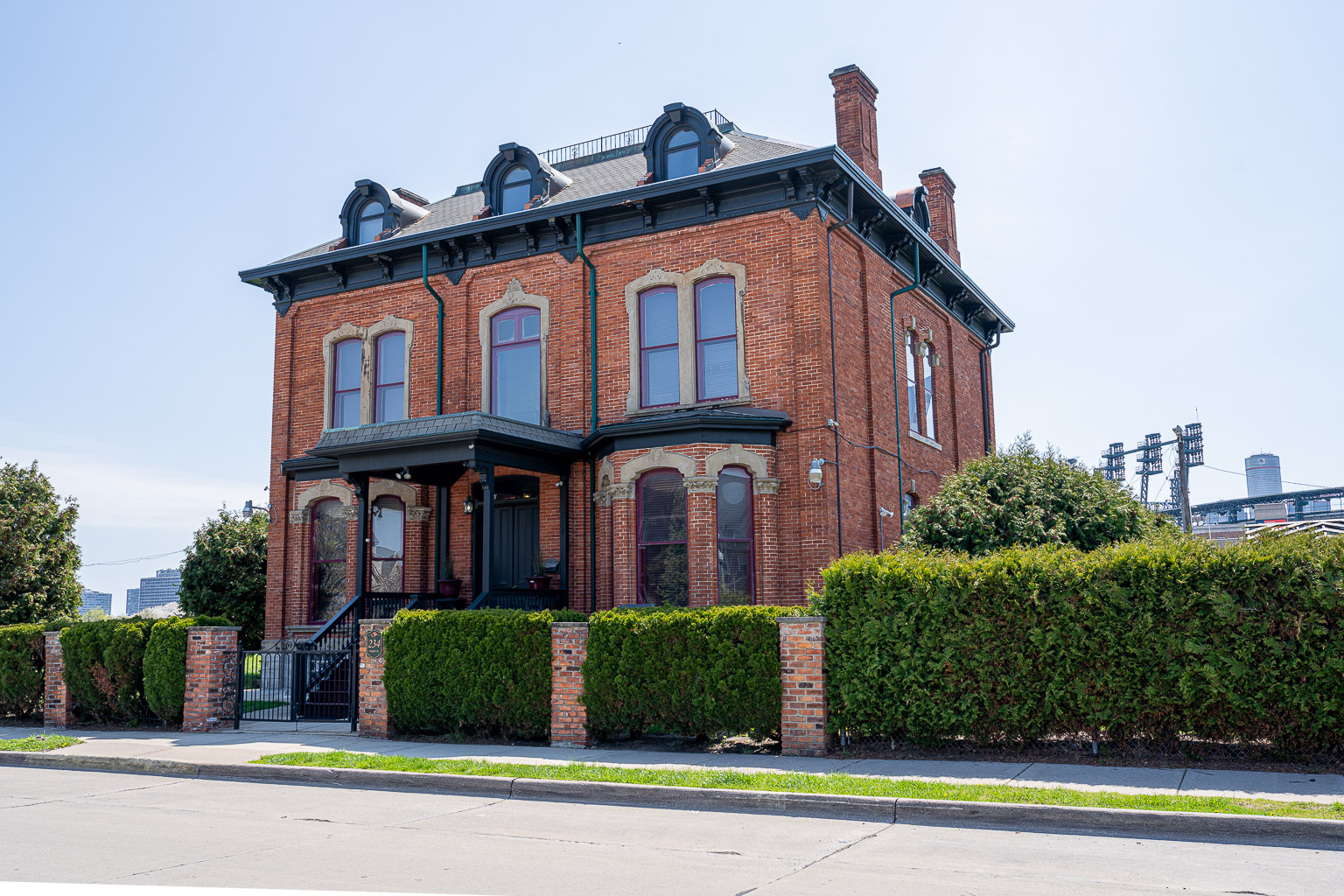
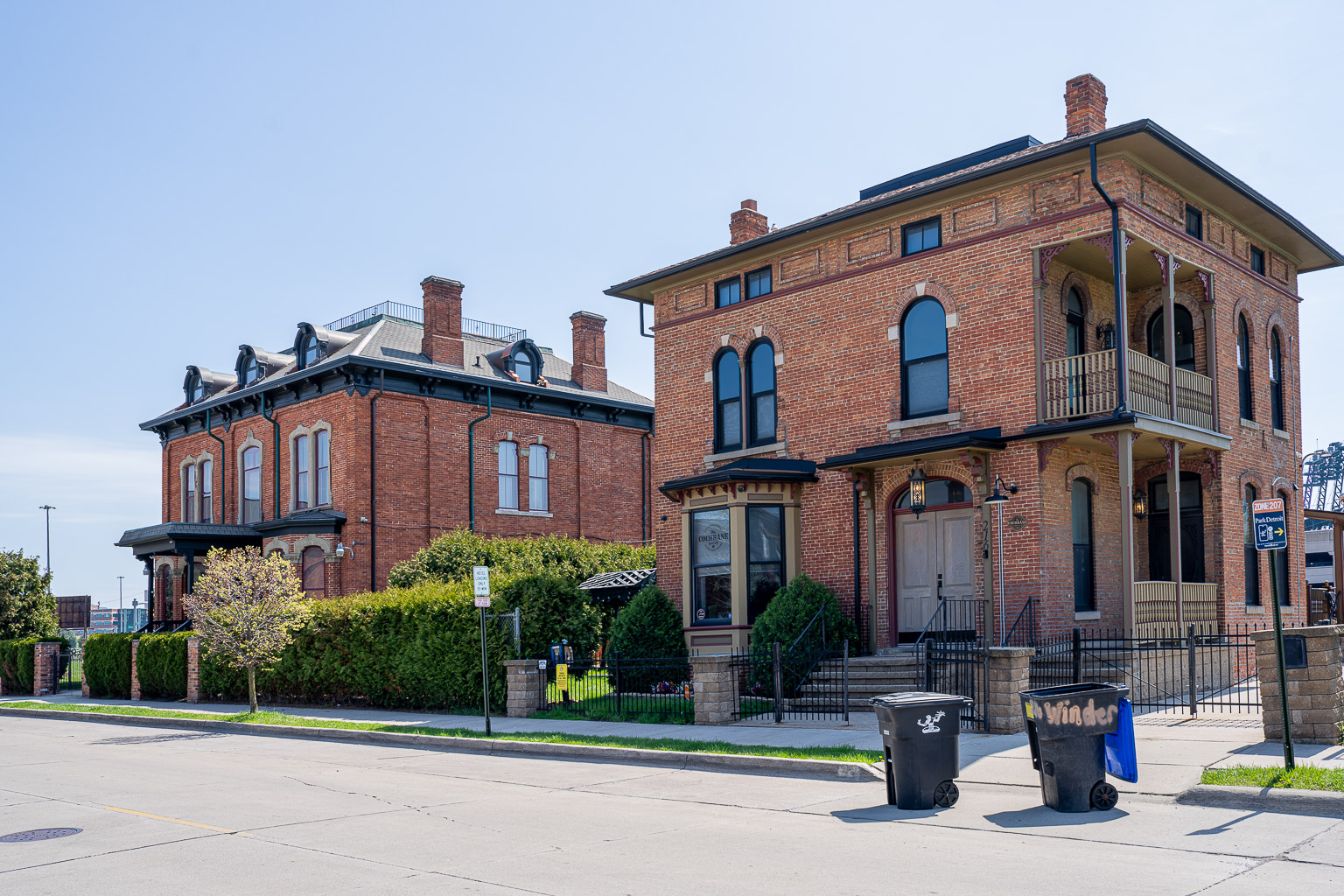
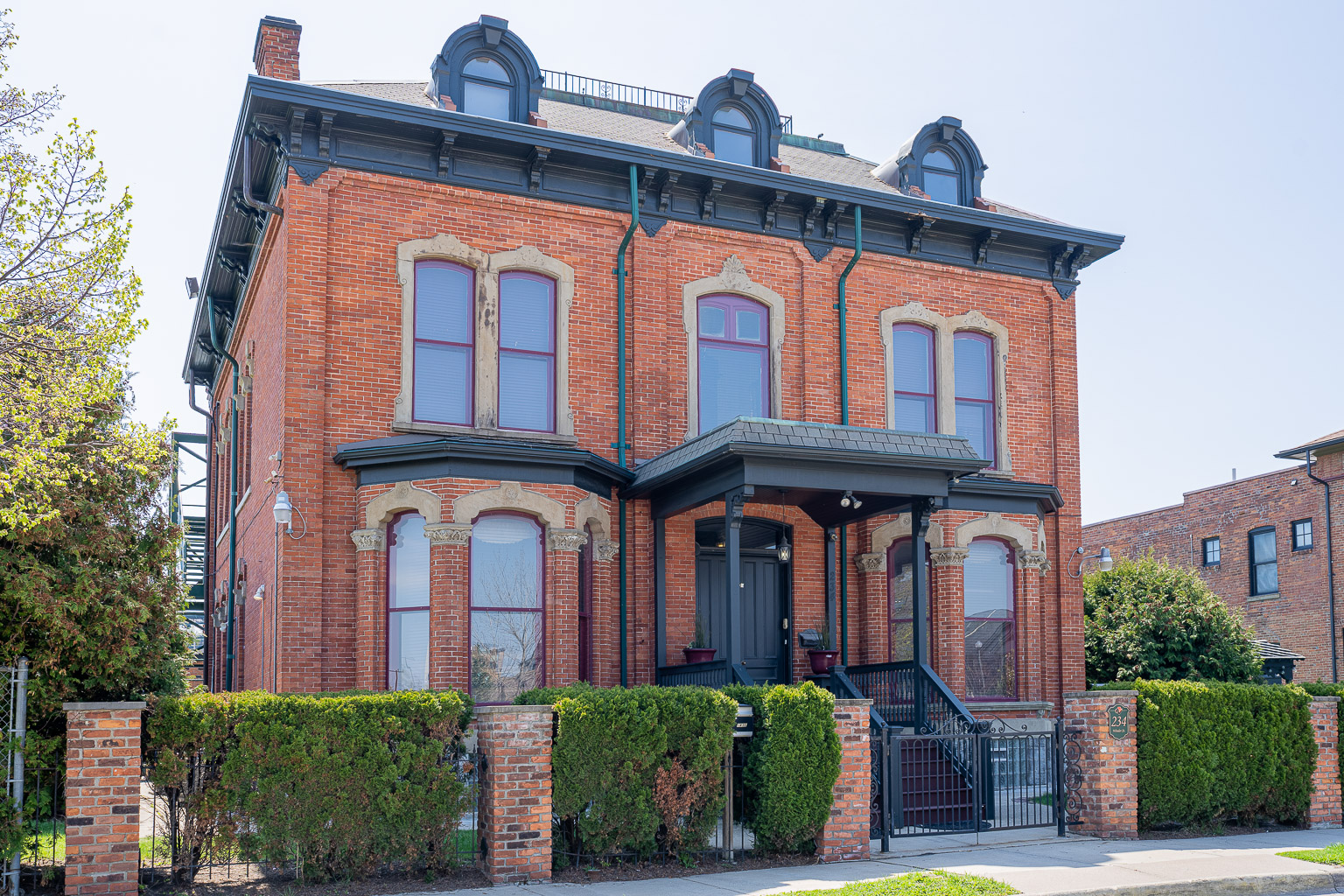
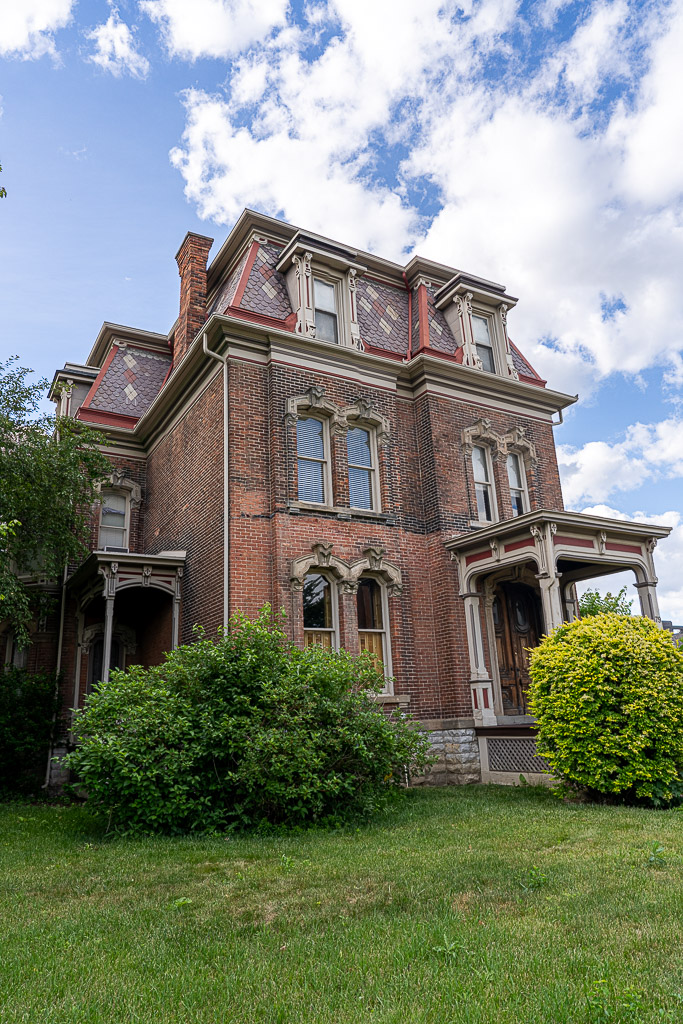
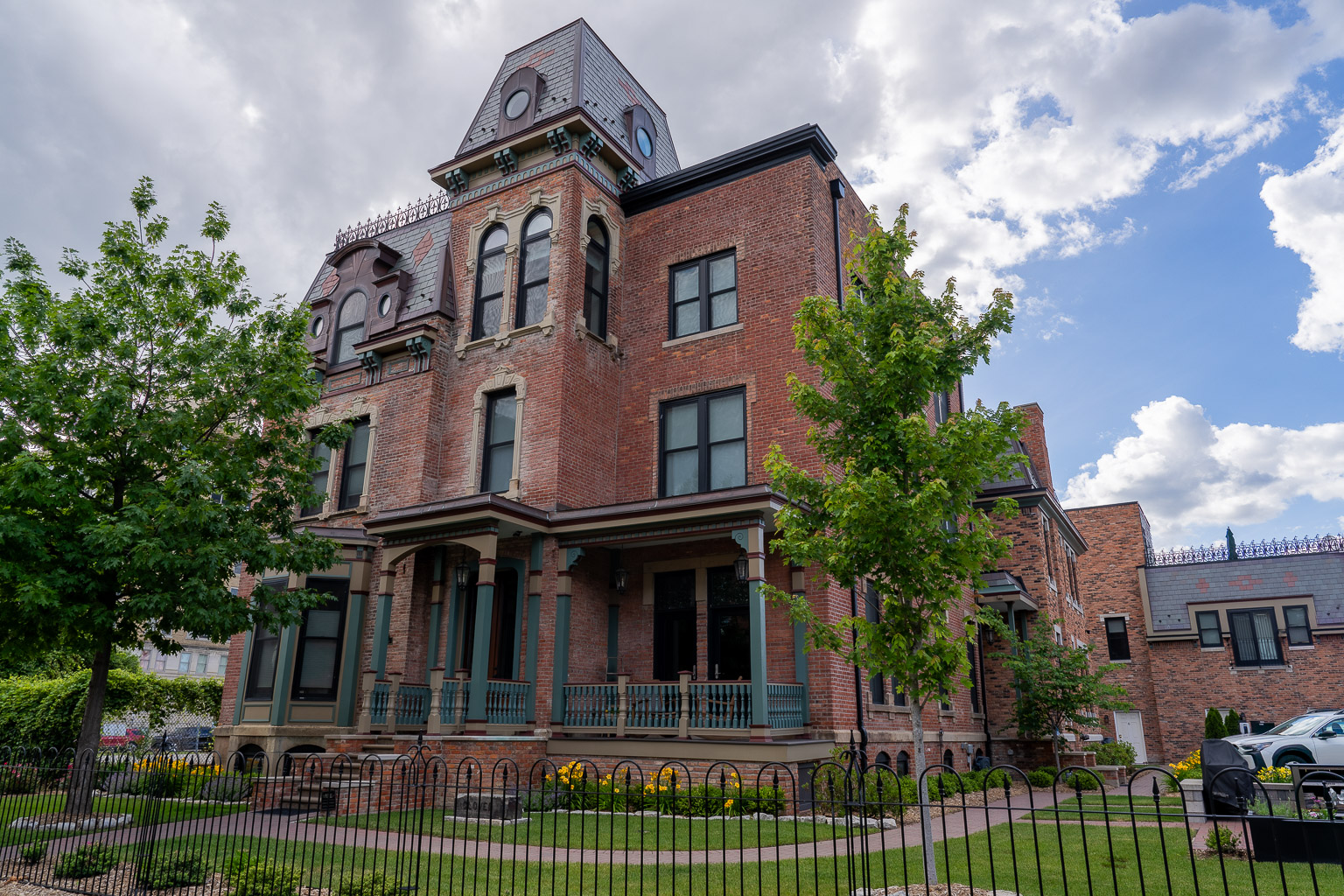
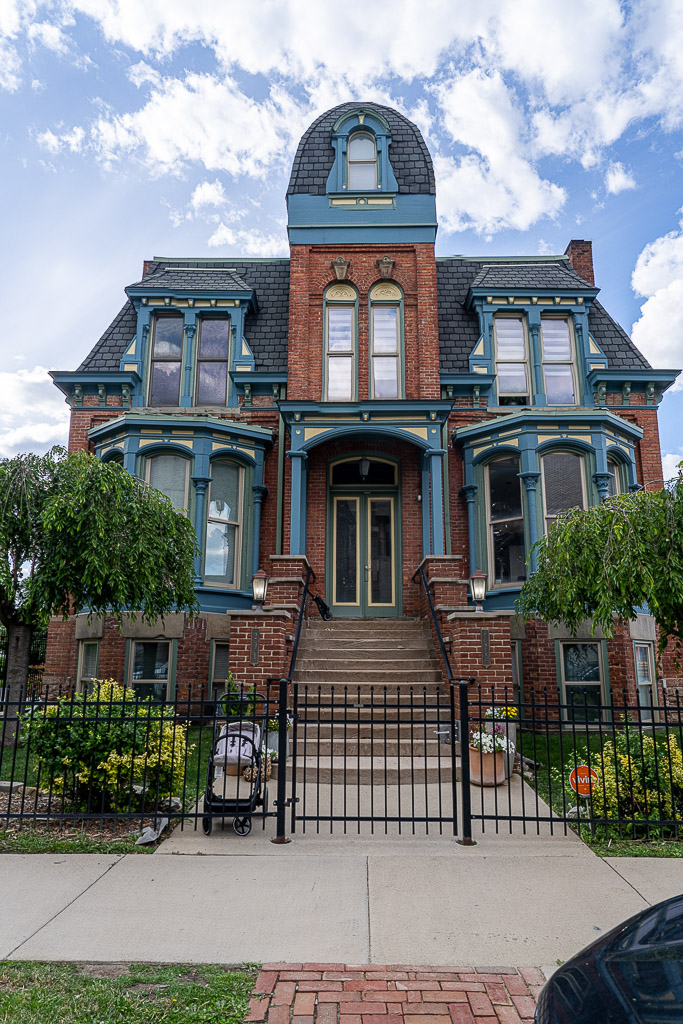
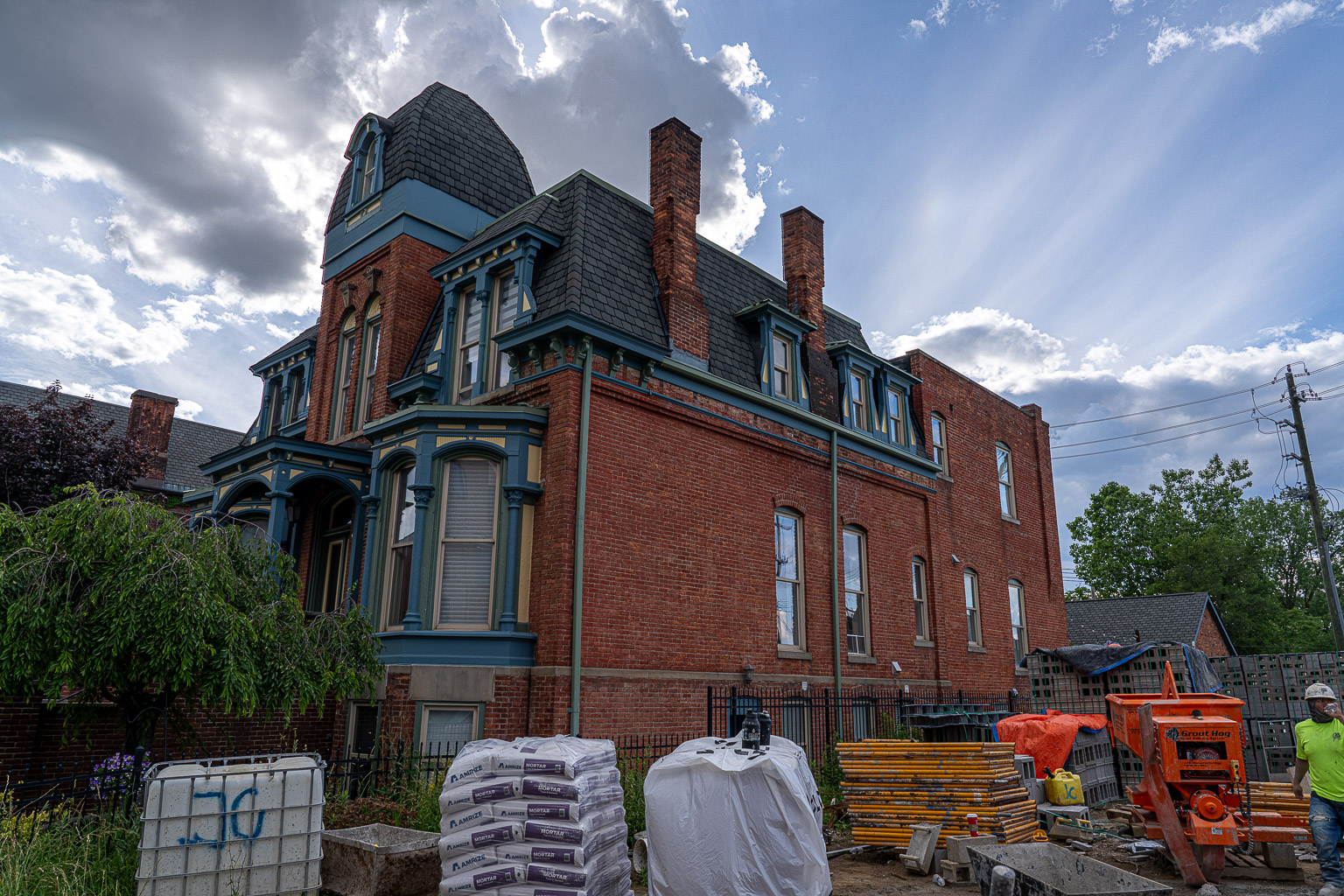
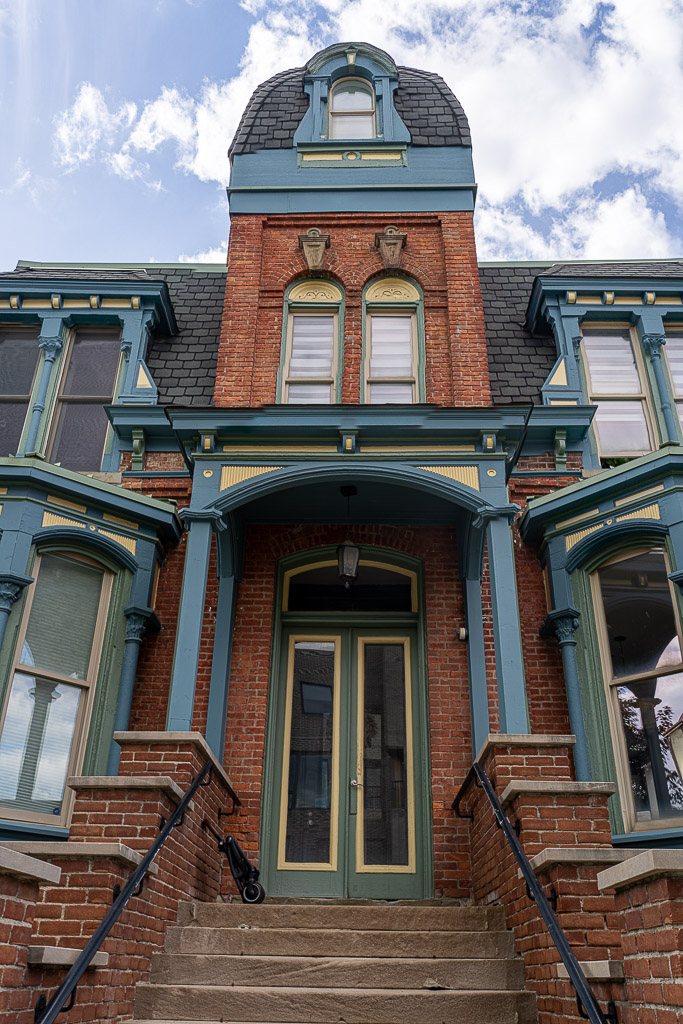
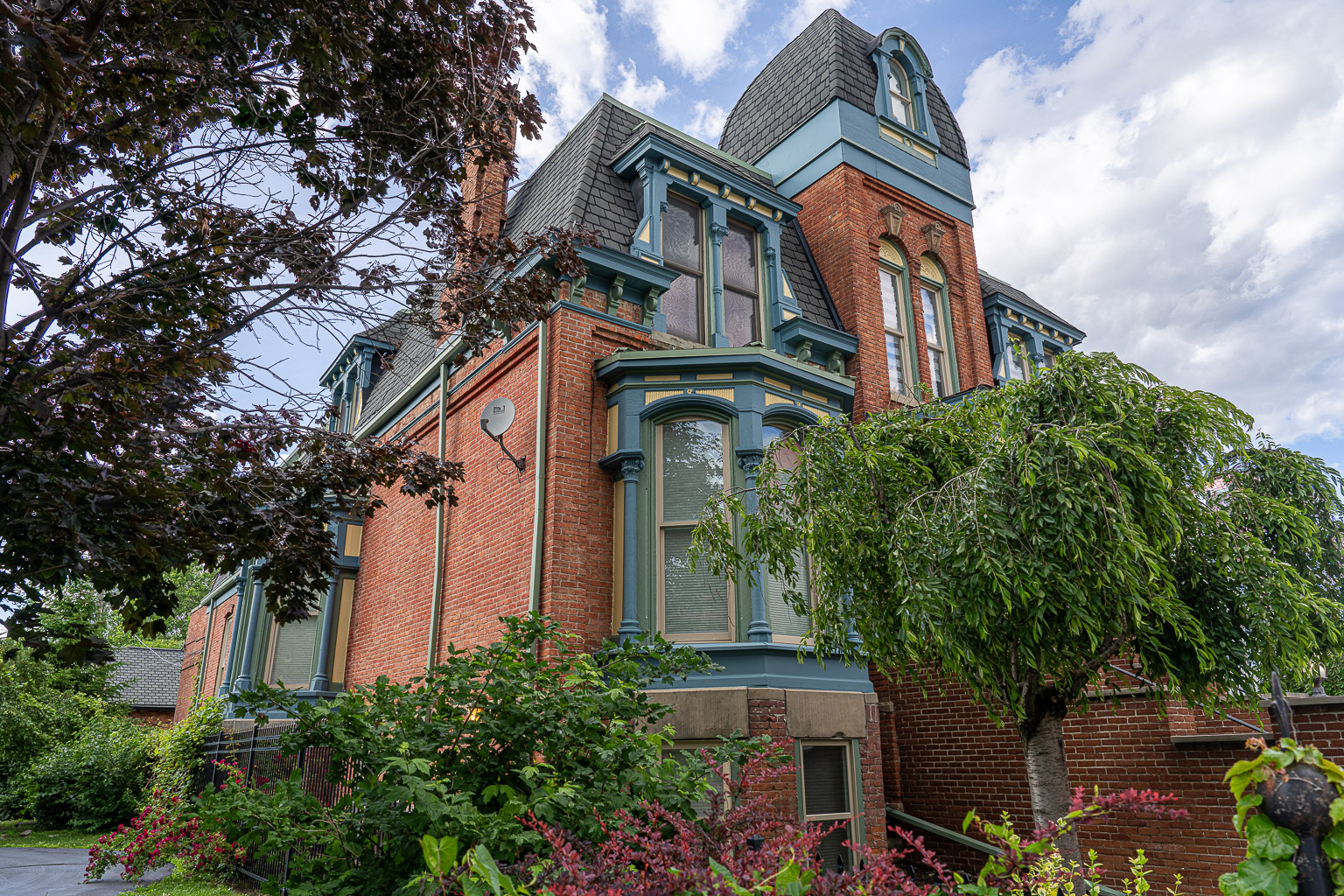
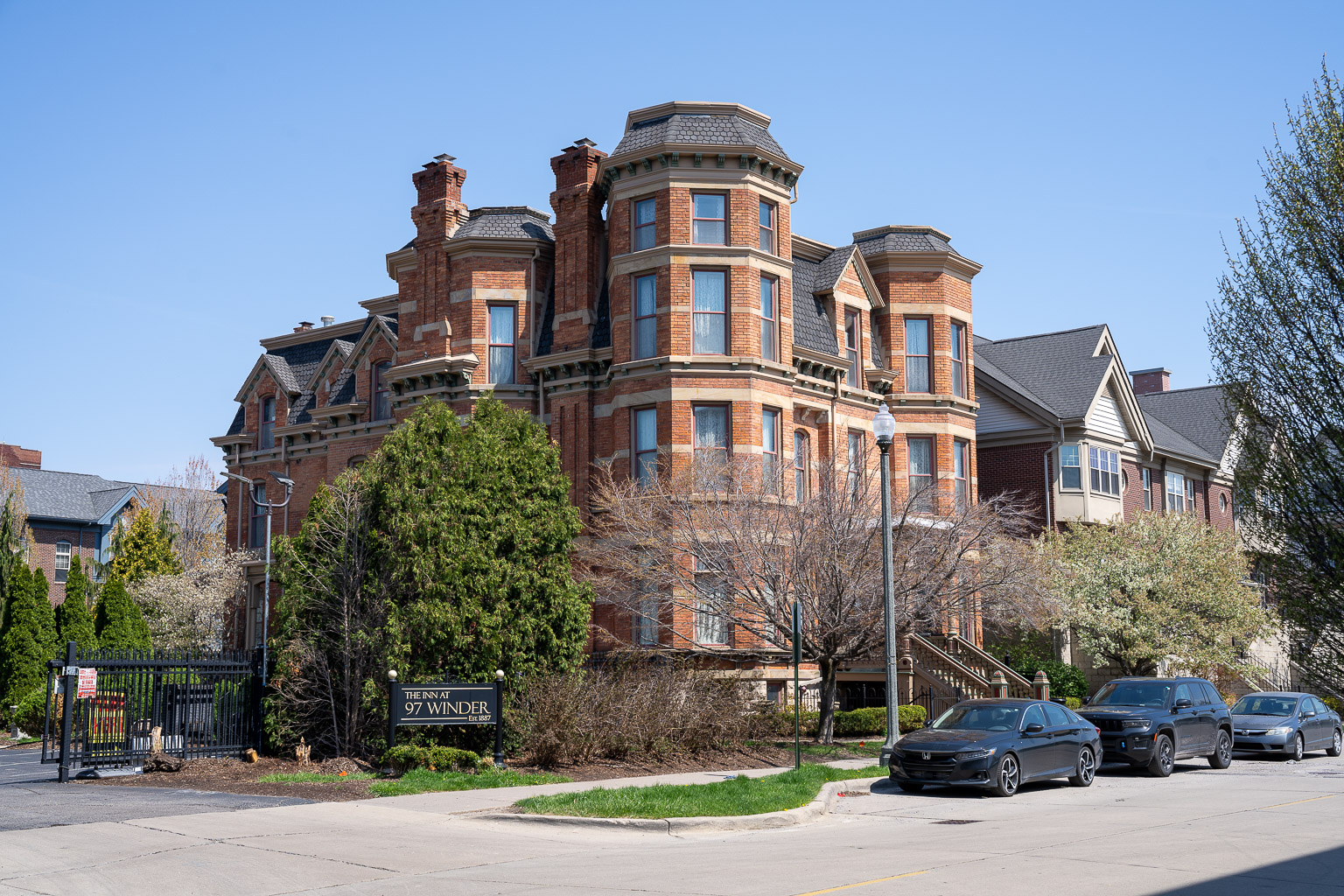
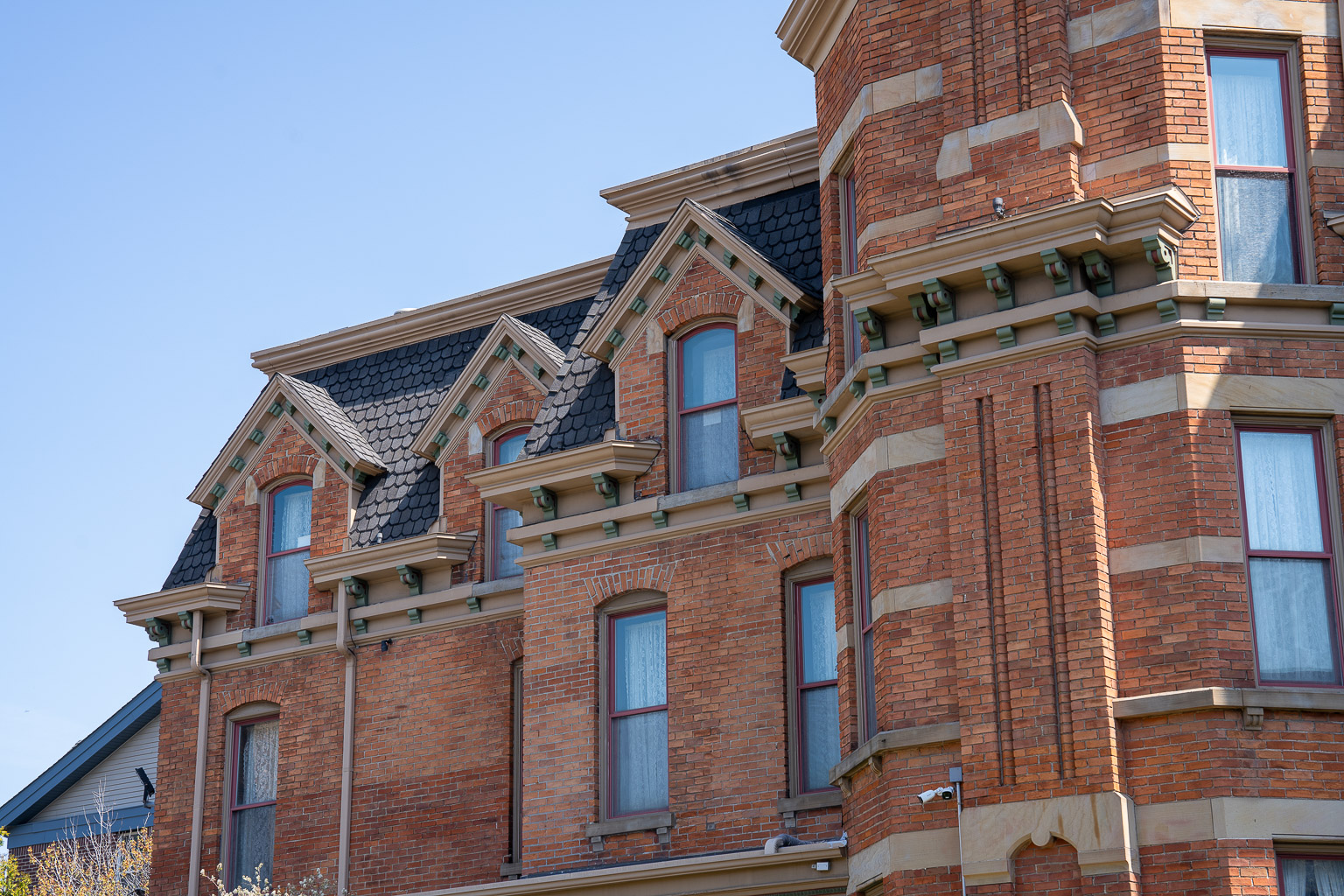
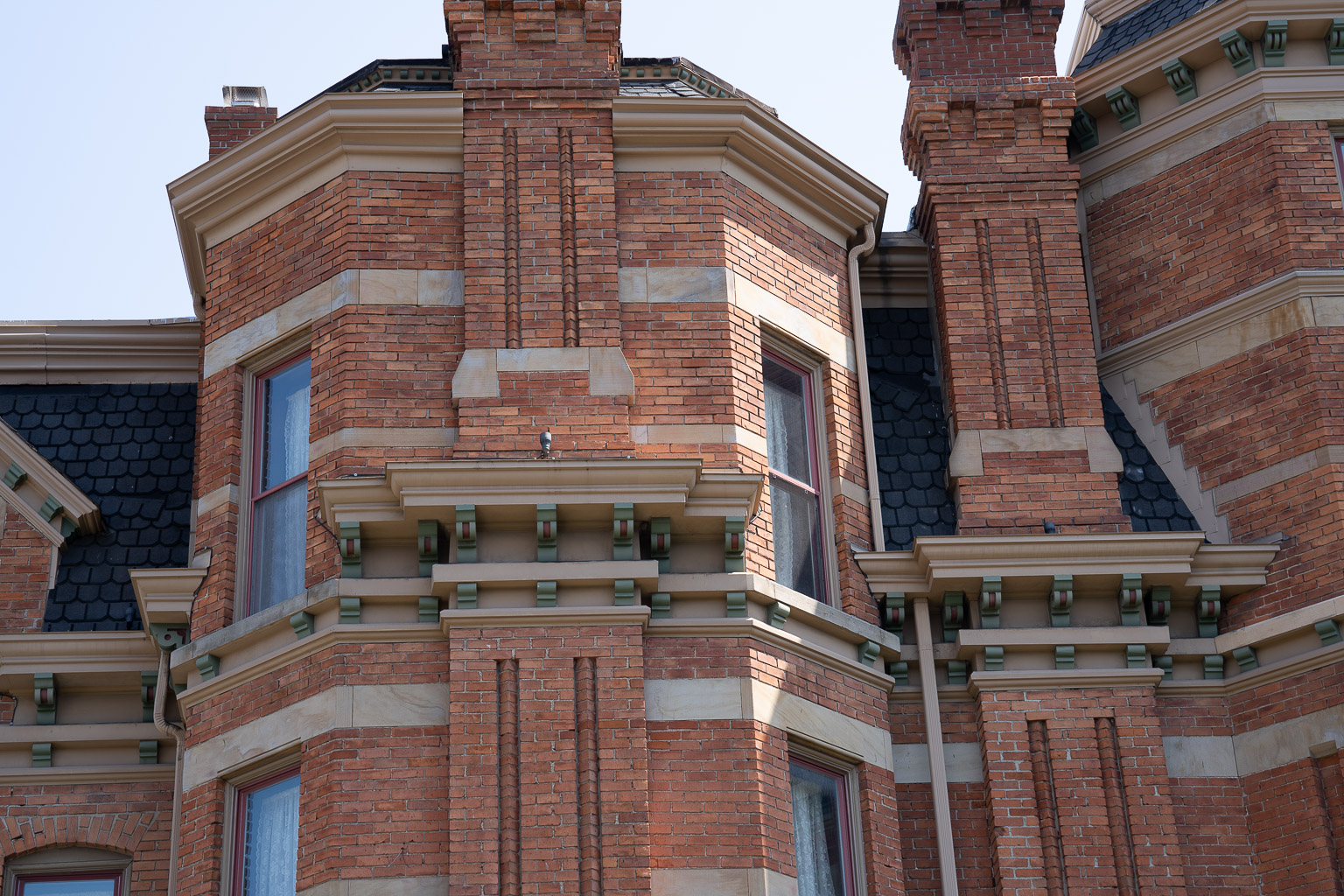
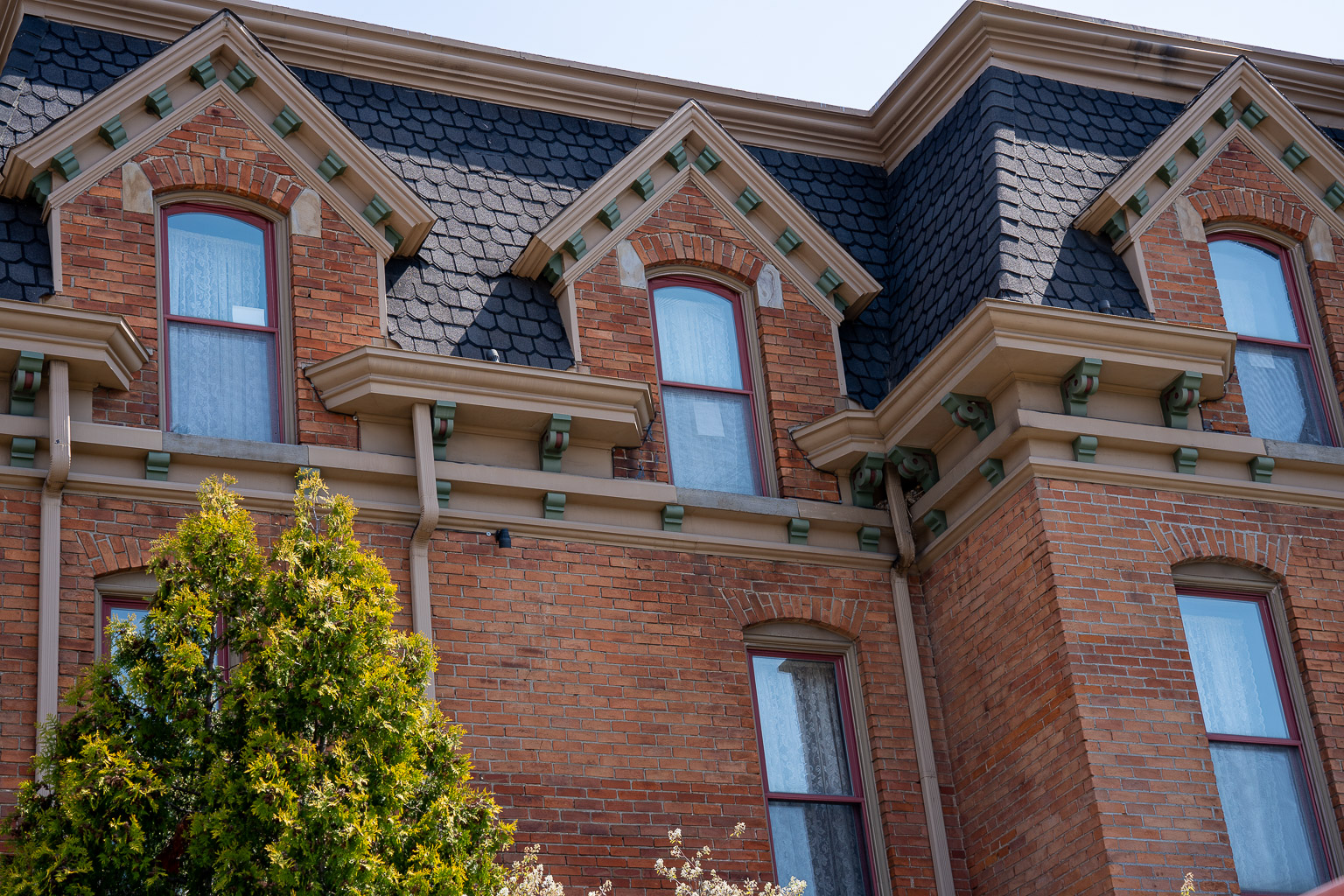
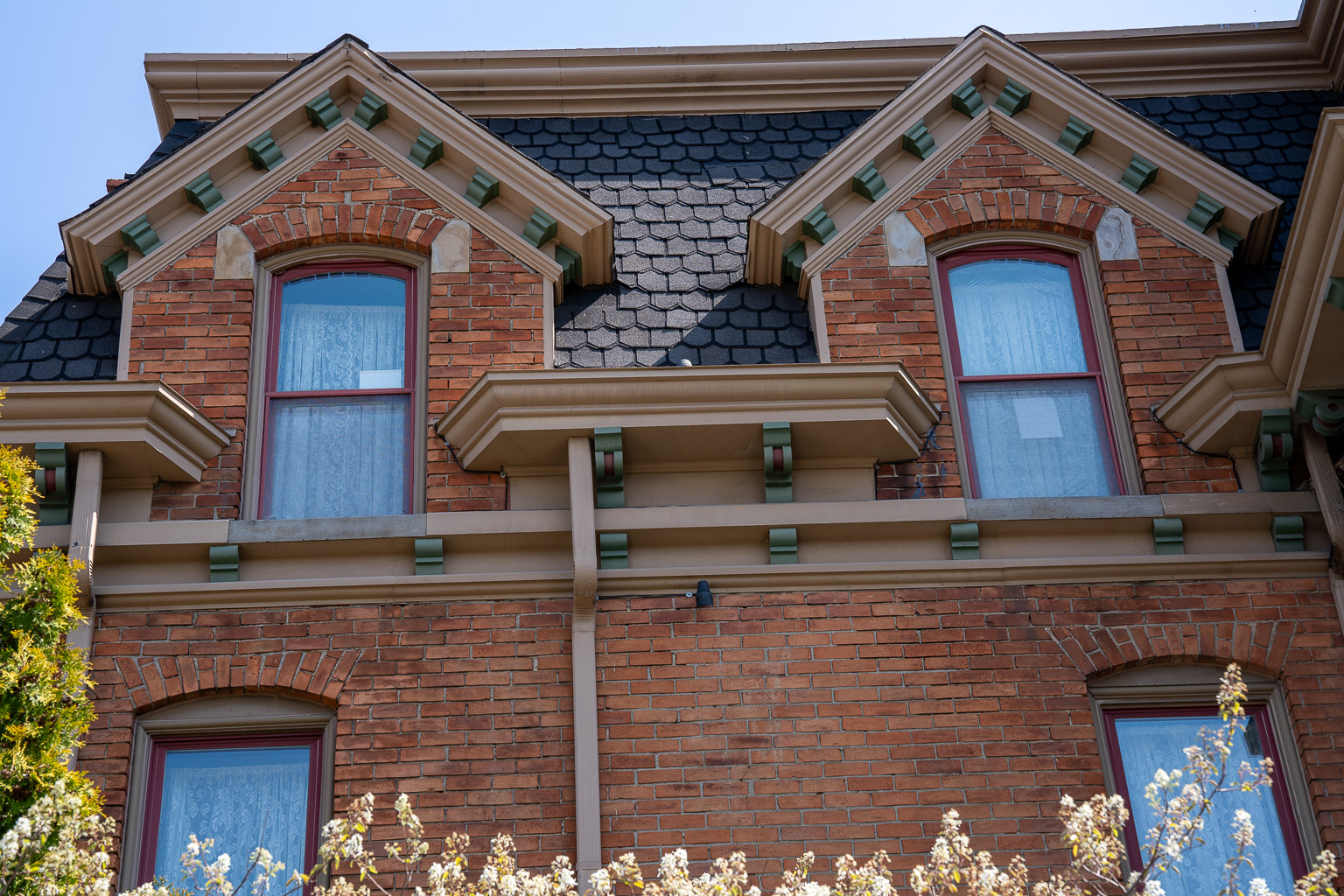
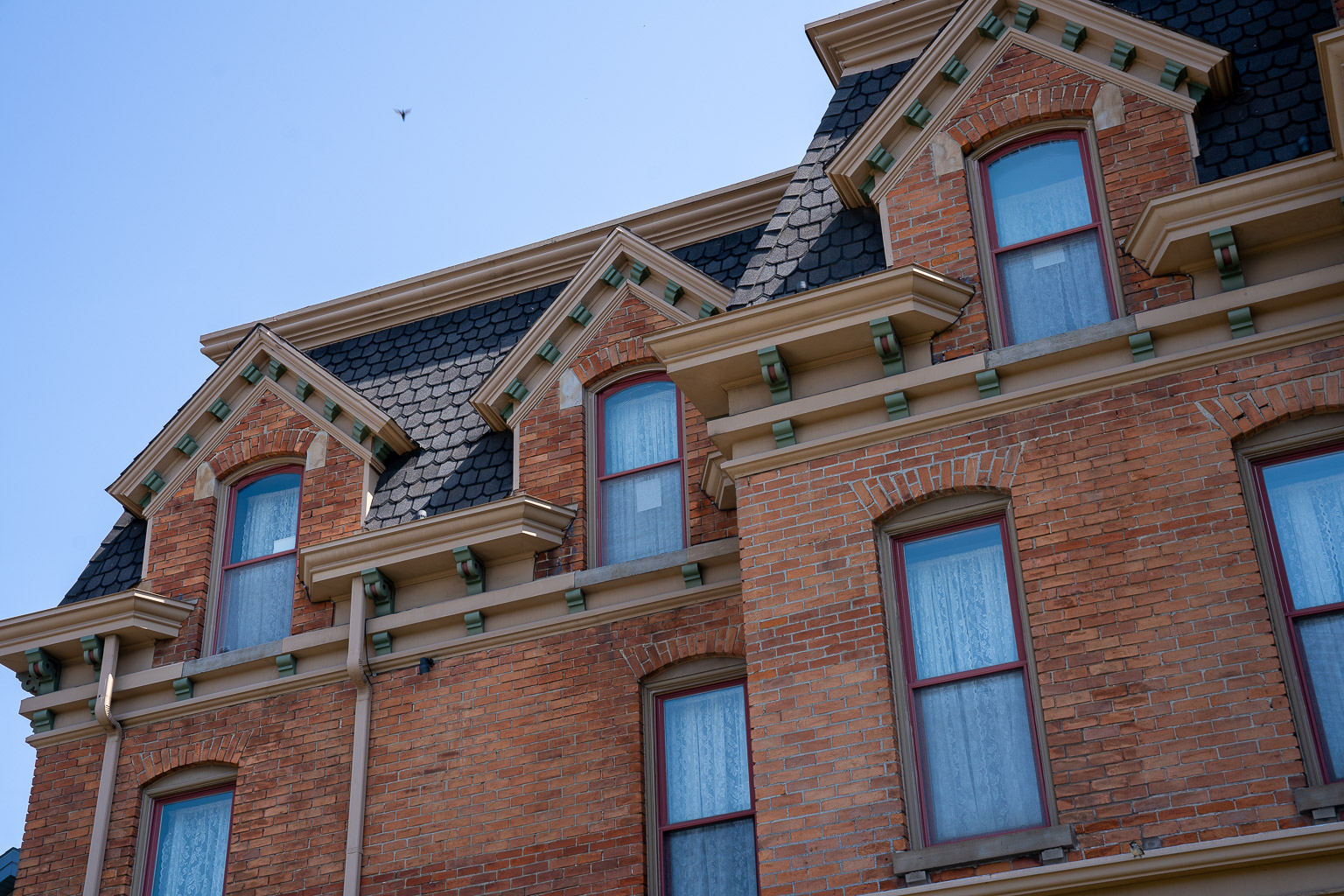
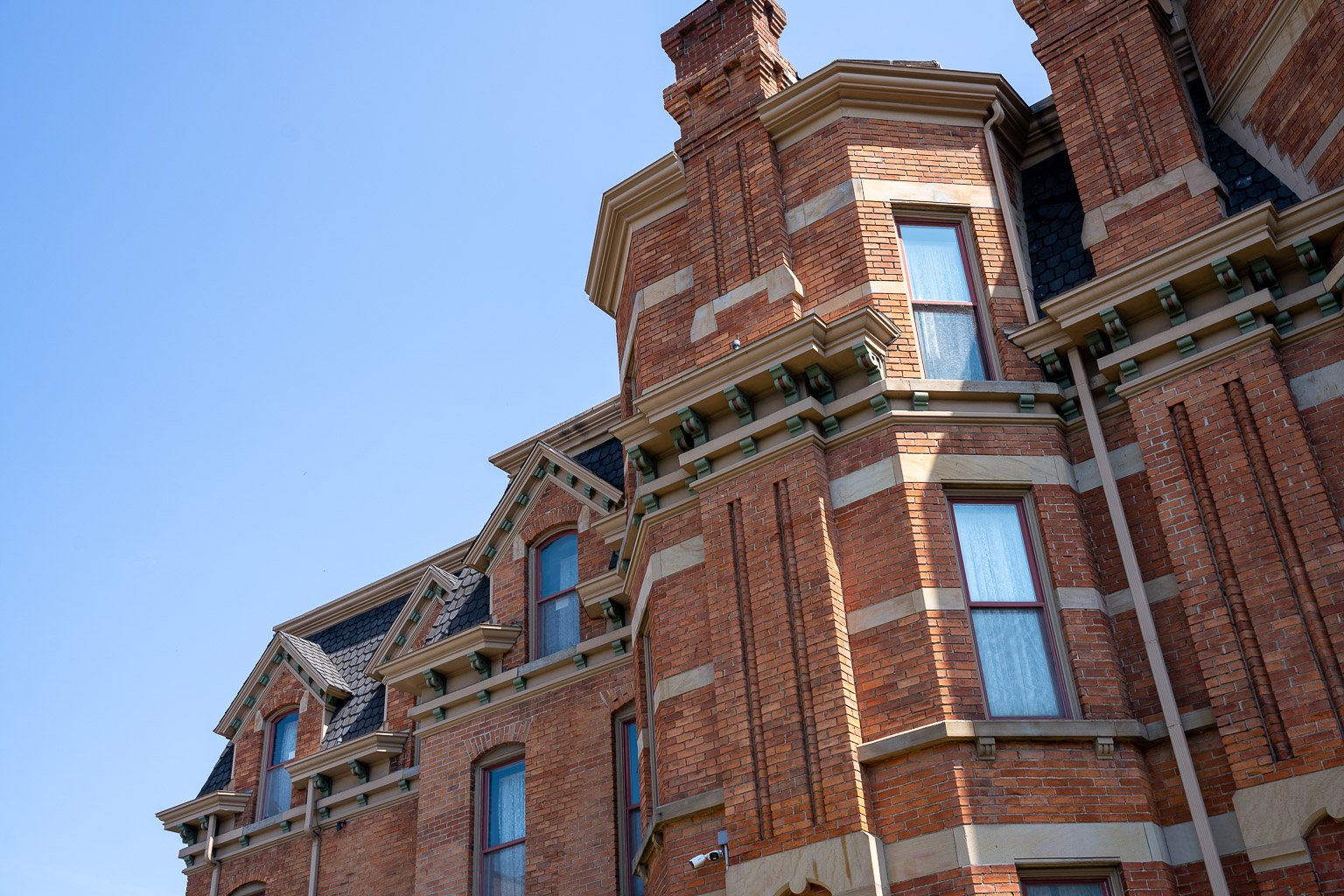
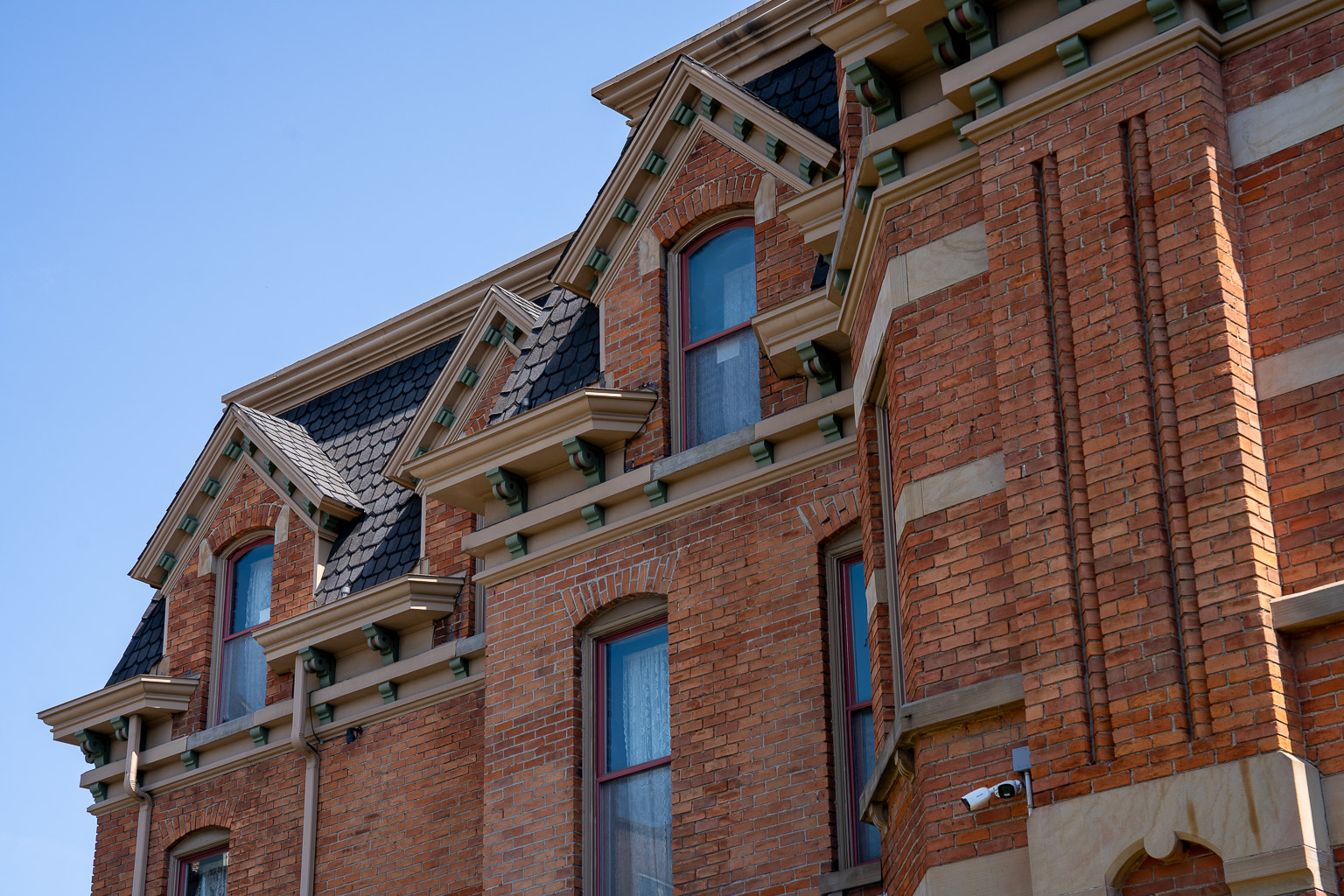
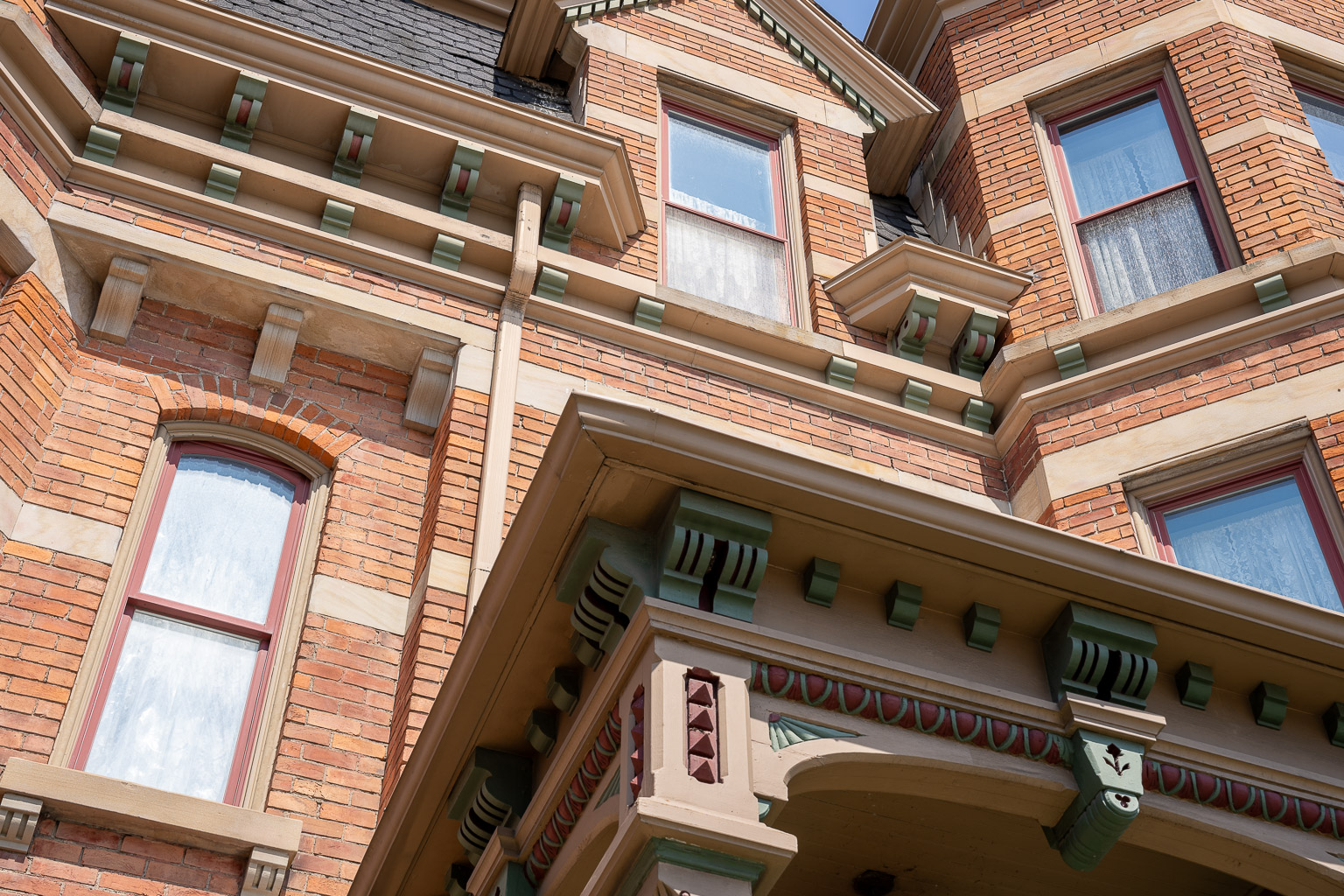
I have no idea why none of the beautiful homes on Winder Street are mentioned in the Brush Park Local Historic District Final Report, but I am going to include the more famous ones here, despite the fact that they're not mentioned. The Inn at 97 Winder is a Second Empire Victorian home, built in 1880, which has been beautifully-restored to characterize Brush Park during Detroit's Gilded Age.
Photos and more description of this building can be found at HistoricDetroit.org.
When St. Patrick's was formed in the early 1860's, the area was suburban, and the new parish was considered a mission effort. The building as originally constructed was small, and was sometimes referred to as a chapel. The enormous size of the parish in those early years, extending from the alley between Elizabeth and Columbia northward indeterminately, between Grand River and Gratiot. By 1887, expansion was in order, and Lloyd added to the building. The church is unusual in Lloyd's surviving work, being of brick instead of the Trenton limestone usually associated with his churches. The expansion is likely responsible for the rather wide, low character of the building, which is offset to some degree by the twin spires flanking the facade. A typical Lloyd feature is the bell cote centered on the front gable; much wooden Gothic ornament is now gone from the building.
By the time a parish school was a consideration, land in the area around the church was scarce, and the school was built on Parsons between Woodward and Cass. Later, in the 1920's, the necessity for school children to travel from Adelaide to Parsons in order to attend school services in the church led to the construction of a large and handsome chapel on Parsons. This opened the way in recent years for the concentration of all parish activities at the Parsons site, as the area around the old church declined, and parish activities became more oriented to programs using the old school building. Old St. Patrick's has not been used for church services for some years, and is neglected. Still owned by the Archdiocese of Detroit, its future is unknown.
The church burned down on May 4, 1993 and is now gone.
Photos and more description of this building can be found at HistoricDetroit.org.
This house was built for William H. Craig, a wealthy land speculator, who sold it within a year or two of completion to Elisha Taylor. Taylor was an attorney who occupied a number of public offices during his life, including that of City Attorney. The house is two stories tall with a high mansard roof. A seeming amalgam of Gothic and Tudor Revival with elements of other styles as well, it remains one of the finest examples of residential design remaining from the period in Detroit. Its interiors are largely unaltered; featured is a magnificent staircase centered in a large entrance hall. This house is listed on the National Register.
Built for a local shipowner, Philo Wright, this three-story red brick structure was designed in the French Second Empire style. Most of its stylistic details are still intact, such as the slate patterns of the mansard roof and the elaborate two-story bay windows on both sides of the house. A major missing feature is the front porch, replaced by a simple full-width one. In 1882, the house was a wedding present to Grace Whitney Evans, daughter of the lumber baron, David Whitney, Jr. She later became involved in charitable activities and was the first president of the Detroit Y.W.C.A. Between 1894 and 1904 Mrs. Evans rented the house to Joseph Lowthian Hudson, founder of Detroit's J. L. Hudson department store. The building is in sound condition and has seen some restoration work.
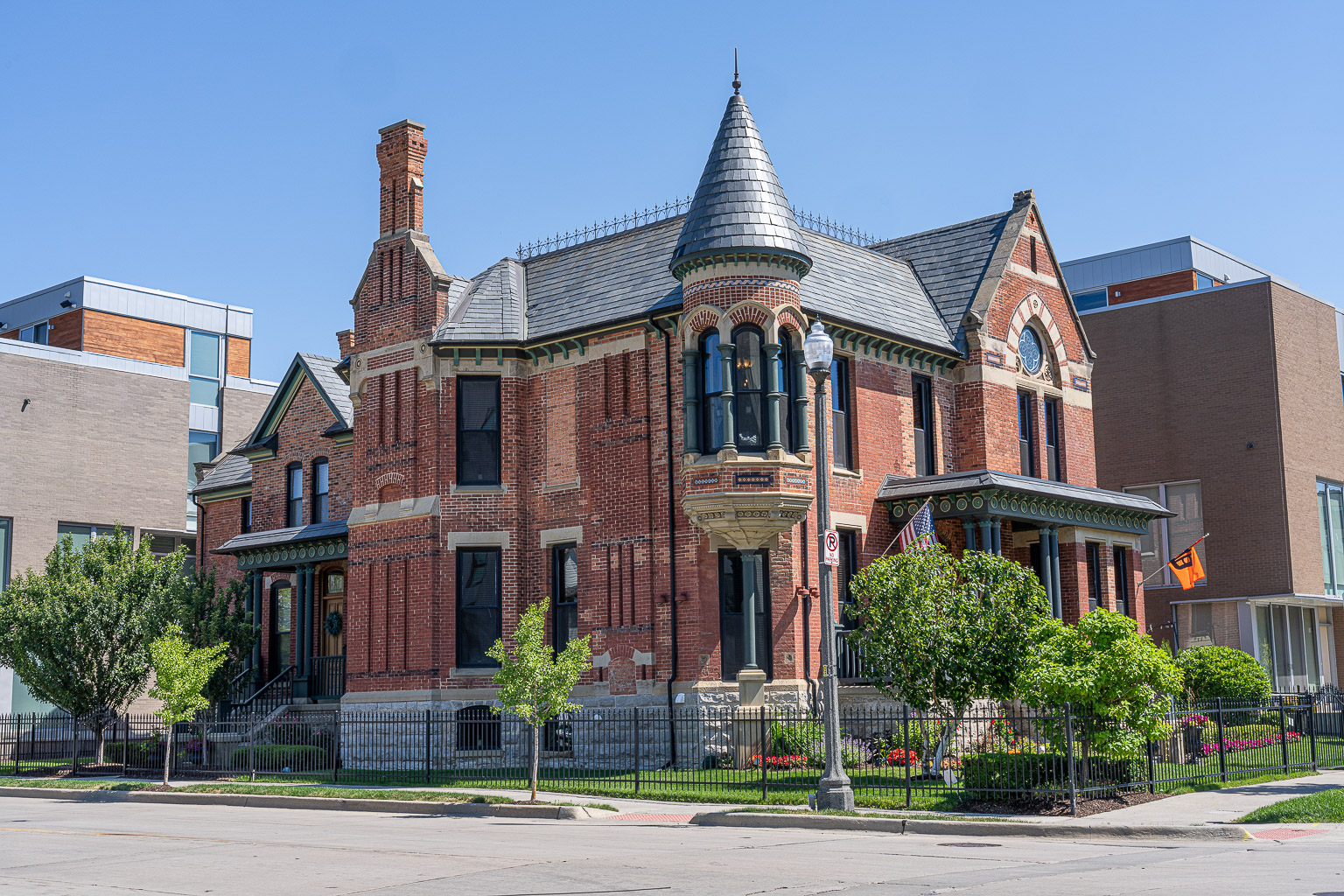
This house at the corner of John R. and Alfred may have introduced to Detroit the so-called "Venetian Gothic", a style brought to popularity by the The Stones of Venice, an extraordinarily influential book on Venetian art and architecture by John Ruskin, the important English art critic whose work ties in as well with the Pre-Raphaelite movement and the Arts and Crafts movement. While Detroit had a number of buildings in the style, most which are dated are later; this is also the first building in which George D. Mason's name appears as an architect. This talented designer remained a most important influence for good design in Detroit through many decades, and his firm survived into the 1960's.
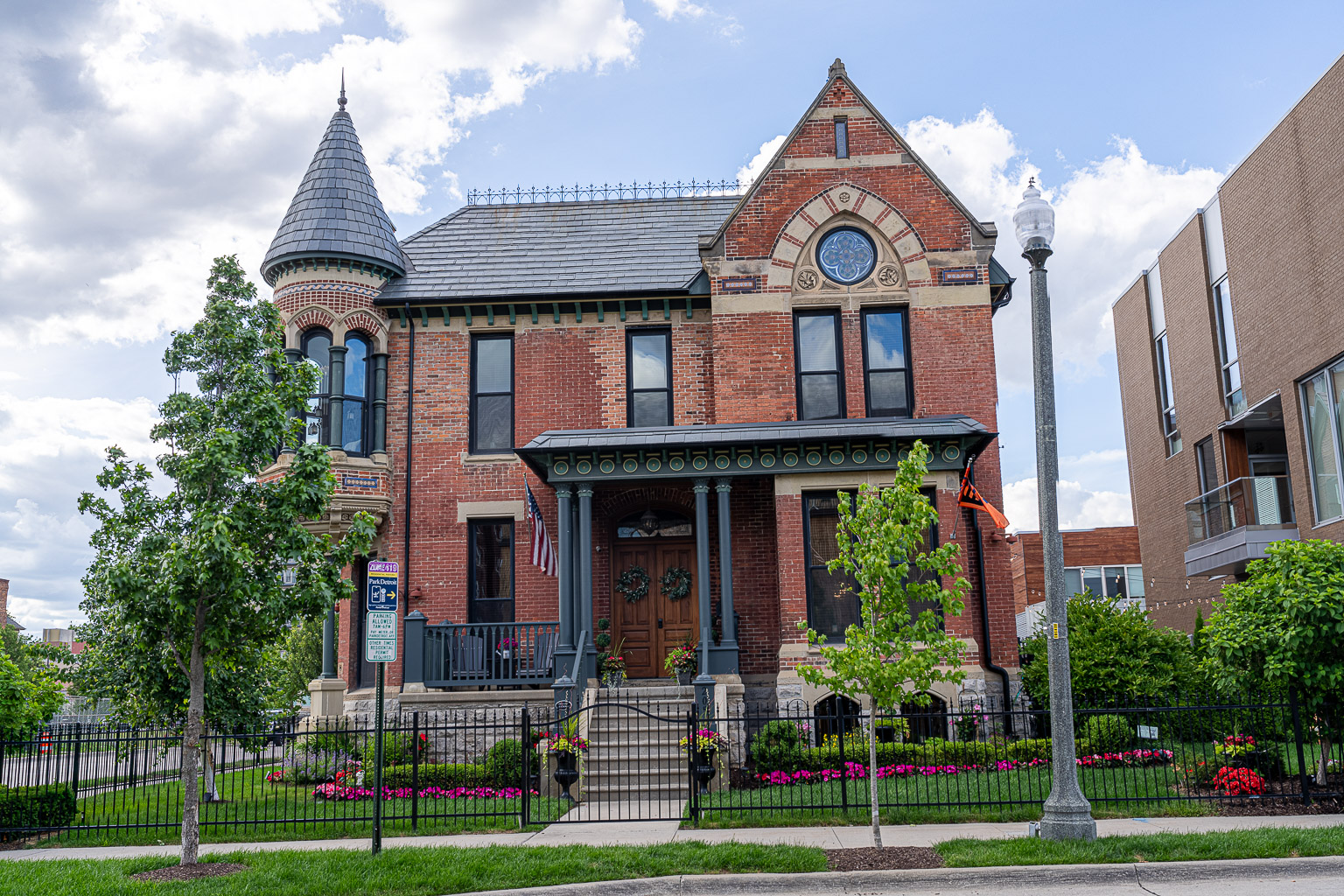
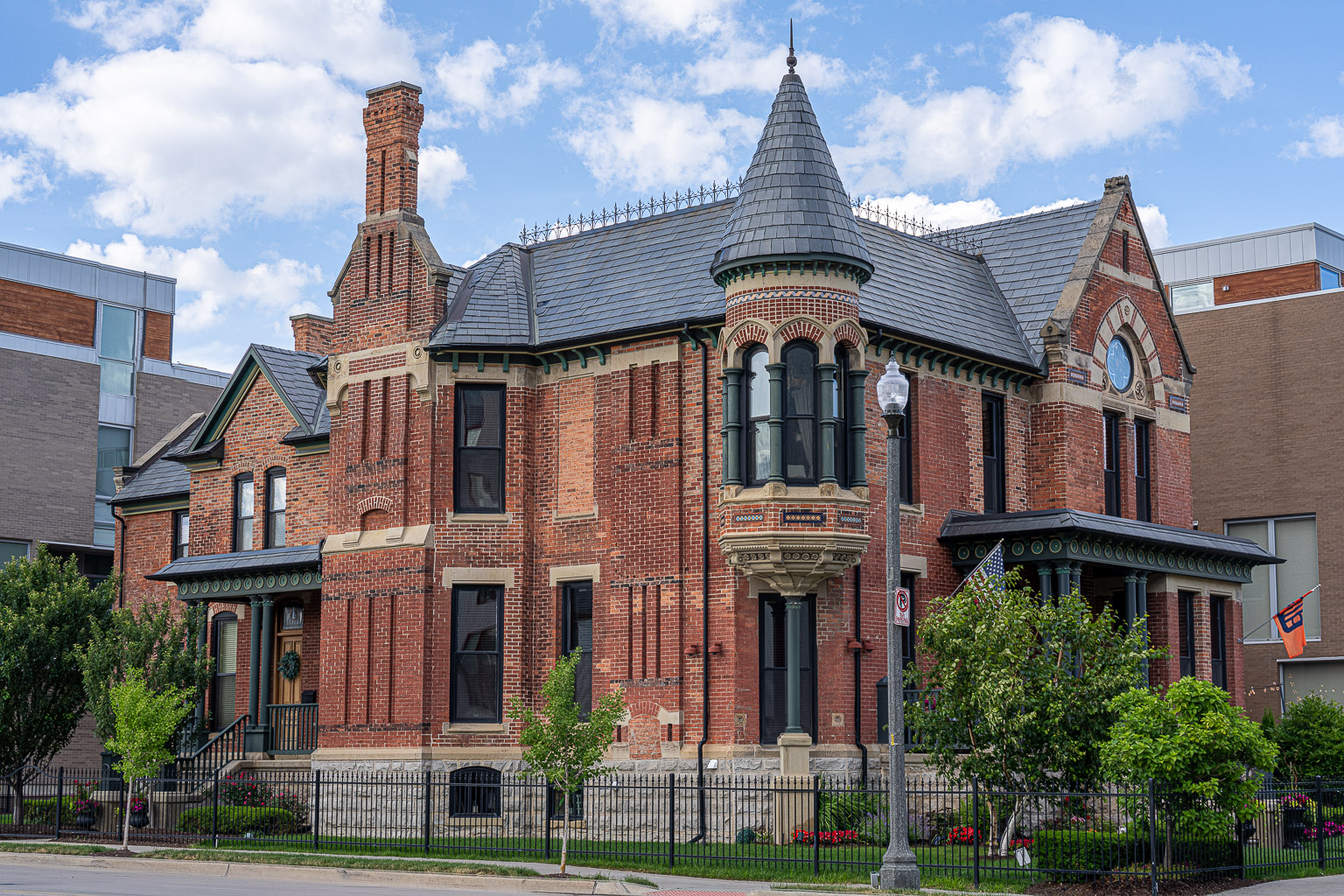
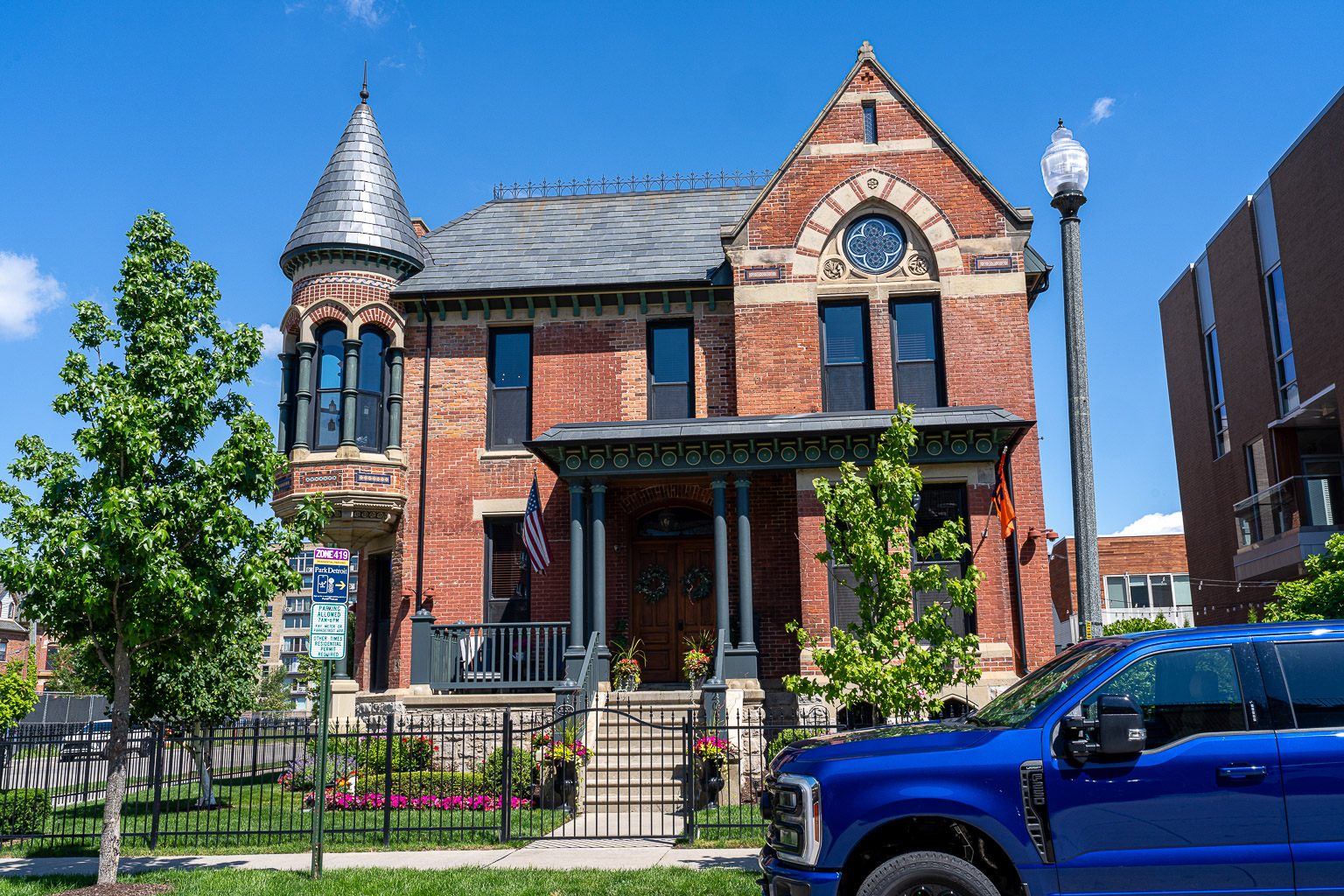
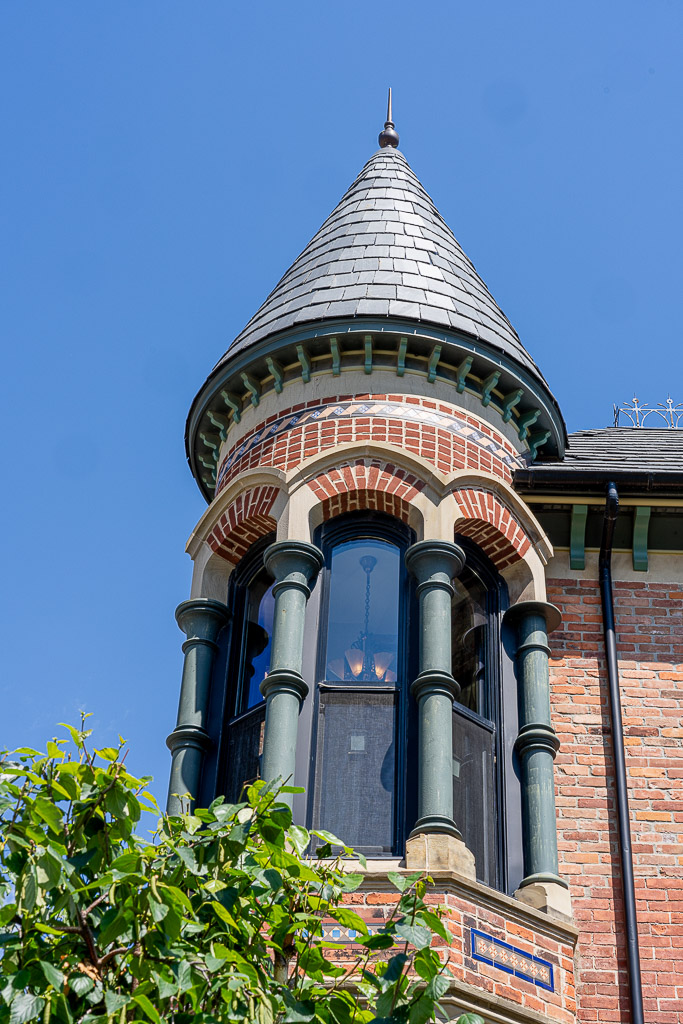
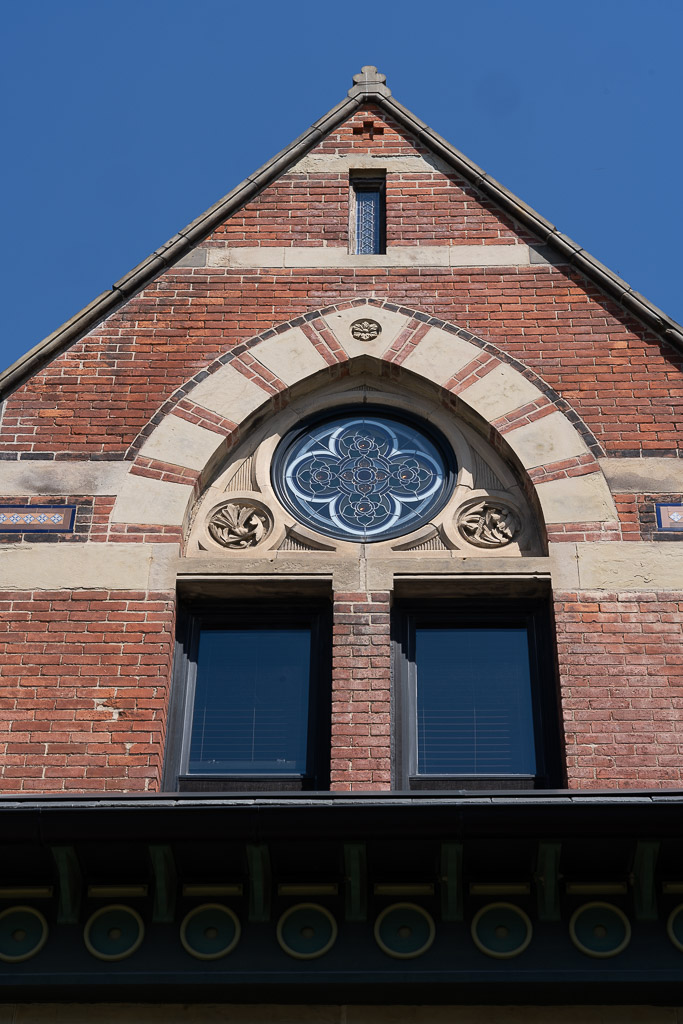
Although altered by the removal of its porches and the addition of a one-story storefront to its southwest corner, the house remains an excellent example of Ruskinian Gothic. The hip and gable roofed building has a corner turret supported on a cul-de-lampe, which features Florentine arched windows and decorative bands of brick and stone bands containing panels of ceramic tile -- thereby introducing the color so important to Ruskin. The paired second story windows on the east side of the second floor are contained in a Gothic arch; above the windows the arch is striped, and the tympanum contains a large quatrefoil window. A large porch roof supported by Gothic columns was placed centrally sheltering the entrance, and echoing the rectangular bay next to it on the east, similarly roofed. The slate roof was decorated with iron lacework along the ridges, with decorative ironwork atop the "witch's hat" roof of the turret and atop the roof of the bay on the west side of the house.
The building was built for Ransom Gillis, son of a New York State farmer, who was one of the founders of Edson, Moore & Company, a large dry goods firm. In addition to his business interests, Mr. Gillis was interested in social concerns, and was a member of the board of Grace Hospital, which at the time was devoted to serving all those who were ill, regardless of ability to pay. For many years he was secretary of that board. He was also an elder at First Presbyterian Church, located near his home.
Additional historical interest is added to the Gillis property by the fact that the first home of Mary Chase Stratton's Pewabic Pottery was located in the Gillis coach house, now demolished.
This mansion had been vacant since the 1960s. It was famously restored in 2015 by host Nicole Curtis in partnership with Quicken Loans and was documented in an 8-part special on HGTV. You can see some pre-renovation photos at Wikipedia.
See also HiatoricDetroit.org.
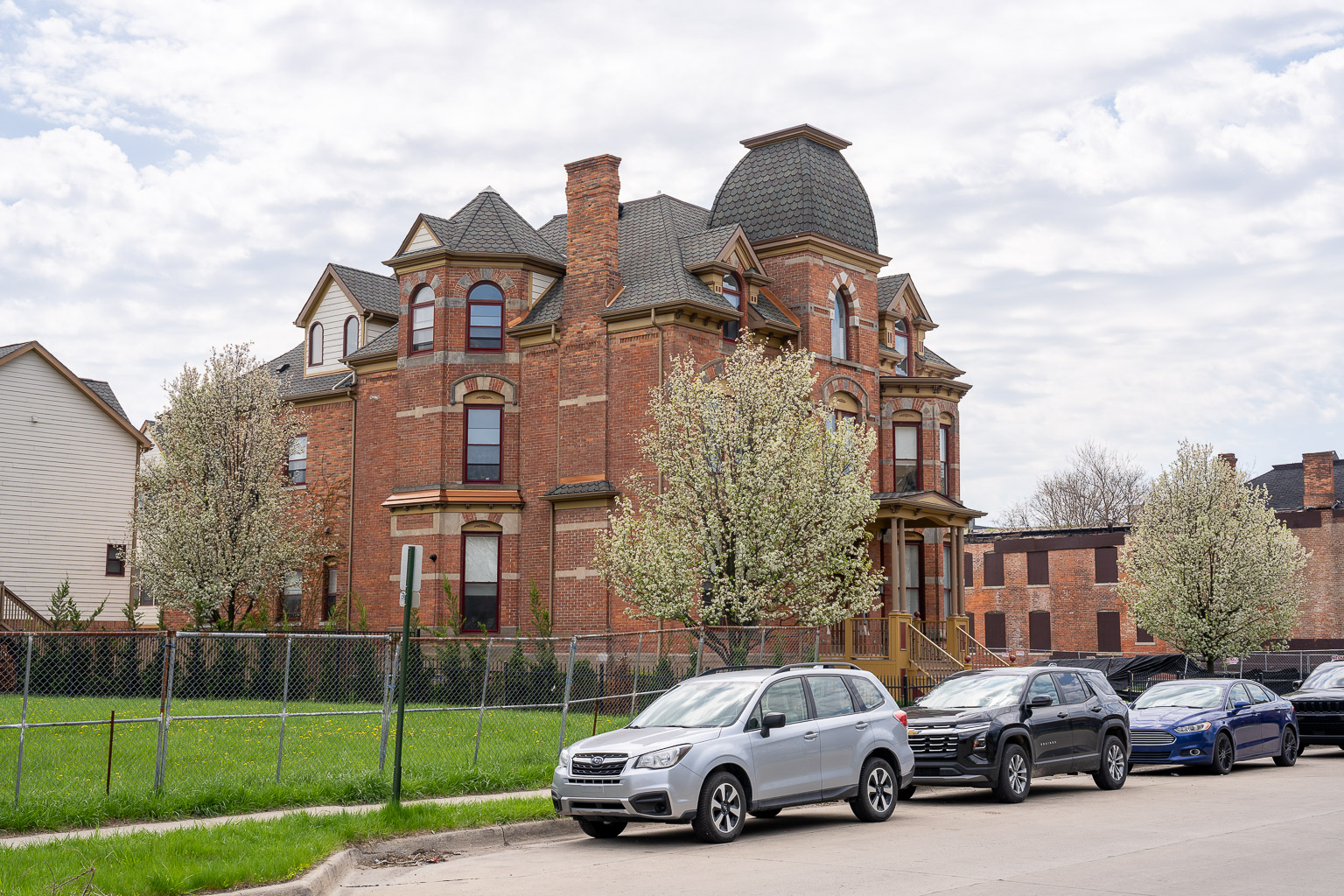
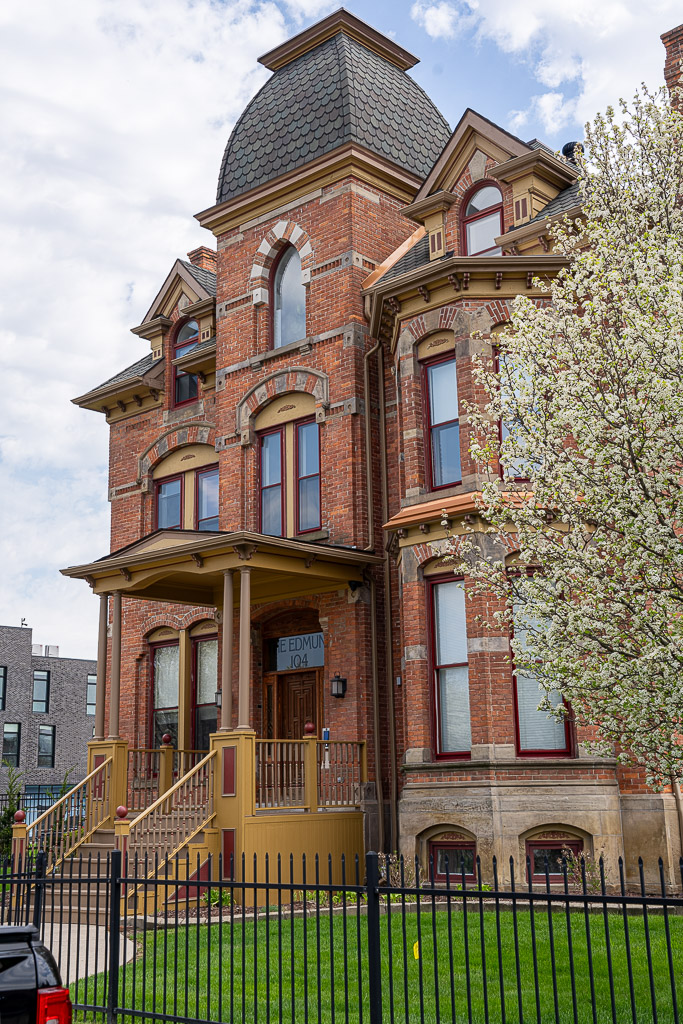
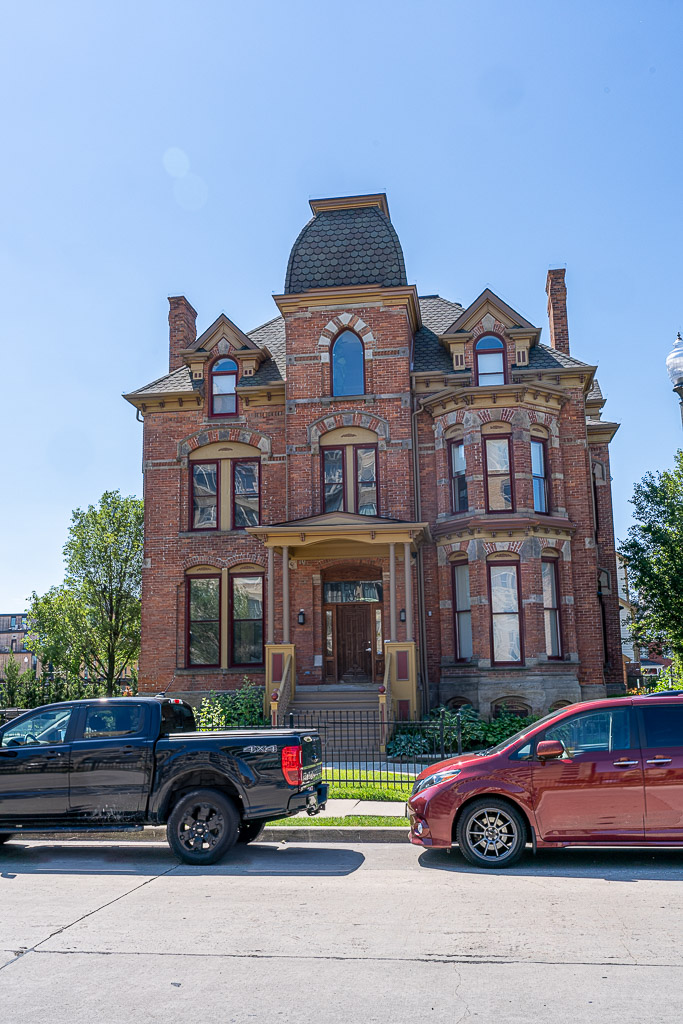
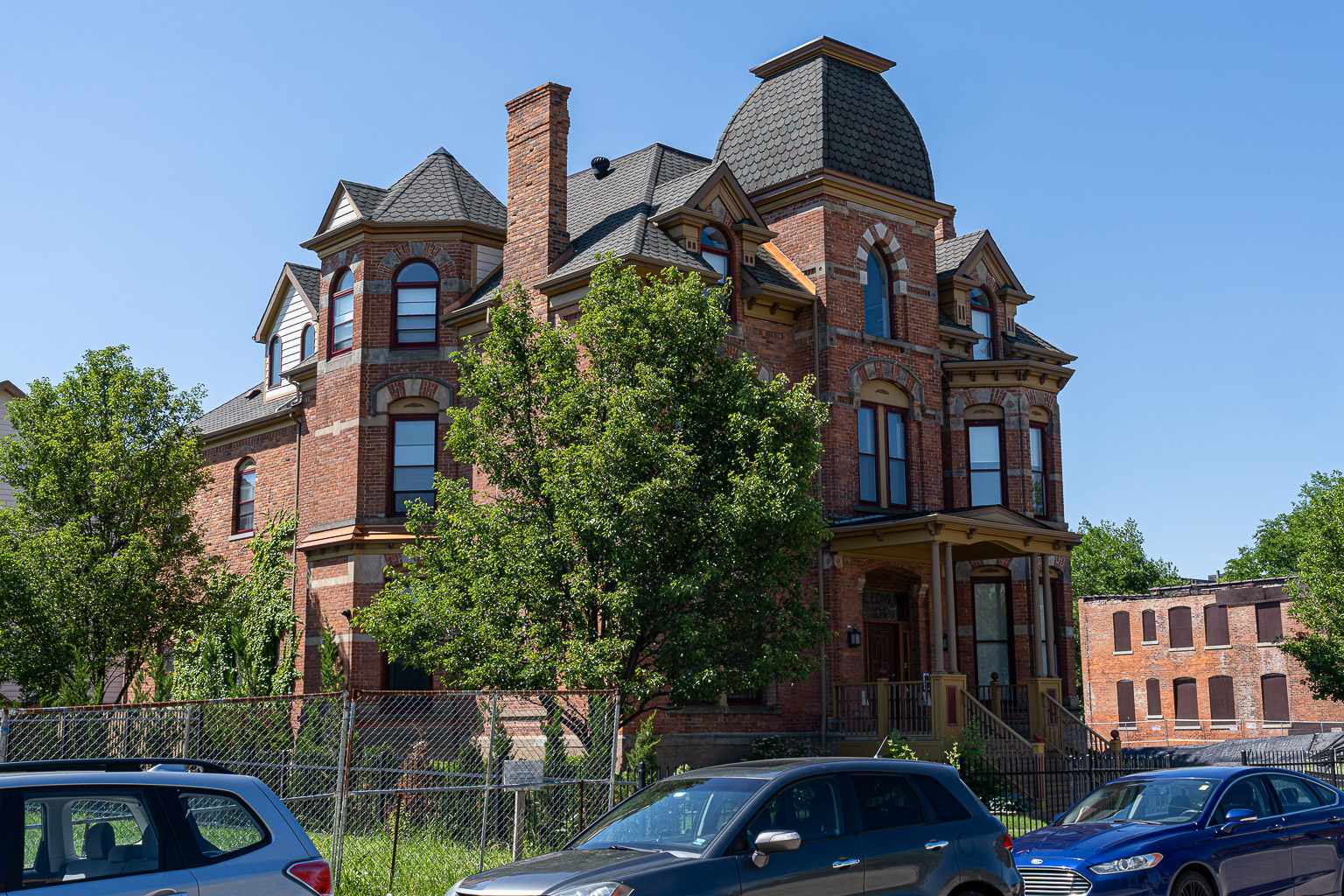
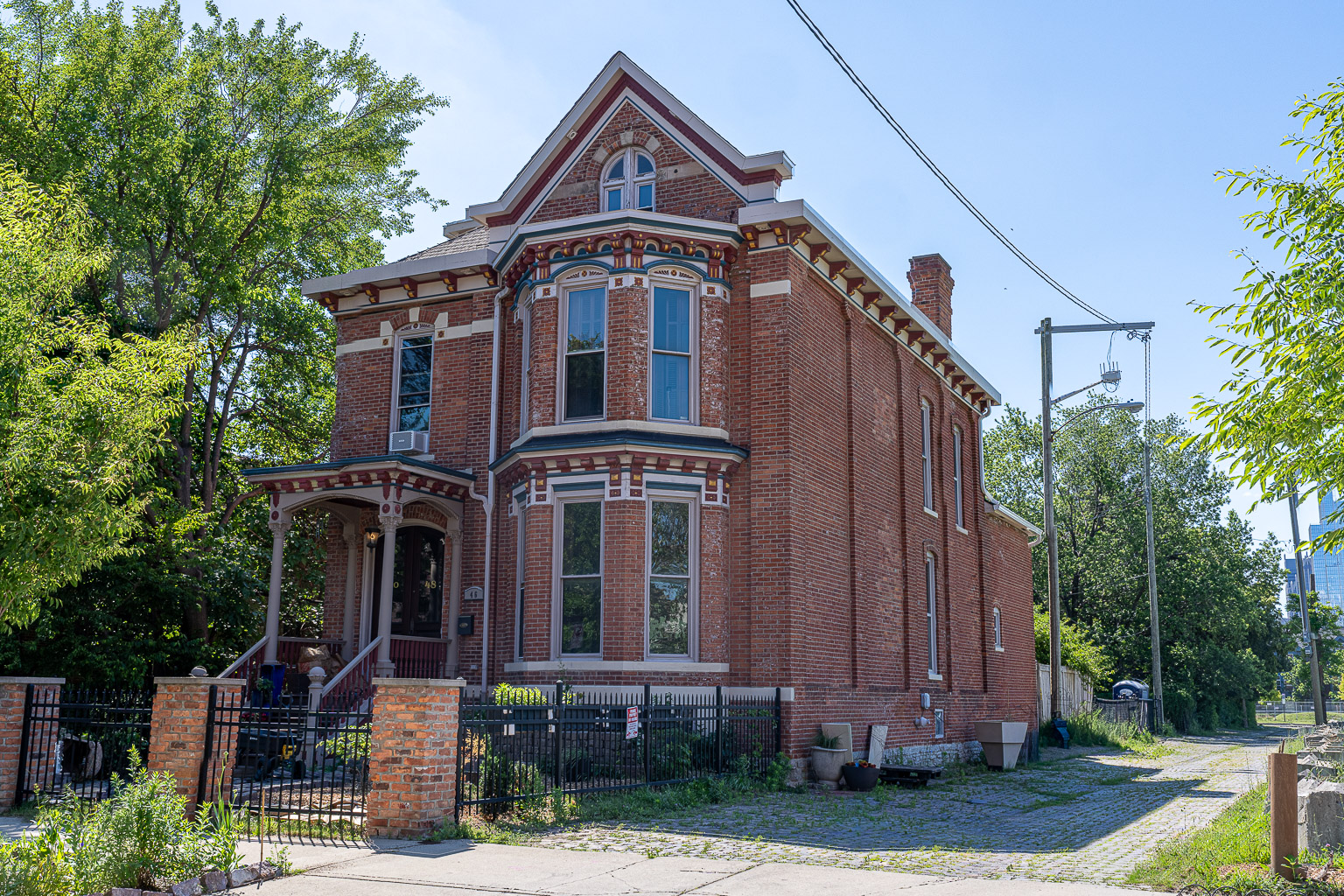
The Edmund, at 104 Edmund Place, is not mentioned in the Brush Park Local Historic District Final Report, but I'm including it here since it's a gorgeous Victorian home.
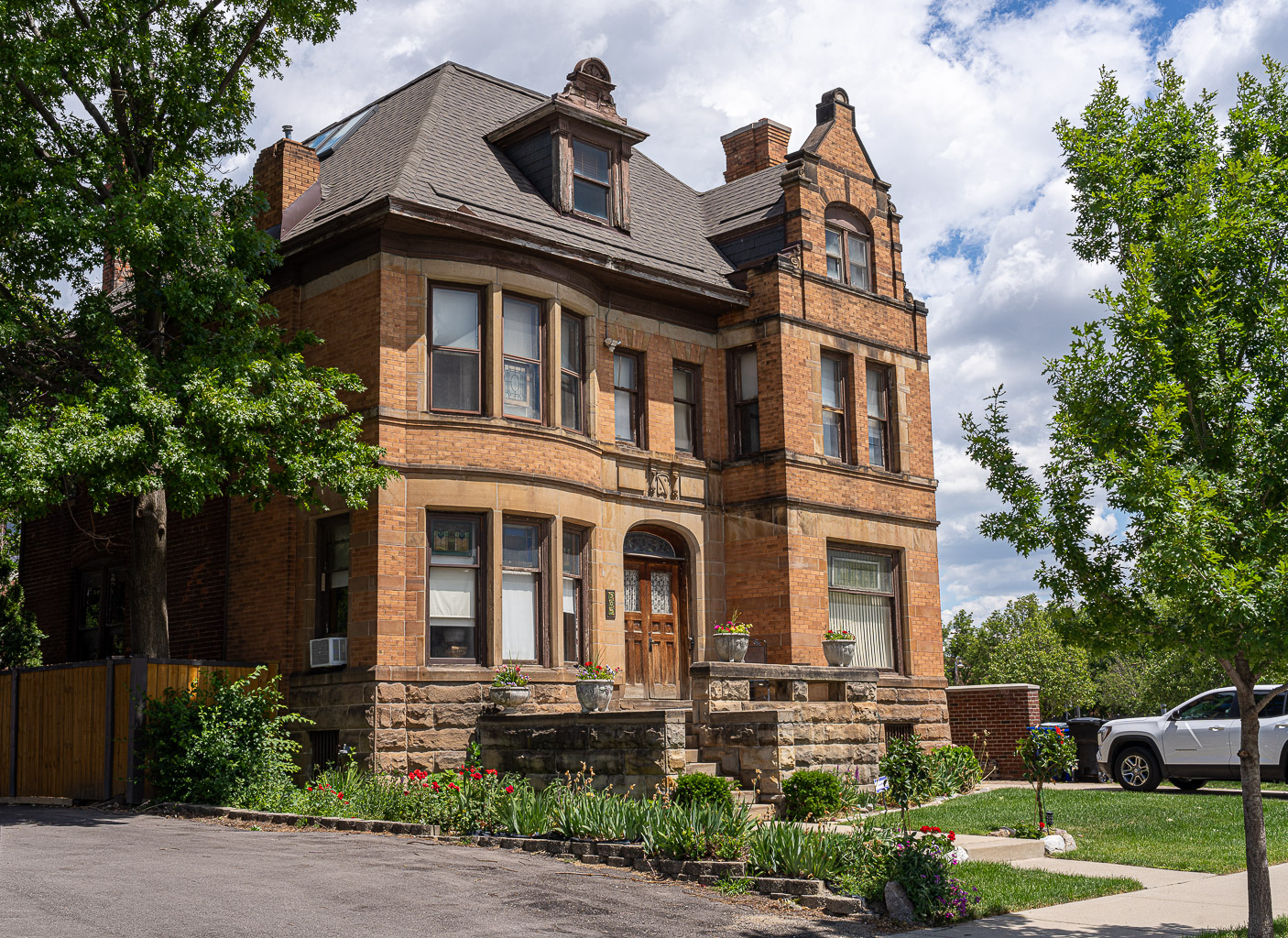
229 Edmund Place is not mentioned in the Brush Park Local Historic District Final Report, but here is a photo of it.
Not much is known about Edwards, the architect of this house, several of its departed neighbors, and several other houses in the district. The house is a highly interesting study in assembled form; a tower, a turret, and many other elements combine to make a house which is almost playful in its geometry. Ruskinian Gothic is the basic source of decorative design. The central tower contains the entrance, which is sheltered by a porch which extends in from the eastern portion of the first floor facade; above, a second story porch is placed in front of the tower only, with a gable supported on curved brackets supported on Gothic columns. The gable of the second floor porch echoes the gable on the front of the tower directly above, which contains a double window surmounted by an ogival tympanum in an arch. An elaborate dormer decorates the roof to the east of the tower. The west half of the facade is dominated by the rounded tower with Gothic windows and a conical "witch's hat" roof. Of common brick on a Trenton limestone foundation, the house was covered with a slate roof.
The house was built for George Smith Frost, a New Yorker who came to Detroit by way of a time spent living in Pontiac. In 1839, he came to Detroit to work as a clerk, and joined the First Presbyterian Church. There he met Lewis Cass, who took the young man in tow and encouraged his career. Frost was Land Commissioner for the construction of the St. Mary's Falls Ship Canal (Soo Locks) in the early 1850's, and later became one of the largest timberland owners in the state. He was also a local political figure, having served as an alderman and as a member of the City Plan Commission.
The Frost house is one of those on which restoration work was begun by the Woodward East project. Its rehabilitation incomplete, it is standing vacant and boarded. Much of its elaborate detail is now gone, but an engraving of the house in Farmer's History of Detroit and Wayne County allows us to judge the original appearance of this fine high Victorian residence.
As of 2026, there is a 246 and 250 Edmund Place, which are new-build condos, but no 248 Edmund Place.
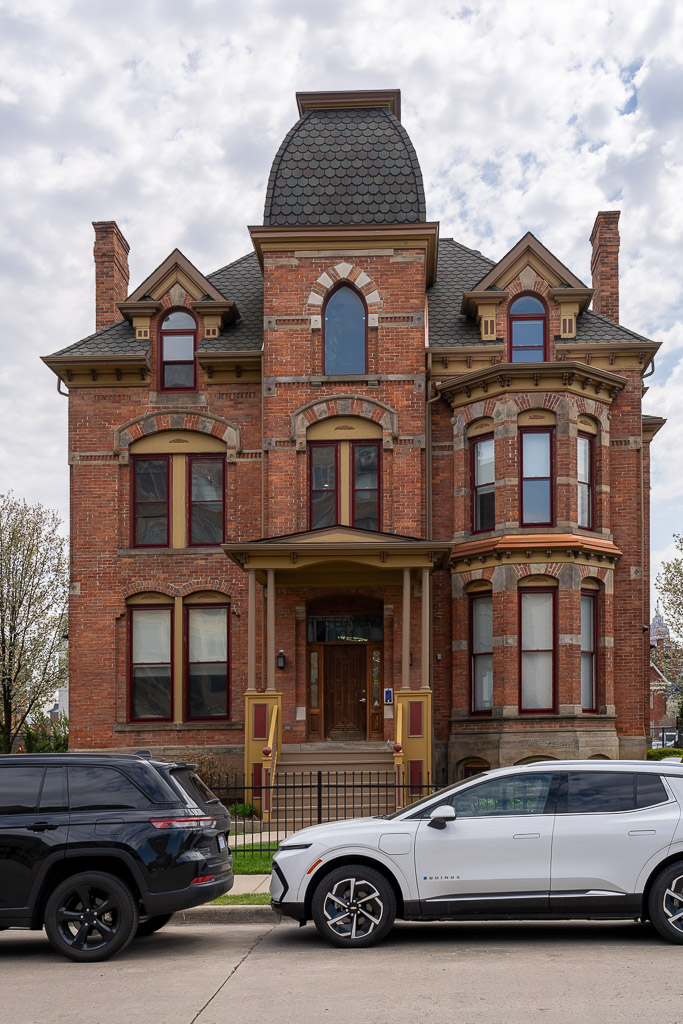
Perhaps Detroit's finest remaining essay in the French Second Empire style, this unusual house remains in good condition with such of its detail intact. Built for Frederick Butler, a teller at the Mechanics Bank, the house reflects the position of the Butler family in Detroit. William A. Butler, Sr. was the founder of the Mechanics Bank, and so Frederick's position as a teller is misleading as to his standing in the firm. Frederick's brother, William A. Butler, Jr., some years later a residence at the northwest corner of Third and Hancock which is also architecturally distinguished, and has been the subject of a designation study by the Historic Designation Advisory Board.
The Frederick Butler house is unusual in the proposed Brush Park district as, in effect, a story-and-a-half house. Tall two-story houses with high roofs were the norm in the Brush family's subdivisions; this house is one-story with a high mansard and tower. An imposing appearance is achieved nonetheless by placing the house on a high foundation, nearly a story tall in itself, and making necessary a long flight of steps to the front entrance, placed in the tower. The tower is a full two stories tall with a domical mansard roof; it is placed in the center of the symmetrical facade, with bay windows flanking on the first floor and double dormer windows breaking the cornice line on the second. Much of the detail of the house remains intact, both inside and out.
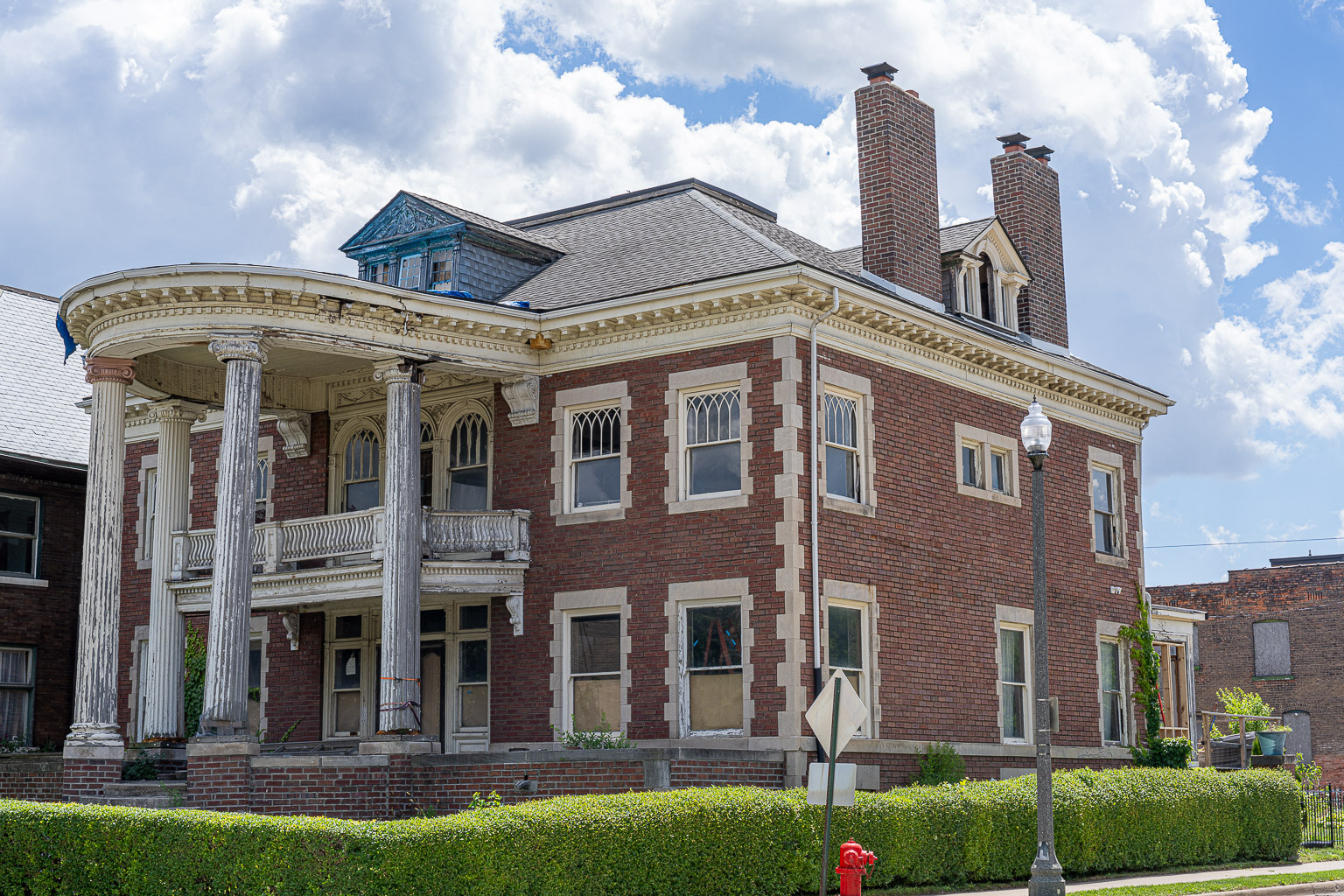
Built for Lucien S. Moore, a lumber dealer, this house is, perhaps, in the public's eye the image of the later Victorian house with its central tower. Elements of the Ruskinian Gothic are present in the slender gothic colonnettes of the porch, now gone, and in the banded arches above the windows. The third floor tower window is distinctly Gothic, with its ogival arch. Yet the dormer windows, which break the eave line as they rise above the roof, are flanked with Renaissance consoles, typifying the stylistic freedom which critics of the Victorian period have characterized as stylistic confusion. The house, vacant and abandoned, is a ruin. When I visited in 2026, there was no house at this address any longer.
46 Edmund Place is not mentioned in the Brush Park Local Historic District Final Report, but here is a photo of it.
This building, a row of four townhouses, is located at the northeast corner of Alfred and Brush. Victorian rowhouses are rare in Detroit, and this example, in the French Second Empire style, is certainly the most spectacular surviving example. Two story brick with stone trim, the building is surmounted by a mansard roof, which is taller above the entrance bays. Though the eastern of the two front porches is gone, and the condition of the buildings is not ideal, the structure remains an exemplar of a type more usually found in the east. When I visited in 2026, these townhouses have been replaced by a modern senior living community called The Village of Brush Park Manor Paradise Valley.
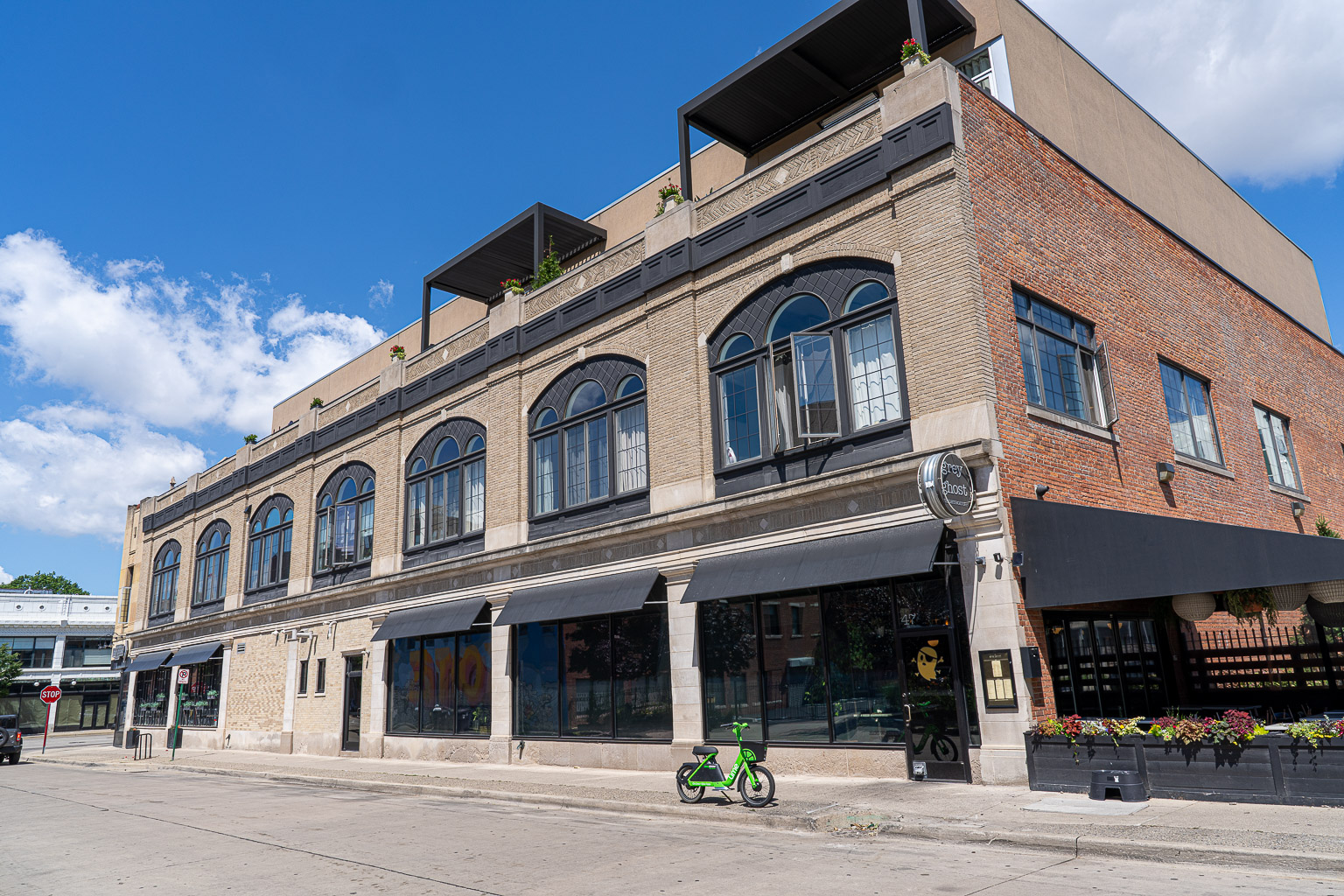
This is not a historic building, having been built somewhere between demolition of the prior building at this spot in 2005, and the opening of the Grey Ghost restaurant in 2016. But I found it while searching for the historic 57 Watson (next entry) and thought it might be a historic building.
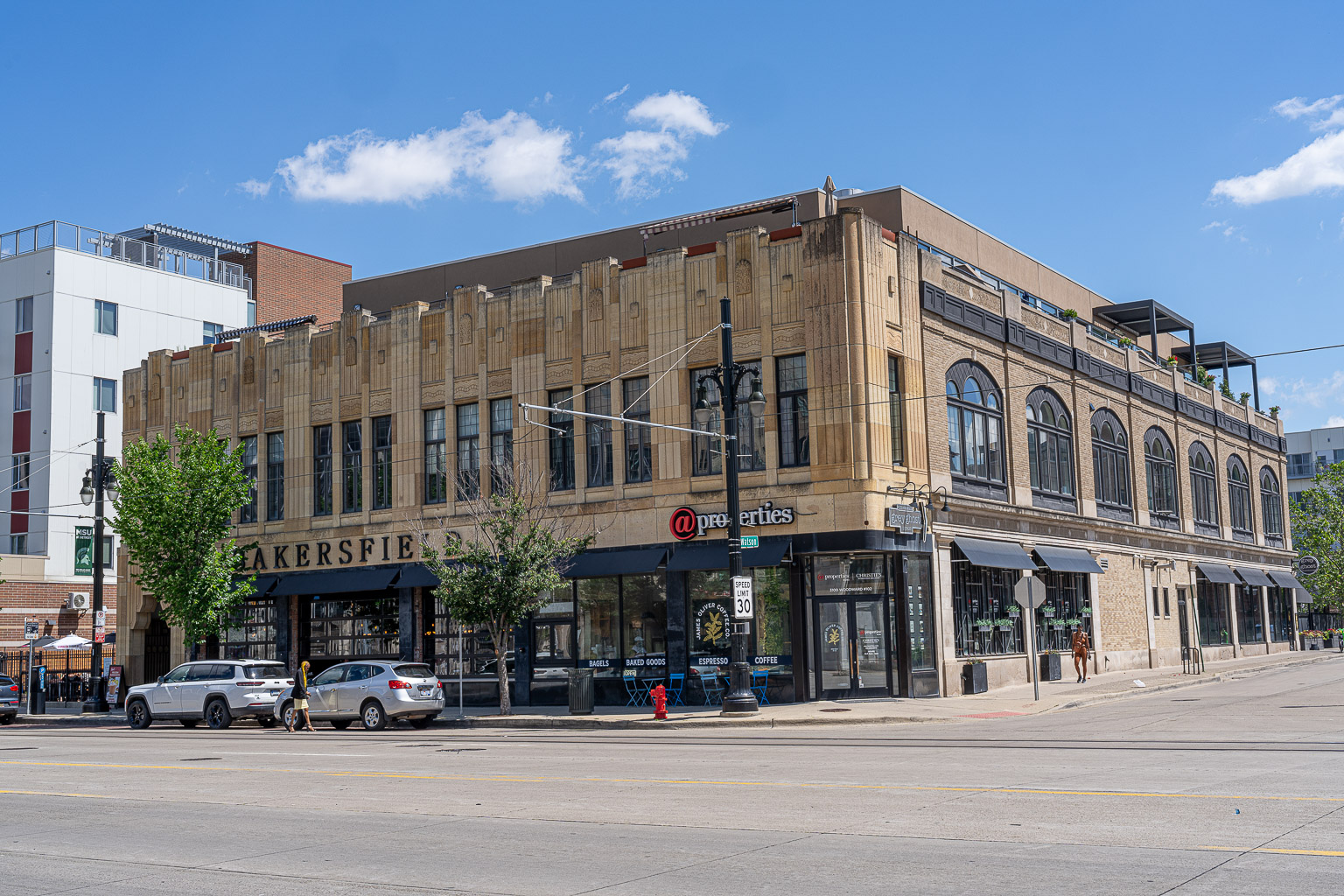
This massive residence was built at an estimated cost of $11,000 for Robert C. Faulconer, president of the Laland, Faulconer & Norton Company, tool manufacturers. The popular Romanesque Revival is reflected in the weight of the design, though not in its details; the variety of the Queen Anne is reflected in the bays, oriel window, dormers, and other detail. A stone foundation rises to the first floor window sill height; the building is brick above. Some fine original ironwork survives on the building. When I visited in 2026, no building was at this address. Instead the ground where this home once stood is a patio for a restaurant named Bakersfield DET (the left side of 3100 Woodward, see prior entry).
This much simpler building by Hess & Raseman shows more strongly the influence of the Romanesque Revival. A central arch shelters the entrances to both units of this side-by-side double house, and the use of ornamental brickwork is characteristic of the period as well. The 1892 City Directory lists the two occupants as Labell Altman, a bank clerk, and Samuel Rindskoff, a traveling agent; thus we gain some idea of the middle-class nature of such a dwelling.
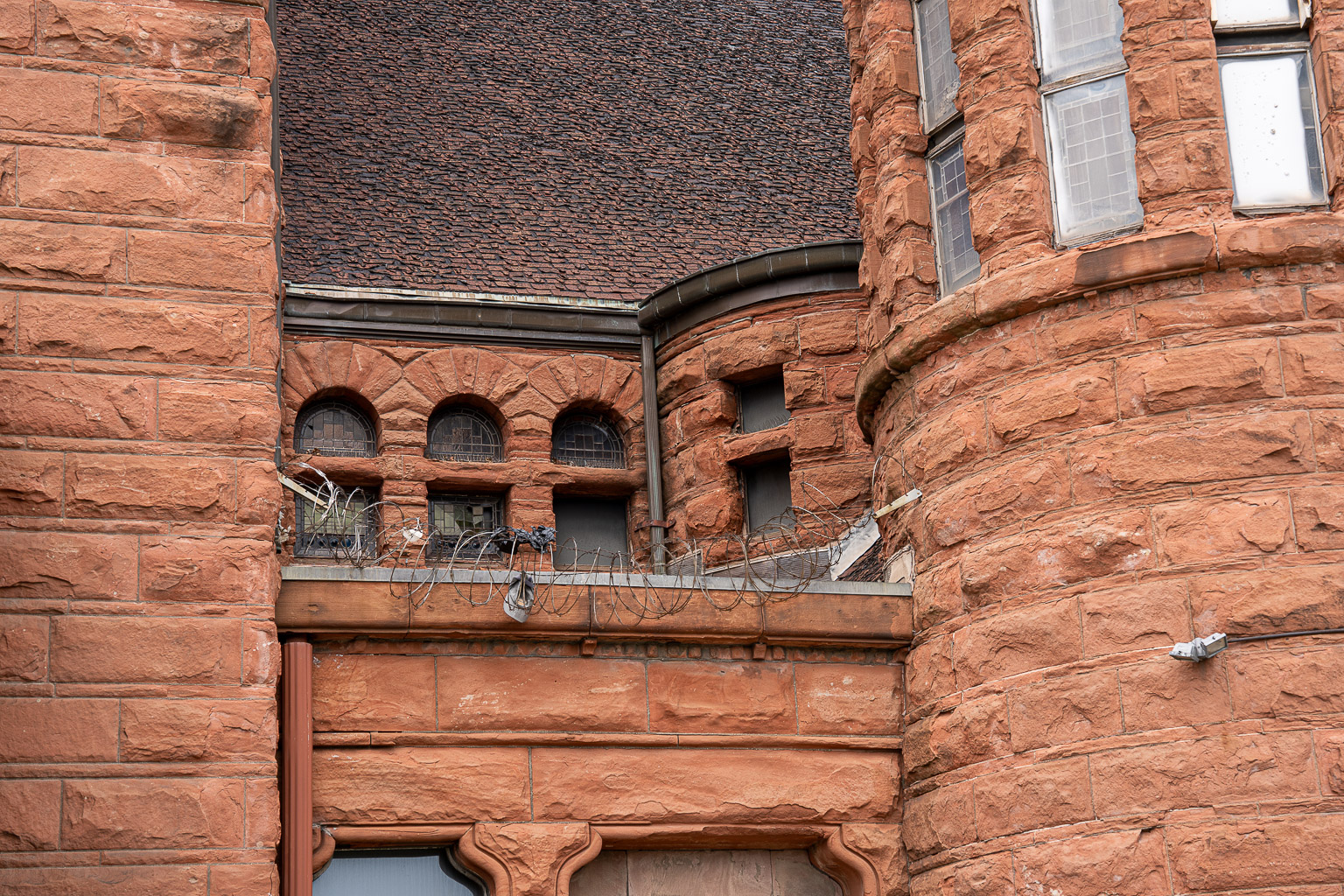
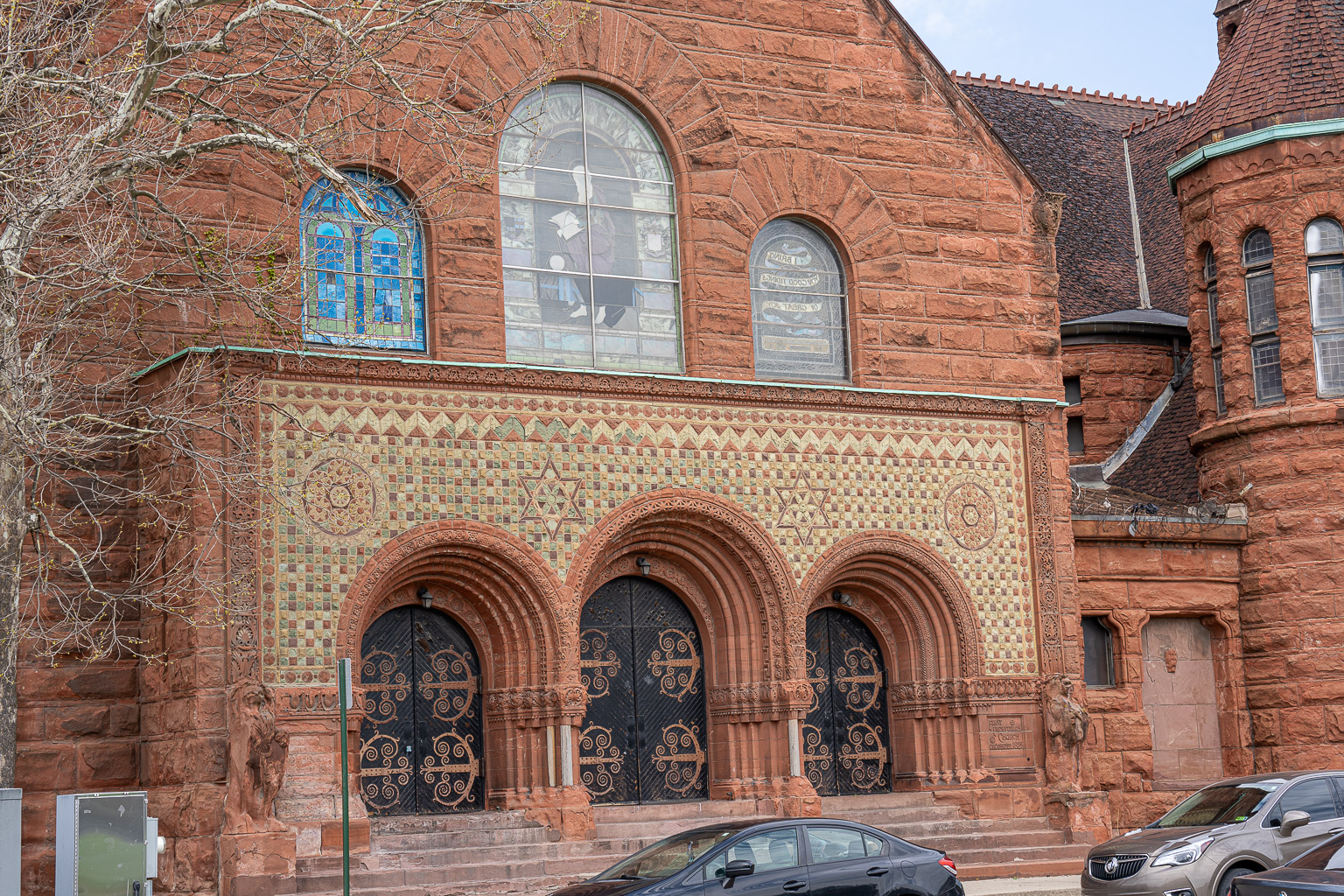
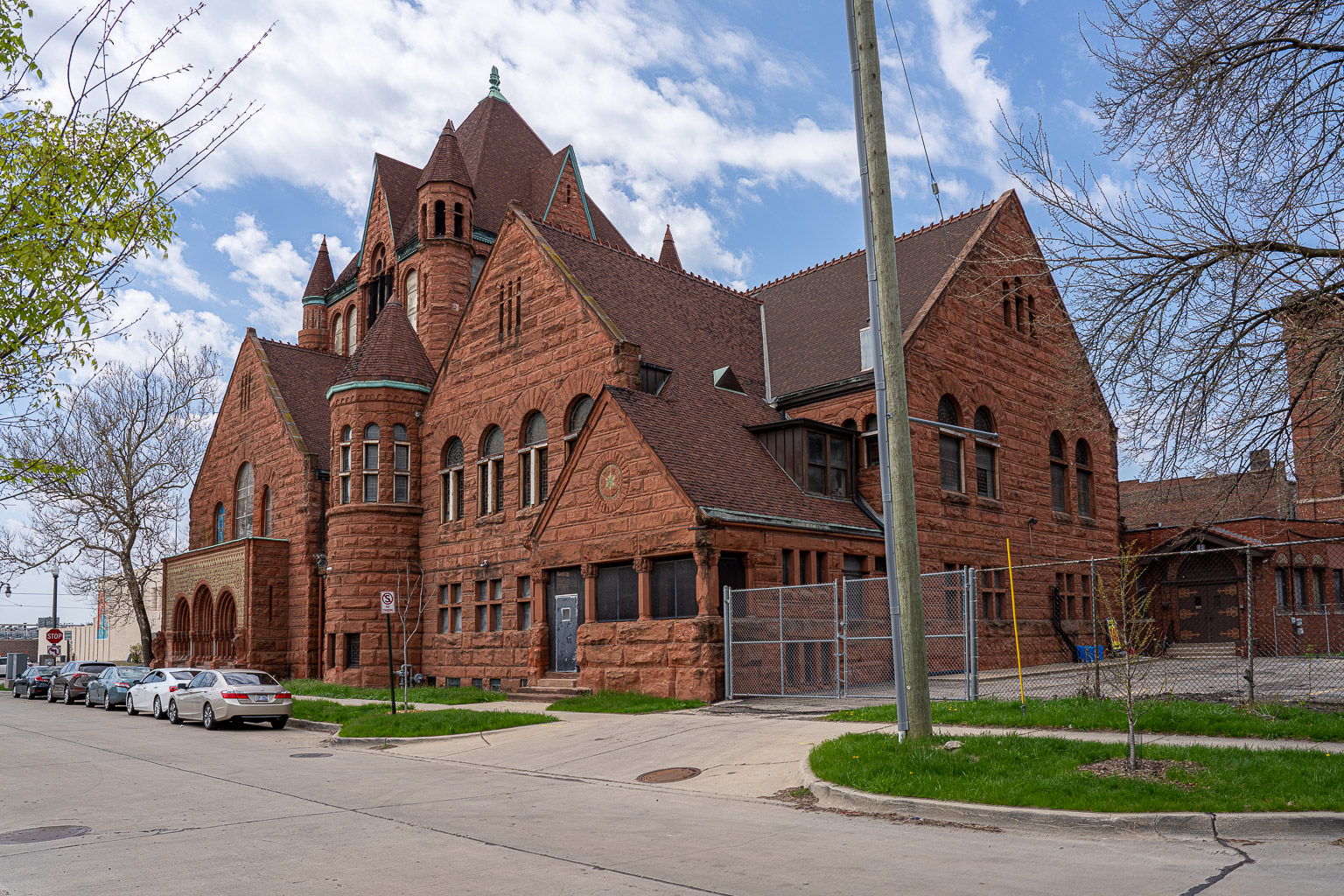
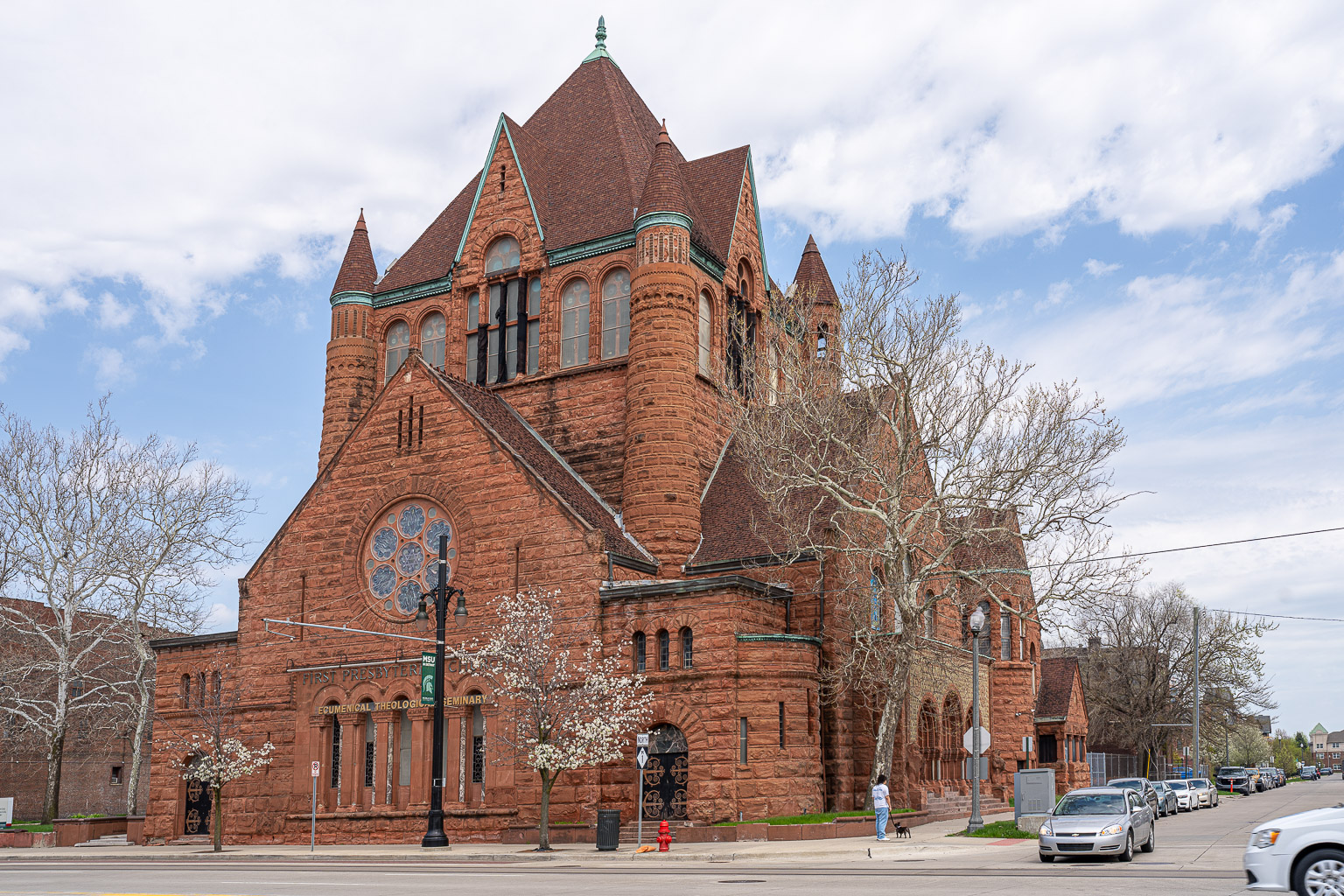
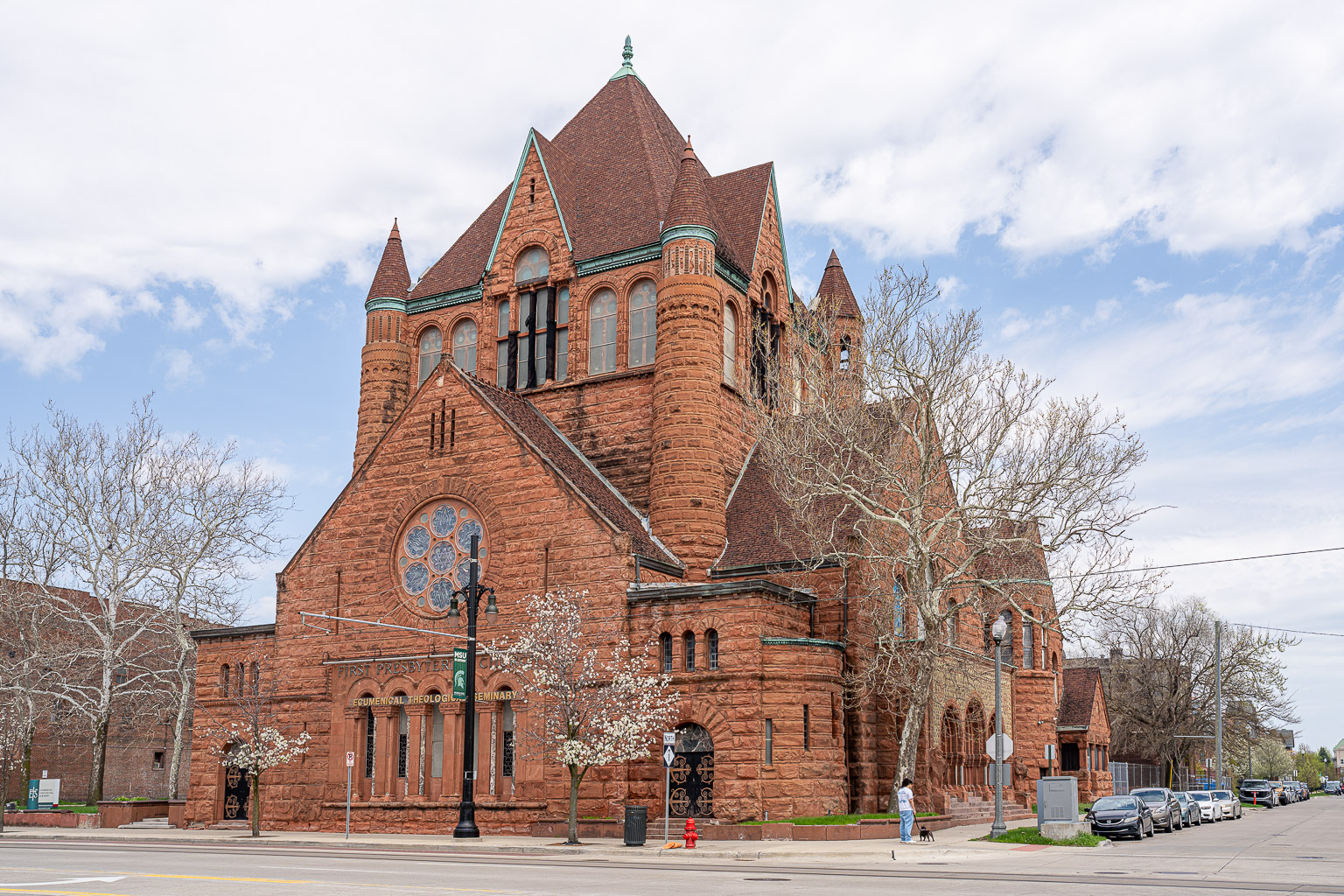
The outgrowth of Detroit's earliest Protestant congregation, the First Presbyterian Church moved to this site when the present church was completed. Mason, one of Detroit's most able architects, has used as his model for this church Trinity Church in Boston, designed by the great H. H. Richardson, and the "watershed" building for the Romanesque Revival of the late nineteenth century. Richardson made the tower the dominant feature of his Boston church; here Mason takes the concept a step further and the tower becomes the church. When Woodward Avenue was widened in the 1930's, it became necessary to alter the church; fortunately, the magnificent multi-color stone entrance portal was moved around the corner onto the Edmund Place side, and was thus preserved.
As of these 2026 photos, there is no answer at the doorbells, nor at the phone 313-831-5200 to request interior access to what was once a church, but here are my exterior photos:
The permit for this French Renaissance house was issued on May 7, 1894, though Hawkins Ferry's The Buildings of Detroit attributes the house to the year before, perhaps reflecting the time when the architects were drawing the plans. According to Ferry, the young Albert Kahn was responsible for the design; he was working for Mason & Rice at the time, and had completed a sketching tour of the chateaux of the Loire Valley two years before. Ferry has also suggested that Kahn may have been familiar with the C. A. Whittier house in Boston, a work of McKim, Mead and White of New York, which had received notice in architectural publications.
A rather formal composition of tower on the right, and flat facade with recessed entrance on the left, the house is built of red sandstone and brick, with a slate roof and copper gutters with decorative iron brackets. A large window embrasure on the east side is sheathed in decorative copper. The finely carved decoration in French Renaissance style was carved by Julius Melchers, Detroit's well-known sculptor.
A banker by profession, William Livingstone, was an influential figure in his lifelong interests of Great Lakes shipping, banking, politics and city improvement. After an education in both the academics and the machinist trade, he began work in the shipping industry on the Great Lakes in 1864. He rose in this industry to become president and general manager of the Michigan Navigation Company and the Percheron Steam Navigation Company Besides this official position, he was instrumental in the growth of the Lake Carriers Association, a group devoted to the improvement and expansion of lake transportation. Livingstone was also responsible for the construction of a canal for down-bound vessels in the lower Detroit River. Through his efforts, appropriations for its construction were approved by Congress in 1907, and the Livingstone Canal, as it was authorized by Congress to be named, was opened to commerce in 1912.
A well-known figure in banking circles, Livingstone was a founder and president of the Dime Savings Bank. He also served a president of both the Michigan Bankers Association and the American Bankers Association.
He was active in politics as a member of the Republican Party. In 1875, he was elected to the State Legislature, and served on many state committees in subsequent years. He was appointed as Collector of the Port at Detroit by President Chester A. Arthur. Livingstone's two volume book "History of the Republican Party" was published in 1900.
The improvement of the city was another of his major concerns. He promoted its beautification as president of the Detroit Park & Boulevard Commission; he was a member of the Detroit Board of Commerce and president of the Detroit Board of Trade.
After his death, the Livingstone Lighthouse on Belle Isle was named in his honor, as was a street located just a few blocks north of his house on Eliot.
The house was demolished in 2007.
Photos and more description of this building can be found at Wikipedia.
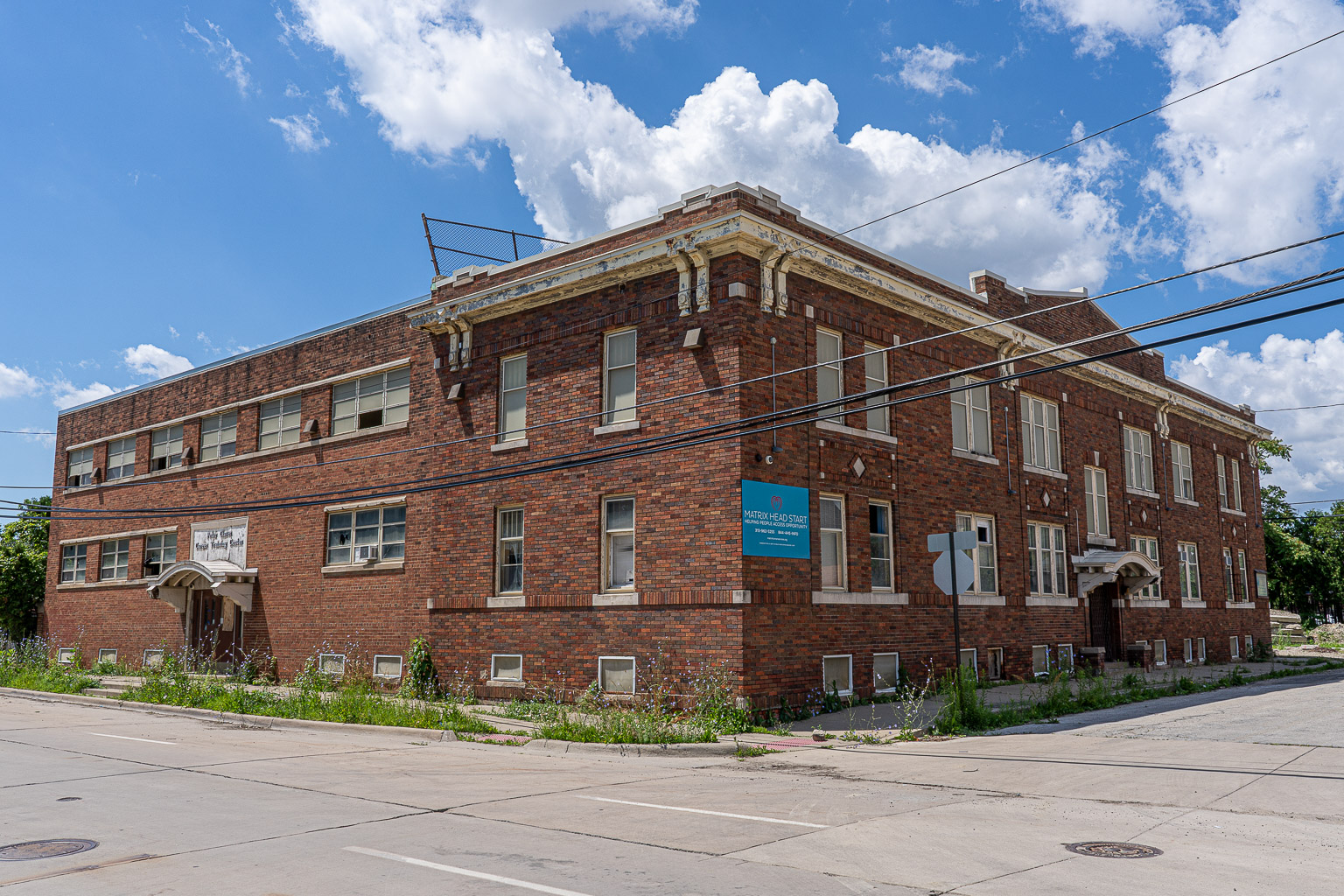
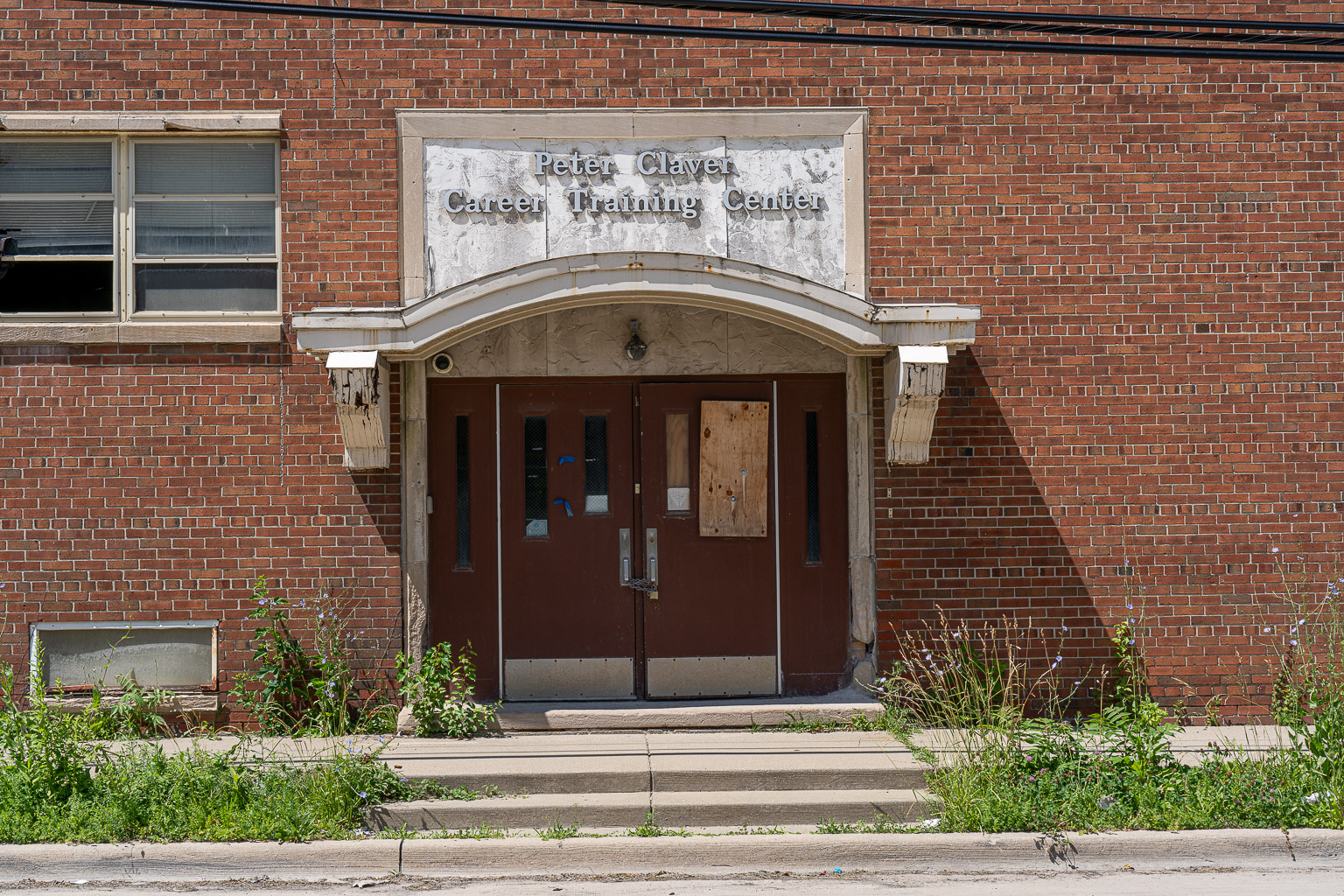
This simple brick Gothic Revival church was built in 1897 by a mason, George D. Duncan, for St. Mary's Episcopal Church. Sold in 1914 the building became St. Peter Claver, the first Roman Catholic parish founded expressly to serve blacks. For many years, Sacred Heart Parish to the east across the Chrysler Freeway has served the liturgical functions St. Peter Claver was founded to provide, and the old church at the northwest corner of Beaubien and Eliot has served, together with a building across Eliot, as part of St. Peter Claver Community Center. Though now used as a gymnasium, the building is generally unaltered externally. The once-church, now (unsure whether it still is) a gymnasium is shown in the first two photos below, and the Community Center is shown in the last two photos below.
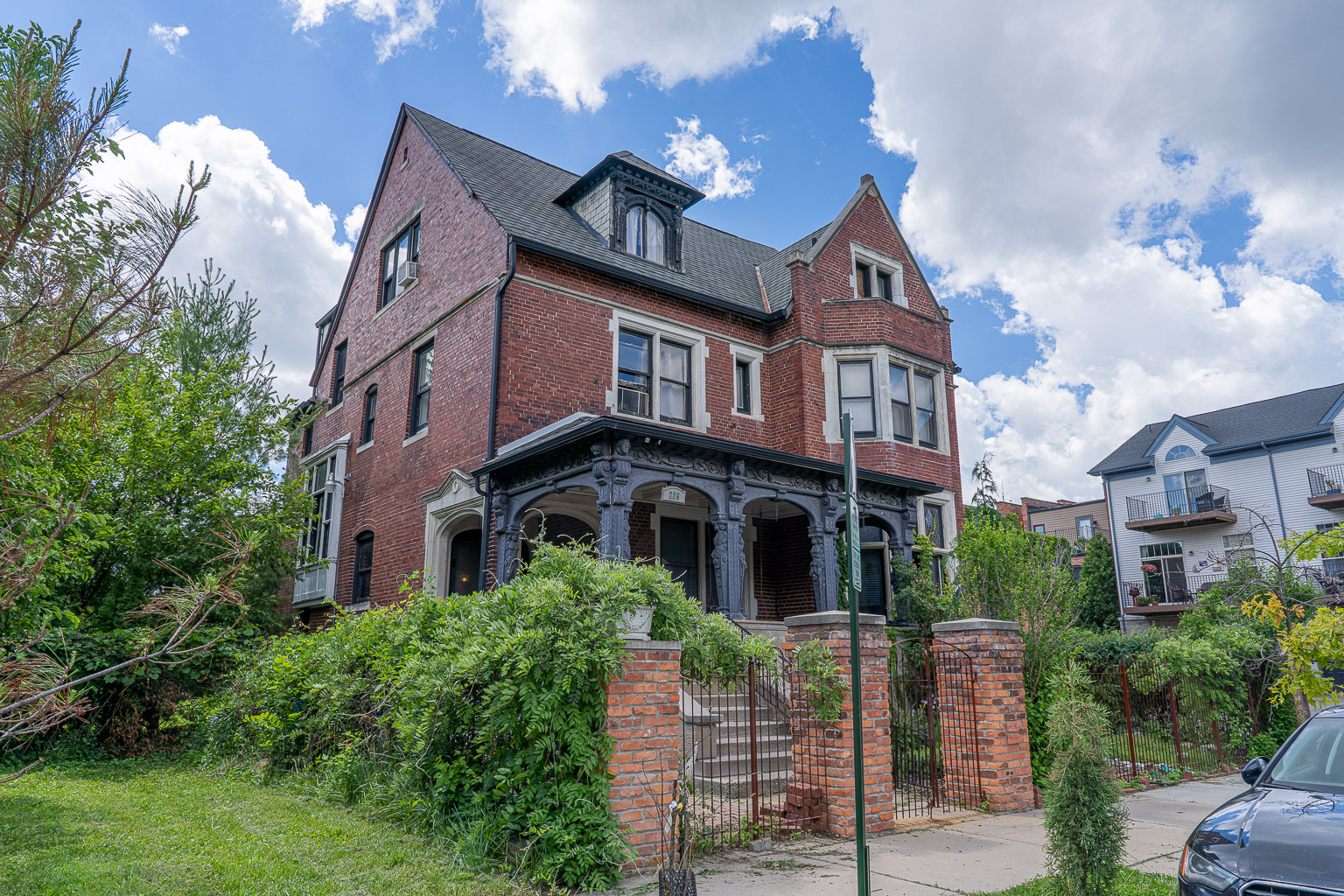
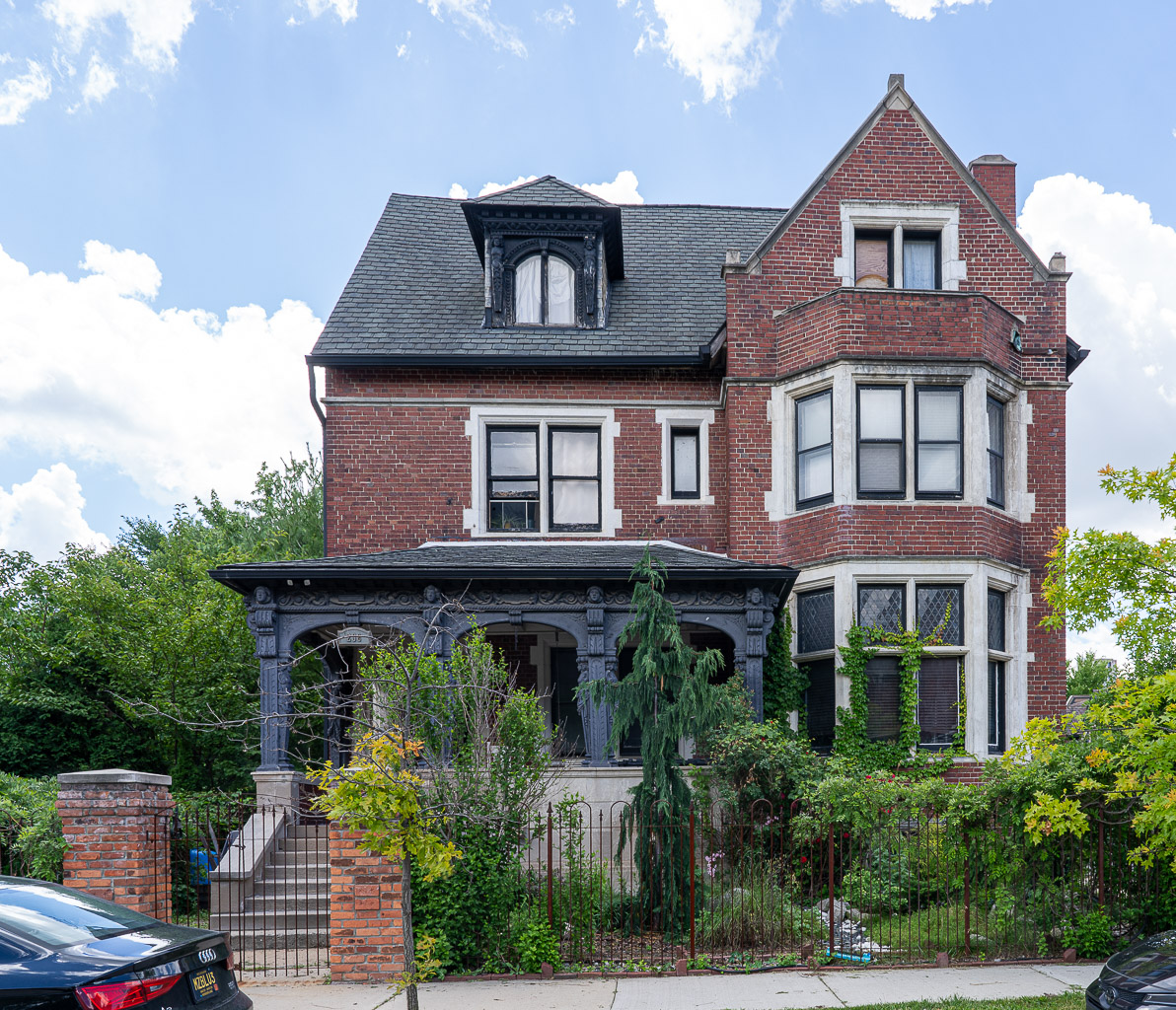
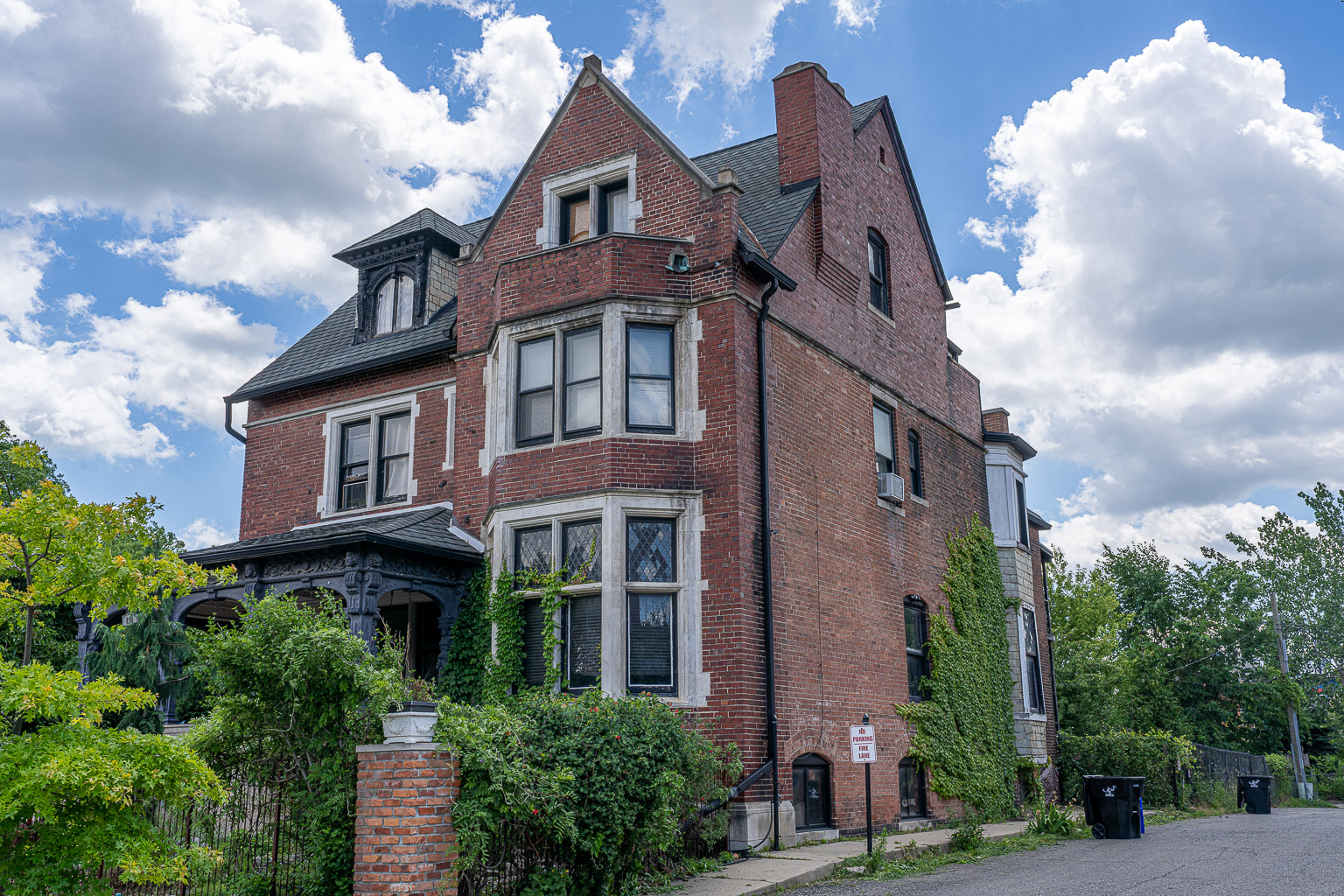
This early work in the independent career of Albert Kahn is suggestive of a turning point in his development. The house is designed after English Renaissance precedents, a style which occurs frequently in his work of this period. Externally, however, the house still harks back to the late Victorian period in the arrangement of its elements; compare this house with the Livingstone house designed while Kahn was with Mason & Rice. The entrance is similarly recessed on the left in both houses; the tower of the Livingstone house is echoed by a two story bay on the left of the Ginsburg house. Internally, the house differs from the Livingstone house somewhat, but has similarly arranged double parlors across the front. The red brick and stone structure of the house is relatively simple; interest is centered in the extraordinary carved front porch, with its caryatid figures enframed in carved oak.
The building of this house for Bernard Ginsburg, a junk dealer who later became vice-president and general manager of the Detroit Auto Specialty Company, reflects not only the increasing Jewish population of the neighborhood at the end of the century, but also the wealth being accumulated from the fledgling auto industry.
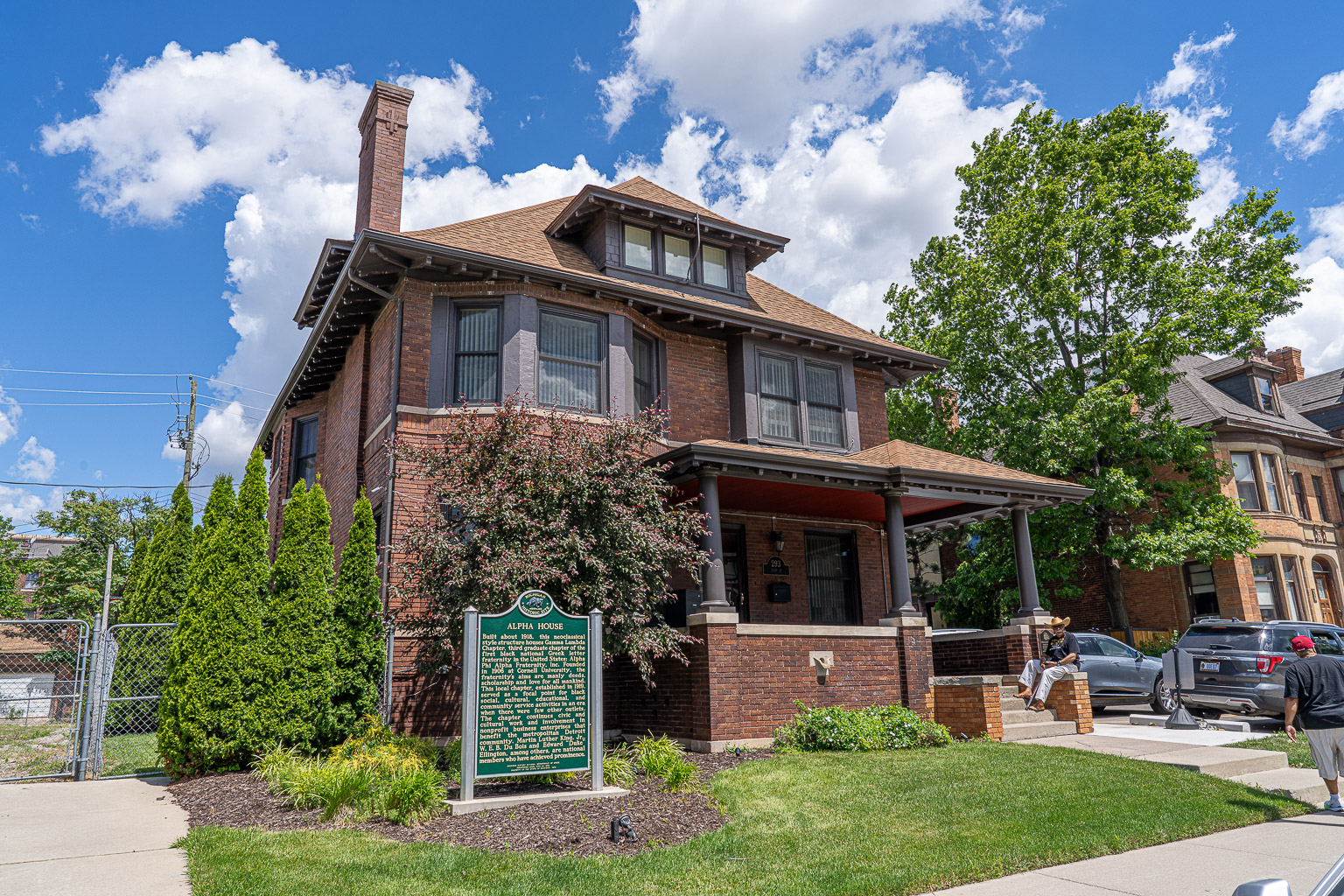
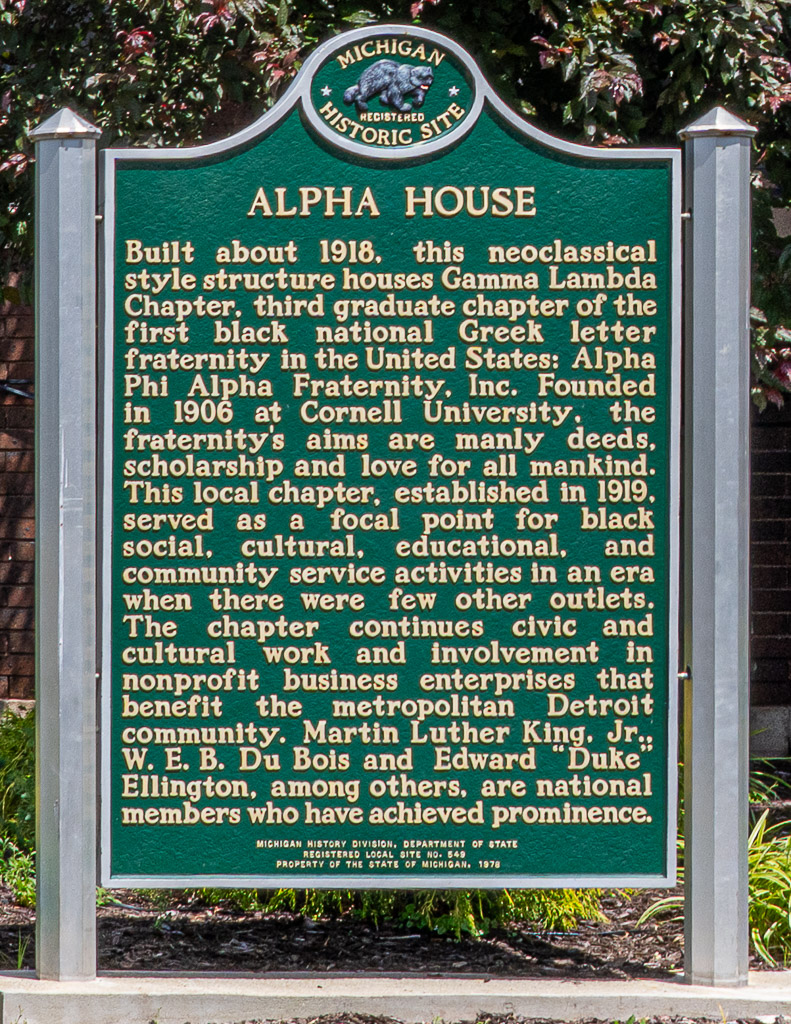
Alpha House at 293 Eliot is not mentioned in the Brush Park Local Historic District Final Report, but I'm including it here since it looks like pretty cool neoclassical-style home built in 1918.
Not much is know about M. A. Edwards, a Detroit architect whose buildings appear rather infrequently in the building permit files. He appears to have practiced from his home much of the time, and it may be that most of his career was spent in larger offices.
This house on Eliot, built for Clifford Elliot, a wholesale grocery executive, represents well the interest in nineteenth century, and the coming of new forms in architecture which characterize much of this northern portion of the proposed Brush Park district.
Built of a hard-baked glazed golden brick which was an innovation of the late nineteenth century, the house suggests Holland, Flanders, or northern Germany in the stepped and curved gable which surmount the window bay on the right hand side of the facade. Balanced on the right by a two-story curved bay window, this facade, as with other designs in this area, suggest the transitional period when Victorian design was giving way to what we might call "Edwardian" for lack of a better term. One suspects that the interior, however, decorated, is still laid out in a Victorian manner, and that this layout is reflected in the forward-reaching rectangular bay and the curved bay, with the entrance in the central recess thus created.
The house has been vacant and boarded for some time; recent reports indicate that it has been purchased for rehabilitation by a private party.
This building is one of the earliest apartments in the area, and apparently was a fairly substantial place to live, for the building permit lists six apartments in this large three-story structure. The appearance of apartment buildings, however grand, was surely a signal of change in the Brush Park subdivisions, since originally only substantial houses were permitted. The site apparently remained vacant during the area's heyday, and was sold by the Brush family to Frederick D. Standish, a businessman who lived on the same block, for $5,000 on July 30, 1901. The building is of brick, but the street facade is of rusticated Casota limestone in a castellated style popular at the time. No doubt the substantial and impressive facade of the building made it a very acceptable neighbor amongst the large houses that surrounded it. It was destroyed by a fire in 2010.
Photos and more description of this building can be found at this Facebook post.
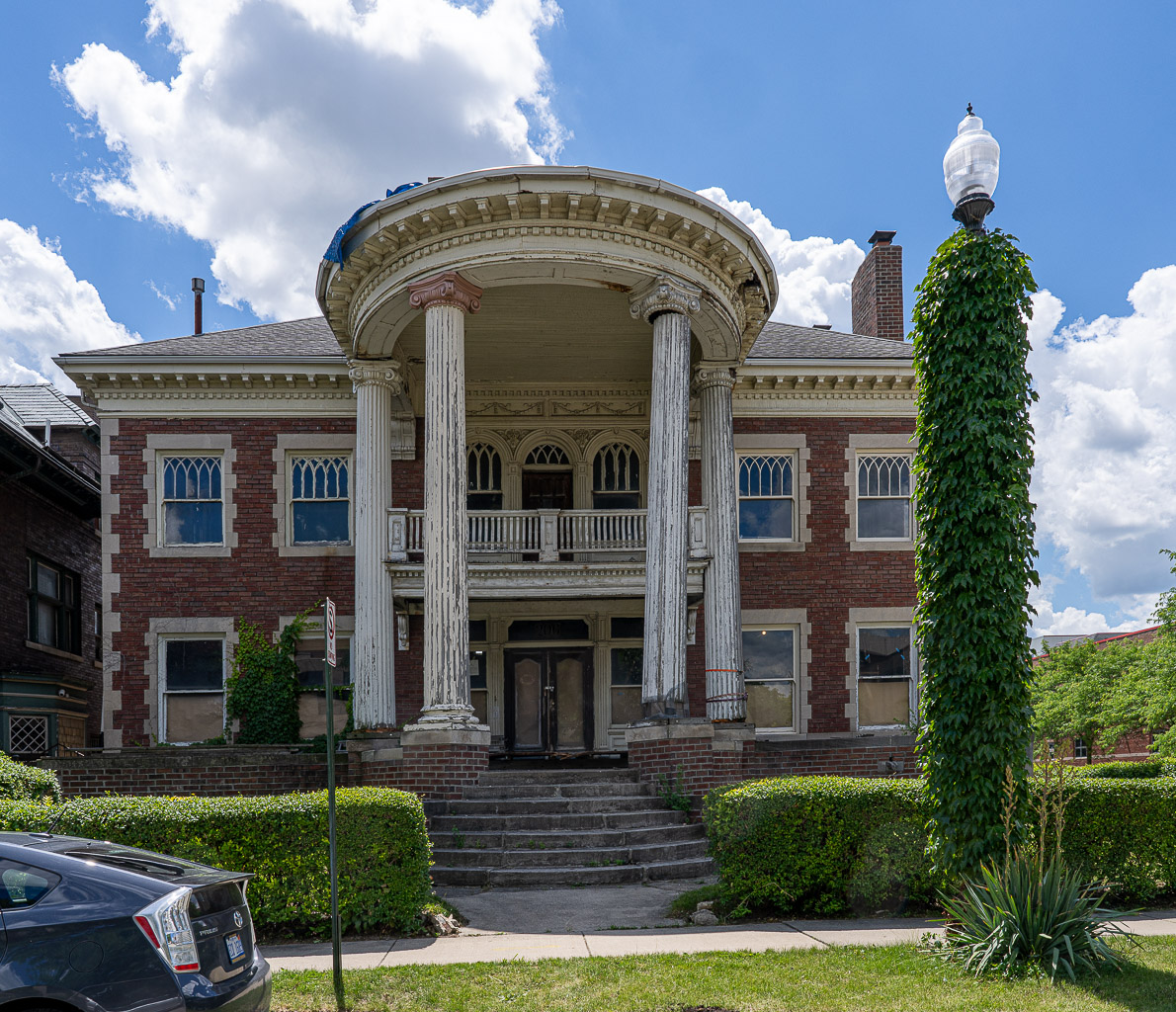
The permit for this house was issued on October 25, 1901, to J. F. Weber & Company, a lumber and millwork firm. Apparently the company built the house for the president of the firm, Mr. Joseph F. Weber. Since the company took out the permit the architect's name was not listed, but the Colonial Revival character of the house is suggestive of such firms as Rogers & McFarlane, who were already active in the Indian Village and Boston-Edison areas designing houses of colonial derivation.
The Centennial of the Declaration of Independance in 1876, and the Philadelphit Centennial Exposition which celebrated that anniversary, began a new interest in art circles in the work of American artisans of the eighteenth and early nineteenth centuries. The styles were indiscriminately called "colonial" though much of the inspiration was found in buildingsand objects created as much as fifty years or more after the Revolution. Beginning especially in New England, the "Colonial Revival" as it is now called, applied decorative detail of the earlier period to houses not essentially different in form and structure from the Victorian buildings which were still being built alongside the new style. Moving west, the colonial reached Detroit in the 1890's, and transformed itself into the Neo-Georgian, a style more accurately derived from the precedents.
The Weber house is characteristic of the Colonial Revival of the turn of the century. Built of red brick with stone trim, the facade is perfectly symmetrical. The two-story semi-circular portico which dominated the composition clearly was inspired by such examples as the White House, which is an early nineteenth century building; yet the rest of the facade with its quoins and window surrounds seems to hark back into the eighteenth century. The actual period of the house is firmly proclaimed by the brick, a dark red brick burned at high temperature to form a hard surfaced block; such brick did not exist before the latter part of the nineteenth century.
The house is presently vacant and boarded up.
One of the most beautiful houses of worship in Detroit, this building, originally Temple Beth El, was converted in the 1930's to house a theatre, now part of Wayne State University's theatre arts program. The building derives in form from Roman classical precedent -- notably the Pantheon with its portico and dome - but the treatment of the entrance bays derives from the very different classicism of eighteenth century France. The building lost its forecourt when Woodward was widened in the 1930's, and conversion to a theatre brought with it the enclosure of the elegant facade in an "Art Moderne" shell of no particular distinction. Apparently Kahn's beautiful carved stonework still survives within that shell. The interior has been very extensively altered for theatre use.
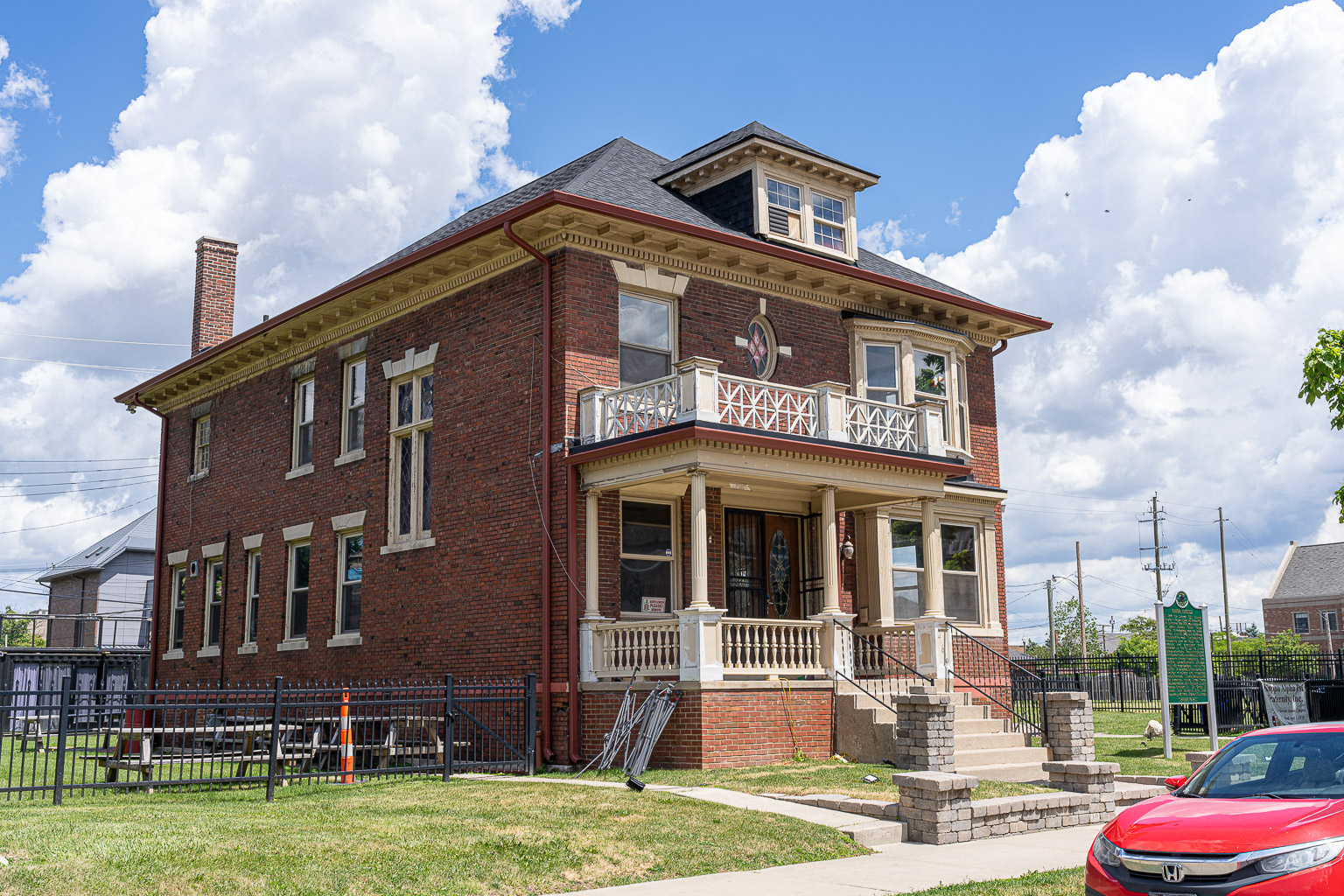
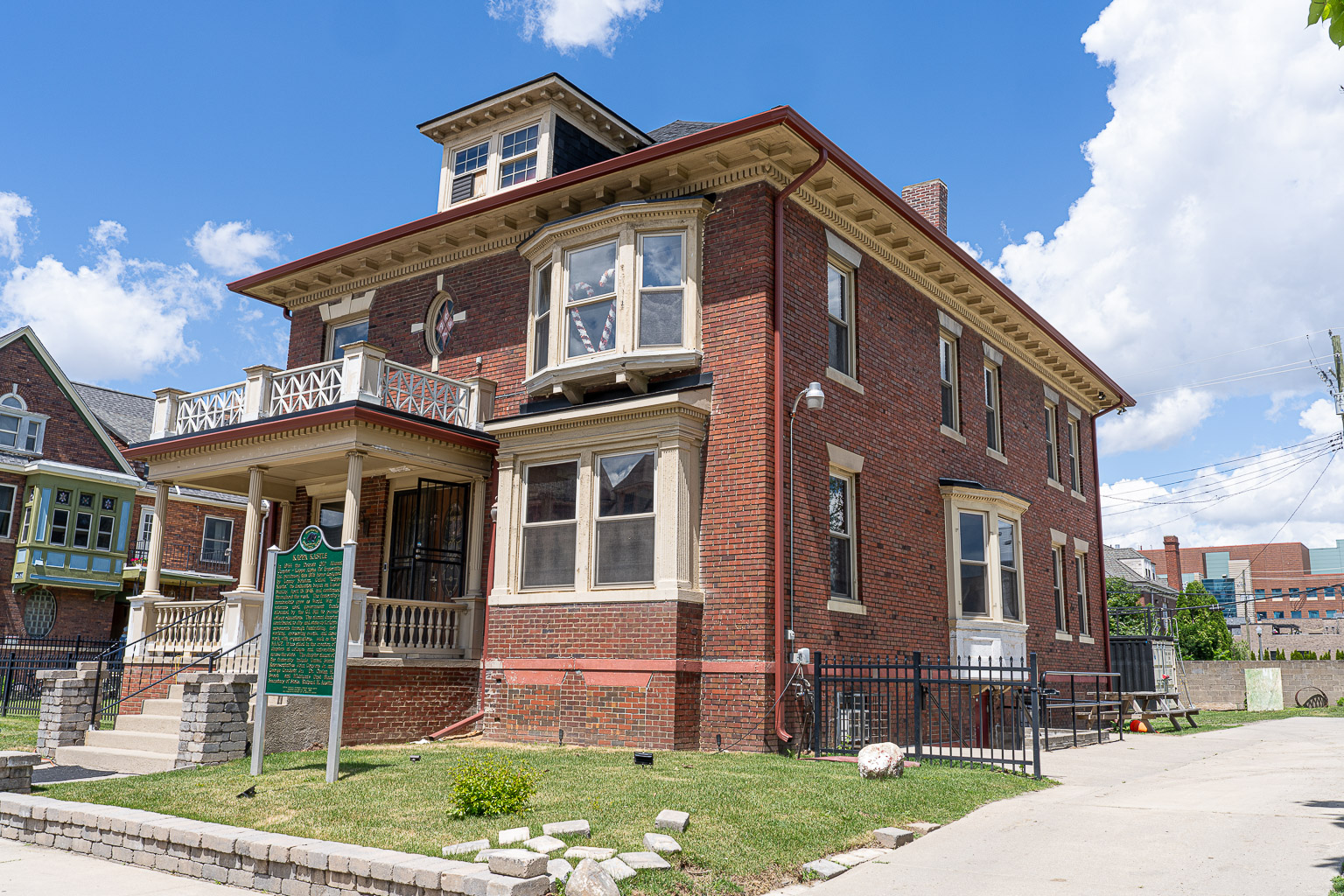
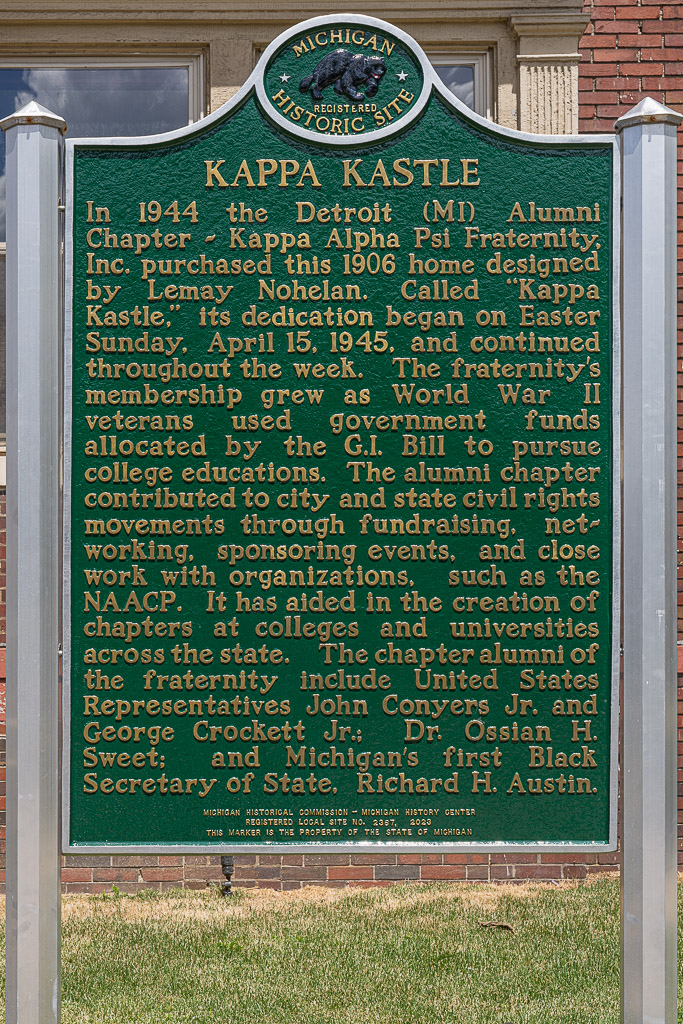
Kappa Kastle, at 269 Erskine, is not mentioned in the Brush Park Local Historic District Final Report, but this 1906 home turned Fraternity House is certainly a historic building.
See more at HistoricDetroit.org.
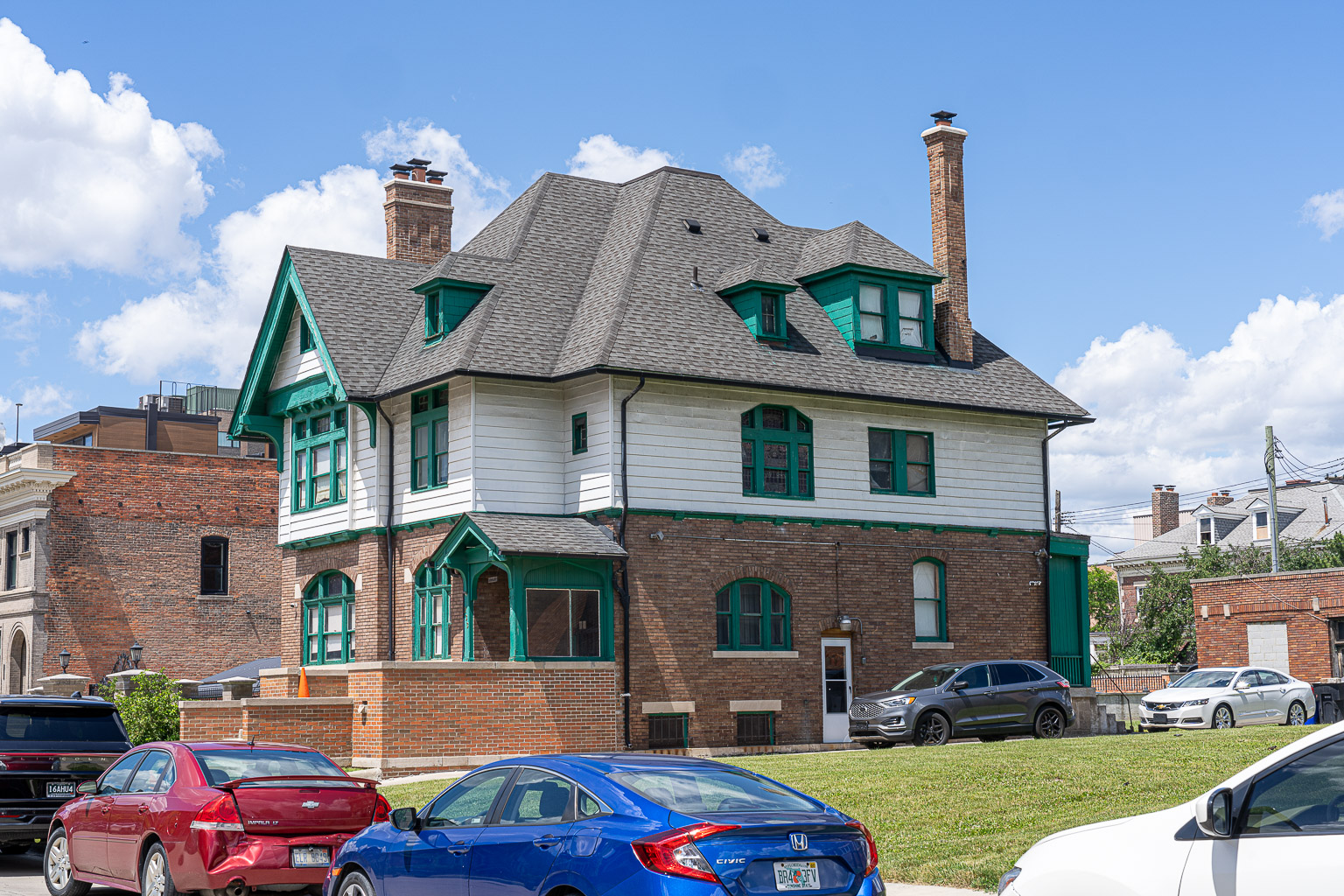
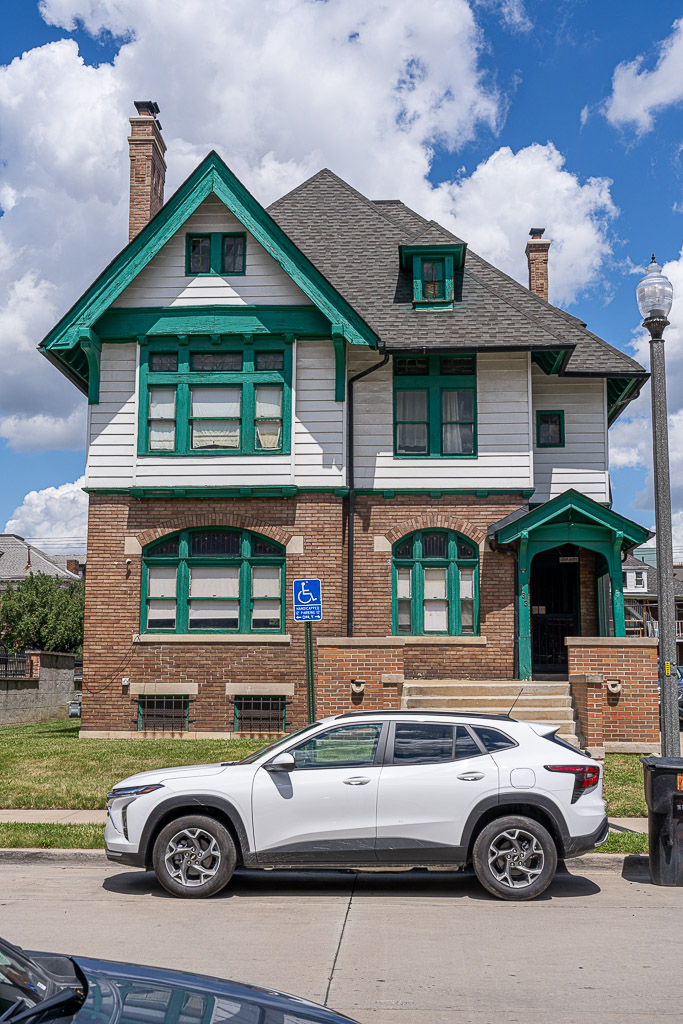
The Detroit firm of Mueller & Mildner took out the permit for this residence on July 20, 1905. A stylistic amalgamation, the house reflects strongly the transitional character of many houses of the Edwardian period -- part Victorian, and part twentieth century. Tall and vertical in feeling, the house is an assemblage of shapes very characteristic of the freedom with which Victorian architects could envelope a floor plan freely designed without regard for the exterior. The arched windows of the first floor front reflect, too, the work of the 1890's. Yet the house, overall, is clearly twentieth century; elements from the cottage style in England and the associated interest in medieval domestic architecture transform what appears to be a Victorian core into a house of our century. The upper story has been covered with aluminum siding; while not ideal visually, this alteration continues the designer's intent that the second floor be of a different material from the first floor brick.
The house was built for Max Broock, a real estate and insurance broker with offices in the Breitmeyer (Tobin) building. Interestingly, Broock moved closer to downtown when his house was completed; he had previously lived on Garfield.
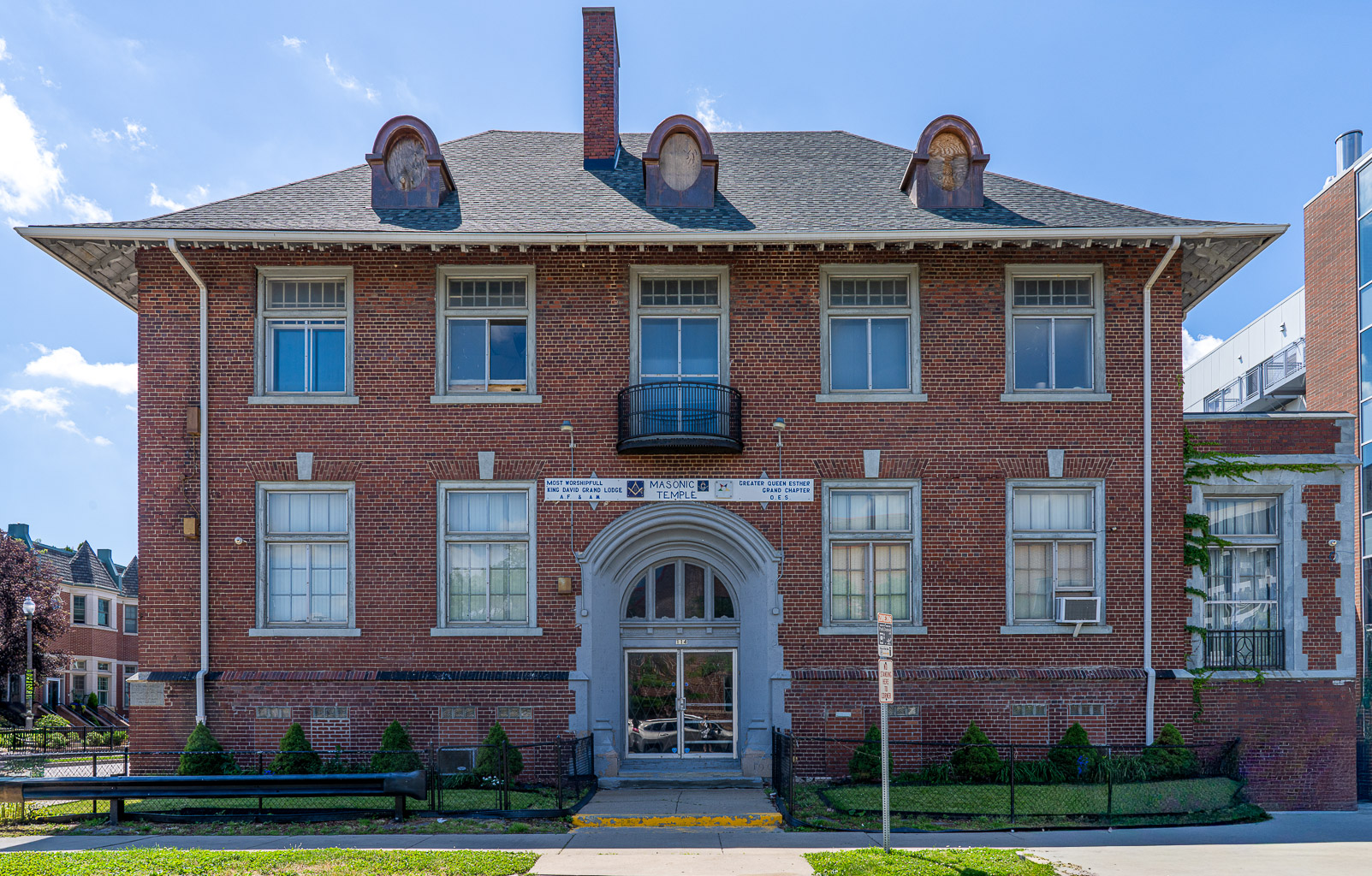
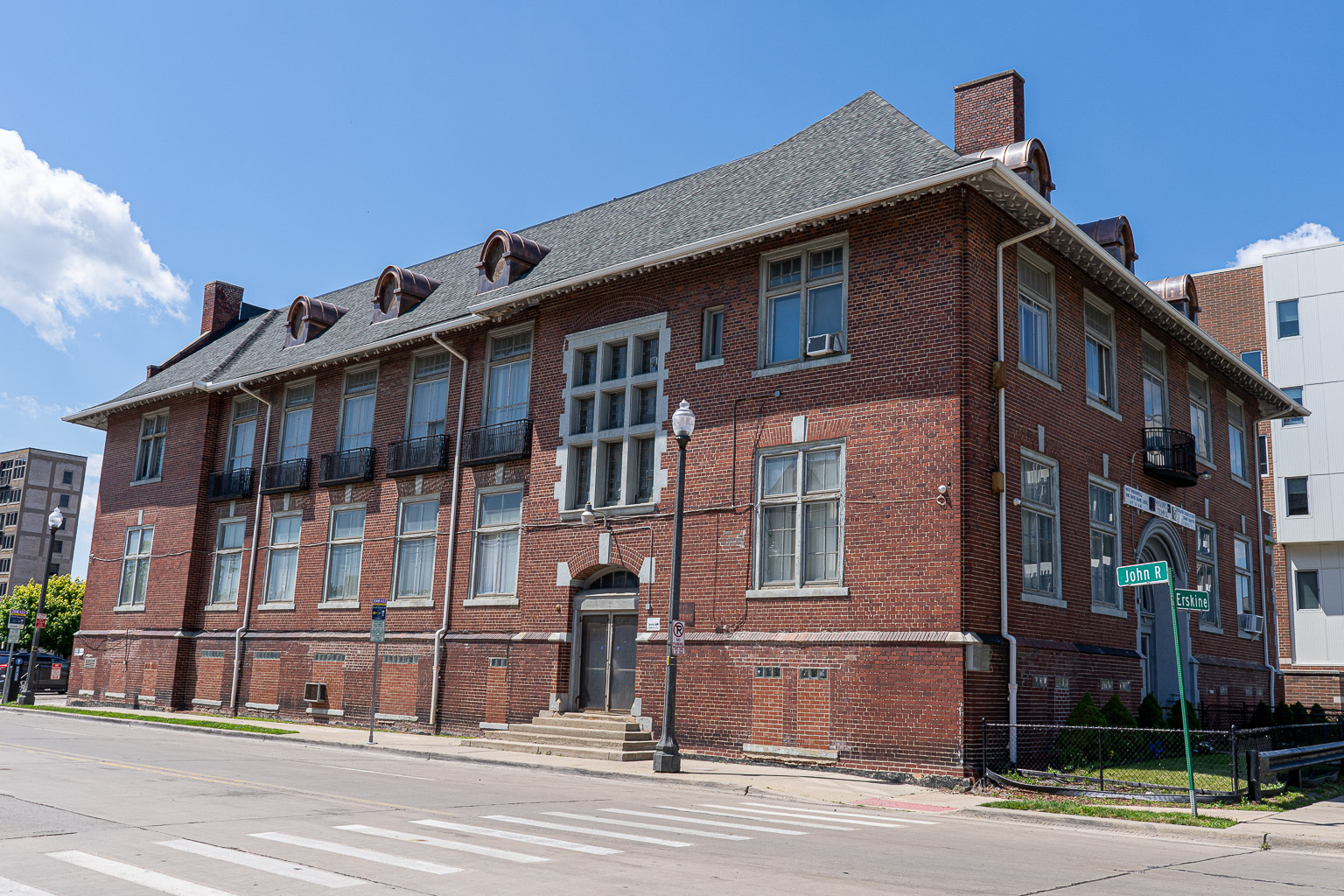
King David Grand Lodge is not mentioned in the Brush Park Local Historic District Final Report, but here are my photos of this Masonic Temple. It was designed by Albert Kahn and built in 1905 in the Renaissance Revival style as a home for the Phoenix club, an exclusive social club for affluent residents of the neighborhood. It was taken over by the Masons in 1963.
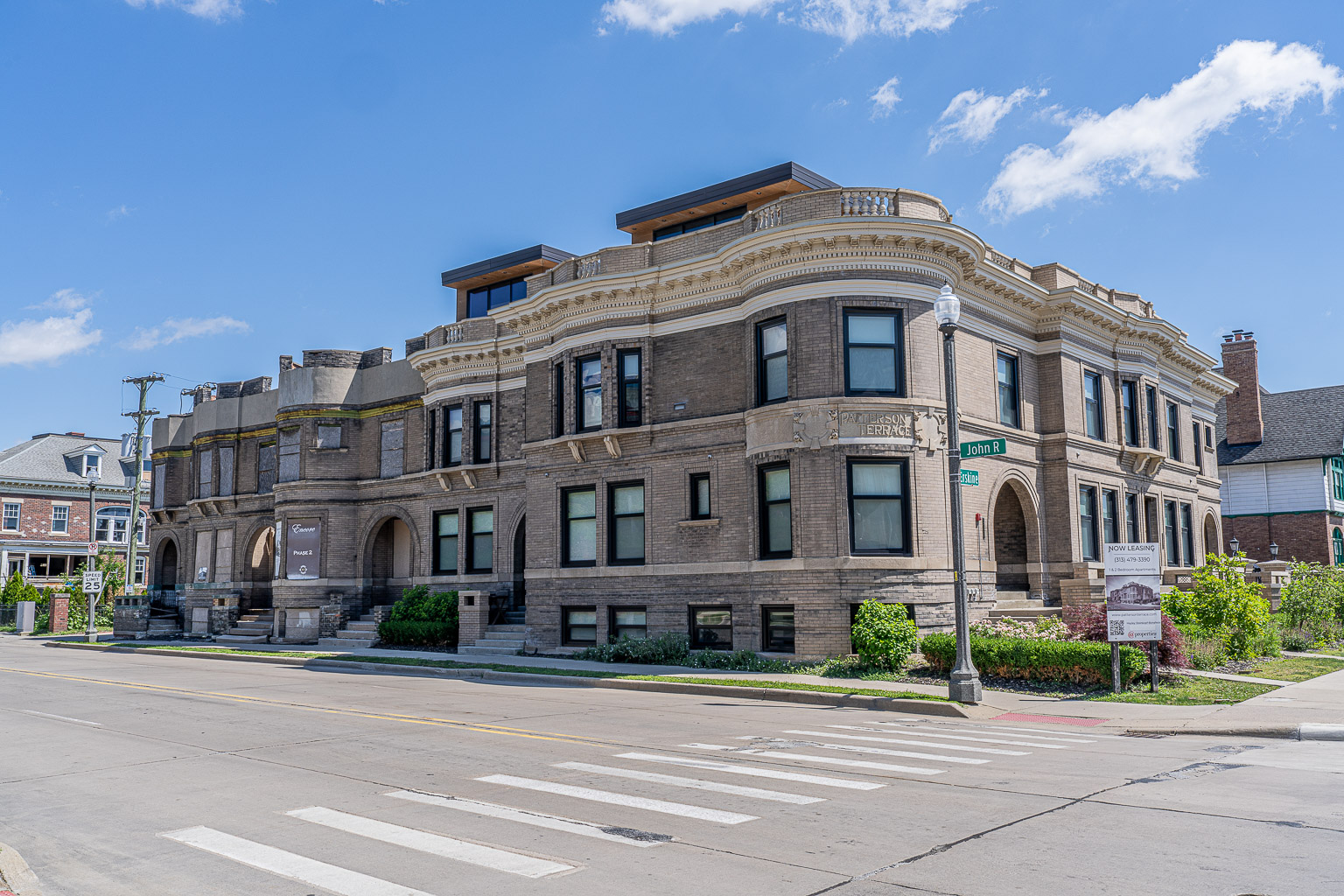
Patterson Terrace was built in 1905 as seven distinct attached townhouses that shared a rear courtyard. During the late 20th century decline of Brush Park the building was vacated and suffered major damage from fires, and it was an abandoned, roofless ruin. It was restored from 2012-2022 and turned into nine luxury apartments while preserving the historic brick exterior.
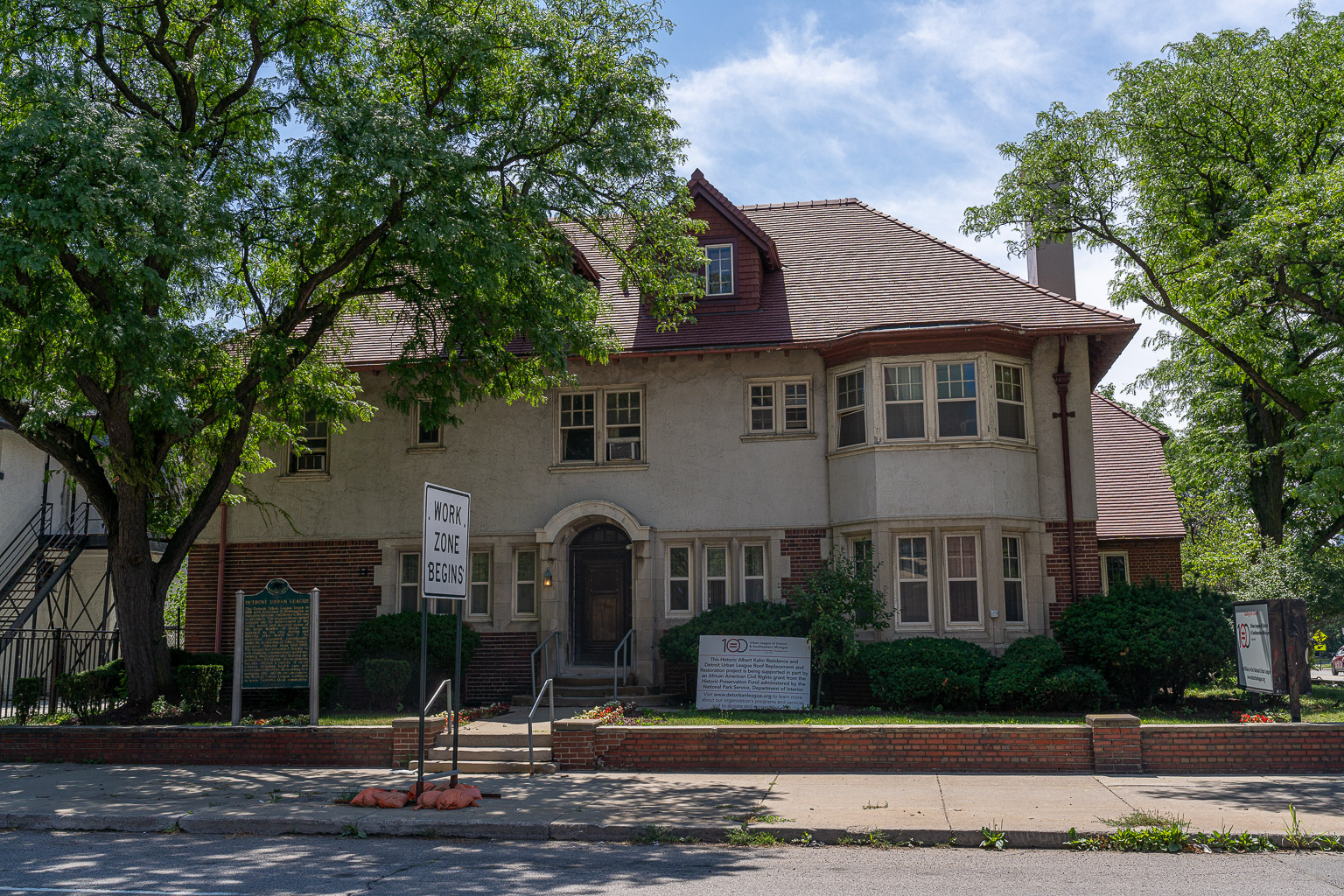
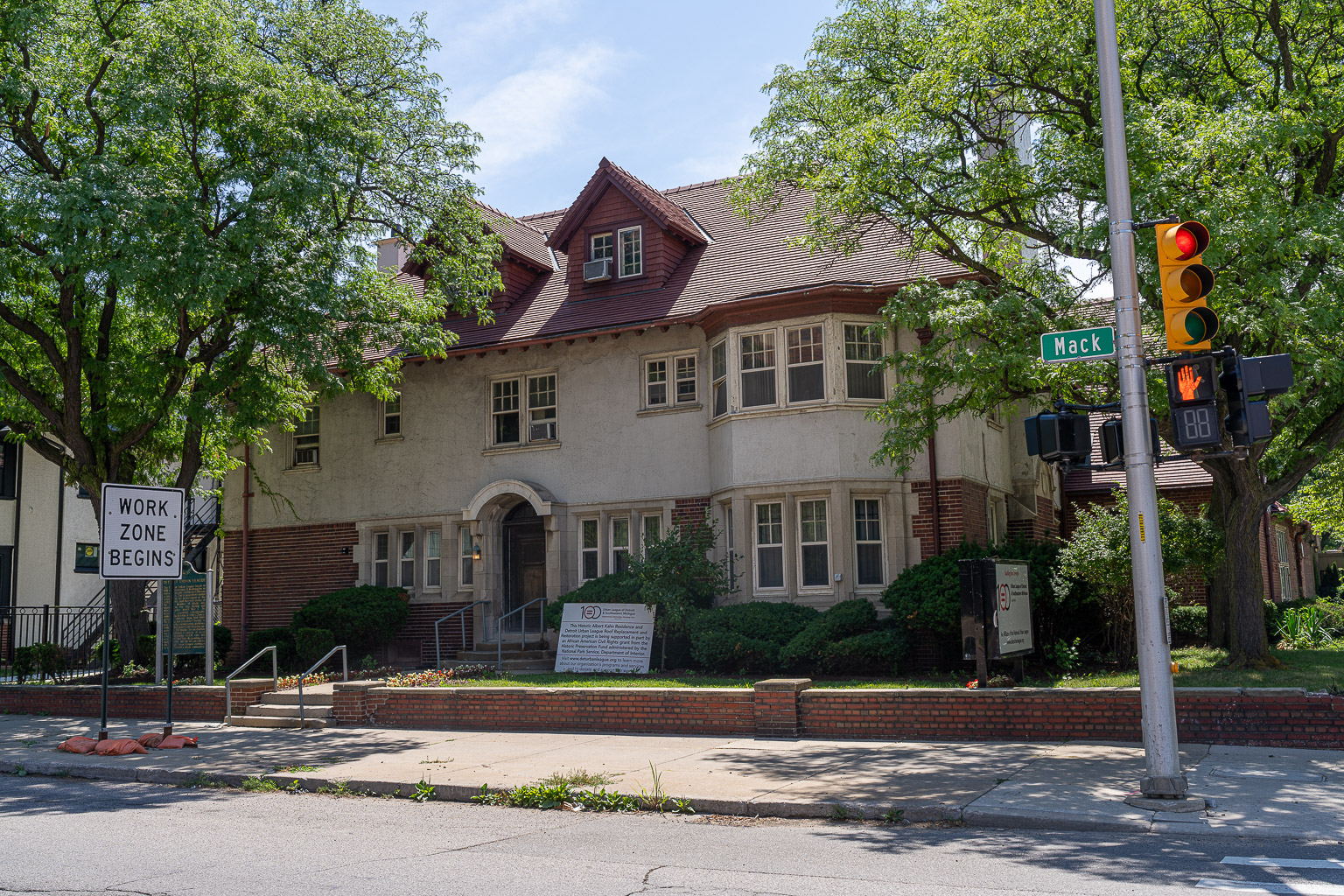
Now occupied by the Detroit Urban League, this house was built by Detroit's most famous architect for himself in 1906, when his reputation was newly-established. The house clearly derives from English precedents of the late nineteenth century, in work by such architects as Voysey and Webb. Taking as a departure point medieval and Elizabethan precedent, these Englishmen created a style sometimes called the "Cottage Style" which was a then-startling departure from the standard elaborate residences of the late nineteenth century. Modern in spirit, these houses dispensed with elaborate and often cheap detail, and allowed simplicity and good workmanship to speak for themselves. Much of the decorative impulse in these buildings derived from the influence of William Morris, the leader of the English handcrafts movement, whose talent and influence are sometimes demeaned by the public's awareness of only the "Morris Chair." Kahn saw in the work of these Englishmen an opportunity to design comfortable and beautiful housing without the excesses of an era that shifted styles in building as easily as styles in hats. His own house, with a later wing added to the rear, is an excellent example. Cranbrook House, built later for the Booth family, is a larger, more luxurious, and much larger example.
The LaSalle Hotel, as it was originally named, but known most commonly as Carmel Hall, gained national prominence in 1930 as the scene of the still unsolved gangland murder of Jerry Buckley. Buckley was a famous expose radio broadcaster who had.exerted powerful influence over public opinion. There were hundreds of Buckley fan clubs throughout the city. Not so popular was the mayor, Charles Bowles, who faced a re-call election in 1930. On the eve of the recall, Bowles and his inept police force were denounced over the air by Buckley; on the night of the election, July 22, Buckley announced the successful recall of the mayor. Later that evening, Buckley went to meet a tipster in the lobby of the LaSalle Hotel. As he waited there, he was shot and killed by three men. There was little effort, of course, exerted by the police to find the men and the crime remains unsolved today. The building has had a number of name changes, perhaps due in part to this incident. It is presently known as The Detroiter Residence.
The building was built by the Savoy Hotel Company of New York, and cost about 1} million. There are eleven stories visable, although there is apparently a twelfth floor, likely for mechanical equipment. That height makes this the tallest building in the proposed historic district. The material is cream brick and stone trim; the first floor facades and the cornice have been altered. The design is a simple arrangement of windows placed against a plain brick wall; the first two floors are treated with glass in metal frames; this has been partially altered by the application of artificial stone. The cornice is now sheet metal, plainer than the original, and of a silver color.
When I visited in 2026, this is new-build condos.
This two story frame house is an early example of the Italianate style, with an added front porch hiding some of the detail of the first floor bay window. Too old to be dated from the Detroit Building Permits, the house likely dates from about the time of the Civil War. Typical of a middle-class dwelling of the time, it is distinguished by its vertical board-and-batten siding, a rare survival. Tending to be overshadowed by its more elaborate and luxurious neighbors to the west, it remains a valuable example of the type of house which would likely have been occupied by a relatively prosperous workingman.
When I visited in 2026, this is part of the Brewster-Douglass neighborhood, which has been levelled and is being rebuilt.