Croul-Palms House Local Historic District
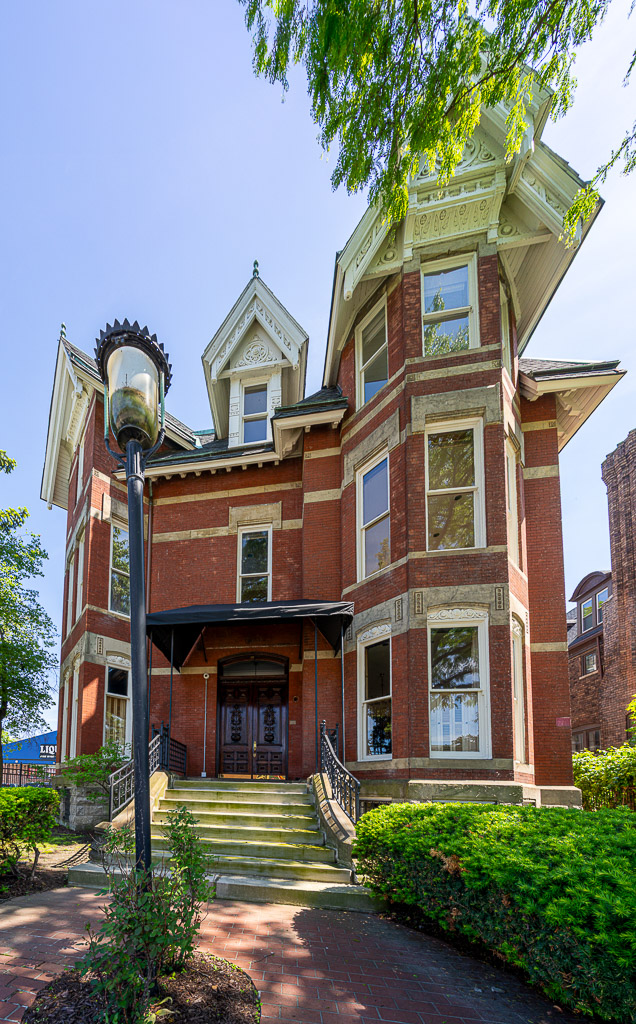
The Croul-Palms House Historic District consists of one building at 1394 East Jefferson Avenue. The Croul-Palms House, one and one-half blocks east of the Chrysler Freeway, is the eastern-most of three extant nineteenth century residences between Rivard and Riopelle Streets on the south side of E. Jefferson Avenue. It was designed in 1881 by the architect William Scott. You can read details about the Croul-Palms House Local Historic District in the Croul-Palms House Local Historic District Final Report (local copy), which I recommend highly to anyone interested in Detroit's history.
HISTORY: [+ expand]
A permit issued April 28, 1881 to Jerome Croul notes the construction of this substantial Victorian residence (permit#263, City of Detroit). The Croul House is the most spectacular Queen Anne style house remaining on Jefferson Avenue. Its irregular massing, contrasting surface materials, and picturesque rooflines, all characteristic of the Queen Anne style, were handled with polish and fluency by the architect, William Scott. The Croul House cost an estimated $25,000 when built. Scott also built a two-story brick barn to the rear of the house in 1882 (permit #1165, October 28, 1882) costing $3,000.
The architect, William Scott, was active both as an architect and a civil engineer. Active in railroad engineering, he also designed a number of other buildings in Detroit, including the Detroit Stove Works (demolished), and the Sprague House at 80 W. Palmer. William Scott's sons, John and Arthur, were also in the architectural profession, and were best known for the design of the Wayne County Building.
Jerome Croul was born at Lyon, New York in 1829. When he became of age, he went to Rochester, New York to learn the machinist's trade. After clerking for two years for a wool dealer he came to Detroit at age 20 with J. E. Parsons of Rochester, and they began the firm of Parsons and Croul, woolens and sheepskins. Croul, who had taken Parsons' daughter as his wife, and his brother William continued the business as Croul Brothers after Parsons died five years later. Croul Brothers added leather tanning to their skills, and set up a large tannery at the junction of the Rouge River and the Detroit River. In 1869 they erected a large four story building at the corner of Bates and Atwater Streets for the manufacture of leather belting. Jerome Croul acted as president of the Croul Brothers Leather Company, later the Detroit Oak Belting Company.
Croul was one of the organizers of the Detroit Light Guard in 1855; Gov. Blair appointed him a member of staff and gave him the rank of Colonel. But his dearest hobby was the fire department, of which he was fire commissioner from 1872-88 and president from 1895-1897. "He made a practice of attending fires, and was often seen downtown with his trousers tucked into a pair of rubber boots. This gave him quite a professional appearance. The general verdict is that Detroit has never had a better or more enthusiastic fire commissioner than Jerome Croul." (Volume 18B SB/Palmer) Jerome Croul died in 1899 at the age of 70.
The Croul-Palms House is better known for its second owner, Francis F. Palms. Jerome Croul sold the house at 1394 E. Jefferson to Celimene Palms in 1887. She resided there with her husband, Francis F. Palms (1838-1905) until her death in 1888. She was the second wife of Francis F. Palms, and left him seven children.
Francis Palms, the father of Francis F., had been an important figure in the expansion of Detroit during the last half of the nineteenth century. He came from Antwerp with his parents in 1833 and took up residence in Detroit. Francis Palms was in the wholesale grocery business with the firm of Franklin Moore and Company and later became a partner in the reorganized firm. Upon his retirement he began buying and selling outstate lands, primarily pine lands, becoming the largest landowner in the northwest. In the 18S0s, shortly before his death in 1886, he invested in Detroit property, primarily constructing large business blocks. Though Francis Palms listed his profession as "real estate," his business more likely corresponded to what we could call a "developer" today.
In 1880 Francis F. Palms came to Dotroit from New Orleans, where he had been since his mother, Martha Burnett, died when he was a child. He returned to Detroit to help in his father's business affairs. Francis Palms' only other child, by his second wife Catherine D. Campau (daughter of Joseph Campau) was Clotilde Palms, who became the wife of Dr. James Burgess Book. As one can imagine, Francis Palms left quite a sizable estate to be managed. After his father's death, Francis F. Palms stayed on to manage the estate, the value of which was estimated at $7,000,000.
Francis F. Palms had married three times, all ladies of old Louisiana families. He died in 1905 in New Orleans of pneumonia. The family had been members of S.S. Peter and Paul's Jesuit Church at Jefferson and St. Antoine. F.F. Palms was buried in the Palms mousoleum at Mt. Elliott cemetery.
His third wife, Marie Aimee Palms (nee Martin) continued to live at the Croul-Palms House after her husband's death in 1905. In 1914, when Mrs. Palms moved out of the house, it was converted to a boarding house. It was divided into 25 sleeping rooms and three apartments; in 1954-55 the brick garage, possibly the original carriage house, was demolished and the interior converted to eight apartments and 12 sleeping rooms. The Palms family, in the name of Palms Realty Company, had an owner interest in the building until 1945.
While the Croul-Palms House was not by any means one of the most pretentious on Jefferson, it remains today as the last of the large mansions of the 1870's and 1880's. Once it faced across the street to such structures as the Newberry House, one of the most magnificent Victorian houses in America. The urban renewal of the early 1960's removed the Victorian houses from the north side of Jefferson, and left the Croul-Palms house as the singular reminder of the posh days of its era on Jefferson
PHYSICAL DESCRIPTION: William Scott designed the Croul-Palms House in 1881 in the Queen Anne style. Characteristic of the Queen Anne style is its variety of forms, textures, materials, and colors resulting in a varied, rich architectural composition.
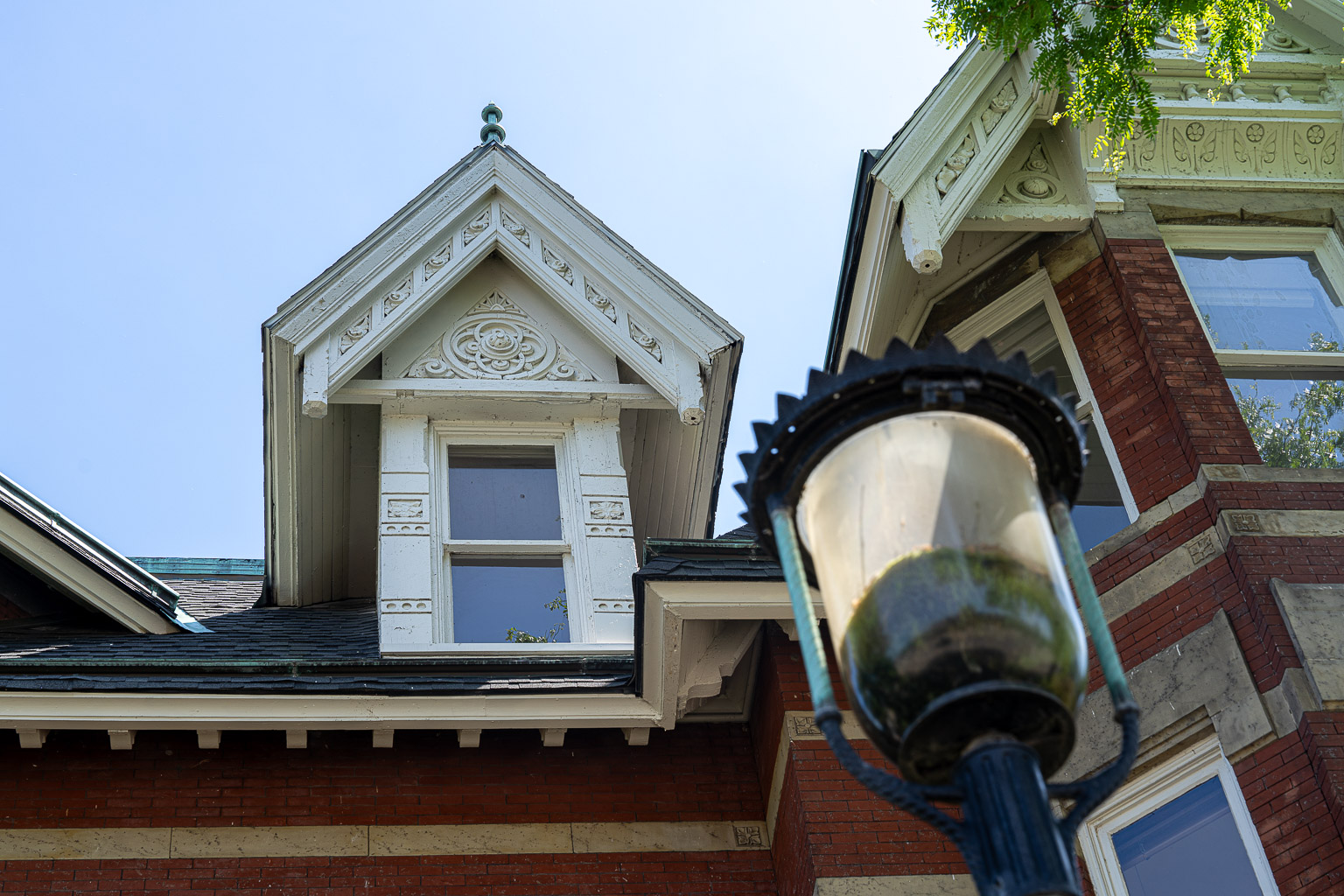
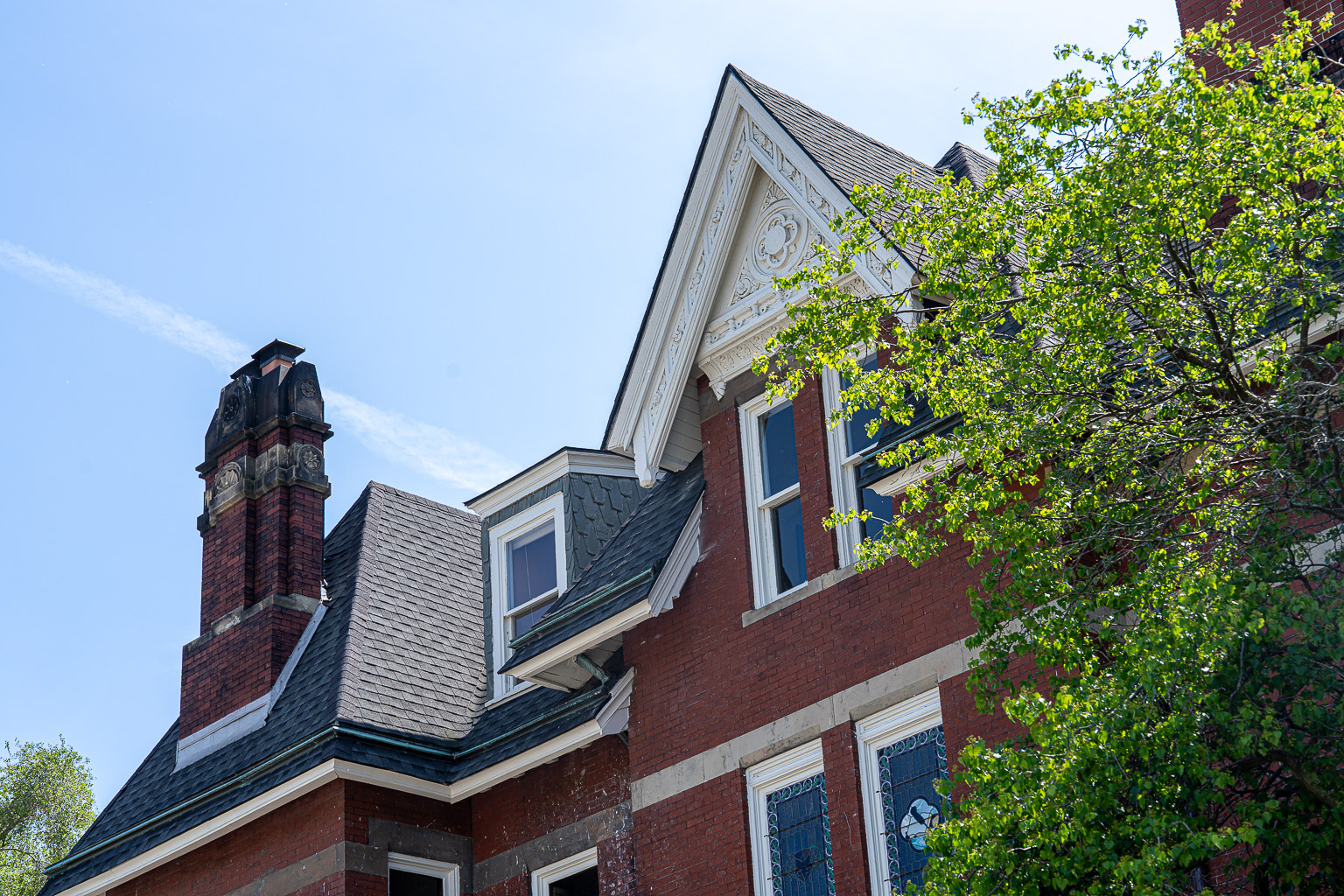
The Croul-Palms House is a red brick two and one-half story building with a fult story within the roof. The multi-planed roof with projecting gables, dormers, and decorated chimneys caps off the multi-faceted mass of the building.
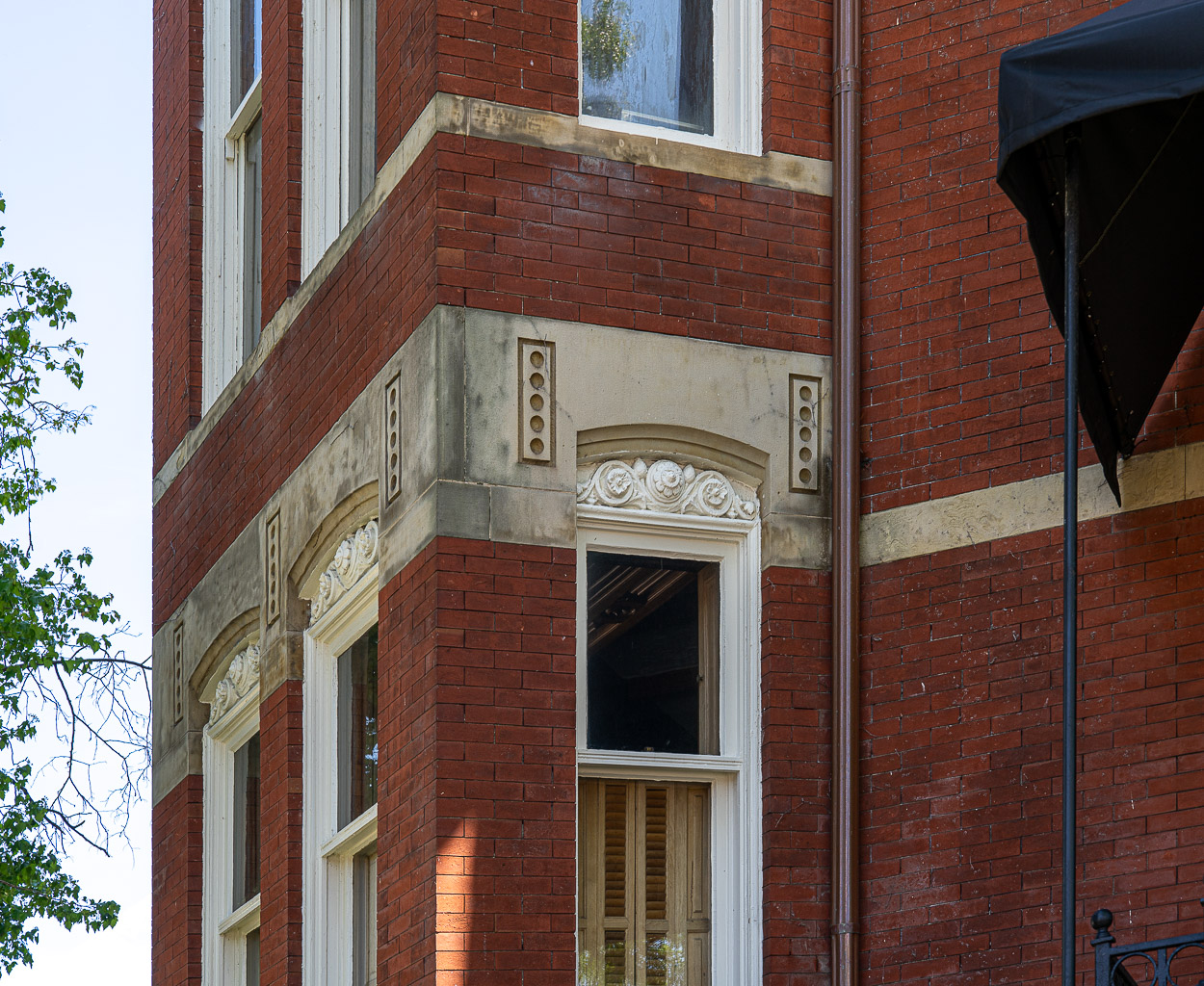
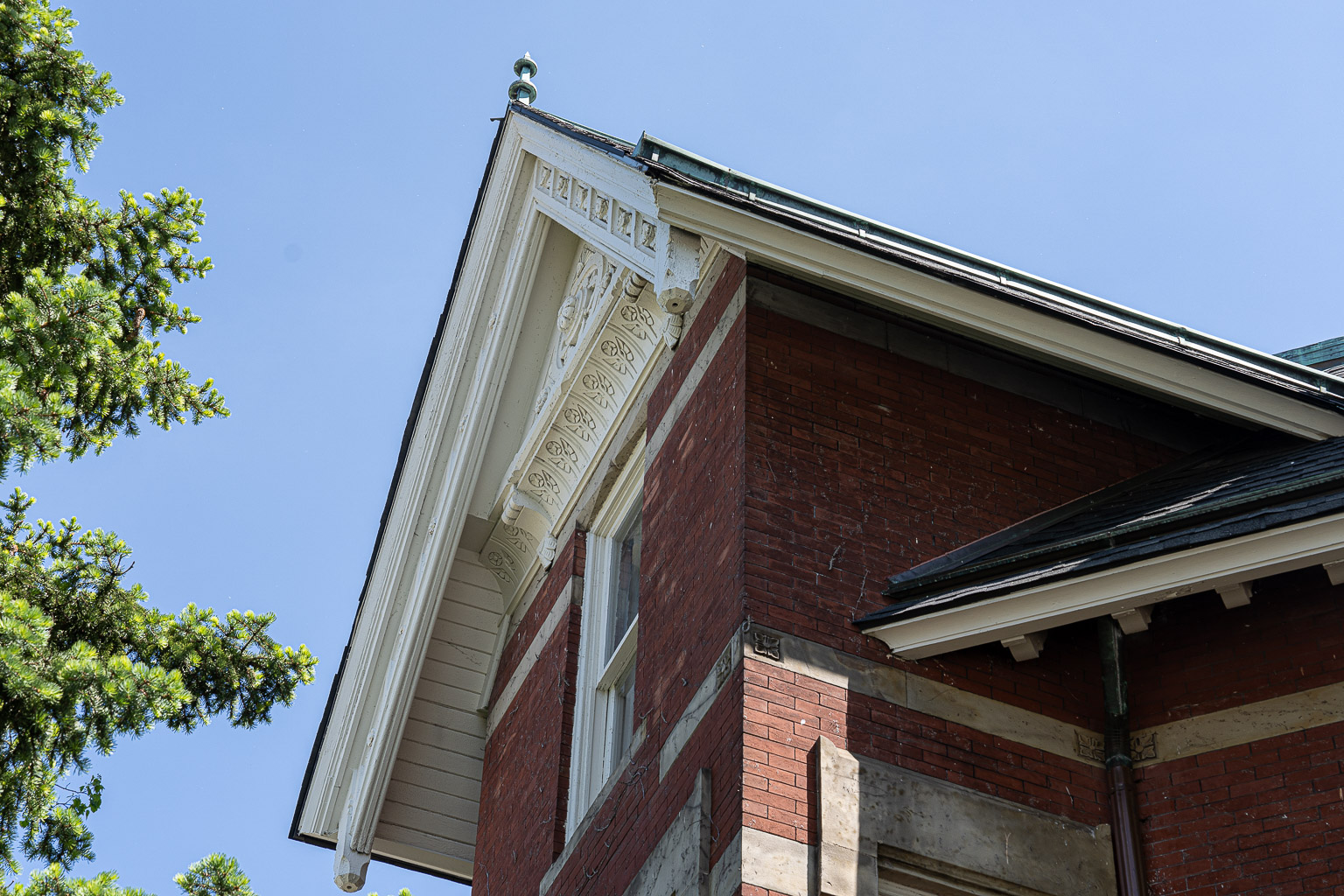
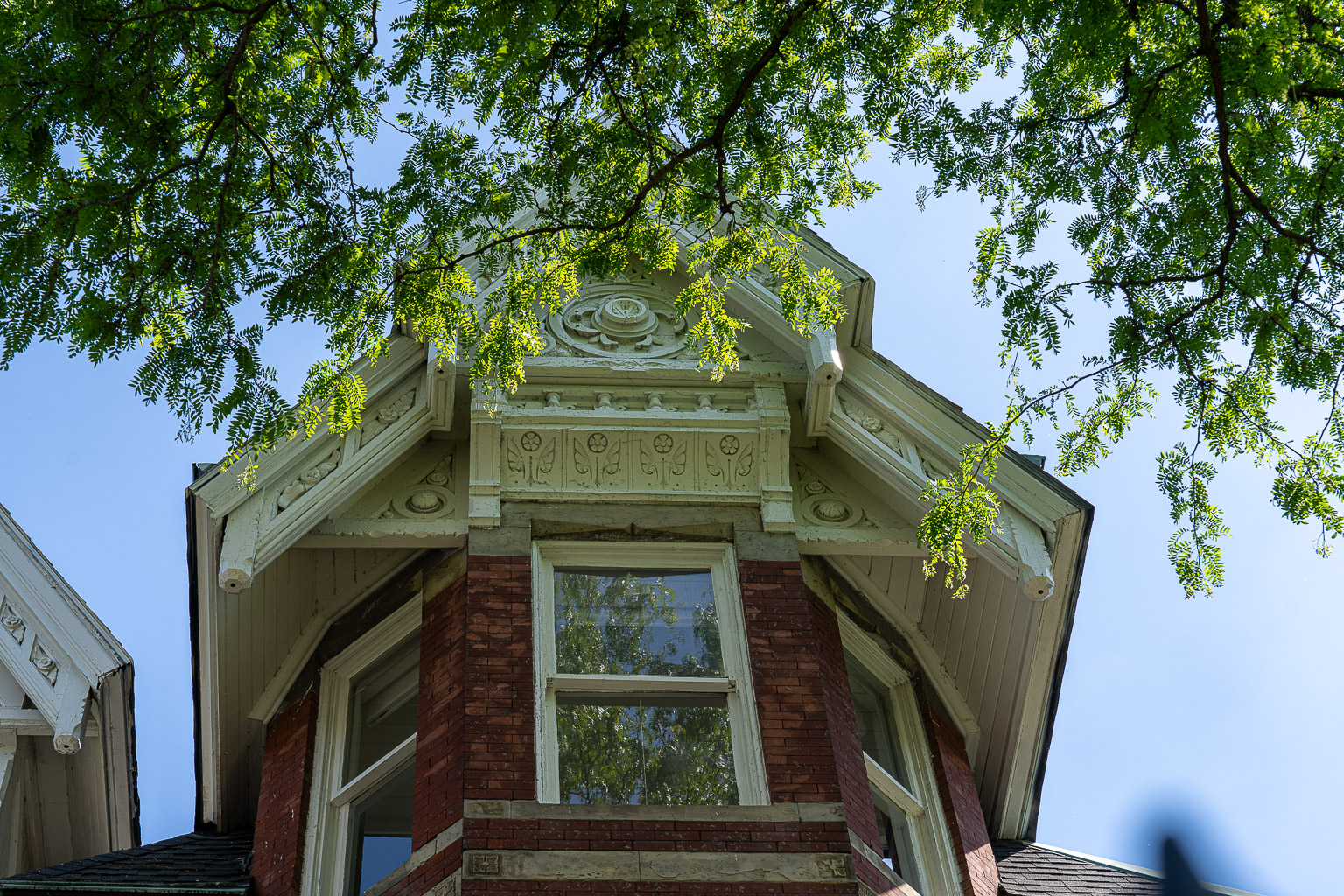
The front facade of the Croul-Palms House is divided vertically into three bays. Its western bay rising through three stories contains a three-sided bay window with elongated double-hung sash windows; there are carved semi-circular wood transoms above the first story windows. This bay is crowned with a gable containing an ornately carved vergeboard and carved wooden panel.
The central bay consists of an elaborate recessed entryway with ornate double doors. A small centered double-hung sash dormer window with a decorative gable roof is flanked by knobby Eastlake-style pilasters.
A three story bank of windows angled to the corner of the building with a projecting gable above comprises the east bay of the building.
The building is unified horizontally with stone ribbonwork, window hoods and rock faced stone foundations with margins.
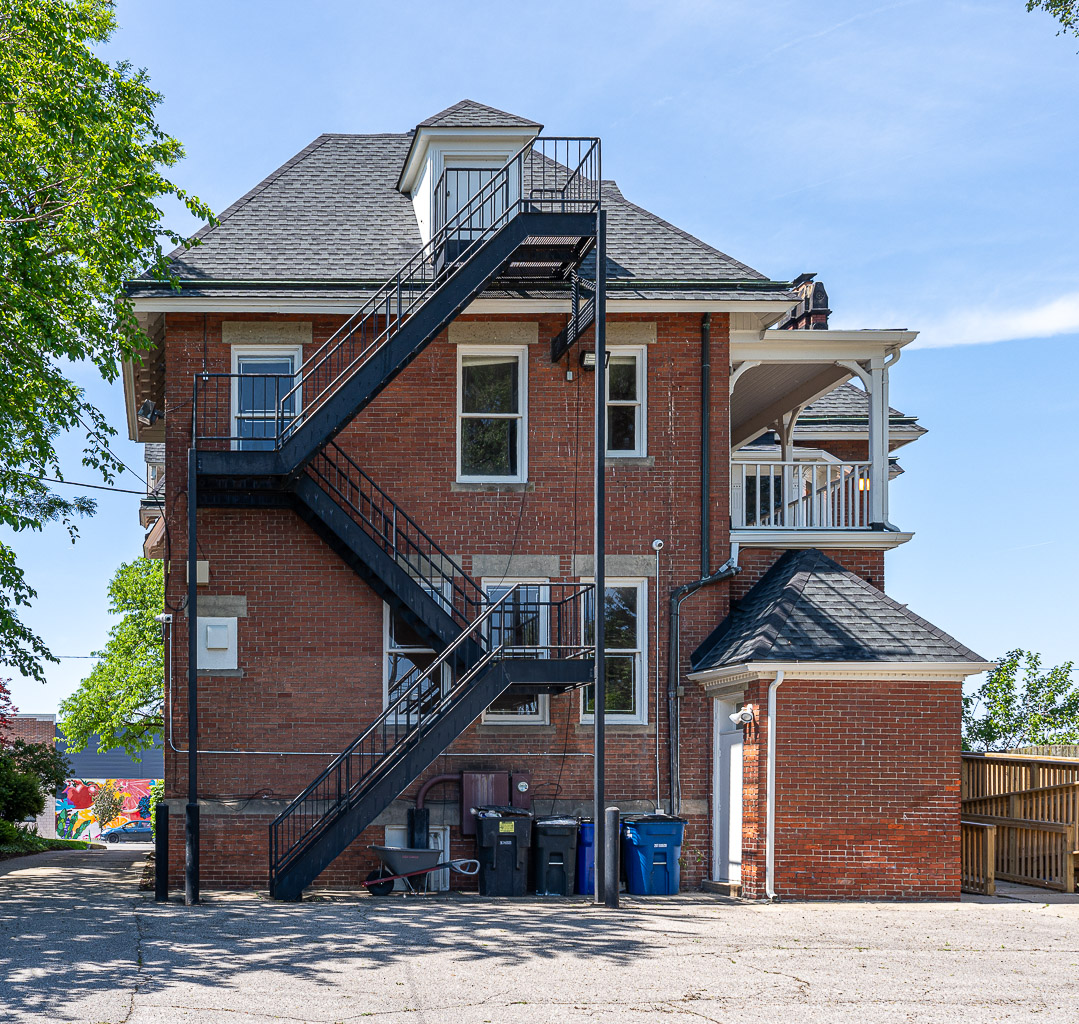
The visible west side of the building also contains carved stone detail and carved window surrounds. However, an elaborate side porch has been removed.
Relatively little alteration has occured on the exterior of the building. The slate roof has been covered with asphalt and the iron cresting has been removed from the roof ridges. A small balconet is missing from the third story of the eastern bay of the front facade and an elaborate porch roof has been removed. Regardless, the Croul-Palms House is a superb architectural example of the "picturesque" coming into vogue in the 1880's.