G. A. R. Building Local Historic District
The Grand Army of the Republic (G. A. R.) Building Local Historic District is the single building at 1942 Grand River Avenue in the triangle between Grand River Avenue, Cass Avenue, and West Adams Avenue, 3 blocks west of the center of Grand Circus Park. You can read details about the district and its buildings in the G. A. R. Building Local Historic District Final Report (local copy), which I recommend highly to anyone interested in Detroit's history.
HISTORY: [+ expand]
The G.A.R. Building is historically significant because of its associations with Civil War veterans and their descendants from 1899 to 1973. It is architecturally significant as one of the few remaining examples of Richardsonian Romanesque in the City of Detroit and as the final design of Julius Hess.
The Grand Army of the Republic (G.A.R.) was founded in 1866 as a society for those who fought for the North in the Civil War. Its purpose was to strengthen fellowship among men who fought to preserve the Union, honor those killed in the war, provide care for their dependents and "uphold the Constitution." The G.A.R. served as a lobbying group and Congress responded by making generous allocations to Civil War veterans. The G.A.R. started the custom of celebrating Memorial Day on May 30, 1868 to honor the graves of Union soldiers. After the war, 391 G.A.R. posts were established in Michigan alone.
In Detroit, G.A.R. members were some of the city's most respected citizens and included such leaders as Hazen Pingree, Mayor of Detroit and Governor of Michigan; and Claudius Grant, Justice of the Michigan State Supreme Court.
Detroit and Michigan veteran's groups lobbied the City to erect a memorial meeting building in 1891. The site selected was part of the farm of Lewis Cass, Territorial Governor of Michigan from 1813 to 1867, and was given to the city by Cass as a site for a public market. On February 11, 1896, the Common Council directed the execution of a lease to the G.A.R. on the condition that the first floor of the building they were to build would be designed and used as a public market, in accord with Cass' deed to the City. The existing Cass Market was demolished in 1896 and the G.A.R. Building was erected in 1899 at an estimated cost of $44,000, with $38,000 from the sale of city bonds. Henry Englebert was hired as the architect, but was relieved of his duties soon after and replaced by Julius Hess, apparently due to Hess' popularity amongst some G.A.R. members.
Hess, a well-known Detroit architect, was born near Zurich, Switzerland in 1841 and began his architectural training there. At the age of 17 he emigrated to the United States and, in 1874, he moved to Detroit. He continued his practice independently for twelve years, during which time he designed a number of Detroit churches. Hess affiliated with Richard Raseman in the firm of Hess and Raseman from 1885 to 1891. Raseman is credited with the original Edison Illuminating Company Building which is replicated at Greenfield Village. He was primarily an industrial specialist and is remembered for his designs of several Detroit breweries. Mr. Hess was the senior partner and designed a variety of buildings, among them the Trumbull Avenue Presbyterian Church, several county courthouses in Michigan, and the Michigan Building of the Centennial Exposition in 1876 in Philadelphia.
Hess died in 1899 leaving Raseman to supervise the final stages of the G.A.R. Building's construction. Raseman added electric lighting and an elevator enclosure to the original plans. In an effort to cut costs, the basement under the market, all except that necessary for boilers and elevator machinery, was eliminated. The building was completed in November 1900.
From the time of its opening the G.A.R. Building was utilized as a gathering place for parties, dances, weekly or monthly meetings and celebrations of national holidays by various veteran groups. The G.A.R. collected the market rents while the city maintained the building. After the original thirty year lease expired in 1927, an additional five year lease was granted and after that there were year-to-year extensions. By 1934, only twenty-four G.A.R. members remained, the youngest being the 87-year-old W. J. Fraser.
The city made some improvements in the building and, in 1937, the Works Progress Administration (W.P.A.) began a two year occupancy. Two years later the City Department of Public Welfare was granted permission to occupy all parts of the building not used by veteran's organizations. The Detroit Parks and Recreation Department took over the building in 1943 for use as a recreation center. Formal lease agreements with G.A.R.- related groups ceased after this time, although the women's auxiliary organizations were permitted to continue their meetings in the building as a courtesy. The G.A.R. Memorial Association has not held meetings in the G.A.R. Building since 1973.
In the early 1980s, the Recreation Department vacated the building and it was transferred to the then-Community and Economic Development Department as surplus property. It was sold on land contract to a developer who proposed a rehabilitation for commercial use, but returned to city ownership some years later after non-payment on the land contract and the failure to carry out the rehabilitation program. The building remains unused and boarded-up, and is still in the city's inventory, although there is an agreement for sale of the building to commercial interests. As of 2026, the building has been restored and a high-end restaurant named SEXY Steak occupies the ground floor.
ARCHITECTURAL DESCRIPTION: The triangular shape and dramatic vistas of the four and one-half story G.A.R. Building result from its placement on a site that is a remnant of the Woodward Plan of 1805. Cass and Grand River meet in a "V" and are crossed on the northwest by Adams Street, forming the triangular site.
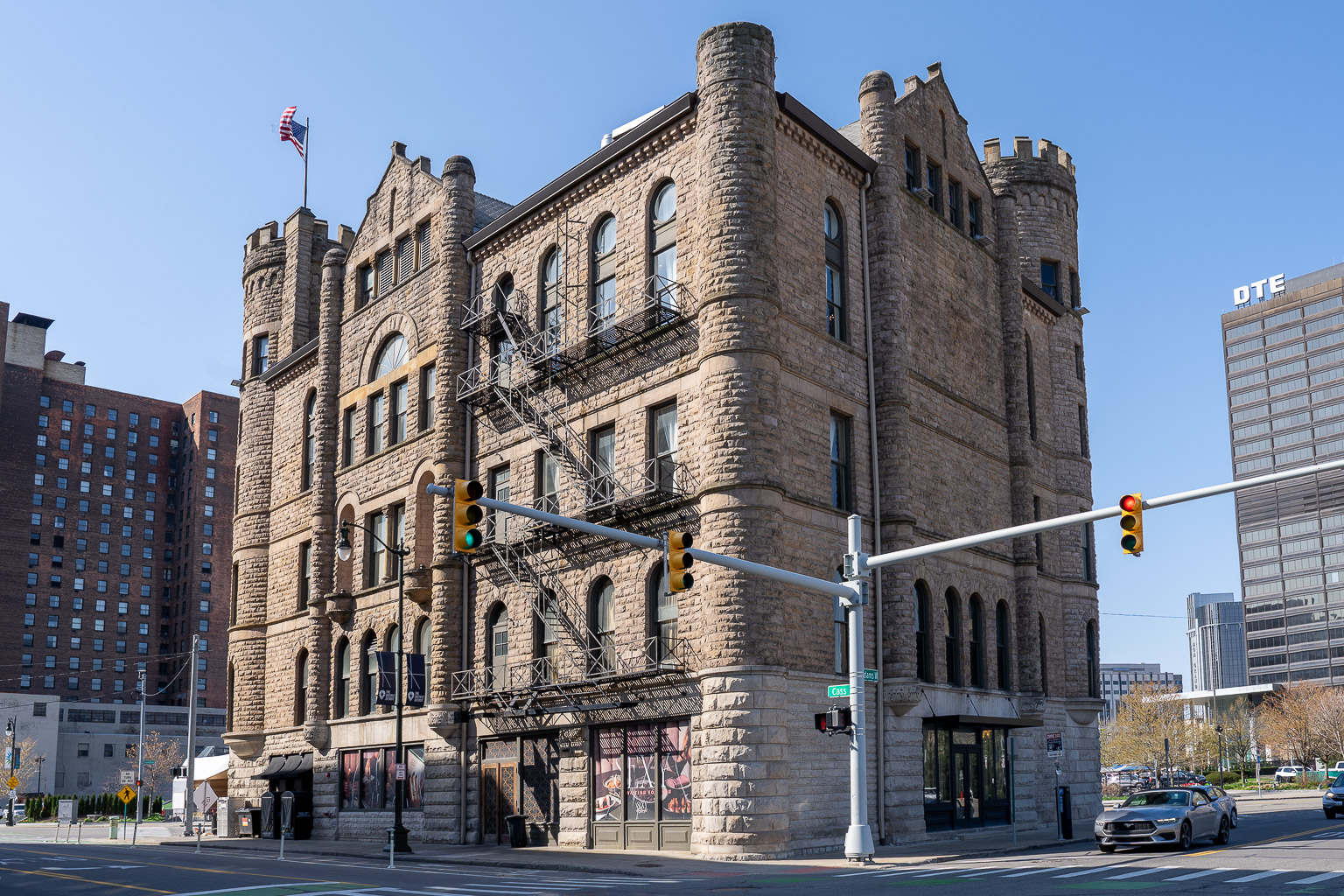
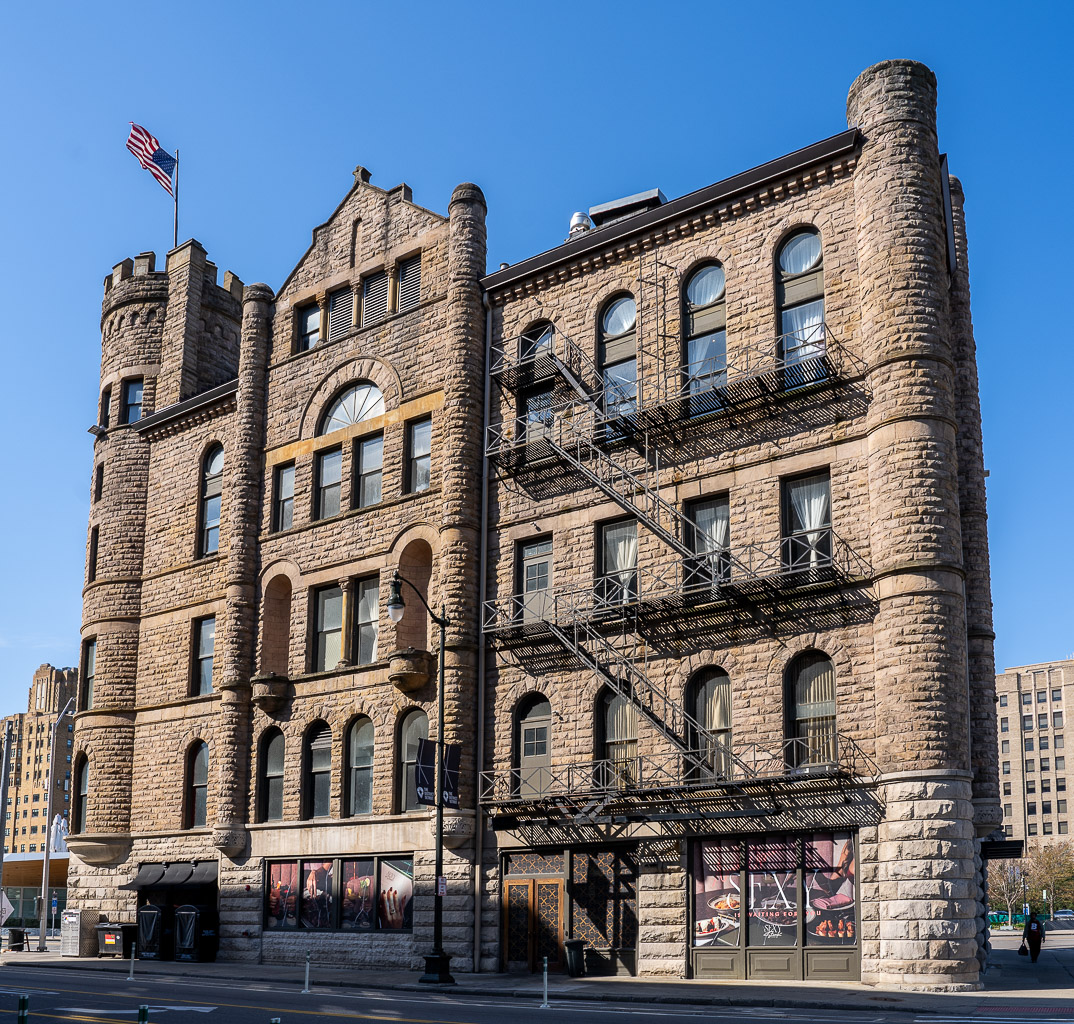
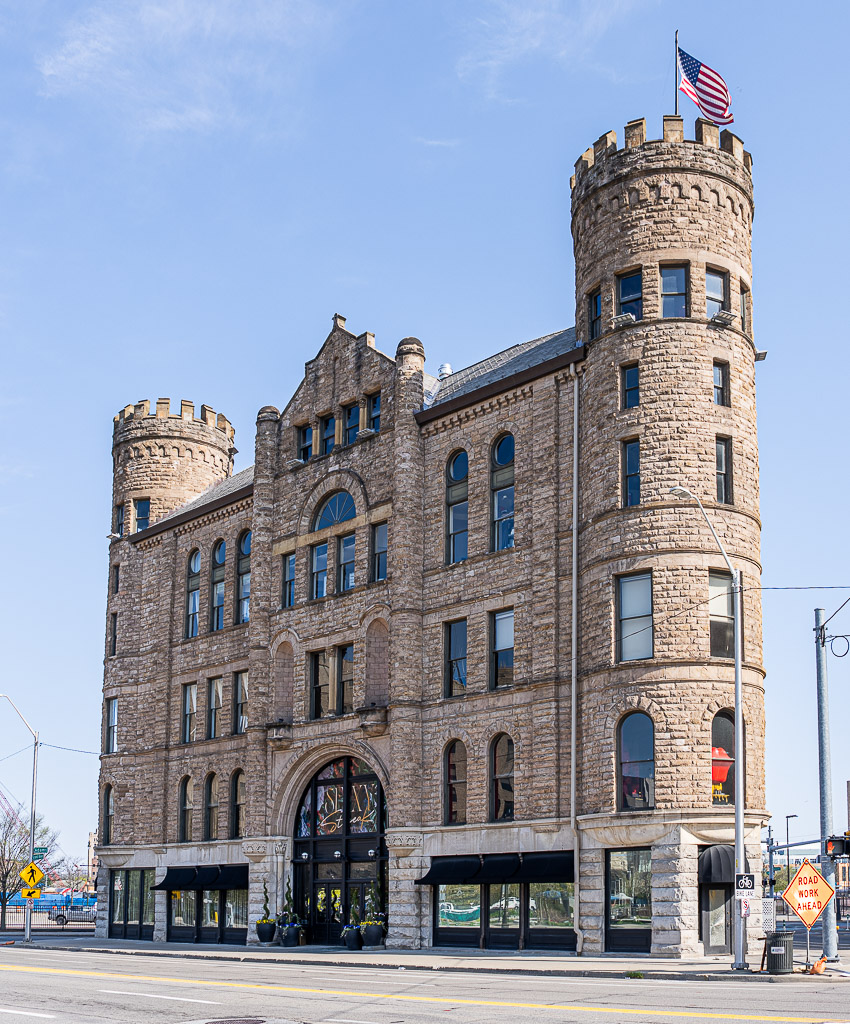
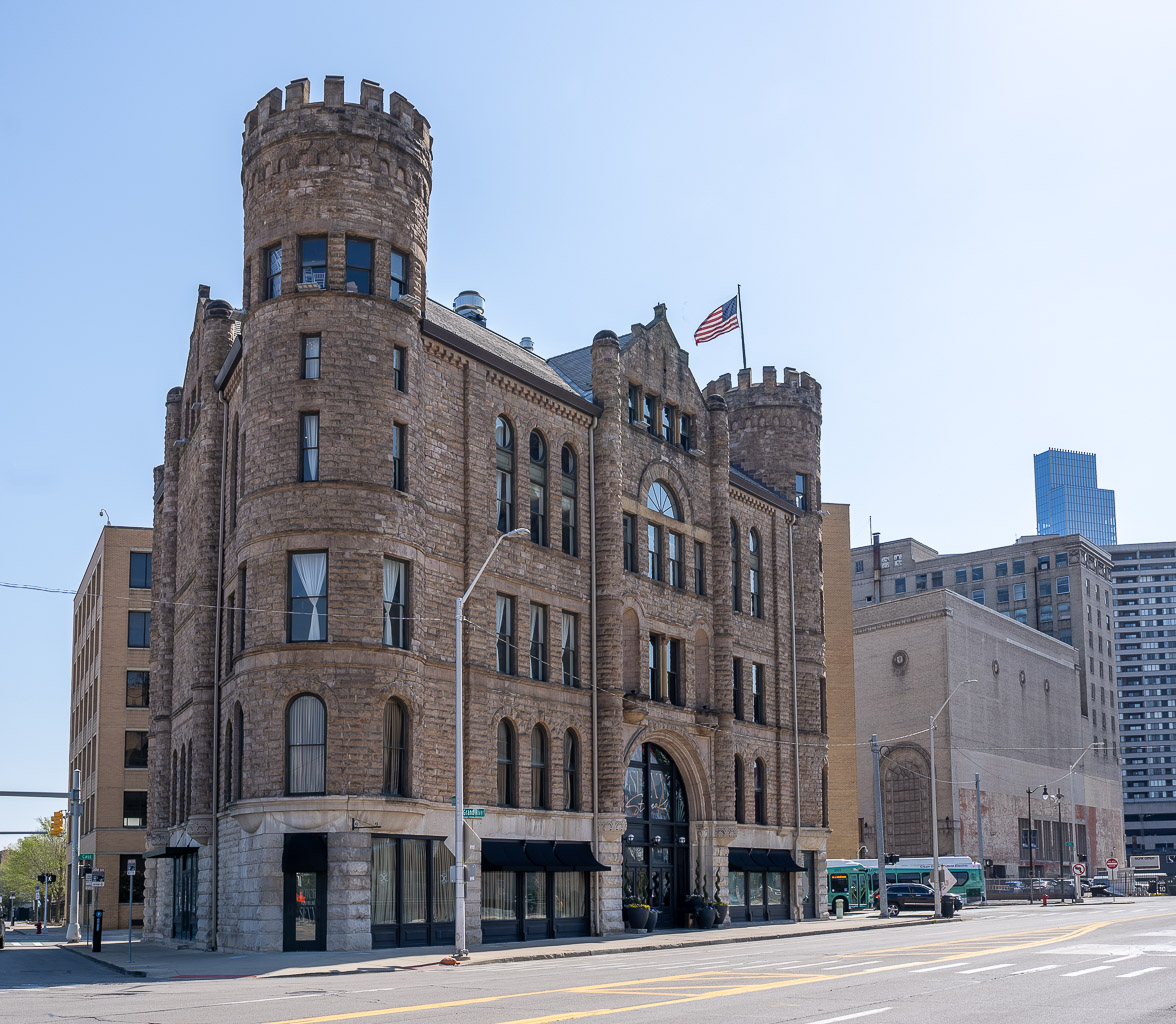
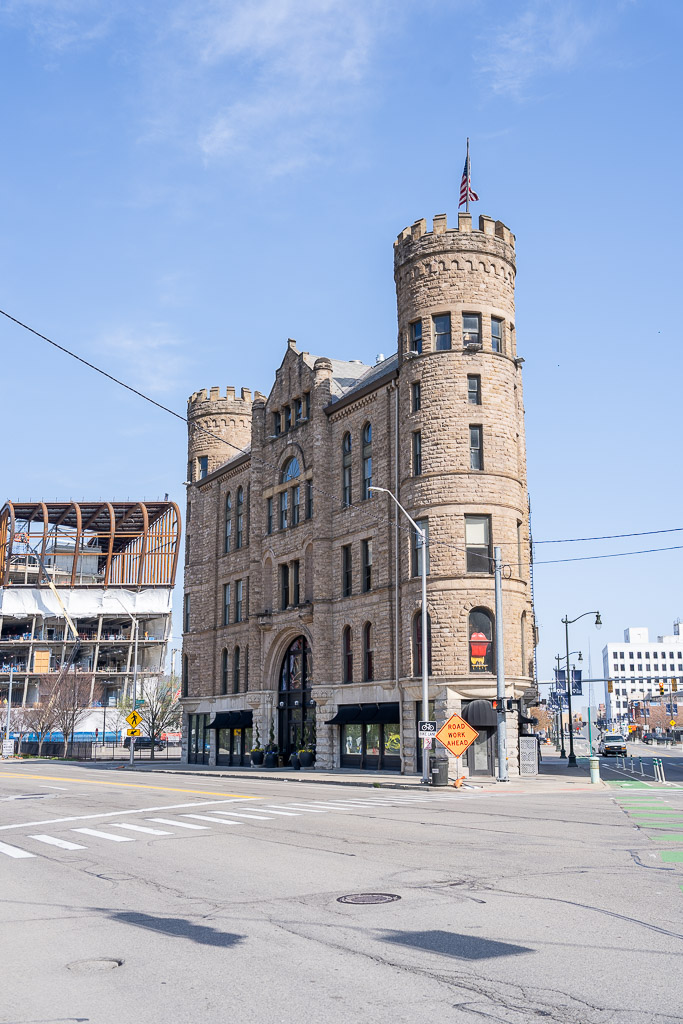
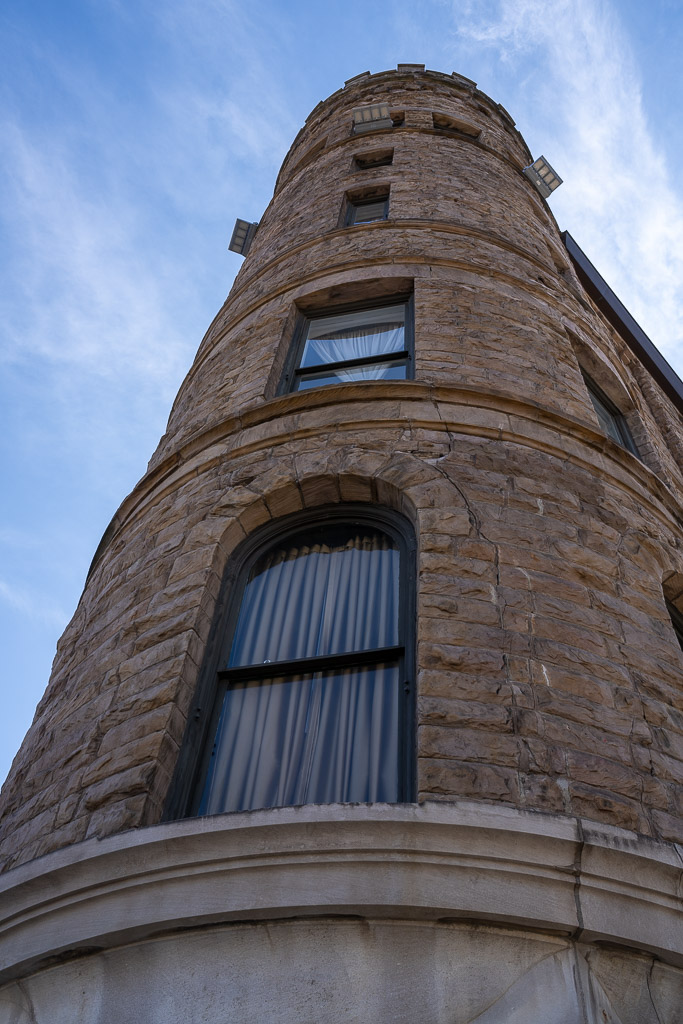
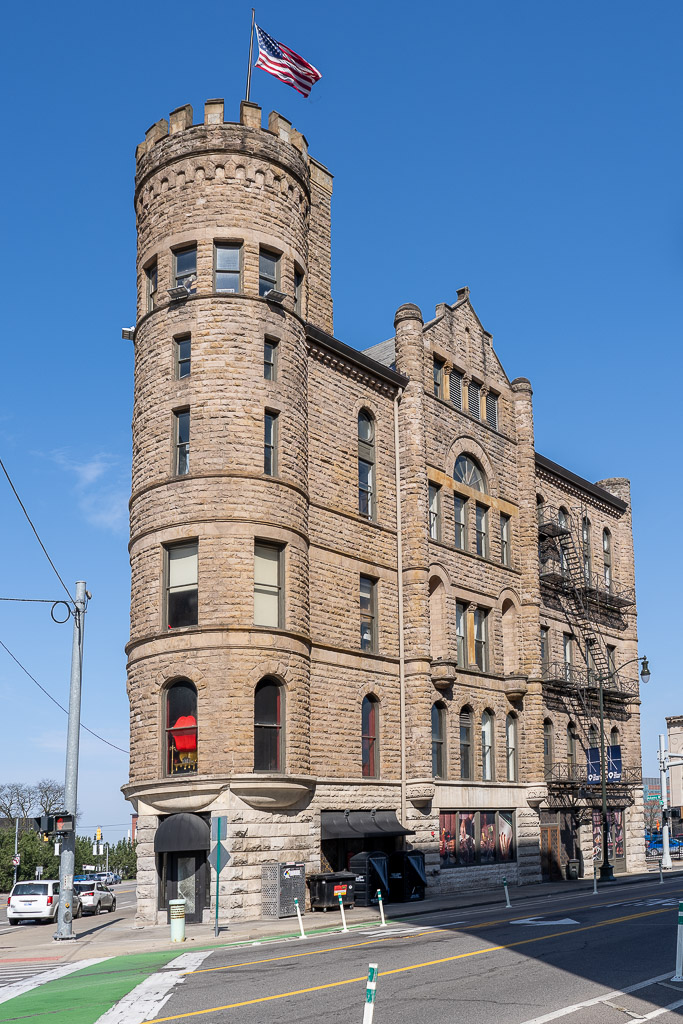
The G.A.R. Building was designed in the Richardsonian Romanesque style to resemble a fortress. It is punctuated on the east and west ends of the south facade (1st through 3rd photos below) by crenelated engaged towers rising from the second story to above the roofline (4th and 5th photos below). There is arcading beneath the battlements and the towers are punctured with a variety of window shapes and openings. Smaller round buttresses flank gabled pavilions on two sides of the building, and a turret forms the northwest corner. The major opening in the south facade is the large arched entrance at the base of the gabled pavilion. Fenestration of the rest of the building is almost symmetrically arranged and contains a variety of niches and openings.
The exterior walls of the G.A.R. Building are rock-faced gray limestone on the street level and reddish-brown sandstone above. The foundation around the partial cellar is uncoursed rubble. Composition shingles replaced the original slate roof long ago, and the flat portions of the turrets are tar-covered sheet metal. The facade contains a fair amount of carved detail; for example, the bases and finials of the round buttresses contain a floral motif. A cornerstone at the southeast corner of the building contains the inscription, "Memorial to the Soldiers and Sailors of 1861 to 1865."
Over the years there have been relatively few visible changes to the exterior of the building. The most visible alteration is the replacement of the original windows and doors in the north end of of the first floor with glass brick in 1944. Originally, these windows were similar to those remaining in the south half of the first floor. A fire escape was added to the east facade (1st and 2nd photos below) in 1904, necessitating remodeling of windows into doors. Widening of streets and sidewalks at unrecorded dates led to the walling up of light-well openings serving the basement.
On the interior, the building also exhibits only modest changes. The alterations have been made primarily at the north end of the first floor and on the third floor. The first floor interior is distinguished by a carved staircase and a ceramic tile entrance lobby inlaid with the flag and the initials, "G.A.R., 1861-1865." The second floor consists of G.A.R. organizational meeting rooms and has been kept closed from recreational users of the building. As a result, these rooms contain much of their original atmosphere. The fourth and attic story at the north end consist of an auditorium and overlooking concave balcony. These floors have richer omamentation, including circular transom windows in the auditorium and semi-circular segmented windows lighting the balcony.