Globe Tobacco Building Local Historic District
You can read details about the Globe Tobacco Building Local Historic District in the Globe Tobacco Building Local Historic District Final Report (local copy), which I recommend highly to anyone interested in Detroit's history.
The proposed Globe Tobacco Building Historic District consists of one building at 407 East Fort Street on the northeast corner of East Fort and Brush in downtown Detroit. It is two blocks south of Greektown and northeast and kitty-cornered from the old Wayne County Building. It has parking lots on its east, west, and south sides and the Wayne County Morgue on its north side. The six-story brick building is currently undergoing rehabilitation and its National Register nomination is pending.
HISTORY: [+ expand]
Detroit's tobacco industry goes back to 1841, when George Miller began producing chewing tobacco with Canadian tobacco. His was a crude operation; the tobacco was cut in the cellar, the power was supplied by an old blind horse, and the tobacco was dried in the loft of the building. The tobacco trade picked up in 1856 when Daniel Scotten established the Hiawatha Tobacco Factory. By 1864 there were seven large manufacturing establishments in the city, probably the largest market in what was then the West. In 1891 tobacco manufacturing was the leading industry of Detroit, with the top five tobacco manufacturers being the American Eagle Tobacco Company, John J. Bagley and Company, Daniel Scotten and Company, Banner Tobacco Company, and Globe Tobacco Company. By 1913, the tobacco industry ranked first in Detroit in the number of establishments, third in number of people employed, and fifth in the value of the product. The big tobacco factories were the largest employers of women in the city; the ten largest employed 302 males and 3,896 females, many under 20 years old. In 1925 it was reported that more than a million cigars were made each day in Detroit, and, as all quality cigars were hand rolled, this provided among the highest paid jobs for women in the city, paying $25 to $40 per week.
However, the Globe Tobacco Company was no longer in business by 1925. The property upon which the Globe Tobacco Company building sits was once part of the farm of Adelaide and Edmund A. Brush. The Brush heirs granted an executors deed to George Peck, president of the Michigan Savings Bank, on October 1, 1888, approximately two months prior to the issuance of a permit for the construction of the Globe Tobacco Company's building.
Globe Tobacco Company was established in 1871 on Atwater Street by Thomas McGraw, Hiram Walker, William A. Moore, and O.P. Hazard. Thomas McGraw (1824-1897), the president of the company, established the wool house of T. McGraw and Company in 1864. He invested his money in real estate and manufacturing in Detroit, and was a president of the Michigan Savings Bank. Hiram Walker prospered in the distillery business in Windsor and William A. Moore was a prominant Detroit attorney. 0.P. Hazard was a pants and overall manufacturer, and a relative of Rodman Hazard, whose great-granddaughter, Sarah Selden, was the wife of Thomas McCraw.
Touted as "among the largest manufactories in the West" in an 1878 article in the Detroit Free Press, the Walker, McGraw and Company Globe Tobacco Works, at 31, 33, and 35 Atwater Street East manufactured about 300,000 pounds of Globe Tobacco annually in 1878. Although their leading one-cut brand was the Globe, their other specialties included the World, Phaon, Myrtle, and Hope brands. In addition to those chewing tobaccos, Globe also manufactured Globe fine-cut for smoking.
In 1880, the Globe Tobacco Company of Detroit was incorporated. The officers at that time were Thomas McGraw, president, W.K. Parcher, vice president, and Alexander A. Boutel1, secretary/treasurer. By 1883 production was over 1,300,000 pounds of smoking and chewing tobacco annually. The Globe was still the leading brand of chewing tobacco while Nerve and Fearless were the best smoking brands.
In 1888, the company decided to move to a larger facility, which was necessitated by the expanding nature of its business. Permit #1707 was issued to A. Chapoton, Jr., a contractor, to build a "six-story brick manufactory, 70' X 138'" at an estimated cost of $37,000. Alexander Chapoton, Jr. (1839-1897) was a descendant of Dr. Jean-Baptiste Chapoton, the surgeon of Fort Ponchartrain. His father, Alexander Chapoton, Sr., was also a builder and he and his son were partners until he retired in 1884. Alexander Chapoton, Jr. supervised the building of many of Detroit's important buildings, including the Parker Block, Palms Building, St. Mary's Church, and the Whitney Building. Chapoton was the first president of the Builder's Exchange and president of the Peninsular Savings Bank.
The Globe Tobacco Company building on East Fort Street was reputed to be " ... the first factory in the U.S. to utilize electricity as a motive power in the manufacture of tobacco ... " (Detroit of Today ... , 1893) The building was lit throughout by electricity, with nine electric motors supplied by one 50HP dynamo generating power for all of the electricity in the building, including the elevator. The building was also built in accordance with the principles of slow burning "mill" construction.
The company in 1892 employed about 230 people and its annual output of smoking, fine cut, and plug chewing tobaccos was 2,500,000 pounds. Only the choicest Virginia and Kentucky leaf was used, and Globe owned and operated large curing establishments in leaf tobacco growing districts. The company still manufactured Globe fine cut chewing tobacco but had added "Hand-Made" plug and "Hand-Made" flake-cut as well. With a capacity for over 15,000 pounds per day, annual sales were over one million dollars. Several machines were designed and patented by Globe especially for the production of plug tobacco in the new quarters on Fort Street. Globe Tobacco Company annually used 100,000 pounds of granulated sugar and 50,000 pounds of licorice as flavorings for leaf tobacco; 95,000 pounds of tin foil went into the patented packaging, which consisted of tin boxes in the shape of cigar boxes with glass covers. Globe Tobacco Company had "an extensive trade throughout sections of North and South America and Great Britain" (Detroit of Today ... , 1893), although its prime market was the northwest and northeast portions of the United States.
George Peck, executor of the Brush estate, transferred the property on East Fort and Brush to the Globe Tobacco Company Corporation of Detroit in 1897, and in 1916 it was transferred to Charles M. Hamper, Louis F. Dillman, Charles P. Spicer, and Hobart B. Hoyt, trustees. The Hamper Real Estate Company had its office in the building, as did many small manufacturing firms from 1916 to the 1970s, as the building had been transferred to many owners and had an average turnover of tenants over the years.
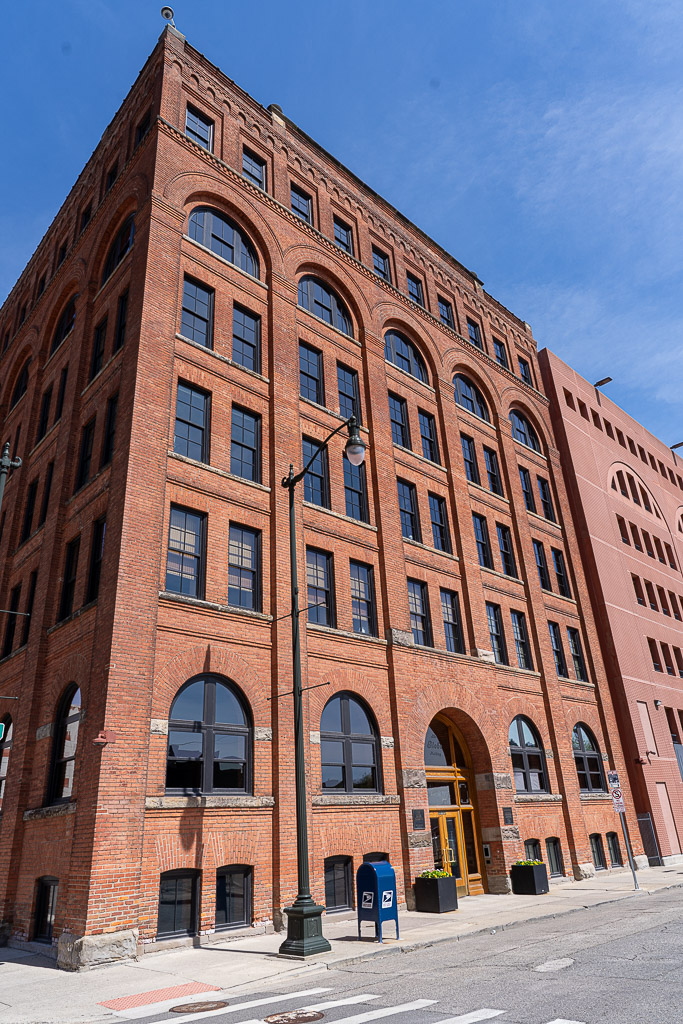
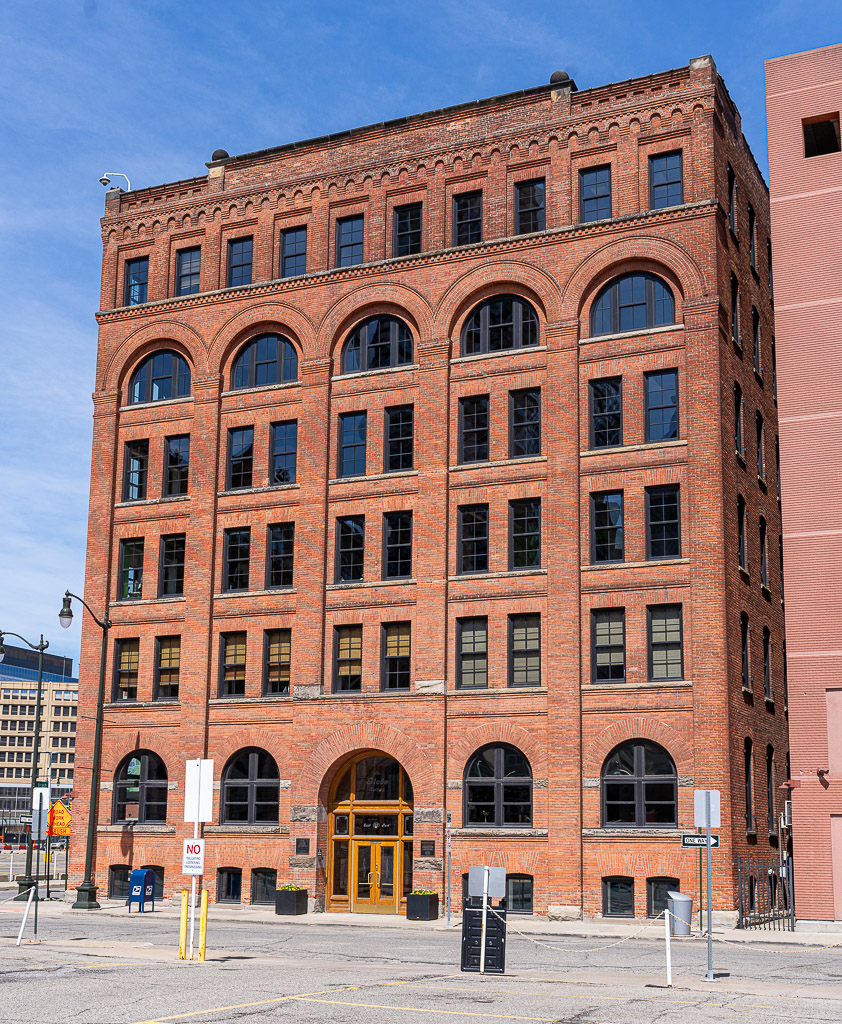
PHYSICAL DESCRIPTION: The Globe Tobacco Company building at 407 East Fort Street is reputed to be the oldest tobacco manufactory still extant in the city of Detroit. Its construction was overseen by Alexander Chapoton, Jr. and it was completed in 1889.
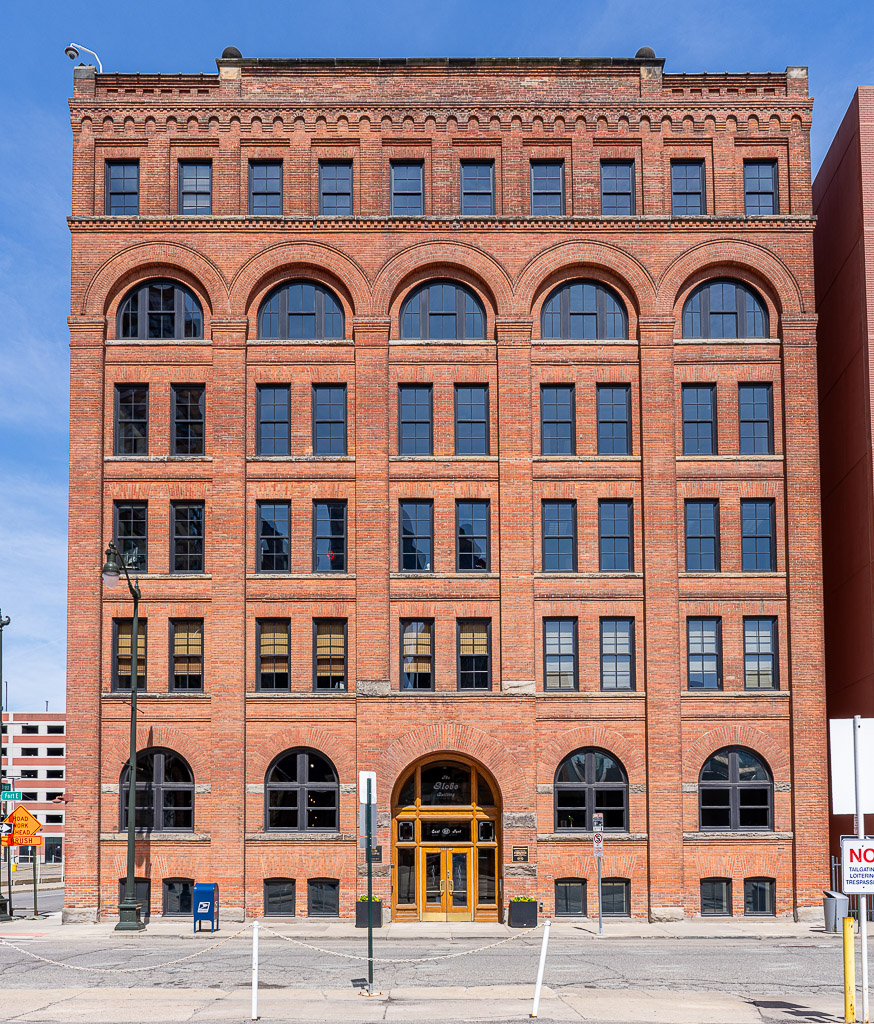
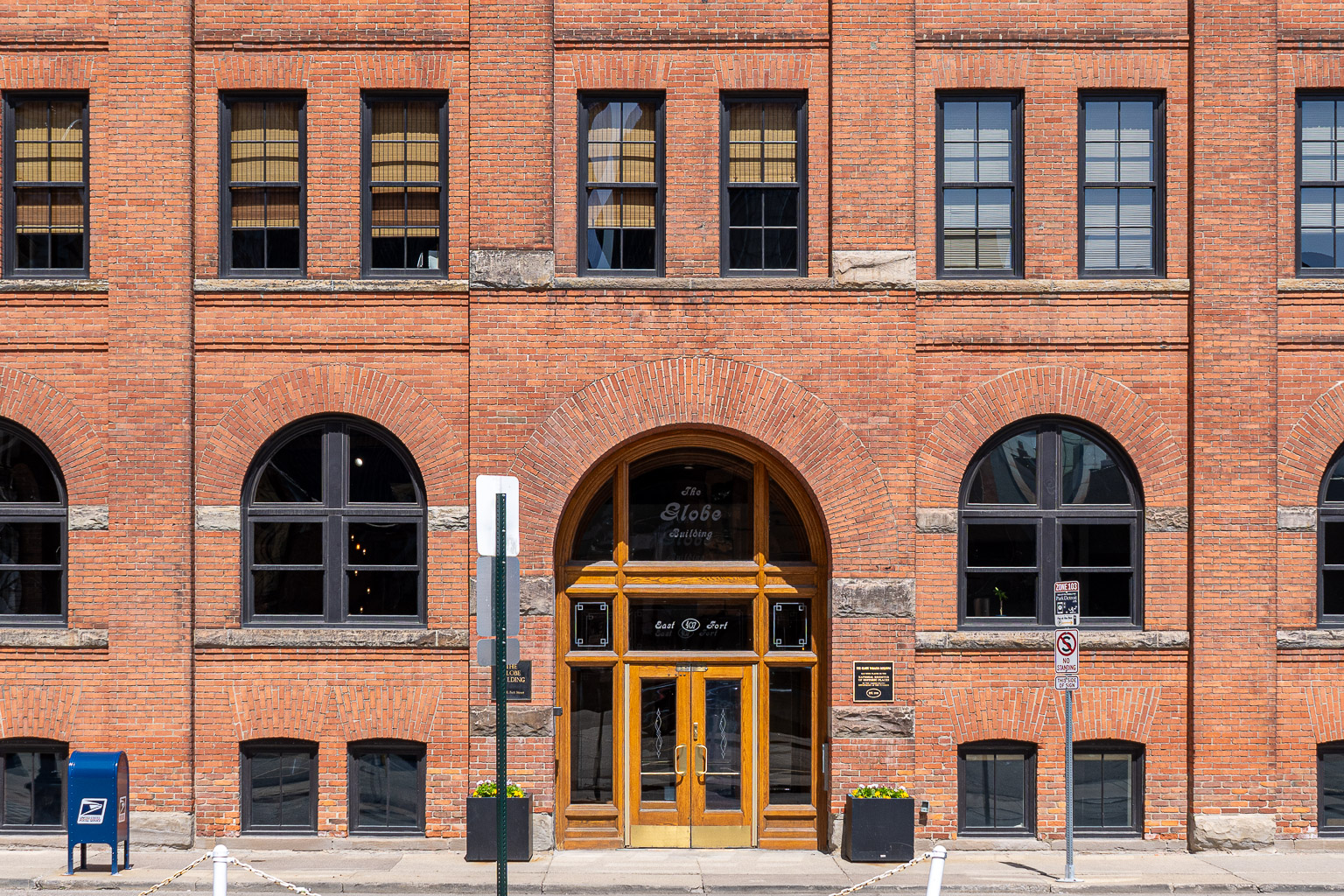
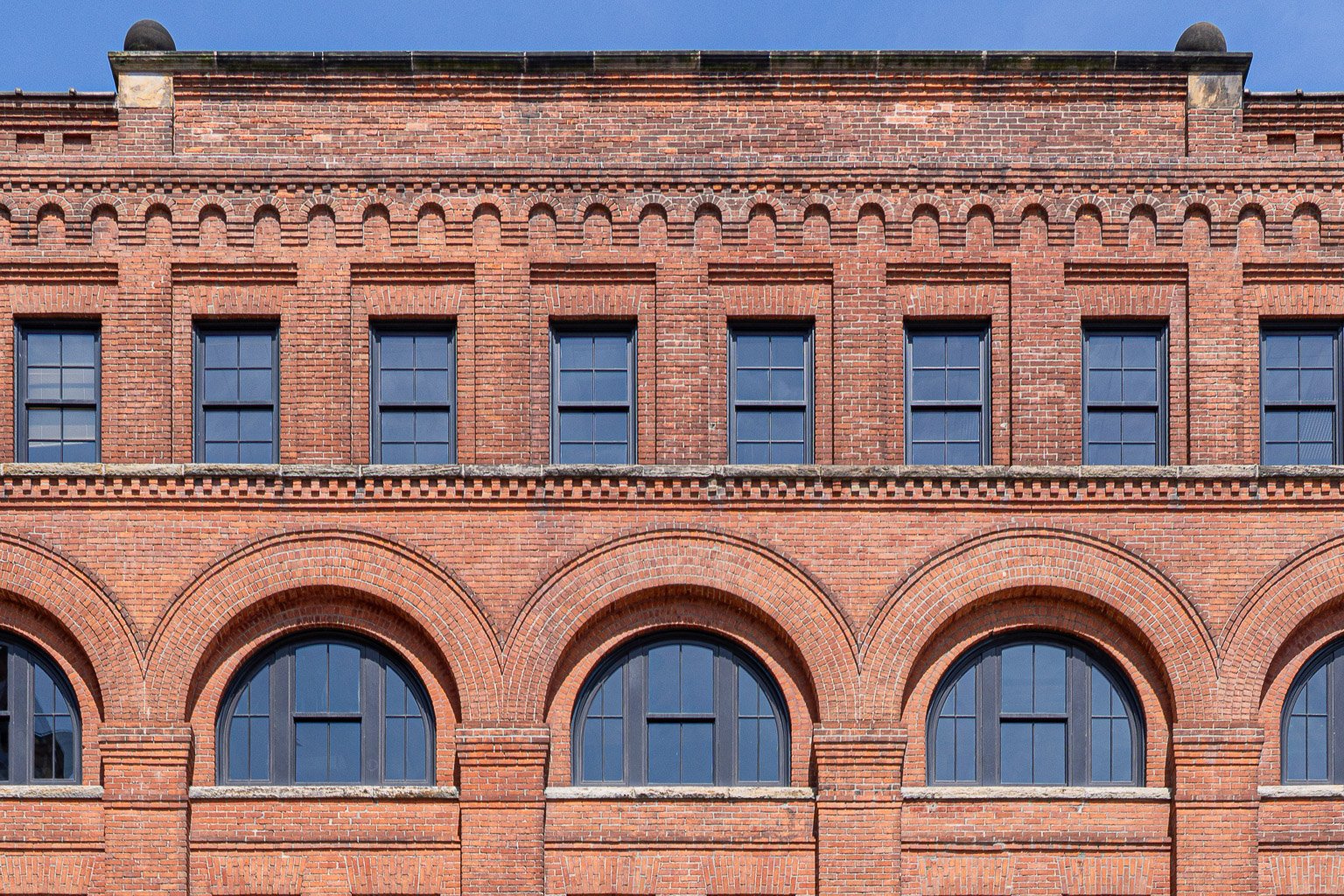
The Globe Tobacco Company building is a six-story orange brick building designed in the Richardsonian Romanesque style. Its front facade (1st photo below) is articulated into five bays, the central bay containing a wooden double-doored entrance within a large round arched opening (2nd photo below). A block of rock-faced limestone ornaments the base, impost, and an area in between on both sides of the entrance opening. On the first story of the other four bays of the front facade are large round arched windows with stone imposts, stone sills, and brick voussoirs. Pilasters rise from the first story to the fourth, culminating in the arcading that forms the fifth story round-arched windows (2nd photo below). At the base of each pilaster is a rock-faced limestone block. Stories two through four have two window openings per bay that share a stone sill. Projected brickwork between the pilasters separates the stories. The sixth floor is not articulated into bays and is separated from the fifth floor by brick denticulation. It consists of rectangular window openings evenly spaced and separated by pilasters (3rd photo below). Brick arcading and a brick corbel table above separates the sixth story from the parapet wall, which consists of square brick panels with stepped brick corbelling above and a raised panel centered at the top of the front facade with masonry balls at the corners. While the corbelling beneath the cornice line may appear decorative, it does, in fact, step out to provide bearing for heavy timber roof trusses while protecting timber from fire and weathering.
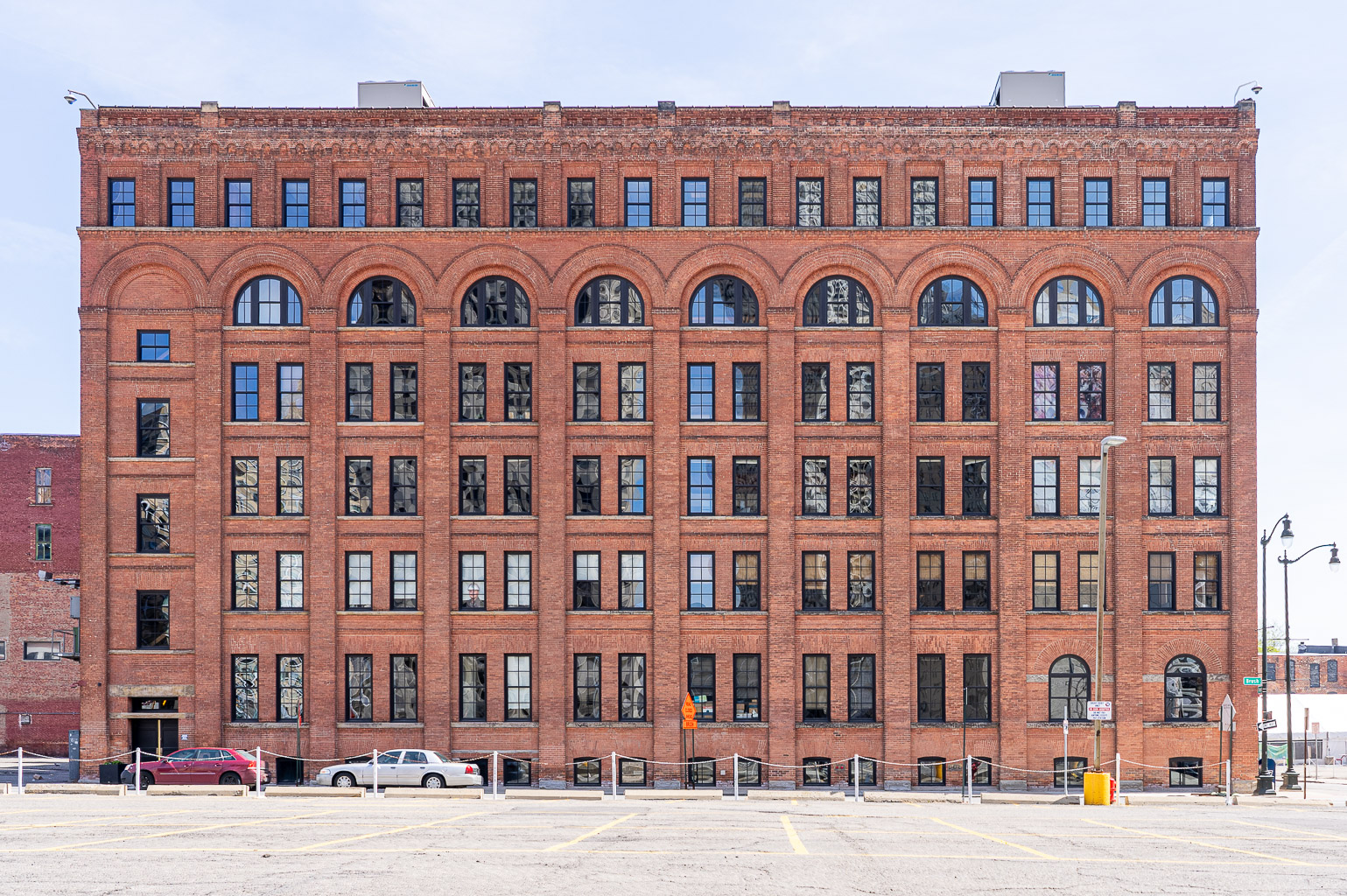
The west elevation of the Globe Tobacco Company building (1st photo below) is very similar in the articulation of its ten bays as the front facade, although the northwest corner, because it contains the staircase and secondary entrance, is articulated slightly differently. The east elevation and rear elevation are simpler in detail and composition, containing four-over-four double hung sash windows within evenly spaced segmentally arched openings.
The size, shape, fenestration and plan of the building were dictated by the necessities of innovations in the processing of tobacco, the requirements of better lighting and ventilation, changes and improvements in machinery and changes in motive power. It was constructed according to the principles of slow burning "mill construction," a popular type of factory construction in the United States from approximately 1880 to 1900. The main characteristic of "mill construction" was the use of heavy masonry load-bearing walls to support heavy timber floor and roof structures. If fire did strike, buildings of mill construction could be rebuilt in the most expedient and least expensive way because the fire was usually brought under control with brick walls still standing. Flat roofs were ususally covered with composition or built-up type roofing which consisted of pieces of cloth, felt, or paper saturated with a tar-like substance and then nailed to the roof, which was then coated with more viscous substance and finished off with a coat of sand or gravel (Goldstein, History of Industrial Architecture ... , pp. 26-27).
For its slow burning effect, the Globe Tobacco Company building was designed with heavy timber floor beams spaced about four feet apart. These were held up by girders, forming a compact ceiling with fireproof layers. This type of construction was endorsed by insurance companies at the time to reduce the risk of fire to its lowest possible point without going into the cost of fire-proof construction. Supporting columns rest one on top of the other to alleviate shrinkage and undue pressure on the walls. The building's principle stairway, on the northwest corner of the building, was enclosed in a 15' X 15' passage of brick, and the elevator shaft was also enclosed in brick. An additional stairway was placed in the front of the building. Every effort was taken in the design of this building to make it as fireproof as possible given that the techniques of concrete or hollow tile were not yet developed for industrial construction.
More photos and more description of this building can be found at HistoricDetroit.org.