Lafayette Park / Mies van der Rohe Local Historic District
You can read details about the Lafayette Park / Mies van der Rohe Local Historic District in the Lafayette Park / Mies van der Rohe Local Historic District Final Report (local copy), which I recommend highly to anyone interested in Detroit's history.
By a resolution dated July 29, 2002, the Detroit City Council charged the Historic Designation Advisory Board, a study committee, with the official study of the proposed Lafayette Park/Mies van der Rohe Historic District in accordance with Chapter 25 of the 1984 Detroit City Code and the Michigan Local Historic Districts Act.
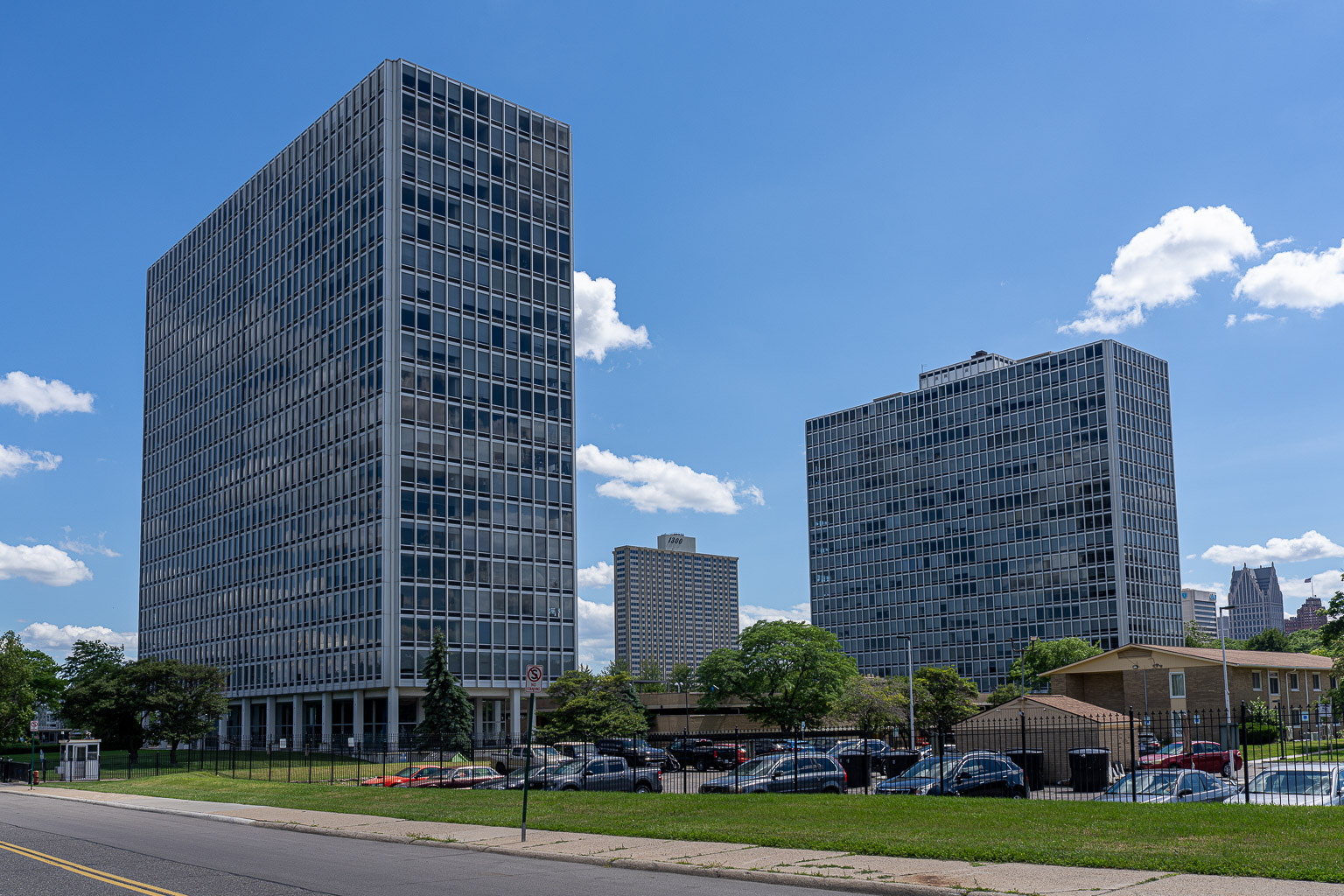
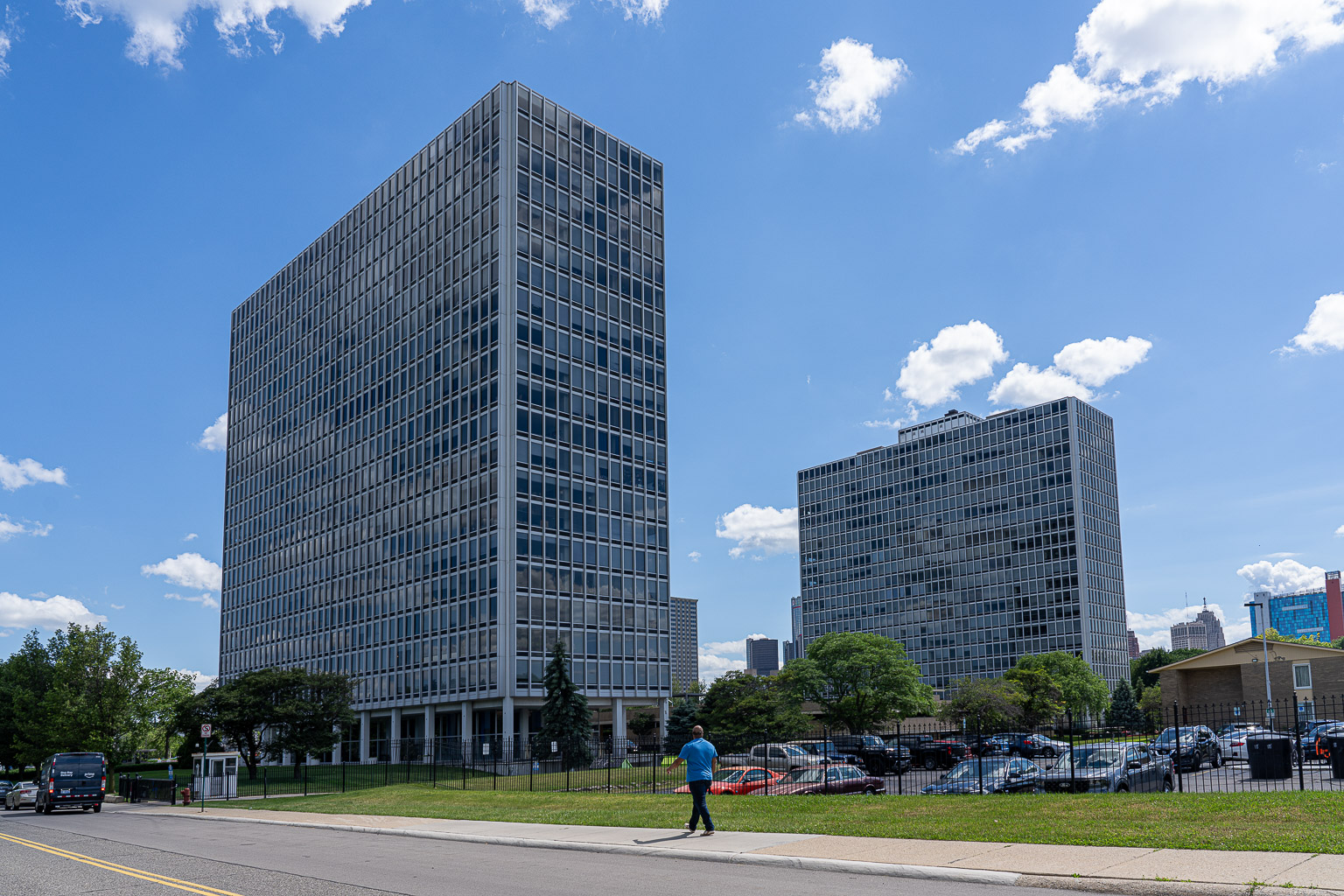
Lafayette Park is located immediately adjacent to the Central Business District, generally east of the Walter P. Chrysler (I-375) expressway, north of East Lafayette Boulevard, west of the Grand Trunk Railroad right-of-way, and south of Gratiot Avenue and Eastern Market. It is a primarily residential community composed of several separate developments positioned around a central park. A public school and a shopping center are located on East Lafayette Boulevard. The residential buildings designed by architect Mies van der Rohe - the Pavilion, Lafayette Towers, and the townhouse cooperatives - and the park that connects them, are listed on the National Register of Historic Places as the Mies van der Rohe Residential District, Lafayette Park. To the immediate east of the proposed district are two historic reinforced concrete bridges over the Dequindre rail cut that are also included on the National Register, listed as Antietam Street, Grant Trunk Railway and Chestnut Street, Grand Truck Railway, as part of the multiple property nomination of Highway Bridges in Michigan.
Contents:
HISTORY: [+ expand]
The proposed Lafayette Park/Mies van der Rohe Historic District possesses exceptional importance in the history of community planning and development, modern architecture, and social history. In the area of community planning and development, the district has the distinction of being Michigan’s first urban renewal clearance project, designated UR Mich 1-1, Gratiot Redevelopment Project, and one of the first in the nation. Its site plan was developed as a remarkable collaborative effort by Herbert Greenwald, the developer, Mies van der Rohe, architect, Ludwig Hilberseimer, city planner, and Alfred Caldwell, landscape architect.
In the area of architecture, the twenty-six residential buildings by Mies van der Rohe—his only works in Michigan and the largest collection of his buildings in the world—are excellent examples of the methods, materials, and ideas that this world-renowned master architect used in his later works. The district’s townhouse complex is unique among his works, for it is the only group of rowhouses ever built to his designs. Other buildings designed by other architects, such as Chateautfort Place, Chrysler School and Lafayette Towers Shopping Center, are International Style in character (in keeping with the example set by Mies) and were sited within the Mies-Hilberseimer Plan. The manmade aspects of the district - its architecture, layout, and landscape design—have been key ingredients in the desirability of Lafayette Park today.
In the area of social history, Lafayette Park is significant in terms of the history of urban renewal and the involvement of the labor and civil rights movements in bringing it to fruition. As was often the case, it took several years, court cases, legislation, several developers and major changes in scope to be realized.
Social History
Built on the site of the former Black Bottom community (named for its rich, loamy black soil), Lafayette Park was the outcome of a city plan to counter the flight of middle–and upper–income families to the suburbs by creating a community that would attract people of diverse backgrounds. Ironically, this area previously served a diverse community. Beginning in the 1880s through the 1900s the district served as a "port of entry and stopping off place for much of the city’s foreign born." By 1915 blacks shared this neighborhood with Detroit’s Italian, Greek, and Russian Jewish newcomers. However, by the late 1920s racial prejudice coupled with restrictive covenants and real estate codes prevented the majority of blacks, especially the new arrivals, from finding housing anywhere in the city outside of this "east side district." By this time the term, "Black Bottom community," was used only in reference to the southernmost section of the district, a three–square mile portion of the near–eastside which was home to over 500 African American families.
Immediately after World War II, Detroit was faced with two problems then prevalent in other cities across the nation: the deteriorated state of old, inner-city residential areas, which had gone into decline during the depression of the 1930s and become overcrowded and increasingly rundown during the war years; and the exodus of middle-and upper-income families to the burgeoning suburbs, which posed a threat to the city’s tax base. These problems gave rise to a nationwide movement for urban renewal, and Detroit was among the first cities to take action. In 1946, in an innovative move that was soon tested in the courts, city officials proposed to acquire a large tract of land a few blocks east of the central business district, raze all buildings on it, and resell it to local builders to develop as rowhousing for low–and middle–income families. In the city’s view, this area, inhabited mainly by African Americans "in the... lowest income groups," contained Detroit’s "worst slums," and the new tax dollars garnered through its rejuvenation would more than pay for the city’s expenditure on land acquisition and clearance. Initially known as the Gratiot Redevelopment Project, the site ultimately became known as Lafayette Park.
Condemnation proceedings began in February, 1947 and demolition started three years later. By 1953 only Leland School, the Barstow School (later demolished) and a church were left on the 129 acre site. According to the City of Detroit, Detroit Housing Commission Final Project Report dated June 30, 1964, the Gratiot Redevelopment Project resulted in the necessary relocation of 1958 families and 989 single persons living in 1550 dwelling units. Within the 43–block project area, more than 90% of the housing stock had absentee owners.
Not until 1956 was any new development built on the cleared site. Contributing to the delay was a decided lack of interest on the part of developers. Despite the National Housing Act of 1949, which encouraged private enterprise in urban redevelopment, local builders remained wary of the city’s redevelopment plan. Convinced that middle–income families would never move into this area, especially in view of the older neighborhoods that still abutted it, they advocated high-density high-rises for low-income families. By 1952, the city had evolved a mixed–density site plan aimed at providing housing for both low–and middle–income families. When the city put the land up for sale at public auction that year, it received not a single bid. Another auction a year later did produce a developer, but the deal ultimately fell through. Finally, in 1954, after Walter Reuther, president of the United Auto Workers, began applying public pressure, city officials appointed a citizen’s committee to take over the project.
Headlines in the local newspapers announcing "UAW Takes Lead in Housing Development," "UAW Offers $10,000 for Slum Project," and more heralded the union’s drive to move redevelopment forward. Corporate contributions to the effort followed. Reuther and his fellow officers of the UAW-CIO were interested in better housing for all people, particularly working men and women. He wrote in a telegram to Mayor Cobo that "The UAW-CIO is vitally concerned with the elimination of Detroit’s slums and in the redevelopment of blighted areas. The Gratiot-Orleans areas are both a challenge and an opportunity." In his telegram, Reuther expounded further on his belief that Detroit could develop a "model downtown residential neighborhood ...."
Composed of representatives from labor, industry, and commerce, the new committee was determined to avoid re-creating another low-income ghetto. Its goal, it announced, would be to establish "an integrated residential community of the most advanced design, of the highest possible [construction] standards; a community that, on a purely competitive basis, can attract back to the heart of the city people who are finding their housing in the outlying sections of the city and its suburbs." To draw up a plan for such a community, the committee engaged Oscar Stonorov, the designer of several "socially responsive" International Style housing developments in Philadelphia, and the well-known architectural firms of Victor Gruen Associates and Leinweber, Yamasaki, and Hellmuth. The plan this team produced had mixed–density housing arranged in patch–like fashion, cul-de-sacs as well as a cross street, and a grand avenue running north–south through the center of the area. With low–cost housing included in the mix, the Gratiot Redevelopment Project began to represent an ideal, an example of "democratic living." As told in a 1954 article in the Detroit Times, "Cobo OK’s New Gratiot Plan," Reuther believed the plan "presented an opportunity for Detroit to show how all classes and groups of people could live together in a democracy [and] provided the United States a chance to win millions of minds to the cause of the American way of life."
On the committee’s recommendation, a nonprofit corporation was formed to acquire, own, sell, lease or otherwise dispose of the land at the redevelopment site. Known as the Citizens Redevelopment Corporation (CRDC), it was financed by $500,000 in contributed capital. By 1956, at least one construction company had expressed interest in developing a portion of the site, but the CRDC, wanting to avoid piecemeal development, hired the Chicago-based firm of Herbert Greenwald and Samuel Katzin as exclusive co-developer. Herbert Greenwald was a dynamic and persuasive real estate financier, with whom Mies van der Rohe had been collaborating since 1946. As a result, Mies became the architect in charge of all redevelopment. Mies brought to the project his colleagues Ludwig Hilberseimer, city planner, and Alfred Caldwell, landscape architect. Mies and Hilberseimer’s "superblock" plan, while retaining the concept of mixed low- and high-rise housing, replaced the grand avenue of the earlier plan with a central park; it also eliminated the cross street. Because construction costs had been steadily increasing, it was concluded that it was not economically feasible to include low-cost units in the development, as originally intended. Thus, the community that emerged, while racially integrated, was not integrated in terms of income level; all residents were in the middle or upper-income brackets.
The agreement that the CRDC had with the city was that it would pay taxes and interest on the land the city had optioned to it, and Greenwald and Katzin would purchase the individual parcels as the construction progressed; all parcels were to be purchased by April 1960. The Pavilion was ready for occupancy in the fall of 1958, and construction of Mies’s townhouses began the same year. In February 1959, eleven months before the last of the townhouses was completed, Herbert Greenwald was killed in a plane crash. Without Greenwald's personal persuasiveness to back it, Mies and Hilberseimer’s original plan for Lafayette Park did not come to full fruition. The plan called for five more high-rise and sixteen more low-rise buildings, a school, community clubhouse and swimming pool, shopping center, and parking structures, all to be designed by Mies. While much of this was eventually built, the only Mies-designed complex built in Lafayette Park after 1960 was the Lafayette Towers.
As of May 1960, the Pavilion was 98 percent rented, but little more than a third of Mies’ townhouses had sold. The "urban pioneers" residing in the townhouses were, however, effusive in their praise of the "general plan and layout" of their dwellings, the view and light that the glass walls afforded, and the interracial character of the neighborhood, all of which kindled a good deal of interest (including that of local builders). By 1964 there was a waiting list.
Another major factor in the development of Lafayette Park was new federal legislation creating a quasi-governmental national housing mortgage corporation to move into the cooperative housing field. Large private investors would benefit from the availability of government guaranteed bonds exempt from state and local taxes; monies from the sale of these bonds would be used to provide loan guarantees and technical assistance to housing cooperatives and other nonprofit housing ventures for the construction of middle cost housing cooperatives. Labor unions, veteran groups and welfare organizations were the heaviest backers of low-cost financing for cooperatives. In addition to the developers of the Lafayette townhouse developers, those of Cherboneau and Chateaufort took advantage of the new legislation. Rental housing also got its fair share of federal attention, allowing for mortgage subsides and rental assistance for places like Four Freedoms House in Lafayette Park.
The Detroit Housing Commission had by then sold off the remaining lots piecemeal to various developers, each with a different architect and landscape architect. As Roger Montgomery, director of the Urban Renewal Design Center at Washington University, noted in 1965, "The result was about what might be expected. Plan Commission review, assisted by a voluntary architectural advisory board, prevented absolute chaos. The result is no disaster, but it is less attractive, and it functions more awkwardly than the completed part of the earlier scheme." Similarly, in its 1966 report, the Mayor's Committee for Community Renewal acknowledged that Lafayette Park had "an overabundance of architecturally and physically dissimilar structures," some of "mediocre" design. However, the aesthetic perceptions of the professionals and the public possibly differed; Montgomery noted in an article appearing in Architectural Forum in 1967 that, referring to the Gratiot Redevelopment Project, "... the man in the street approves of its architectural variety." He went on to say that "If Mies, or any other architect for that matter, had done it all it would have looked unmistakably like a project."
Mies van der Rohe, Architect
Widely regarded as one of the greatest architects of the twentieth century, Mies van der Rohe believed that the form of a building must be a clear expression of its structure, or construction, and the structure must incorporate what he called the "civilizing force" of technology—that is, it must reflect the "driving and sustaining forces" of its time. Mies' extensive use of steel, glass, and reinforced concrete in the later stages of his career, as evidenced in his Lafayette Park buildings, reflected his belief that these were the materials most expressive of modern technology. The clarity and simplicity of the interior features of his buildings—for example, the townhouses' open steel staircases—are also the result of his concentration on structure and his exclusion of anything not directly related to it.
Mies first used skeletal steel framing and the type of fixed utility core found in his Lafayette Park buildings in a four-story apartment building that he designed for the Weissenhof Settlement in Stuttgart, Germany, in 1927. As a result of this combination, he was able to create highly flexible floor plans. He continued his study of structure and liberated interior space in his famed Barcelona Pavilion of 1929 and Tugenhadt house of 1930. From 1931 until he immigrated to the United States in 1938, he pursued these ideas in a series of plans for single-family urban residences whose walled courts became part of the flowing space of the house; separated only by a glass partition, the interior space merged with the outdoors. Among these urban "courthouse" projects was one for a block of one-story rowhouses. Like most of Mies’ plans from the 1930s, it was never built. (After the Nazis took control of the German government in 1933, Mies' commissions dwindled to a trickle.) According to Franz Schulze (pp.188, 189), Mies' courthouse designs of the 1930s were "his most creatively significant endeavors." Although the one-story units at Lafayette Park differ in several respects from these 1930s plans, they clearly have their antecedents there, as both Schulze (p. 294), and Peter Carter (pp. 29, 122) acknowledge. Another plan related to the Lafayette Park townhouses was Mies’ rowhouse project of 1951. The projecting steel columns and brick end walls of the rowhouse prototype look much like those of the Lafayette Park townhouses - the sole instance in which Mies’ ideas for blocks of rowhouses were realized.
Mies’ first realized high-rise was Chicago’s Promontory Apartments, a 22-story concrete-framed building that was the result of his initial collaboration with Herbert Greenwald. In his second collaboration with Greenwald, Mies not only fulfilled visions of glass skyscrapers he had harbored since the 1920s but also made architectural history; the 26-story 860 and 880 Lake Shore Drive Apartments, erected on Chicago’s north side in 1948-51, were the first high-rise apartment buildings built almost entirely of glass and steel. Steel was used both in their framing and on their skins. In 1953, again working with Greenwald, Mies designed the two 27-story buildings of the Commonwealth Promenade Apartments in Chicago. The construction methods used in these buildings - reinforced concrete framing and glass and aluminum skins - were more economical than those used at 860 and 880 Lake Shore Drive; moreover, because aluminum is lightweight and can be easily extruded, it provided a means of housing individual air conditioning units (a feature lacking at 860 and 880 Lake Shore Drive) along a building’s perimeter. The Commonwealth Promenade Apartments thus became the model for Mies’ later apartment buildings including the Pavilion and the Lafayette Towers—to which they bear a very strong resemblance.
The Mies-Hilberseimer Plan
As Schulze (p. 292) has pointed out, Lafayette Park "came closer than anything Mies ever designed to a realization of his ideas of modern architecture in the service of modern American city living." Mies’ ideas about city living were evident as early as 1927 when he designed another mixed-density housing development - the Weissenhof Settlement in Stuttgart. A model project intended to produce dwellings that could be built at low cost, the Weissenhof Settlement included single houses, duplexes, rowhouses, and apartment buildings. (As noted, Mies designed only one of these buildings himself; the rest, were designed by other leading proponents of the Modern Movement. When the buildings were finished, their similarities led architect Philip Johnson and architectural critic Henry-Russell Hitchcock to coin the term "International Style.") In his initial plan of the site, Mies had the buildings set like interlocking blocks along the contours of a terraced hill, but since the city of Stuttgart wanted to sell the buildings individually after the exposition they ended up being free-standing. The free-flowing plan, which included traffic-free walkways that wound up the hill and gave onto open plazas, was a radical departure from the usual stiff arrangement of German housing projects.
When Mies met Chicago developer Herbert Greenwald in 1946, he evidently recognized in him not only someone willing to risk money on visionary architectural schemes but a fellow idealist as well. Determined to erect the finest structures that economic realities would allow, Greenwald was the developer of almost two-thirds of the buildings Mies designed in the 1950s. Greenwald was apparently a rarity in the annals of urban renewal - an entrepreneur who was able to reconcile private enterprise with public purpose. After Greenwald's death in 1959, Mies said "[He] began with an idea of the social consequences of his work, along the way he also discovered that he was a very good businessman."
Ludwig Hilberseimer, urban planner, also was concerned with the social consequences of his work. Well known for his theories of city planning, he believed that the city of the future, whose vastness could overwhelm the individual, would have to function "not just technically but also with consideration for the people living in it" (Wingler, p. 496). In Hilberseimer's city plans, polluting industries were located downwind of residential areas, neighborhoods of limited size had a maximum of open green space as well as facilities that made them largely self-sufficient, and pedestrian and vehicular traffic were segregated. In effect, Hilberseimer came to envision the city as a "decentralized suburb." A long-time friend of Mies, he was one of the architects who contributed designs for the Weissenhof Settlement in 1927. While Mies was director of the Bauhaus in Dessau and Berlin between 1930 and 1933, Hilberseimer served on that faculty, teaching architecture and construction design. After immigrating to the United States in 1938, he joined Mies at the Illinois Institute of Technology (IIT), where he became head of the department of city and regional planning. Lafayette Park was the only built project on which Hilberseimer and Mies collaborated.
Alfred Caldwell, the fourth major figure in the development of Lafayette Park, received his early training in landscape architecture under Jens Jensen, creator of the "Prairie Style" of landscape design. (Jensen was well-known in Detroit for his extensive work for the Ford family, including a garden for the Kanzler House in Indian Village.) Like Jensen's work, Caldwell's is characterized by curving paths, spacious meadows edged with indigenous species, and the use of such native trees as crabapples, dogwoods, and hawthorns to emphasize horizontality and stratification. As a young man Caldwell was also greatly influenced by Frank Lloyd Wright. In 1945, Mies, another admirer of Wright, hired Caldwell to teach architectural history and construction at IIT. (A much-revered teacher for over half a century, in 1995 Caldwell, at the age of 93, was still active as a visiting professor at IIT.)
With his colleague Hilberseimer, Caldwell shared a deep concern about the dehumanizing aspects of the industrial city, as well as a philosophy of urban development that emphasized environmental issues and the quality of life. He deplored urban renewal projects made up of "enormous boxes, tier on tier, ten stories high," which he believed would merely re-create the slums they were supposed to replace. The object of slum clearance, he said, should be to create a "city in a garden." Like Hilberseimer, he advocated areas strictly zoned for industry, commerce, and residences; for residential areas, he advocated the elimination of through traffic and the provision of as much green space as possible. "Tall buildings," he wrote, "should be placed far apart in the landscape with both parks and one story houses in the space between."
Lafayette Park was obviously a project well-suited to the talents and interests of Mies, Greenwald, Hilberseimer, and Caldwell. When the project began, the 78-acre site had been so completely stripped that only the street grid remained. With Greenwald's help Mies and Hilberseimer managed to get rid of even that, creating in its stead a residential area with no through streets, a spacious park devoid of traffic, and an inviting network of paths for pedestrians, who could walk to a shopping center, school, and recreational areas without having to cross a single busy street. In comparing the interconnecting green spaces of Lafayette Park with those Mies planned for the IIT campus, Spaeth (p. 139) observed that at both sites buildings "define but do not enclose exterior spaces," but the combination of low-rise and high-rise at Lafayette Park "creates a spatial richness not found at IIT." Caldwell’s design of a naturalistic landscape - which today provides a lush background and dappled shade for Mies’ still eminently "modern" architecture - completed the picture of "a suburb in the city."
Lafayette Park in the Context of Urban Renewal
With its comfortable suburban aura and mixed-density housing, Lafayette Park was the antithesis of the large, high-rise projects built in cities all over America from the 1940s through the 1950s, projects that became synonymous with "Urban Renewal." These developments of monotonous apartment towers set on vast tracts of land were intended to meet Hilberseimer’s requirements for a healthy environment: access to open space, sunlight and clean air. What they resulted in was an institutional environment where people felt cut off from the surrounding community and where the open spaces often became a "nocturnal no-man’s land." Typical of these was the Pruitt-Igoe housing project in St. Louis. Designed in 1958 by the St. Louis office of Leinweber, Yamasaki, and Hellmuth, it was demolished in 1973. Among the many other examples was Detroit’s Edward J. Jeffries Homes, a public housing project of 2,170 units that in 1955 began accepting some of the former occupants of the Lafayette Park site. Four of its towers were imploded in 2000.
An article in Fortune in October, 1964 observed that "the worst faults of renewal design appear in New York City, where high building costs....have dictated the postwar pattern of huge, identical apartment slabs separated by wide malls of grass upon which tenants and their children are forbidden to trespass. The effect is about as homey as Yankee Stadium on a Monday morning." The phenomenon was not limited to public housing projects. Under Robert Moses' direction, New York's early urban renewal projects had a decided middle-class slant, and by the early 1960s, they included such luxury high-rises as Kips Bay Plaza, designed by I.M. Pei. While acknowledging that Kips Bay avoided "slab monotony" the Fortune article pointed out that this renewal project, too, made no use of the open space around it for living purposes.
In 1965, of Lafayette Park Roger Montgomery wrote, "Now that people have lived in Mies’ settlement for more than five years, their behavior and the waiting lists demonstrate their affection for it. To the outsider, the design is consistent, powerful, and memorable....[Lafayette Park] joins Radburn, that other incomplete monument, as one of the few triumphs of American urban design." (Designed in 1927-29 by Clarence Stein and Henry Wright, Radburn, in northern New Jersey, incorporated some of the principles of the garden city propounded by Ebenezer Howard in Britain; in its separation of automobiles and pedestrians, it anticipated Lafayette Park by three decades). Montgomery’s observations about the residents’ affection for Lafayette Park were confirmed by two sociological studies based on interviews with the townhouse residents (see Lansing, Marans, and. Zehner, 1971; Wolf and Lebeaux, 1969).
Lafayette Park was described as a pocket of affluence in a June, 1975 article in the Detroit Free Press. It was described as wealthy, educated, integrated and liberal; "The democratic party’s Bloomfield Hills." Well know Detroiters living there at the time were several members of the administration of Mayor Coleman Young, Detroit’s first African American mayor, including Carol Campbell, Esther Shapiro, Harriet Saperstein, Sidney Rosen, Kermit Bailor, and William Deane Smith; labor leaders including Leonard Woodcock, Douglas Fraser, Horace Sheffield, and Irv Bluestone; Federal Judge Wade McCree and Recorders Judge George Crocket Jr.; television weatherman Sonny Eliot, and Ruth Belew, the first teacher in the emerging neighborhood’s school (precursor to Chrysler School), who lived in the Pavilion.
Montgomery’s praise of Lafayette Park has been echoed by many other members of the design professions over the years. In 1974, Peter Carter wrote that despite the negative effect that the introduction of other architects’ work had on the project, "the initial concept was strong enough to absorb the alien structures. So that Lafayette Park is today probably one of the most spatially successful and socially significant statements in urban renewal." In 1985, David Spaeth described it as "a prototype for future urban redevelopment, ...a new structure predicated on human values, disciplined but not dominated by the automobile." In 1986, Franz Schulze, while taking issue with the whole phenomenon of urban renewal in the 1950s and 1960s, acknowledged that Lafayette Park "was one of the handsomer endeavors of its kind."
At the local level, Lafayette Park served as the model for Detroit’s next major effort at urban renewal. Elmwood Park, contiguous to the Lafayette site, incorporated many of the features of the city’s pioneering redevelopment effort: a preponderance of low-rise townhouses based on the "courthouse" concept, a relatively small number of high-rise apartments and a good deal of open space. Far larger than the Lafayette site, Elmwood Park was also to include multiple "schools, churches, shopping areas, parks and playgrounds." In tacit acknowledgment of the mistake made in allowing the piecemeal construction of "architecturally and physically dissimilar structures" in Lafayette Park after Greenwald’s death, the Mayor’s Committee for Community Renewal, as it embarked on the Elmwood project in 1966, established a "design standard to provide for architectural quality, site parceling and compatibility of design." However, once again piecemeal development was the rule.
Summary
Lafayette Park did little in the way of reversing the flight to the suburbs. In other ways, however, it more than fulfilled the CRDC’s vision of urban renewal. That it is "an integrated residential community of the most advanced design, of the highest possible [construction] standards" has been borne out by sociological observations of its interracial character; by accolades from members of the design professions the world over; by professional real estate appraisals; and by low turnover and high occupancy rates that attest to the residents’ affection for their neighborhood. Unlike so many other post-World-War II urban renewal projects, this one fulfilled its promise of offering, "a new kind of city living."
The buildings of the district have experienced relatively few changes. Not many structures designed in the 1950s or 1960s have withstood the test of time as well; in their minimalist tendencies, they seem as modern today as when they were built. The changes that have occurred within the district to date have not significantly affected its original character, and it thus retains a high degree of historic integrity.
DESCRIPTION
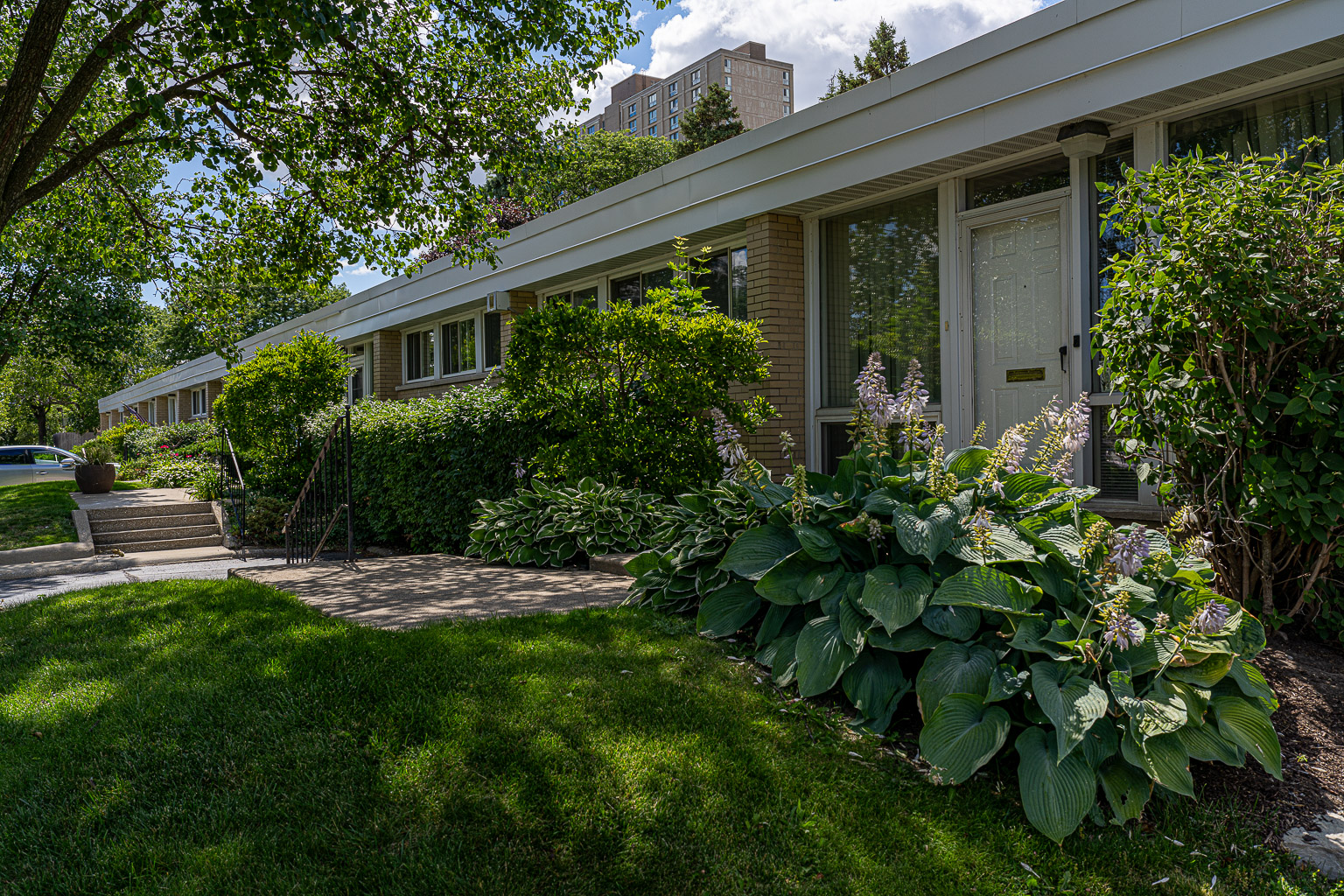
Lafayette Park is the outcome of an urban renewal project that was launched in 1946. The section bounded by Lafayette Avenue, Rivard, Antietam, and Orleans streets occupies about 78 acres and is based on a "superblock" plan that Ludwig Mies van der Rohe and Ludwig Hilberseimer devised in the mid-1950s. Closed to through traffic, it has a thirteen-acre city-owned park running through its center. This sweep of green is dotted with trees and contains playing fields, tennis courts, and a series of curving walkways. On its periphery are eight housing complexes, a shopping center, and a public school. Although Mies van der Rohe was to have designed all of Lafayette Park’s buildings, only the high-rise Pavilion Apartments, the twin Lafayette Towers, and the low-rise Mies van der Rohe Town Houses and Court Houses were built to his specifications. With their skeletal framing, aluminum and glass "skins," and spare, open interiors, these buildings typify Mies’ distinctive post-World War II style. Together with the park that connects them, all of the buildings within the boundaries identified above are significant parts of the larger whole. Set in a naturalistic landscape designed by Alfred Caldwell, the area has often been described as a "suburb in the city." The thoughtful planting scheme, open green space of the park, scale and placement of buildings, and relative absence of cars are among the factors that help define the uniqueness of Lafayette Park.
Owned by four cooperative associations, the townhouse complex was built in 1958-60 on an eighteen-acre site west of the central park. Its twenty-one buildings accommodate 186 units. Four of the buildings are one-story and contain "courthouses" units with walled courtyards in the rear. Approximately 218 feet long and 42 feet deep, each of these buildings houses six units. All other buildings are two-story. Fifteen of these contain ten units each and are about 182 feet long and thirty-eight feet deep. The remaining two buildings both contain six units; they have the same depth as the other two-story structures but are roughly 110 feet long.
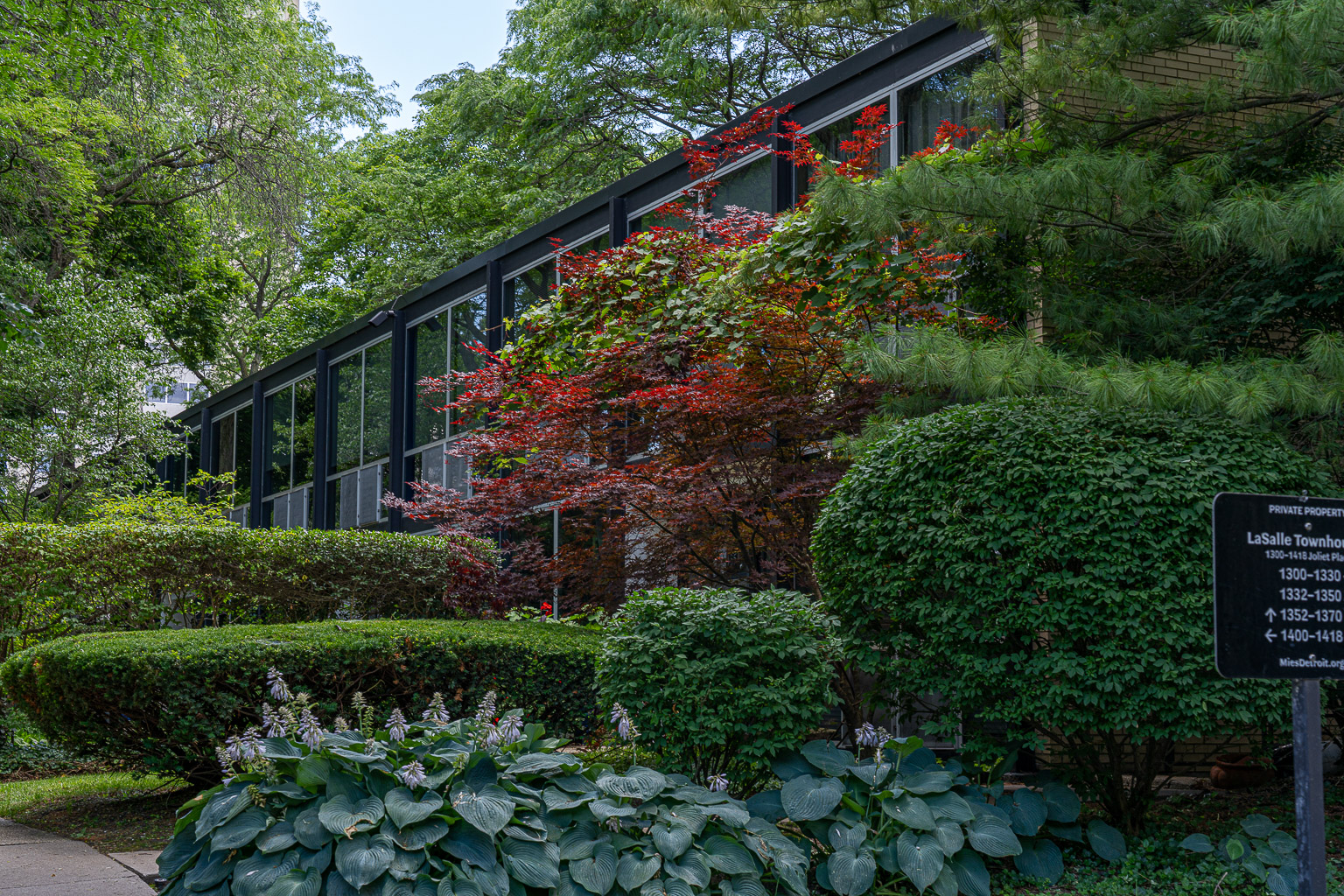
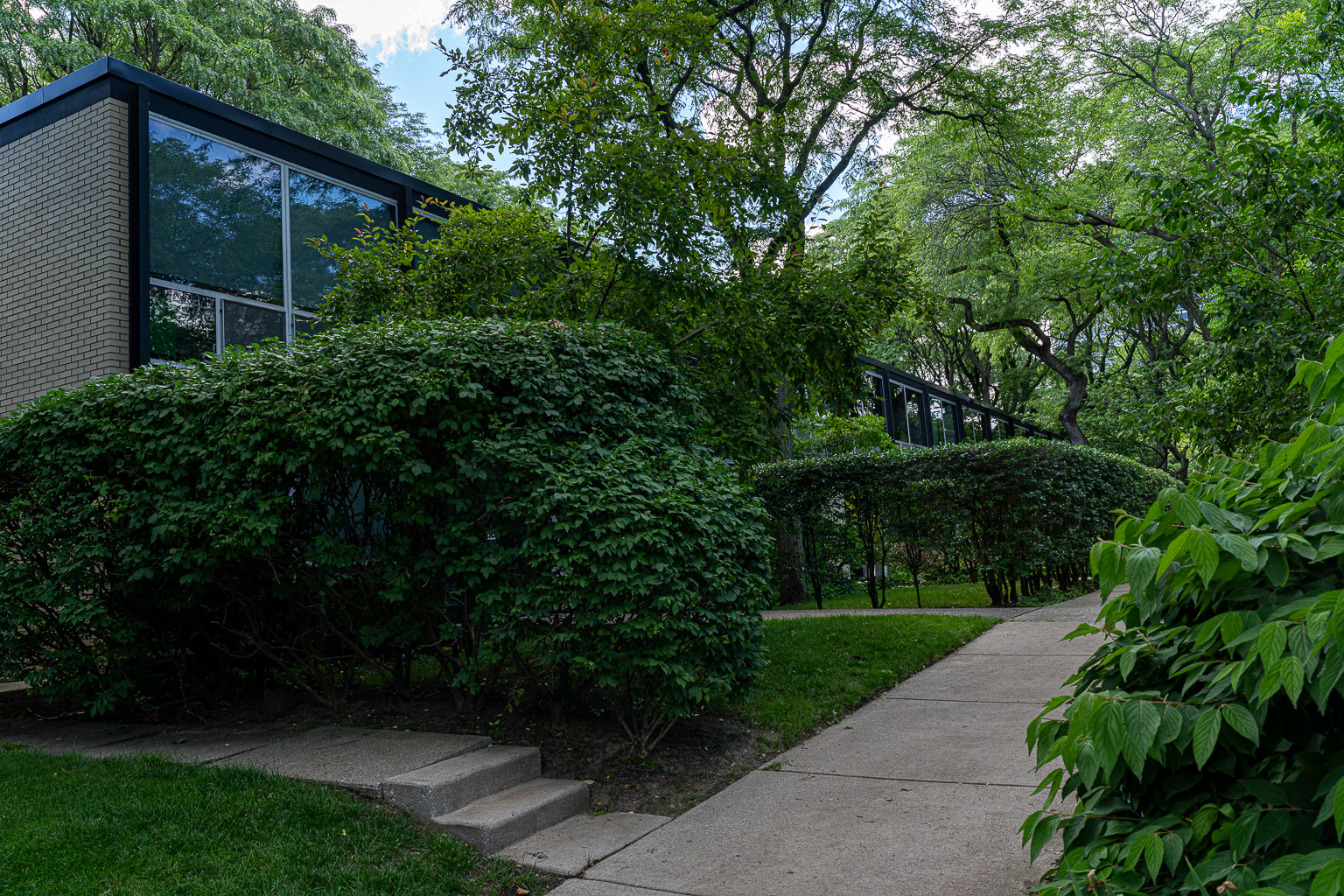
All buildings have poured reinforced concrete foundations and a framework of welded steel. In typical Miesian fashion, proportions are carefully calculated and the structure of the buildings is undisguised. Projecting wide-flange steel columns punctuate the 12-foot bays of front and rear elevations. Where they not only provide structural support but are aesthetically pleasing as well, they are painted black, as are the wooden doors in the recessed entryways at the front of the townhouses. Between the steel columns the buildings are enclosed by a skin of light gray glass in clear-anodized aluminum framing. End walls are of buff-colored brick. The flat roofs are made of long span steel decking and insulation on steel beams and built-up roofing materials; floors above the basement level are similarly constructed. Basement floors consist of concrete on grade.
The courthouses have from two to four bedrooms; the two-story units have three. In contrast to the "partitioned" bedrooms, living and dining areas are open. Though these areas are fairly compact, particularly in the two-story units, their floor-to-ceiling glass walls open them to the outdoors and create a spacious effect. Another characteristic Miesian feature is the walled "core" that separates the living and dining areas in the two-story units. The core contains heating ducts and plumbing, encloses a half bath and large closet, and screens one side of the walk-through kitchen. The door frames in all units reach to the eight-foot ceilings, which increases the sense of space. Yet another space-enhancing feature - one found in several of Mies’ other buildings - is the open steel staircase with Mies’ classic railings. Each unit has a full basement with a door opening onto an underground service corridor that runs the length of the building.
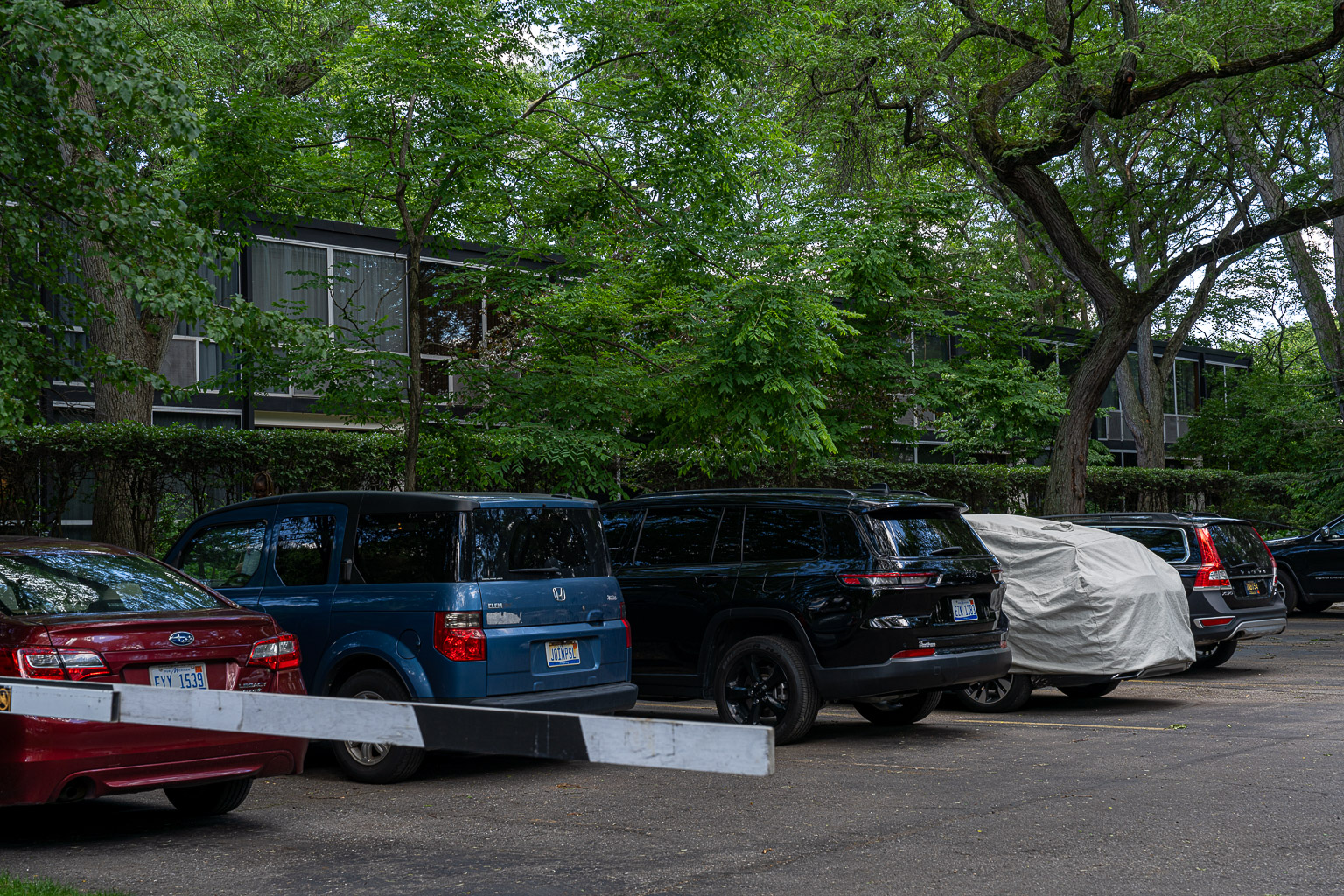
A network of footpaths links all areas of the townhouse complex and also provides access to the park. Like the park, the complex has no through traffic, nor does it have parking garages. Two public cul-de-sacs (Nicolet Place and Joliet Place), each with a tree-lined median, and three driveways into parking lots provide the only means of automobile access. These roadways, together with all parking areas, are about four feet below grade level. Commenting on this feature in May 1960 Architectural Forum, it was noted that "the camera... cannot convey the deftness with which Detroit’s own strident contribution to the world’s landscape, the automobile, has for once been digested into a city street scene, instead of being allowed to dominate it."
Mirrored in the glass walls of the townhouses, Ca1dwell’s naturalistic landscape further reduces the impact of the automobile, and with its free-flowing informality, it also makes an excellent counterpoint to the austerity of the architecture. Various types of native trees and shrubs delineate open and sheltered areas and provide screening. Honey locusts with their fernlike foliage dominate the canopy; the understory includes flowering crabapple, dogwood, lilac, and viburnum. Hawthorn hedges demarcate the small front lawns of the two-story units, and at the rear of these buildings are long swaths of grass. Toward the center of the complex, situated between two buildings, is the "meadow," a fairly open green. On the east side of the complex, between other sets of facing buildings, are more open areas, two of which contain playgrounds.
Together with the landscaping, the layout of the townhouse buildings defines the exterior spaces but does not enclose them. The overall effect is one of considerable privacy and intimacy, to which the scale of the buildings, the cul-de-sac road system, and the suppressed parking contribute. With a density of almost twelve units per acre, the townhouse complex in 1960 had what Architectural Forum described as an air of "comfortable repose." As Caldwell’s trees and shrubs have matured, that feeling has increased.
Well-maintained and in good condition, the townhouse complex has experienced relatively few exterior changes. The natural maturing of its landscaping has been the most noticeable one, but over the years, each of the four cooperative associations has also made some landscaping changes, including the construction of berms and wooden fences, the introduction of nonindigenous species, and the planting of bulbs and annuals around the bases of trees and shrubs. Although the landscape is no longer as open as in Caldwell's original plan, honey locusts with an understory of other native trees and shrubs still predominate. To eliminate condensation on the window walls and improve thermal efficiency, original single pane glass has been replaced with thermal pane glass. Other exterior changes to the townhouse complex include the installation of handicap-access ramps, the replacement of some sidewalks with new ones of a different composition, and the addition of a storage shed in the early 1960s. (Although Mies did not design the shed, the plans for it were approved by his office. Built of buff-colored brick, it is roughly eighteen feet square and eight feet tall and is situated at the end of a suppressed parking lot, where a terrace was dug out to screen part of its side and rear walls.) So far, these changes have not altered the original character of the property.
With their reflecting walls of glass visible above the treetops of the townhouse complex, the Pavilion and the Lafayette Towers make a dramatic backdrop. While echoing the precise proportions of the townhouses, they also delineate exterior space and provide spatial variety. Twenty-two stories high, all three of these buildings are rental properties.
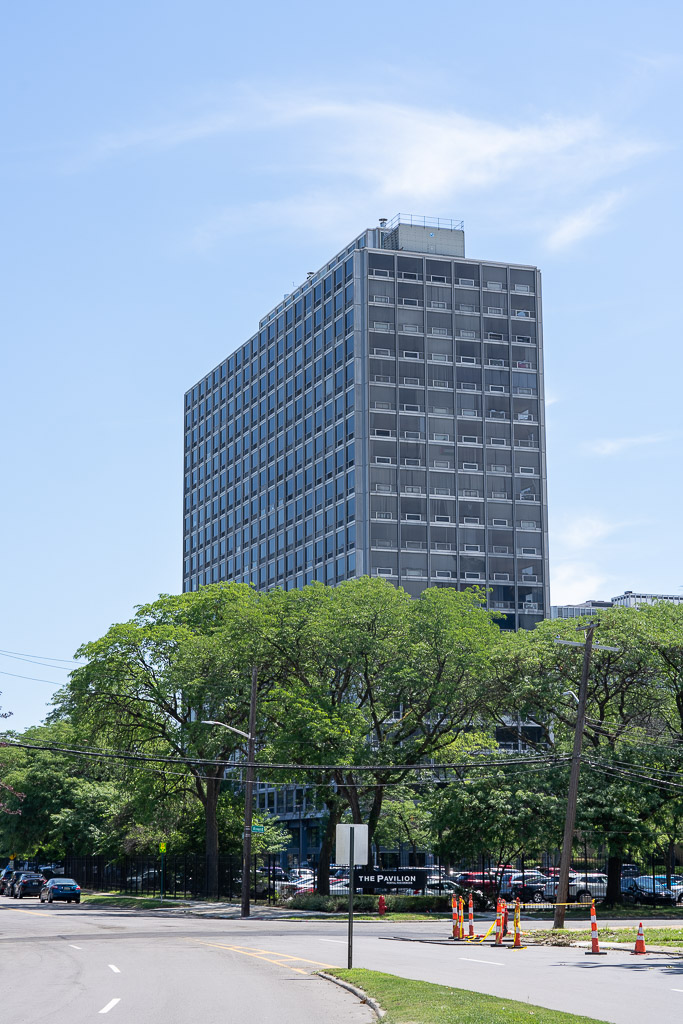
The Pavilion was built in 1956-58 on a five-acre site abutting the townhouse complex on the north. The twin Lafayette Towers, whose site covers roughly ten acres east of the park, were not built until 1963, by which time Mies van der Rohe was no longer the architect in charge of the redevelopment project. The towers deviate from Mies and Hilberseimer’s initial site plan in that rather than being offset from each other, they are parallel and have a low-rise parking structure between them.
Clad in skins of gray-tinted glass and natural-colored aluminum components, all three high rises are of reinforced concrete slab construction. Rectangular in plan, they have overall dimensions of about 66 feet by 206 feet, and each contains between 300 and 340 apartments. Their structural bays are 20 feet square. The Pavilion has two windows per bay; the Lafayette Towers have four, which from a distance gives them a more vertical appearance. Beneath the windows of the Lafayette Towers are cast-aluminum screens that protect a recessed housing for natural ventilation, and individual air conditioning units. The Pavilion has central air conditioning; for natural ventilation, its windows have a hinged bottom panel that can be opened inward.
Each building has one floor below grade. The Lafayette Towers’ ground floors are approximately sixteen feet tall, the equivalent of two stories. The glass walls that enclose the ground floors are set well back from the buildings’ perimeters, so the outer structural columns stand exposed. The Pavilion has a similar exterior configuration, but on its interior, only the lobby is two stories high; the remainder of the building has a second floor, which is used as storage space. A tier of translucent panels encloses the second floor; another tier encloses most of the first floor, where the panels screen various service areas, among them a small grocery store. (Quite a few of the panels appear to have been replaced.) The area around the Pavilion’s lobby entrance is enclosed with gray-tinted glass. Soffits on all three buildings are of cement plaster. The Pavilion’s soffits and columns are painted a putty color; the Lafayette Towers’ are white. Roofs are structurally like those of the townhouses, and on top of each tower is a penthouse containing mechanical equipment
Verde antique marble covers the walls of the Pavilion’s lobby, as well as the elevator cores in the Lafayette Towers’ lobbies. All lobby floors are paved with terrazzo (a carpet now covers most of the Pavilion’s lobby floor). The Pavilion’s terrace is paved with concrete; the Lafayette Towers terraces are of terrazzo, some of which has crumbled and been replaced with concrete.
All buildings have studio and one-and two-bedroom apartments; the upper floors of the Lafayette Towers have three-bedroom units as well. As is typical of Mies’ apartment floor plans, the elevators, stairs and service shafts are located along a central access corridor. Kitchens and bathrooms are also near the centers of the buildings, away from the window walls. Though compact, the apartments have a spacious feeling because of their layouts and large expanses of glass.
The parking structure that lies between the Lafayette Towers has two levels, one below grade, and walls of buff colored brick. On its roof is an outdoor swimming pool. The entrance to the structure is in the rear (i.e. the north side), where the site slopes downward. This area also contains a below-grade parking lot. Another parking lot at street level occupies the area in front of the parking structure. On the-east-and west sides of the complex and in front of each tower are lawns planted with a variety of trees and shrubs.
The Pavilion has no parking garages. Its parking lots are at street level and occupy most of the site. Between the lots on the east side of the building are an outdoor swimming pool and bath house enclosed by a buff-colored brick wall. Designed by Mies, the pool complex was added in 1962. A small, grassy picnic area enclosed by a low metal fence lies just east of the building. Landscaping consists primarily of honey locust trees that dot the edges of the parking areas. In front of the lobby entrance on Lafayette Plaisance—the cul-de-sac that provides the main access to the property—are a raised planter and two bermed areas planted with honey locusts. A partially beamed strip of turf runs along the southern property line.
Although the Lafayette Towers' parking facilities and terraces presently appear in need of some repair, the twin buildings seem in good condition and have experienced no noticeable alterations. The Pavilion also looks largely unaltered and in good repair. Changes to the grounds of the Pavilion include the recent substitution of a parking lot for a lawn on the north side of the building and the erection of an eight-foot imitation black iron fence around most of the property. Intended to prevent car thefts, this fence seems at variance with the flow of space that characterizes most of the Mies van der Rohe - designed property. Otherwise, the historic integrity remains largely intact.
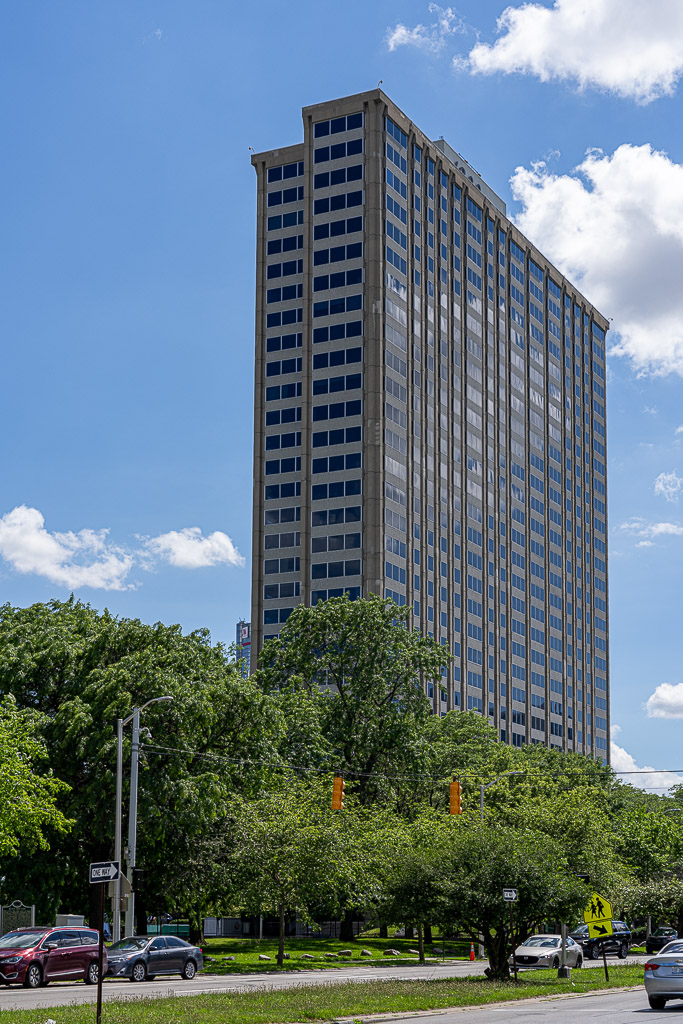
1300 Lafayette is not in the historic district report, but seems to me to be as important as Lafayette Towers. You can read more about it at Wikipedia.
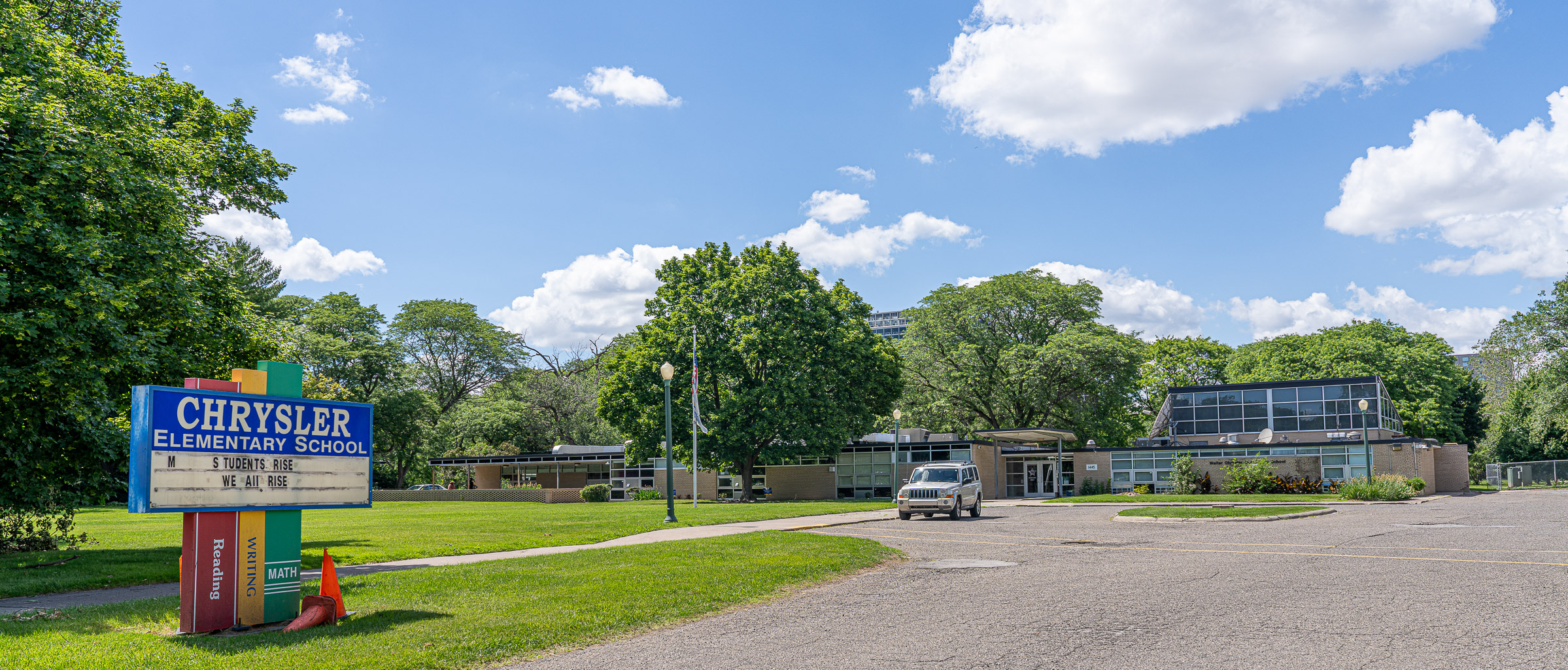
Chrysler School is a one story masonry and steel building measuring 222 feet x 132 feet set back deeply on the north side of East Lafayette Boulevard, providing a grass turf front yard. Its estimated construction cost at the time the building permit was issued to the Detroit Board of Education was $322,000. (Gould, Moss & Joseph, Architects, 1962, permit #10263, 4/3/61).
In the summer of 1959, the Plaisance Realty Company in the Lafayette Park area offered a new townhouse at 1362 Nicolet to the Detroit Board of Education as a temporary school for the emerging new community. On September 9, 1959 Chrysler School opened with fourteen students in grades one through eight taught by Ruth M. Belew. This one room school near downtown Detroit received considerable publicity in the local media and national magazines. In February of 1960, a second townhouse at 1364 Nicolet was offered for the second semester of the 1959-60 school year, and a kindergarten was added. In that same month, Dr. S. M. Brownell, Superintendent of Schools, organized the Chrysler Elementary Project Advisory Committee to plan for the new school. Parents Kermit G. Bailer, Mrs. Joseph Busch and Mrs. Frank Klactke were appointed to the committee, as well as Jacqueline Joseph, architect, and others. At the end of the first school year, Lafayette Park Plaisance Realty required the board to vacate the Nicolet townhouses, and offered two others at 1364 and 1366 Joliet. On April 18, 1961 ground was broken at 1445 E. Lafayette for the present Walter P. Chrysler Elementary School.
The architectural design of Chrysler Elementary School followed the minimalist lead of the Mies-designed buildings nearby. Its pronounced horizontality is emphasized by its flat roof. The eastern section of the front facade is composed of an aluminum-framed glass window wall that projects forward of the plain brick recessed entrance section to its west. A similarly framed, large glass shed dormer projects from the roof above the window-wall. Two spaced aluminum and glass, floor to ceiling window sections to the west of the front doors are joined together by a horizontal row of windows. The east and west sections of the front facade are unified by a continuous row of rectangular, aluminum-framed glass panels beneath the roofline that extend westward to form the fascia of the porch roof. Steel beams provide vertical supports for the roof overhang on the western porch section, and other structural elements are exposed.
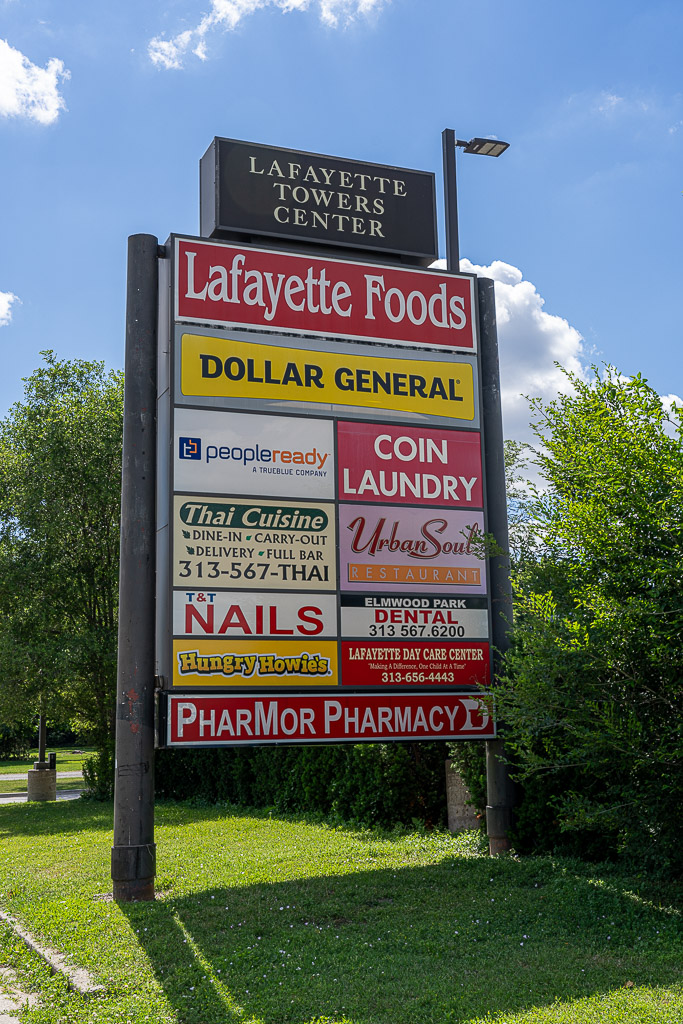
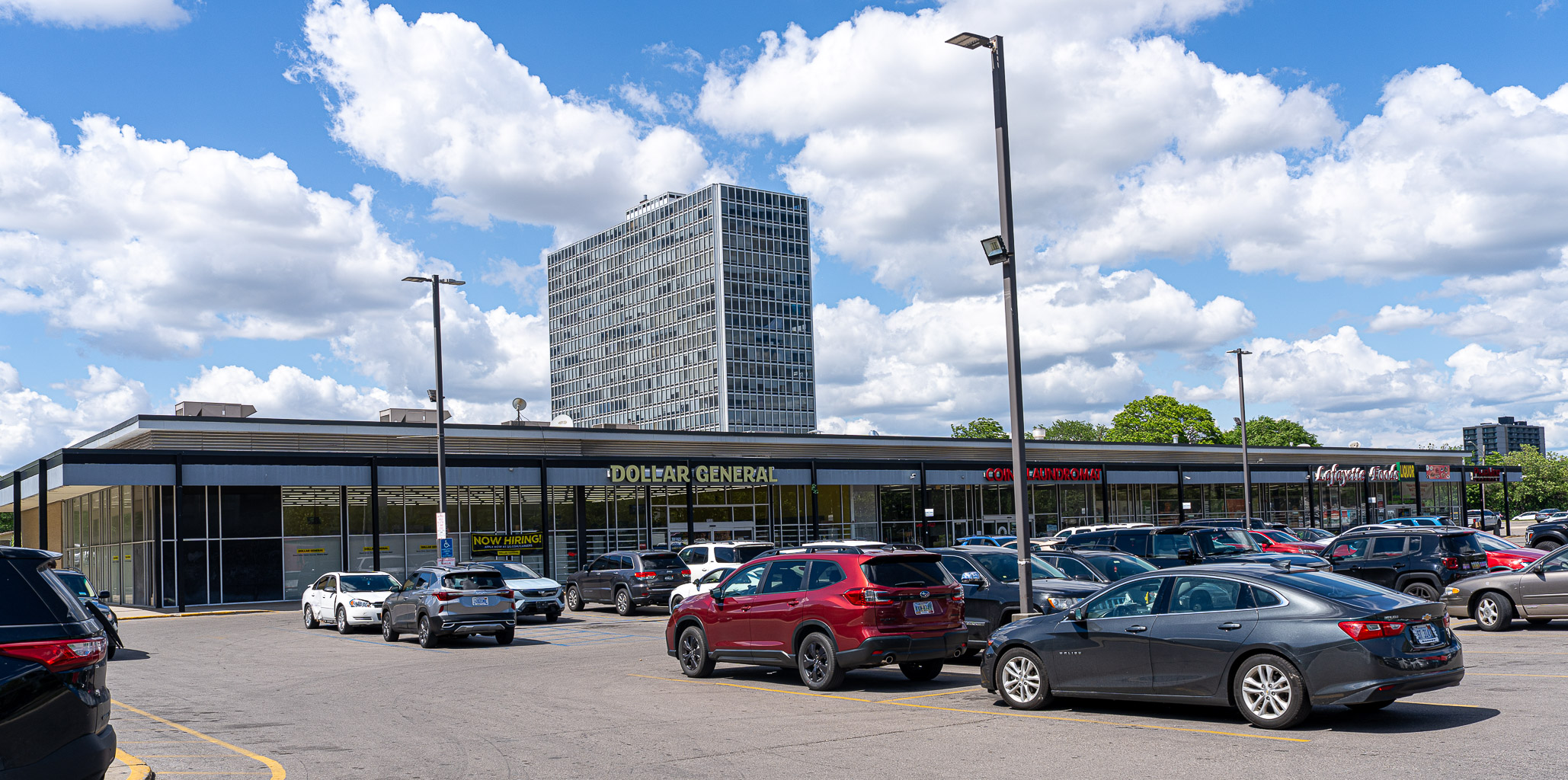
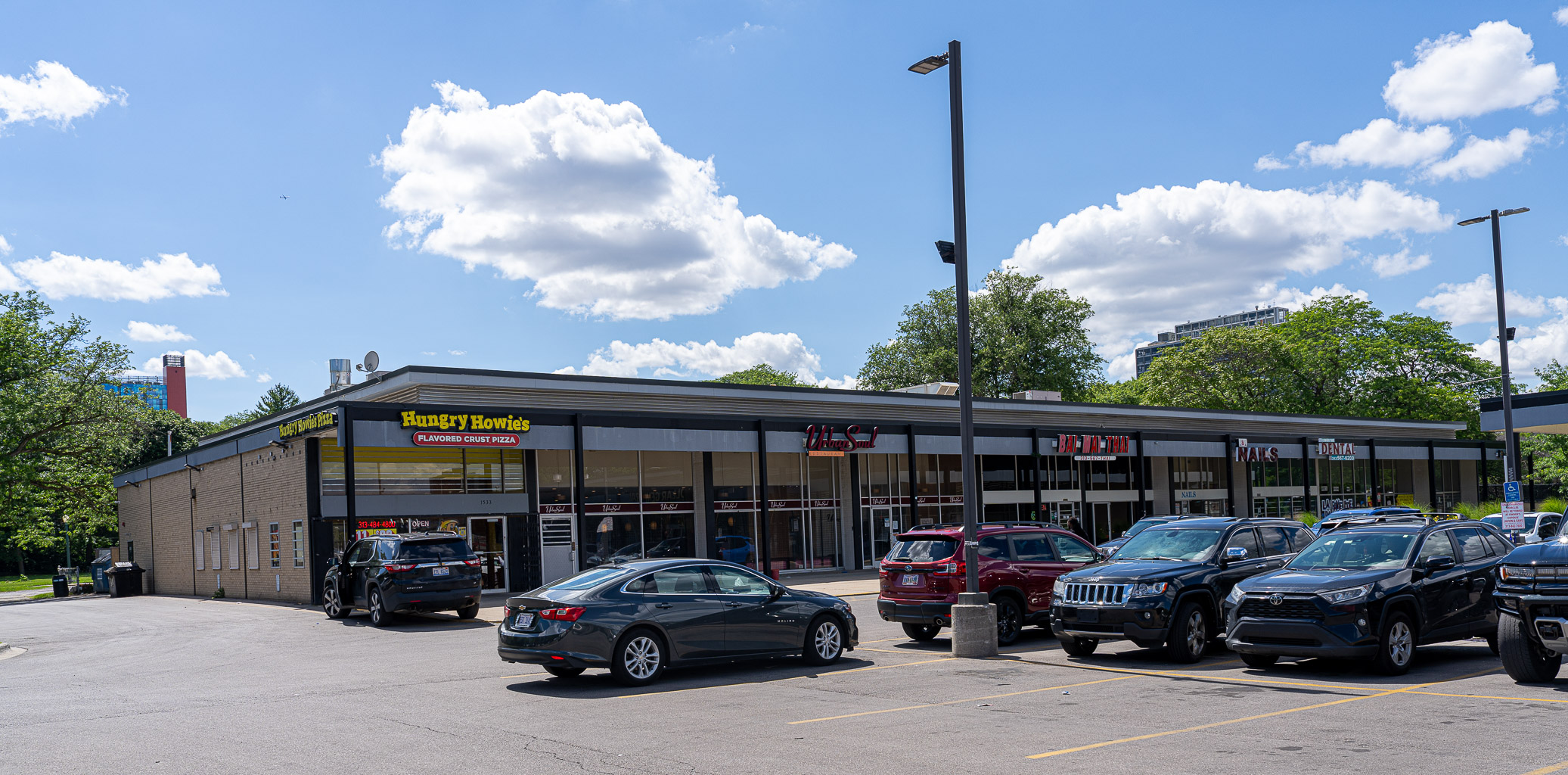
A shopping center positioned at the corner of E. Lafayette and Orleans was a significant component of the Mies-Hilberseimer plan. Its location, at the edge of the Gratiot project but in the middle of the larger urban renewal area subsequently built known as Lafayette/Elmwood, together with its pedestrian-friendly arrangement, were meant to provide a "town square-like" atmosphere. According to a press release issued on February 1, 1956 by the Greenwald-Katzin development team, commercial facilities built within the redevelopment area were for the "...convenience of the people in the development."
Beginning in the mid-1930s, housing projects with federal government involvement included a shopping center as an integrated business development, not just a collection of shops. The Federal Housing Administration encouraged such facilities so that commerce could be contained and controlled, both visually as well as in business terms, rather than sprawl onto nearby arterial strips. The FHA continued to push for this component in postwar developments of any size, which explains why so many tracts came with adjacent shopping centers. This policy appears to have carried over into urban renewal projects as well.
The entire Lafayette Towers Shopping Center was developed at the same time and by the same interests as the twin Mies van der Rohe-designed Lafayette Towers apartment buildings; building permits were issued to Robert E. Johnson on January 31, 1962 for both the shopping center and residential towers (permit #s 21454, 21455, 21456 for the shopping center, and #s21457 and 21458 for the apartment buildings). Johnson worked for A.J. Etkin Construction Company, general contractors and one of the investors in this multi-use project. Another investor was Samuel Katzin, co-developer with Herbert Greenwald of the Gratiot Redevelopment Project. Although built to the designs of a different architect, the shopping plaza was planned and executed as an integral part of the entire redevelopment effort even after Greenwald’s death.
Lafayette Towers Shopping Center was designed by the local architectural firm of King and Lewis, according to its construction documents. Another major commission by that firm was the Ponchartrain Hotel on West Jefferson Avenue in downtown Detroit (1963-65). Harry S. King, the president of King and Lewis, was born in Detroit, attended Cass Technological High School, served in the U.S. Army during World War II in the Pacific Theater, and attended Wayne State University and Lawrence Institute of Technology, before joining Albert Kahn Associates, Architects & Engineers, Inc. (of which his father, Sol King, was president). He also worked at Charles N. Agree, Inc. and was the chief draftsman for Theodore Rogvoy Associates, specializing in commercial design, before partnering with Maxwell Lewis to form King and Lewis Architects, Inc. in 1955. First located in Livonia, King and Lewis moved their architectural offices to the second story of the office building (Building C) in the Lafayette Towers Shopping Center in 1963 when it was completed.
The plans for Lafayette Towers and Shopping Center were first announced in June, 1960. According to an article appearing on October 16, 1961 in the Detroit Free Press, "The Shopping Center is thought to be the first in the nation to be built in a downtown area." While there were likely earlier examples, including that of Lake Meadows on Chicago’s South Side (1957-58), Lafayette Park Shopping Center appears to be, according to Richard Longstreth, noted architectural historian and author of City Center to Regional Mall, "... of high caliber and a now increasingly rare survival of its period."
Consisting of three independent buildings, the 4.5 acre site also has a substantial parking lot in front and a wide, paved open pedestrian walk-way between buildings where they do not abut the main parking lot. Building A, constructed at an estimated cost of $260,000, is the one story structure generally oriented north-south on the west side of the property that houses a number of storefronts of glass in aluminum frames with panels of oak veneer or cypress above and entrances varied in their placements. The concrete block rear and end walls are faced in light-colored brick. A metal structure serving as a canopy supported on steel tube columns extends over the width of the front facade in its entirety, as it does on the glass-faced west and south (front) elevations of Building B. A restaurant, frame shop/art gallery, and coffee house are among the current businesses occupying the building.
Building B, constructed at an estimated cost of $420,000, is one tall story high. Its plate glass windows extend to its ceiling between piers and a sill wall faced with white brick. Above the windows are louvers and a fascia with porcelain enamel panels. Entrance doors are aluminum and glass. The largest space in Building B was originally built out for an A&P supermarket; it is still occupied by a supermarket but under different ownership. Also in Building B is Richards Pharmacy, the last of the original tenants to remain.
Building C, constructed at an estimated cost of $460,000, is a two-story glass and masonry office building closest to the street and the middle of the site; it contains retail space on the ground floor formerly occupied by a bank, and offices above. Different in appearance from the other two buildings, it features precast concrete columns and panels with exposed aggregate, much the same as the exterior walls of the lower levels of the Ponchartrain Hotel, which are clad in precast, exposed aggregate panels and glazed brick and have aluminum with glass above. Like Mies’ apartment buildings nearby, the second story of Building C is supported on columns, thereby overhanging the first floor.
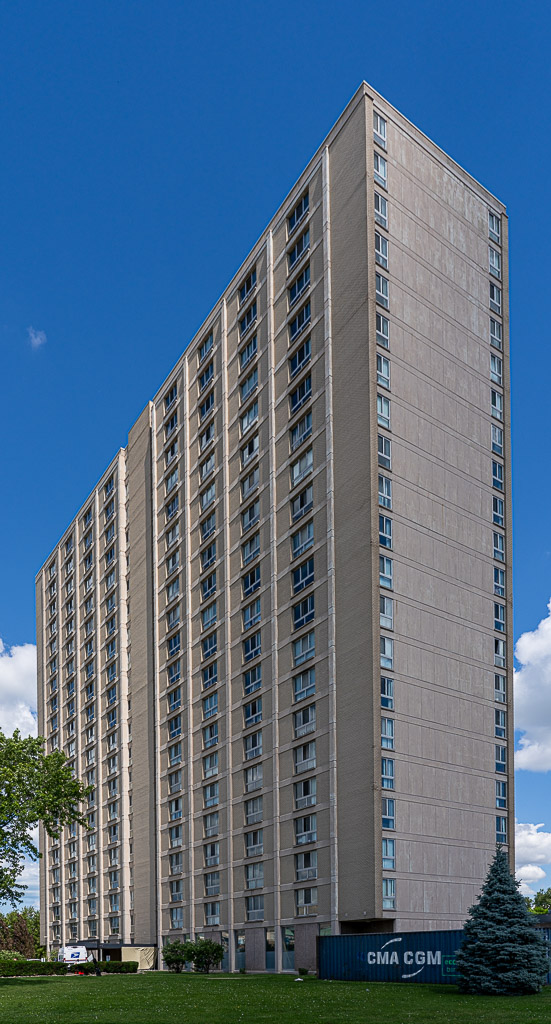
Located at the north end of Lafayette Park and oriented towards Antietam, Four Freedoms House/Windsor Tower is a twenty-one story, 320 unit apartment building for senior citizens, with an underground parking garage. Sponsored by a group of labor unions, the Four Freedoms was erected as a response to the need for housing for the elderly and the availability of federal mortgage subsidies for such housing.
There are at least three other Four Freedoms Houses in the country, all subsidized seniors high-rises. They are in Seattle, Philadelphia and Miami. Like Detroit’s version, they were named in recognition of the Four Freedoms outlined in President Franklin Delano Roosevelt’s speech to the members of the Seventy-Seventh Congress on January 6, 1941. He referred to the "four essential human freedoms" of (1) "freedom of speech and expression" (2) "freedom to worship god in one’s own way" (3) "freedom from want, which, translated into world terms, means economic understandings which will secure to every nation a healthy peacetime life for its inhabitants," and (4) "freedom from fear, which translated into wold terms, means a world-wide reduction of armaments to such a point and in such a thorough fashion that no nation shall be in a position to commit an act of physical aggression against any neighbor."
The Four Freedoms House in Detroit was designed by John Hans Graham & Associates and opened for occupancy in 1965. The building permit was issued to James Savage Corporation with offices in the Fisher Building. Four Freedoms House was listed as the owner, with a New York City address (building permit #49608, 2/28/64). The building changed hands in 2002 and was renamed The Windsor Tower.
The front facade of this substantial masonry apartment slab is symmetrical; its eight bays of windows (composed of two horizontal panes across the bottom of the opening and three vertical panes above), central core, and twenty-one floors are defined by a reinforced concrete structural frame.
Regency Square Apartments was constructed 1964- 67 by Hamilton Construction Company to the designs of architect Green and Savin for Central Park North Company, the owners, at 17408 Wyoming. (Permit #s 55853 - 55858, July 20, 1964). Joseph Savin was a graduate of University of Michigan. He was associated with Eero Saarinen and Associates from 1956-58 before partnering with Morris Green as Green & Savin, Architects, with offices first in Ferndale and later at 24500 Northwestern Highway.
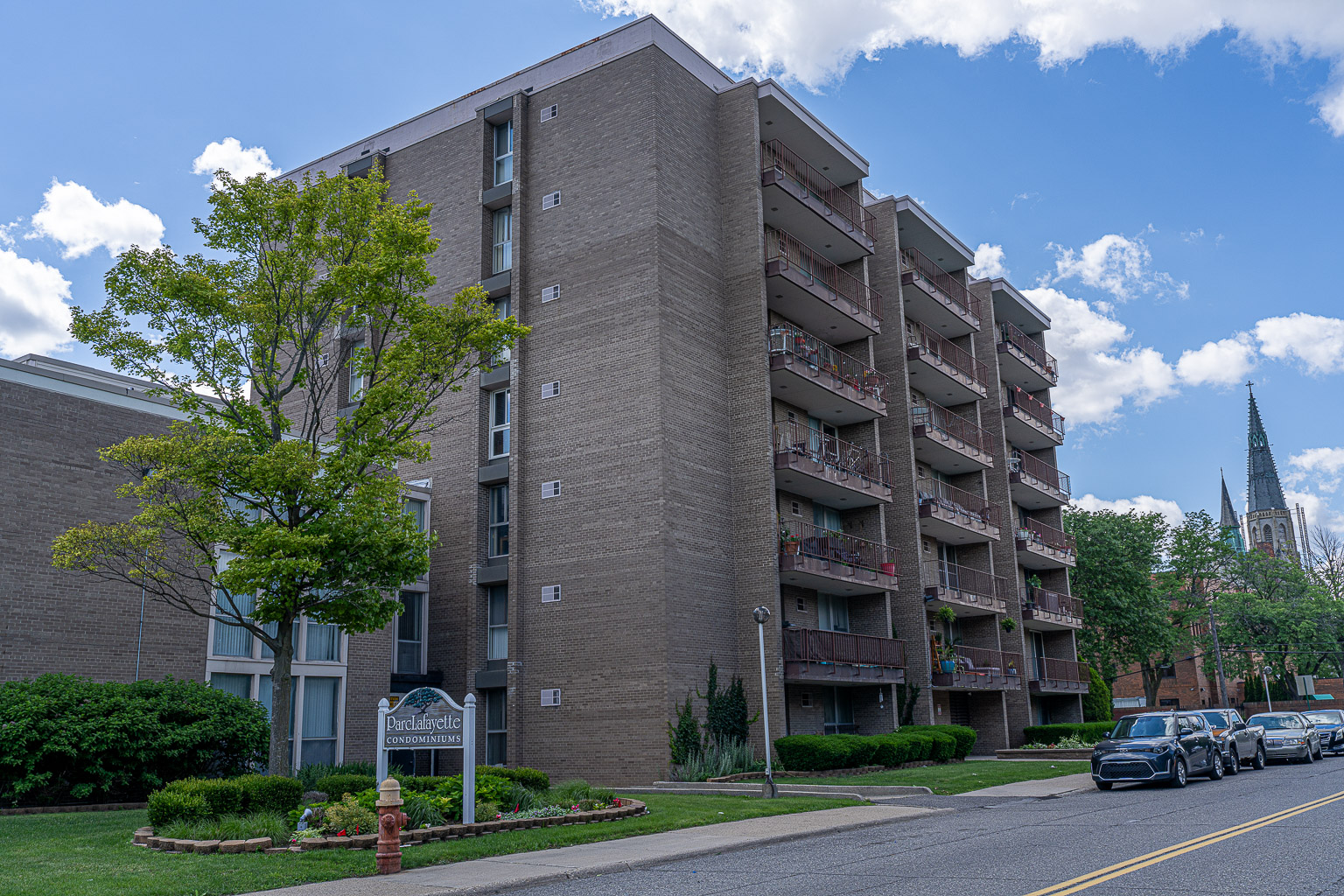
The complex consists of six buildings with a variety of numbers of units but of similar architectural characteristics, ranging from a 37-unit, seven-story apartment building to three-story, 8-unit buildings, all brick veneer and masonry with private balconies and underground parking. Walk-up units and the small elevator tower ring a large square built over a U-shaped street below, so that the tenant’s car is parked in the basement below his/her dwelling unit. Stair towers punch up through the row building’s otherwise flat silhouette to serve as roof decks or penthouses. Solid brick end walls, unadorned cornices, simple metal railings and large panes of direct fenestration create the allusion of "effortless simplicity."
The buildings face onto an ample square with a generous swimming pool and a once impressively planted garden Street furniture, such as the railing around the pool area and the long, slender steel light posts, are in keeping with the understated, un-fussy nature of the overall design of the housing complex. Johnson Johnson & Roy was the original landscape architect.
After Herbert Greenwald unexpectedly died with his plan for the Gratiot Redevelopment Area only partially realized, concern arose about the quality of design of individual, piecemeal housing developments subsequently built around the open space running through the superblock. Regency Square was featured in an article in the January-February 1967 issue of Architectural Forum. Its author, Roger Montgomery, asks the question, "Can the necessary variety be obtained without resorting to architectural mediocrity and worse? Regency Square may answer this question." Montgomery described Regency Square "As the best work and the last in the period since Mies stopped...." Montgomery fails to mention that while it may have "appropriate density," and be free of "narcissistic over-design...," Regency Square, or Parc Lafayette, as it is known today, looks inward on itself instead of celebrating the openness created by the Mies/Hilberseimer Plan. It is nonetheless a very pleasant environment even today.
The Regency earned an honorable mention at the Detroit Chapter of the American Institute of Architects Honor Awards in 1967. It was credited with a "spacially interesting sequence of levels" that led to an opportunity for increased social interaction between its occupants.
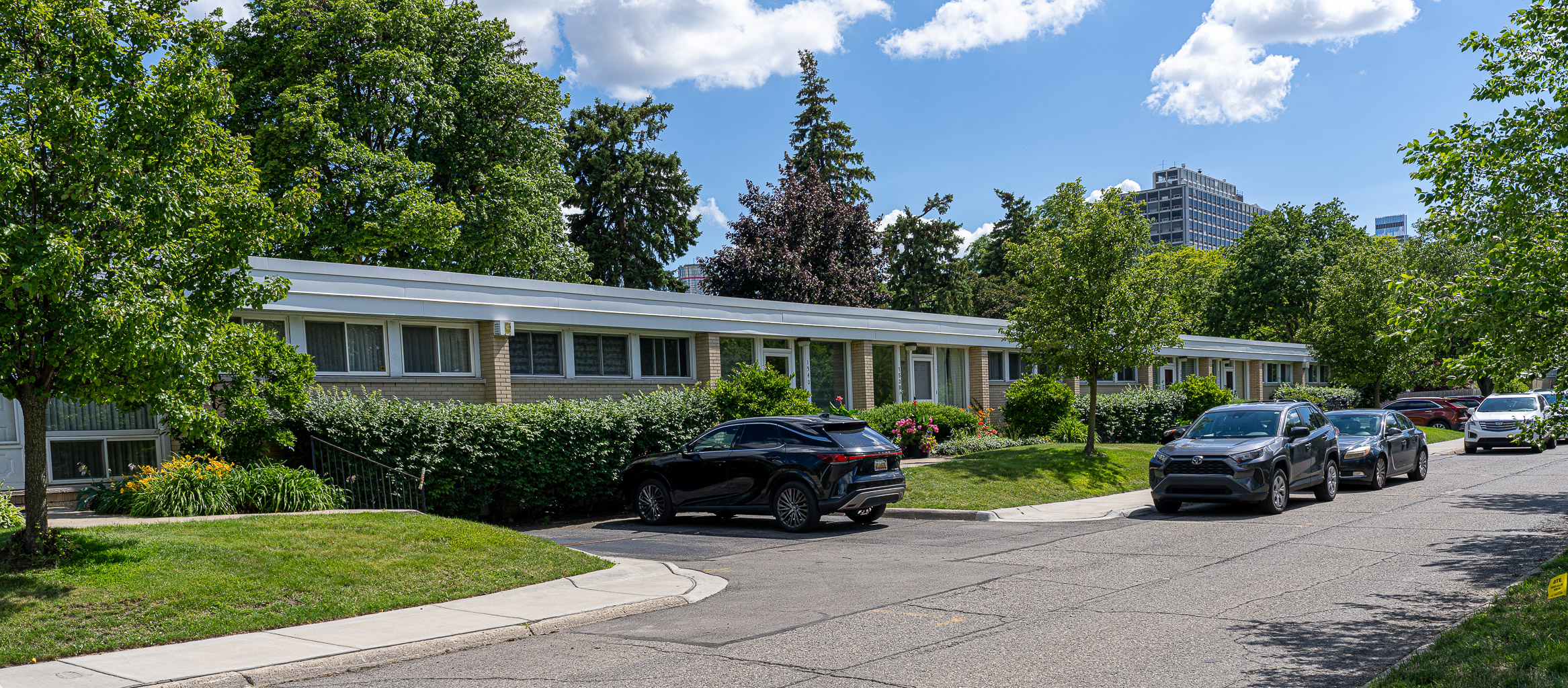
The Orleans Corporation at 14900 Linwood was the developer of the Cheateaufort Place Townhouses, a grouping of fifteen one-story rectangular, light brick veneer buildings containing two to eight units each for a total of sixty units along a cul-de-sac. Separate permits were issued for each building on August 17, 1961; permits for two gunite swimming pools were issued in 1963. Lorenz & Paski, at 19740 James Couzens, was the architect of the buildings.
Although the buildings on the Orleans side of Lafayette Park were not built by Mies (except for Lafayette Towers), the Mies-Hilberseimer plan did identify the Chateaufort site for townhouses. What was built appears to be very much in keeping with the preliminary site plan; the one street into the development was divided with a planted grassy median and the arrangement of buildings is very similar. Like the Mies designed court houses, the Chateaufort Place Townhouses facing Chateaufort Place have space for parking in a driveway in front. An attempt to minimize the visual impact of the automobile was made by steep grading the front lawn, causing the drive to appear lower. Other parking is available in parking lots, like those for the Mies townhouses, but these are not sunken.
Other similarities to the Mies buildings exist. The design of the buildings is modern and minimalist. The front of each unit is composed of two modular parts, one the entrance bay largely of glass except for the door and the other a brick wall lined with a row of three windows beneath the roof. End walls are solid brick. An honest attempt to stick with the "More is Less" dictum of Mies in both the layout of the complex and the design of the buildings is apparent in what was ultimately built. Chateaufort Place is an attractive and pleasant environment in its own right as well.
The Cherboneau Corporation, located at 14900 Linwood, was listed as the owner of Cherboneau North and South on their building permits issued in 1964. Sponsored by the Detroit Federation of Teachers, Cherboneau North and Cherboneau South were a cooperative and condominium project containing 72 units and 58 units respectively. Cherboneau Place North was designed by the architectural firm of Ervin E. Kamp & Associates; Cherboneau South was designed by Clifford N. Wright & Associates in 1964. While no information has been found on Kamp & Associates, Mr. Wright was a graduate of Lawrence Institute of Technology in Southfield, Michigan. He established the firm in his name in Detroit in 1949, doing residential, commercial, institutional and industrial work including banks, churches, restaurants, shopping centers and apartment projects. He was very involved in his profession, and was on the Board of Directors of the Michigan Society of Architects. In 1965, the firm moved to Birmingham.
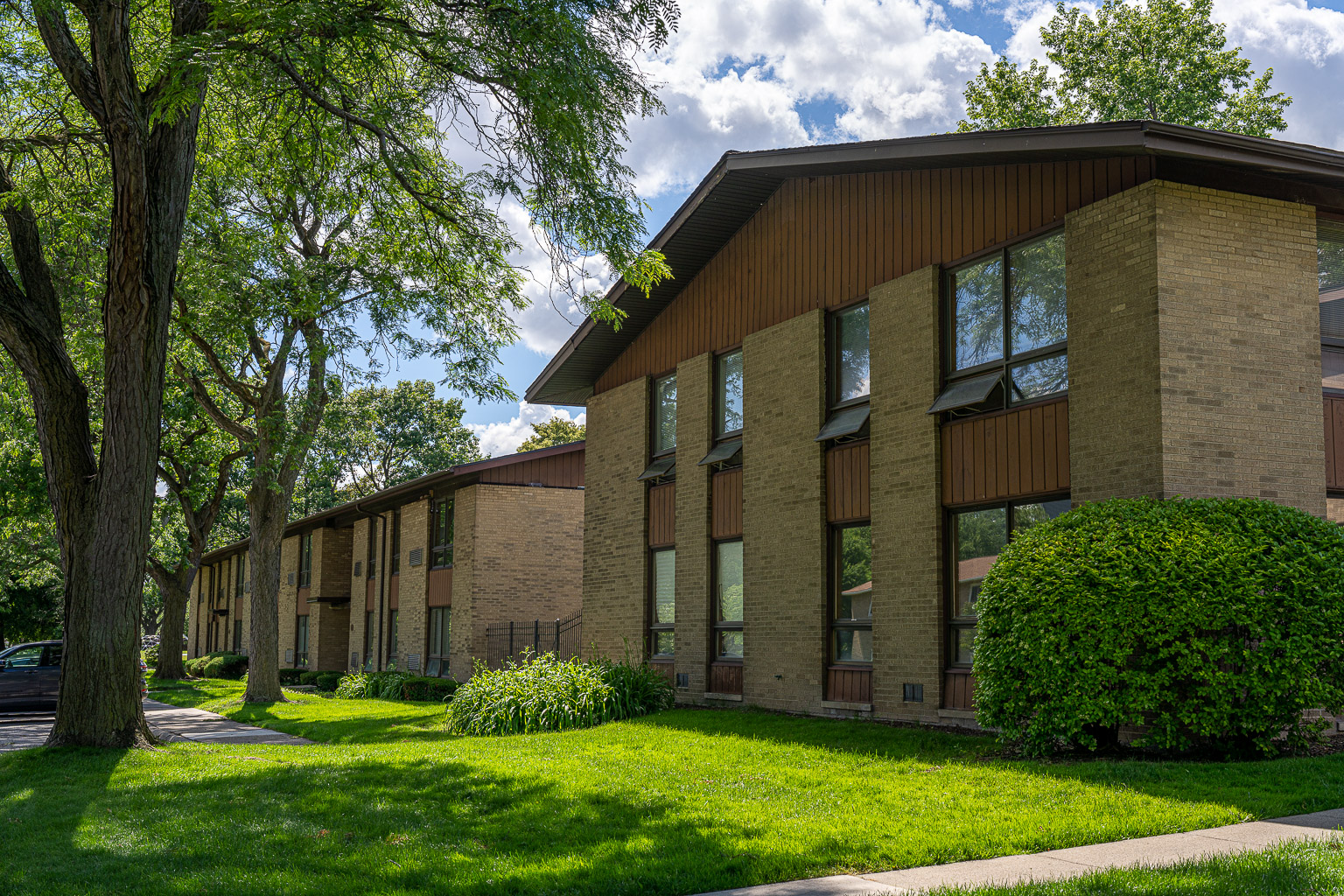
The two Cherboneau complexes are the most dissimilar to the "Miesian ideal" in Lafayette Park, their most noticeable differences being the sloped roofs and the high ratio of solid wall surfaces to openings. The arrangement of buildings tend to be more like garden apartments. However, their siting on a cul-de-sac and their respect for open space adheres to the ideals of the Mies-Hilberseimer Plan.