McGregor Carriage House Local Historic District
You can read details about the McGregor Carriage House Local Historic District in the McGregor Carriage House Local Historic District Final Report (local copy), which I recommend highly to anyone interested in Detroit's history.
The proposed McGregor Carriage House Historic District consists of the one building at 1995 East Woodbridge Street on the East Riverfront. Built in 1885, it was originally used as a garage for carriages and horses and for storage of hay and other horse feed on the second level. The building underwent substantial rehabilitation in 1981 by the architectural firm of Schervish, Vogel, Merz, P.C. Directly to its west is another carriage house, formerly the Brauhaus Restaurant; to its north facing Jefferson Avenue is a gas station. The side of the Manchester Apartment building is to its northeast, and the surface parking lot of Woodbridge Tavern is to its south across Woodbridge Street.
HISTORY: The McGregor Carriage House is one of only four extant carriage houses on the East Riverfront. It survives from the days when East Jefferson Avenue was "the Queen" of thoroughfares lined with the mansions of the wealthy. Unfortunately, the McGregor House, fronting on Jefferson Avenue, did not survive the rapid commmercialization of Jefferson Avenue in the twentieth century; it was demolished in 1936.
The McGregor House and accompanying carriage house were located on the St. Aubin Farm, one of the original tracts of land, or "French Farms," granted by Cadillac to early settlers of Detroit. In 1734 Beauharnois, Governor-General, and Hocquart, Intendant of New France, granted, or in this case regranted, farmlands; among them Private Claim 38 was granted "to Jean Cass St. Aubin, pere", on July 15, 1734, and confirmed a year later by Louis XV, King of France.
The first St. Aubin (or St. 0'Bin as it is referred to in the early land transactions) was a discharged French soldier who decided to settle at the post in 1709 when Detroit had no more than 200 residents. "Casse" was likely the soldier's surname but, as was the habit amongst the Indians, a name characteristic of some incident in his life or personal characteristic replaced the birthname, sometimes permanently.
St. Aubin Avenue was named after Francois St. Aubin in 1847; the subdivision of the St. Aubin Farm was platted in 1858 by Basilique St. Aubin, Anthony Dudgeon and Cullen Brown after the death of Francois St. Aubin.
In 1863 lot 2 of Block 8 was sold to the French Methodist Episcopal Church. This church was originally led by Rev. Thomas Carter in the old Congress Street Methodist Episcopal Church. After Rev. Carter followed his calling elsewhere in 1856 most of his congregation joined other churches, so that in 1861 its new church building on Rivard was sold by the United Congress Street & First Methodist Episcopal Societies. The profit from the sale was then invested in a lot on E. Jefferson Avenue near St. Aubin. A church was built in 1866 and the congregation formally changed its name to Jefferson Avenue Methodist Episcopal Church (Farmer, S., History of Detroit & Wayne County and Early Michigan, 1890).
James McGregor, wishing to build a substantial home for himself and his family, purchased this latter church property in November 1883 for $13,300, and apparently tore down the building thereon. The McGregor House was constructed in 1884-85; its architect was the firm of Donaldson & Meier (permit #1275, 10-27-1884). Its carriage house, which has outlived it, was constructed in 1885 by a mason, A.G. Hollands, at an estimated cost of $2,500 (permit #753, 7-14-1885).
James McGregor (1830-1909) was born and educated in Kincardine, Scotland. He married Susan Christie in 1857, just before they left Scotland to come to Hamilton, Ontario, Canada in 1858 (Book of Detroiters, 1908). McGregor secured a job in the car department of Great Western Railway. In 1860 he ventured to Detroit, where he was made superintendent of the car department of Detroit and Milwaukee Railroad. In 1879 he became general superintendent of the Michigan Car Works and in 1892 he transferred to Michigan Peninsular Car Company as general superintendent, where he remained until 1897 when he retired from active management. "For 37 years he had been closely identified with the industrial growth of the city." (Farmers & Makers of Michigan, S.J. Clarke Publ. Company, Detroit)
In addition to his industrial interests, McGregor was involved with the financial community; he held the position of president of the Home Savings Bank from 1889 until his death in 1909, and he was on the Board of Directors of Detroit Trust Company. McGregor also invested money and time into the Detroit & Cleveland Navigation Company and served for several years as its vice-president.
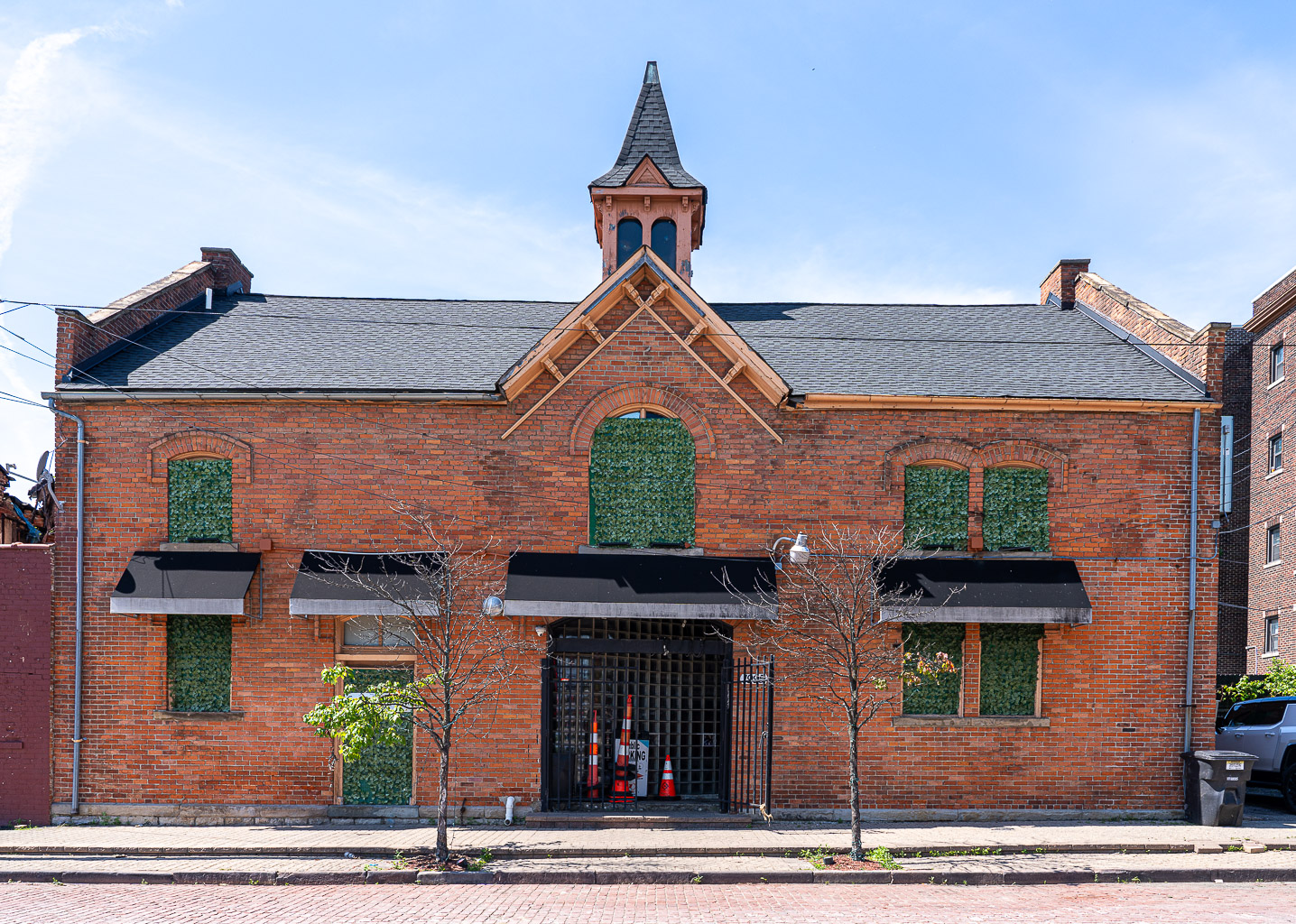
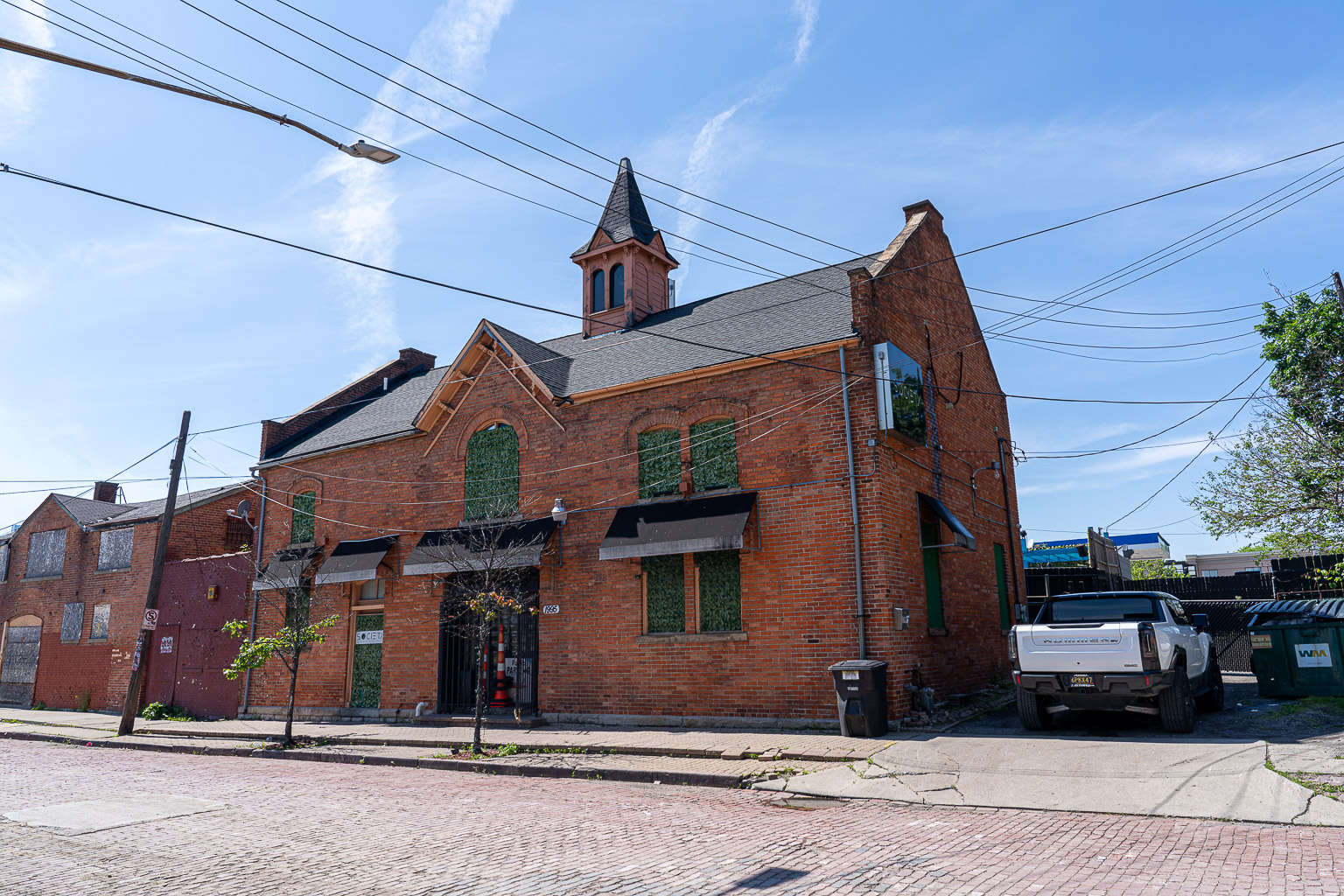
ARCHITECTURAL DESCRIPTION: The McGregor Carriage House is an orange common brick two-story Victorian Italianate building measuring approximately 55' long by 32' deep and 22' high to the eaves and 35' high to the ridge of the roof. A belfry with paired louvred openings on each of its four sides is centered atop of the pitched roof. A small transverse gable projects from the center of the front and rear slope of the roof, resulting in a pronounced central bay.
The asymmetrically arranged front facade consists of a set of paired segmentally arched four-over-four pane sash windows on both the first and second stories of the east bay of the facade and a single four-over-four pane segmentally arched window per story and an entrance door on the first story of the west bay (see drawing, south elevation). All arches have brick voussoirs and sills of stone. The central bay of the front facade is composed of a large segmentally arched drive-through opening with brick hood moldings and a keystone on the first story and a round-headed casement window with brick voussoirs centered above the large first story opening. Brackets support the eaves of the cross-gable. The rear, or north elevation, was similar to the front facade except that the central drive-through entrance opening had a flat arch.
In 1981 the architectural firm of Schervish, Vogel, Merz began construction to convert the carriage house into their professional office. They unblocked the bricked up archway in the front facade and filled it in with a glass block wall in an S-curved configuration and created a new entrance inside the arch.
Originally slate, the roof had been covered with asphalt shingles some time ago. In the rear, or to the north, is a handicapped ramp surrounded by landscaping designed by David Schervish of Schervish, Vogel, Merz, Cardoza.
The interior of the McGregor Carriage House has been substantially altered by SVM in a modern "high-tech" manner. Originally, the building was supported on dry-laid rubble foundations 5'-8' below grade. SVM dug a basement for additional office and conference space and raised the floor of the first story about 3'.
The second story floor was hung from the ceiling beams by iron rods. Originally exposed, the ceiling rafters are now covered with drywall. It appears that the second story was originally used for storage purposes. There was evidence of a small opening, perhaps a haydrop, in the center of the second story floor, and oats fell off the rafters during renovation.
Evidence of a pressed tin ceiling on the first story existed prior to renovation. Walls remain exposed brick.
An atrium was cut throughthe center of the building and a staircase was added. Exposed ducts in pastel colors emerge from the atrium and tubular metal railings surround it, contributing to the high-tech appearance of the interior. Bathrooms and storage modules were situated to cause the least physical change to the original building.
The renovated McGregor Carriage House has recently been awarded the 1982 Honor Award of the Detroit Chapter, American Institute of Architects.