Moross House Local Historic District
The proposed Moross House Historic District is located at 1460 East Jefferson, on the south side of the street west of Riopelle and approximately three-quarters of a mile east of Woodward Avenue. The district contains one contributing resource, a middle-class brick dwelling of about 1850 widely known as the Moross House. The built environment of East Jefferson is extremely varied in the area around the Moross House, reflecting a century and a half of development and redevelopment along a major thoroughfare. Immediately to the west stands the Yondatega Club, newly built about 1955 as a partial copy in brick of the club's former home, a old frame house located closer to Woodward and demolished for urban renewal. To the east stands the headquarters building of the Detroit Municipal Employees Credit Union, a brick building in contemporary style whose western bay appears to have been designed to respect the setback and massing of the adjacent Moross House.
The Moross House was surveyed by the Historic American Buildings Survey in 1936 and is listed on the National Register of Historic Places. You can read details about the Moross House Local Historic District in the Moross House Local Historic District Final Report (local copy), which I recommend highly to anyone interested in Detroit's history.
HISTORY: [+ expand]
About 1850, Christopher Moross, descendant of an old Detroit French family, built this brick three-bay "townhouse" on land which had belonged to his father Victor since 1834. As with most Detroit buildings of such early date, the history of this house is uncertain. Often characterized as "Detroit's oldest brick house", it is, in fact, one of several very similar houses, none of which can be dated with absolute certainty. The other examples are all located within the Corktown Historic District.
Its name is also slightly misleading, for although the Moross family owned the house until 1920, no Moross is known to have lived there. It was apparently built as, and served as, a rental property for the entire period of Moross ownership.
Christopher Moross was born in 1822, and about the age of twenty-one established a brickyard at Chene and Canfield which prospered for a time. In 1846 he married Emily Cicotte. When brick making declined as a profitable business, he established a livery stable downtown. Moross must have been quite prosperous, as he is said to have retired from business before he was fifty.
There are only two certain dates which bear on the construction of the Moross House. In 1849, Victor Moross sold the land on which the house stands to his son Christopher. In 1859, oddly enough, Victor's will was probated and left to Christopher the same land which the father had sold to him in 1849; the will noted that Christopher had built two brick houses on the property.
The land, a portion of Lot 35 of the Plat of the Guion Farm 33 1/3 feet wide, ran all the way from Jefferson to Woodbridge Street, and was thus suitable as the site of two houses, one facing each street. The price in 1849, $500, does not seem, in comparison with other known land prices, to indicate that there were any houses on the land at the time of the sale. On the other hand, this was not an open-market transaction, being between father and son. Given that the land was owned in the family, the speculation that the house predates 1849 could be true; there is evidence of a house or houses on the land prior to 1849, but it must be borne in mind that such evidence applies to the whole 100 foot width of Lot 35, and not necessarily to the 33.3 feet bought by Christopher Moross in 1849. Given the price and the likelihood that Christopher Moross would have bought the land before building on it, it seems reasonable to assign a date of circa 1849. This accords well with the known facts regarding the similar houses in Corktown. In addition, William Cook, Detroit City Attorney, is listed in the 1850 census as living in what appears to be this house. He may well have been the first occupant.
It is said that Christopher Moross also built a house on the plot facing Woodbridge, and moved into that while renting the Jefferson property. By 1859, however, he was listed in the city directory as living on Beaubien Street. That same directory lists a "C. V. Moross" as living on East Woodbridge, and this could be Christopher's brother Columbus V. Moross.
A number of persons who lived in the house as renters have been identified. A shipbuilder named James M. Jones appears to have occupied the house in the mid-1860s, and this occupancy led to the identification of the house as the "James M. Jones House" when it was surveyed for the Historic American Buildings Survey in the 1930s.
Other occupants include Freeman Norvall, Secretary of the Detroit Free Press Company (1872-74); Col. Samuel M. Mansfield (1877-79); Millard T. Conklin, Treasurer and General Manager of the Fulton Iron Works (1886-1898); Rev. Alfred H. Barr, pastor of Jefferson Avenue Presbyterian Church (1899-1901). After several other tenancies, the property was sold by Christopher Moross's heirs to the Beaver Realty Company in 1920. Beaver Realty occupied the house, together with other tenants, until the mid-1960s when it was sold to a Harry W. Theisen, whose purpose was to prevent its demolition.
In 1969, the City of Detroit Historical Department acquired the house and in 1971 began restoration it for use partially as museum rooms and partially for occupancy by the Detroit Garden Center. The restored house was dedicated by Mayor Roman Gribbs in 1973. During 2003-2004, the Detroit Historical Department has made plans to use the house for other purposes.
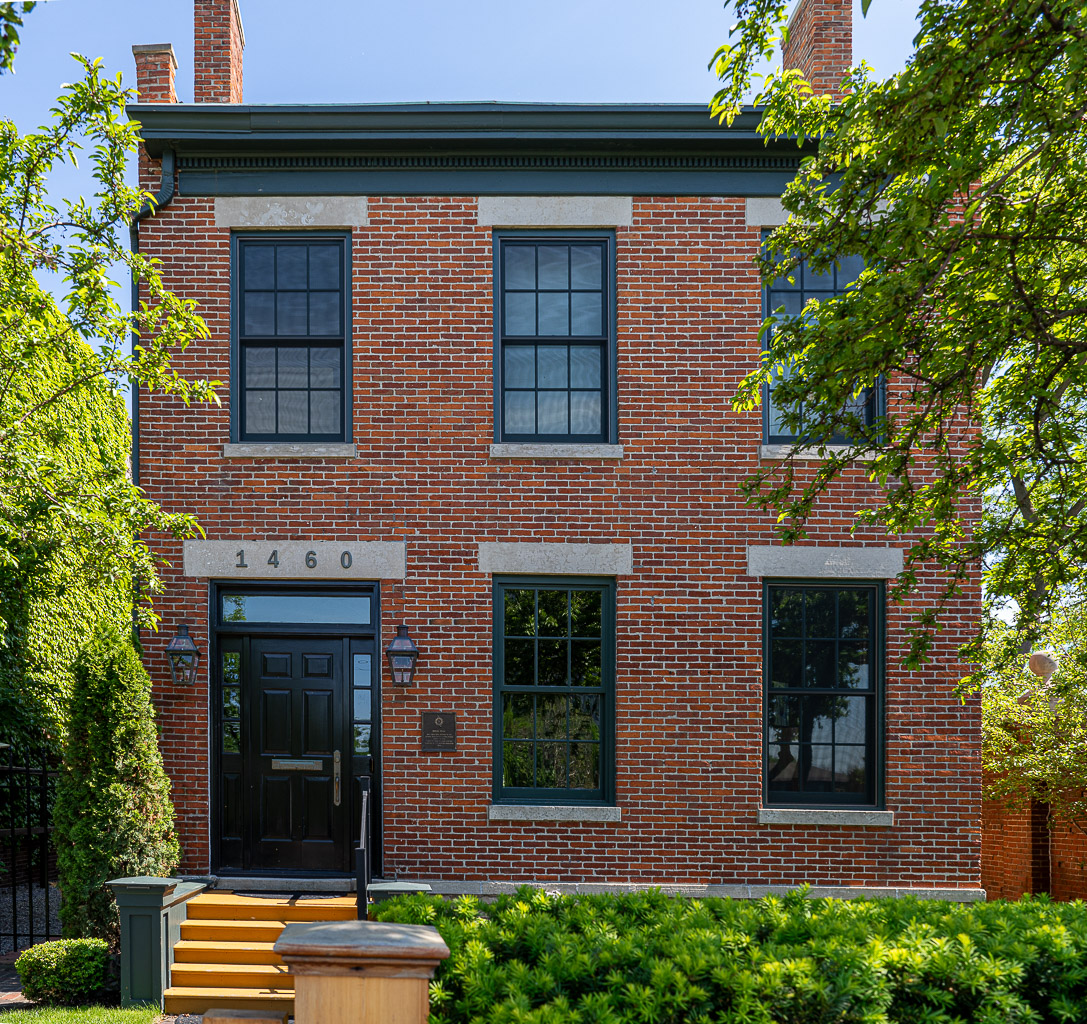
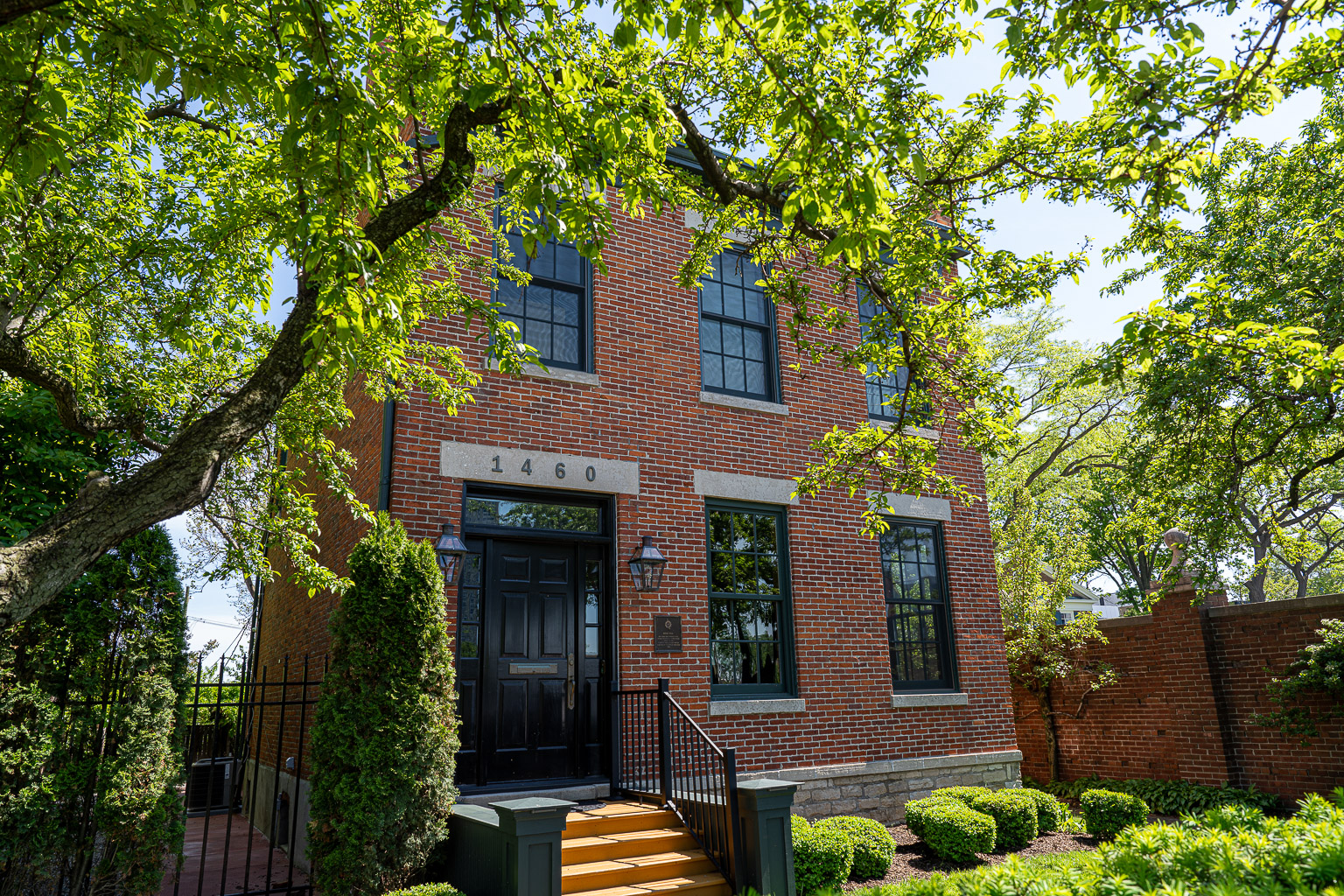
DESCRIPTION: The Moross House is a typical three-bay brick townhouse with the entrance door on the left (east) side of the facade and side walls with parapets with chimneys, the east wall chimneys being false and present for symmetry's sake. Trim is in limestone and wood painted white. The house is detached, as seems to have been the practice in Detroit, but is of a type that can be found in attached rows in cities on the Eastern Seaboard. There is a later one-story addition toward the rear on the west side.
The Moross House has often been described as being in the "federal" style, or sometimes as "federal survival", given the fact that its earliest possible construction date is well after the end of the period of the federal style. It may be that the form "the three-bay townhouse" has been confused with the style, and that some observer has equated the form with the federal period. In fact, townhouses of this type are found throughout the earlier Georgian period, and in a number of later 19th century styles, including the Greek Revival and the Italianate.
Upon inspection, the building has almost no features which display the delicate elegance and attenuated proportions of the federal style. The only possible exception is the row of small-scale dentils in the cornice. The rather heavy flat stone lintels of the front windows and the rectangular sidelights and transom of the front door are clearly related to the Greek Revival, then still a current style, although declining in popularity. It is, perhaps, sufficient to note that the house was built in a provincial location and is largely a vernacular structure although with some influence from the Greek Revival.
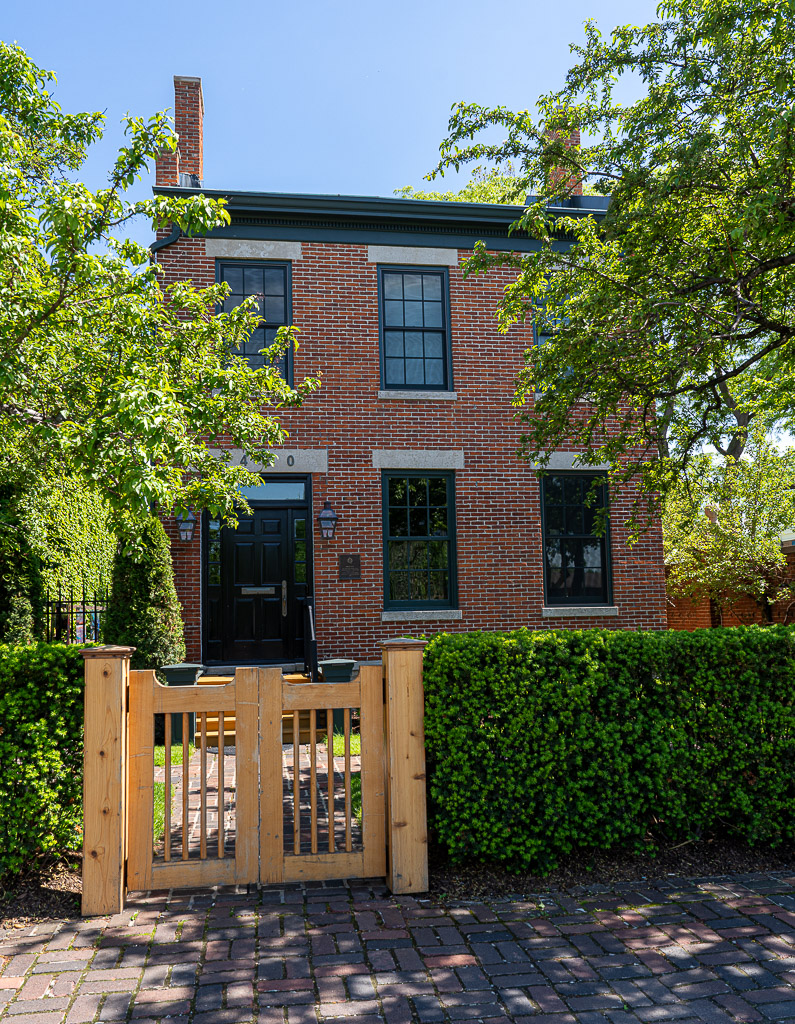
The house is of Detroit common brick with a foundation of local limestone. The facade has three openings per floor, symmetrically placed, with the entrance door occupying the eastern first-floor opening. A low stoop leads to the entrance. A classical cornice is at the top of the facade, with the side wall parapets showing above it at either side. The gable roof slopes to front and rear and abuts the parapet wall on either side. The west side wall of the main block has windows symmetrically placed with two on each of the lower floors placed close to the front and rear walls, and one centered in the gable serving the attic. The two chimneys on the parapet of this wall serve the fireplaces in the double parlors of the first floor. The east side wall of the main block has only three windows, one at attic level centered in the gable and one on each floor at the rear; its chimneys are false. There is a two-story wing to the rear whose gabled roof runs front to back; the rear wall of that wing also has a parapet. The rear wing is lower than the main block, so that the second floor of the house is on two levels, lower in the rear. On the west there is a one story addition with a front-facing door placed at the rear of the main block and abutting the rear wing.
The appearance of the house today is in substantial part a result of its restoration by the Detroit Historical Department in the 1970s. When acquired by the city, the house was painted grey, had a simple Italianate surround added at the front door, and one-over-one windows replacing the originals. In restoring the house, the city removed the door surround and installed new sidelights, transom and door. The windows were replaced with six-over-six sash, based on one surviving example in the west wall. The paint was removed from the brick and the trim was painted white. After moving into the building, the Garden Center developed a period garden in the rear, and there is a wood fence in period style at the Jefferson sidewalk.
The main stair hall and the double parlors of the house were restored as museum rooms, while the rest of the space in the house was adapted to the needs of the Garden Center. The two parlor fireplace mantel were made new in period style; otherwise, much of the parlor woodwork is thought to be original, as is the staircase in the hall.
The Moross House is one of a handful of mid-19th century townhouses surviving in Detroit, and the only one to have undergone restoration at such a professional level. It is also the only example located on a main thoroughfare, and thus highly familiar to the public as a landmark. It is unlikely that its claim to be the oldest brick house in Detroit will ever be documented, but it will remain so in the minds of Detroiters.
More photos and more description of this building can be found at HistoricDetroit.org.