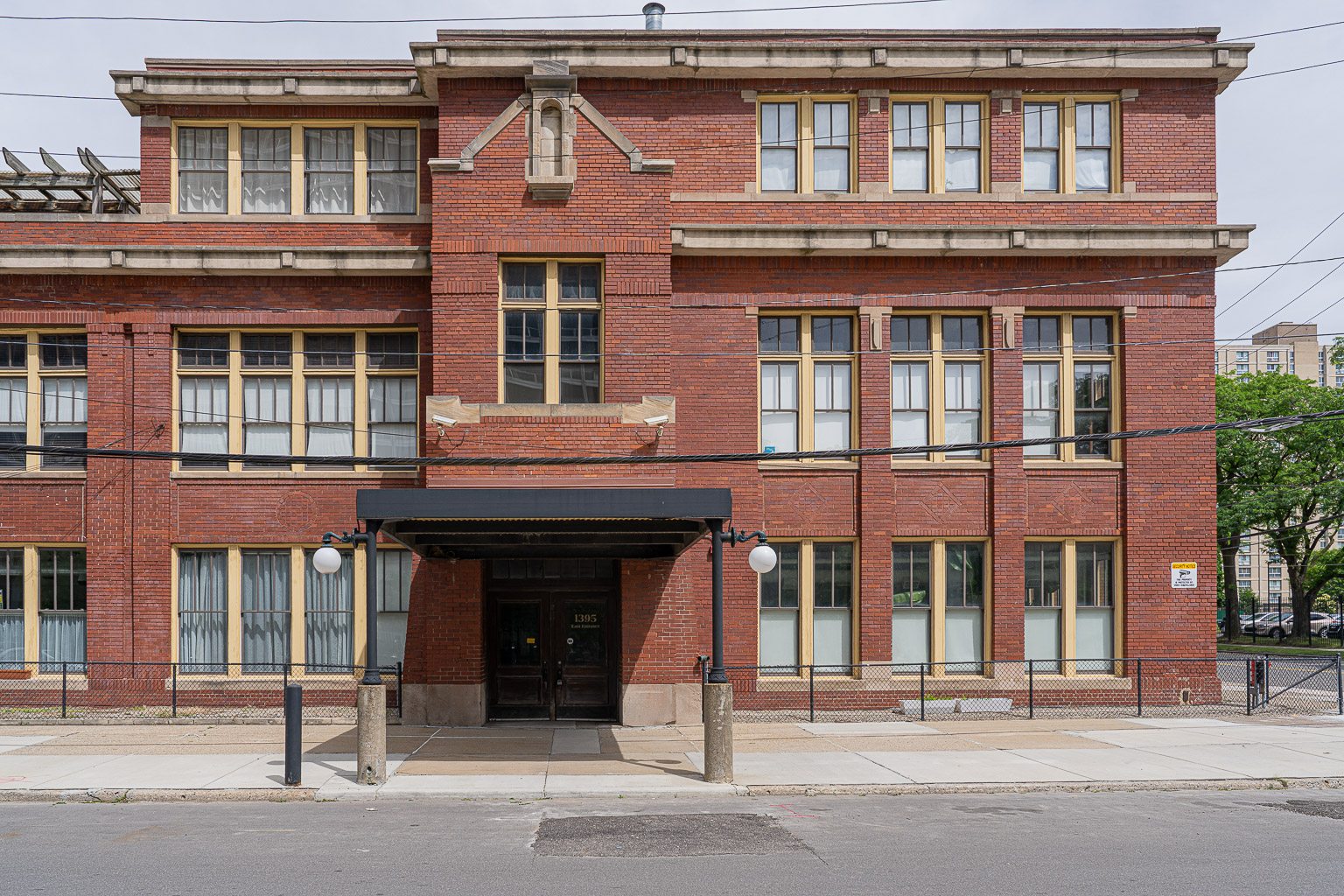
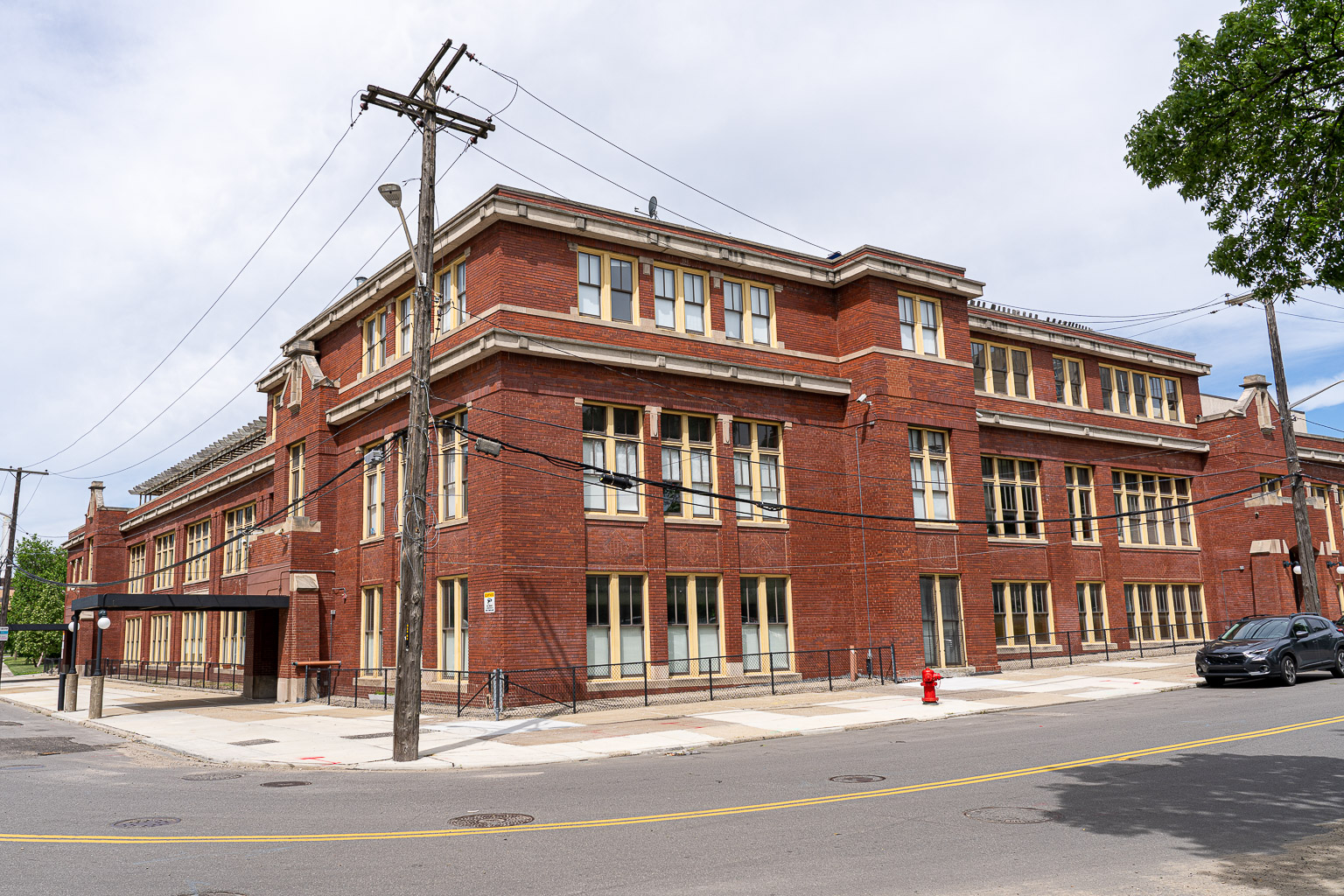
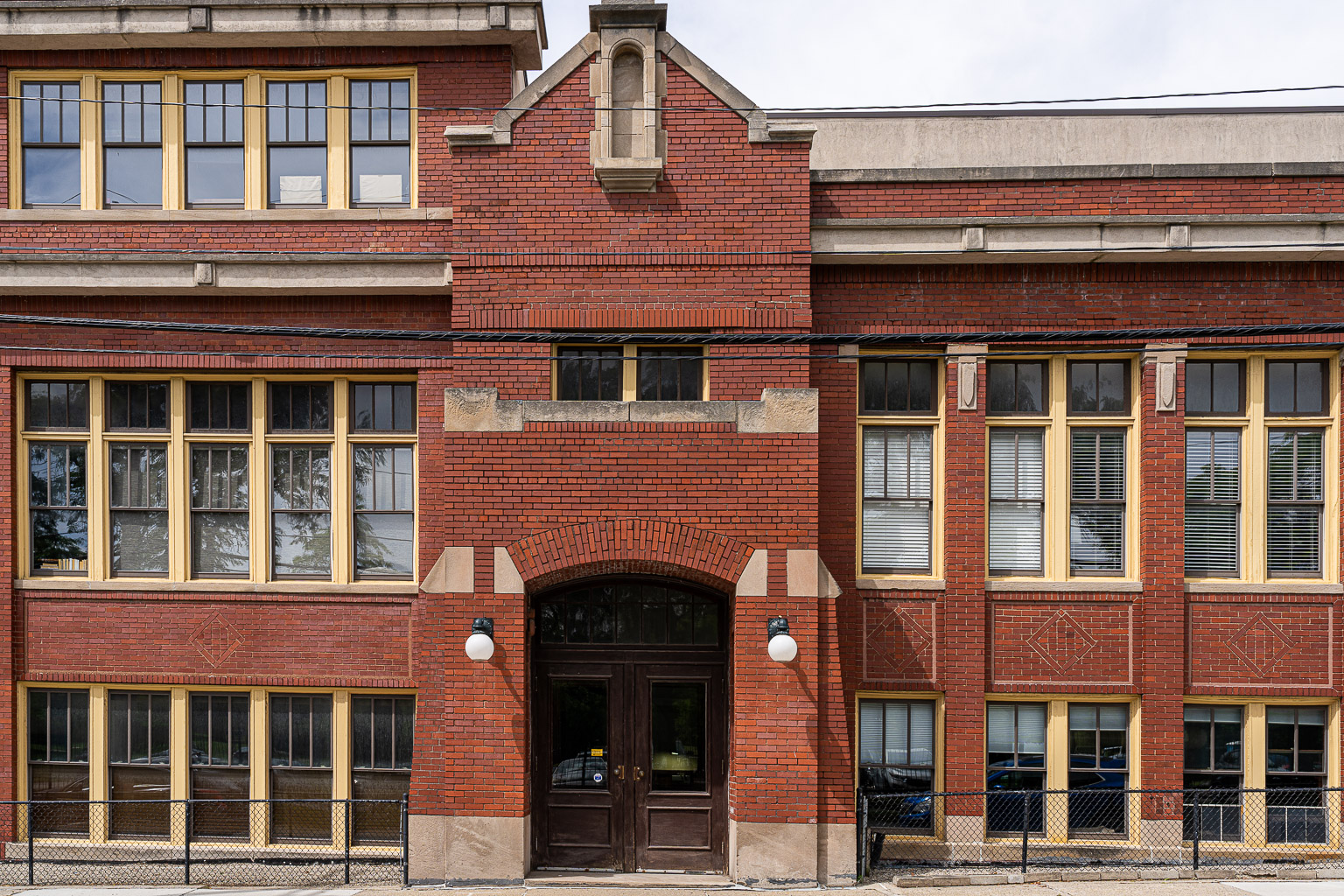
Nellie Leland School Local Historic District
You can read details about the Nellie Leland School Local Historic District in the Nellie Leland School Local Historic District Final Report (local copy), which I recommend highly to anyone interested in Detroit's history.
By a resolution dated July 3, 2002, the Detroit City Council charged the Historic Designation Advisory Board, a study committee, with the official study of the proposed Leland School Historic District in accordance with Chapter 25 of the 1984 Detroit City Code and the Michigan Local Historic Districts Act.
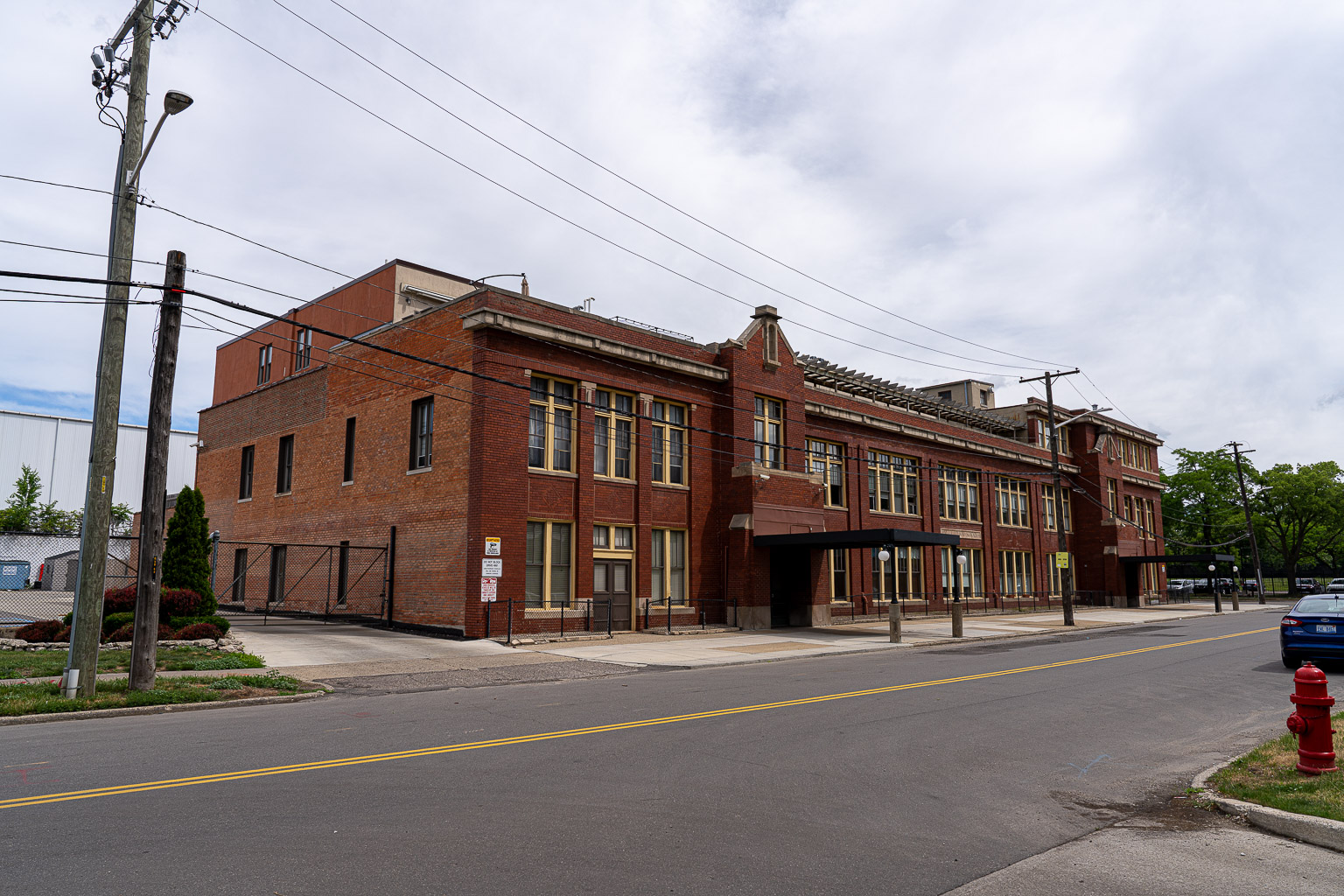
Nellie Leland School is a single building located at 1395 Antietam Street. It is located on a curve of Antietam Street that lies between Rivard Street and vacated Sherman Street. It lies approximately one mile northeast from the heart of downtown Detroit and one half mile south of Eastern Market. It is directly north of the Mies van der Rohe Residential District, Lafayette Park, which is listed on the National Register of Historic Places. It is also located within a few blocks of the Antietam Street and Chestnut Street / Grand Trunk Railroad Bridge and St. Joseph's Roman Catholic Parish Complex, also listed on the National Register of Historic Places.
HISTORY: [+ expand]
The Nellie Leland School for Crippled Children was the first major public school in the city of Detroit and Michigan designed exclusively for physically challenged children with ramps connecting the three floors and other features. It was erected in 1918 by the Detroit Board of Education to replace a few rooms in the Clinton School, which space had become inadequate to accommodate their needs. An addition was made in 1921. The new school was named in memory of Nellie Leland, a trustee of several of Detroit's charitable orginizations, whose main endeavor was to care for the tubercular poor in the city.
Prior to 1919, the School for Crippled Children was housed in a few rooms of the old Clinton School on Clinton Street between Hastings and Rivard Streets. The special school function had outgrown these small quarters and the Board of Education found it necessary to erect a modern building that could provide adequate care and education for physcially challenged children. On May 25, 1916, the Board of Education voted to purchase the locally historic Arbeiter Hall property located on the northwest corner of Catherine (later Madison, now part of Antietam) and Russell (also now part of Antietam) Streets, at a cost of $22,500.00. This site consisted of five city lots and was part of the original Russell Farm.
Architects William G. Malcomson and William C. Higginbotham and consulting engineers McColl and Ammerman were in charge of the construction of Leland School. Appointed on a year-to-year basis, Malcomson and Higginbotham started working with the school board in 1891 and were associated with the Detroit School Board for over thirty years. Approximately 157 school buildings were built in Detroit to their designs including Cass Technical High School and the original Central High School (now known as Old Main at Wayne State University). They were also responsible for many buildings throughout the city of Detroit including the Cass Avenue Methodist Church and the original buildings of the University of Detroit campus on McNichols Road. They were instrumental in bringing fire resistant and "fireproof" construction to school buildings throughout the city.
Ground was broken for the Nellie Leland School for Crippled Children in the early part of 1918 and the building was completed at a cost of $111,495.00. The new School for Crippled Children was named "Nellie Leland School" in recognition of the charitable services rendered by Mr. Frank B. Leland and the late Mrs. Nellie Leland.
Frank B. Leland (1860-1926), husband of the namesake of Leland School, was born on a family farm near Holly in Oakland County in 1860. He graduated from the University of Michigan in 1882 and then attended the university's Law School for two years. After practicing law in Flint he moved to Detroit in 1889. Leland practiced law in Detroit until 1895, when he entered the financial business as general counsel and later general manager of the National Loan and Investment Company. In 1901 he organized the United Savings Bank of Detroit and was president of that bank until his death in 1926. He was also a regent of the University of Michigan for sixteen years.
In 1892 Leland married Nellie Page (1870-1910) of Hillsdale, Michigan. Mrs. Leland was always active in charitable works and enterprises. For many years she was treasurer of the Home of the Friendless in Detroit and was also a trustee of several other charitable organizations. During the last few years of her life her main charitable endeavor was in helping to better the conditions of the tubercular poor in Detroit. Her husband assisted her in establishing and directing organizations on the scientific care and treatment of the tubercular and carried on after Nellie's death. He was fundamental in the establishment of the Detroit tubercular sanitarium, which opened in 1911. In 1912, at his own expense, Mr. Leland built and equipped the first open-air school in Michigan for children in the first stages of tuberculosis. This out-of-door school, built at Vermont and Marquette Avenues, was donated to the city and named the Nellie Leland School in his wife's memory. This building was the first Open Air School built in the city of Detroit and one of the first schools built in the United States designed exclusively as a public open-air school. The Nellie Leland School was so successful that by 1912 the school had a waiting list of children for admission. The 1912-1913 annual report of the Nellie Leland School described the need and planning for an additional school.
By 1917 the open-air school building became part of Goldberg School, and the functions of Nellie Leland were transferred to Marr School on Grand River Avenue. In recognition of Mrs. Leland's charitable services the name was used again for the new School for Crippled Children that had just been built. By 1924, as detailed in "City Health," a City of Detroit Health Department bulletin, the Board of Education operated four schools for children with various disabilities (which included Leland School for Crippled Children); nine open air schools and thirteen schools with open window rooms.
Construction of the new Nellie Leland School was completed in the latter part of 1918 and this first public school designed exclusively for physically challenged children in the city was opened in February of 1919. Miss Isabel Balfour, who had had charge of the old School for Crippled Children on Clinton Street, became the first principal at Leland. At that time there were eighty-two children enrolled from the kindergarten through the eighth grade with six teachers in charge. The school attracted wide attention because of its unusual features, one of these being the inclined ramps from the main to the third floor.
In August 1920, an addition was recommended to eliminate the waiting list of children seeking admittance. The new unit, costing $290,356.00, was ready for the opening of school in September 1921. It consisted of five new classrooms, a room for physically challenged children with special needs, a large cot room, shower room, tub baths, art room, auditorium and a roof playground. An elevator was also installed, making Leland School one of the first schools in the city to have one. The building could now provide adequately for three hundred children.
The Nellie Leland School for Crippled Children continued operating as a school for the physically challenged until 1981 when it was closed. Stroh Properties, Inc purchased the property in the mid-1980s. In 2000, the school was purchased by developer Joel Landy, who intends to convert the building into residential lofts.
A bronze tablet (now gone) was once located on an exterior wall of the Leland School. Placed there in 1925 by the Daughters of the G.A.R., it marked the site as the location of the Detroit Barracks from 1830 to 1866, which Lieutenant Ulysses S. Grant commanded from 1849 to 1851. The post served as a military recruiting station during the Civil War.
Physical Description:
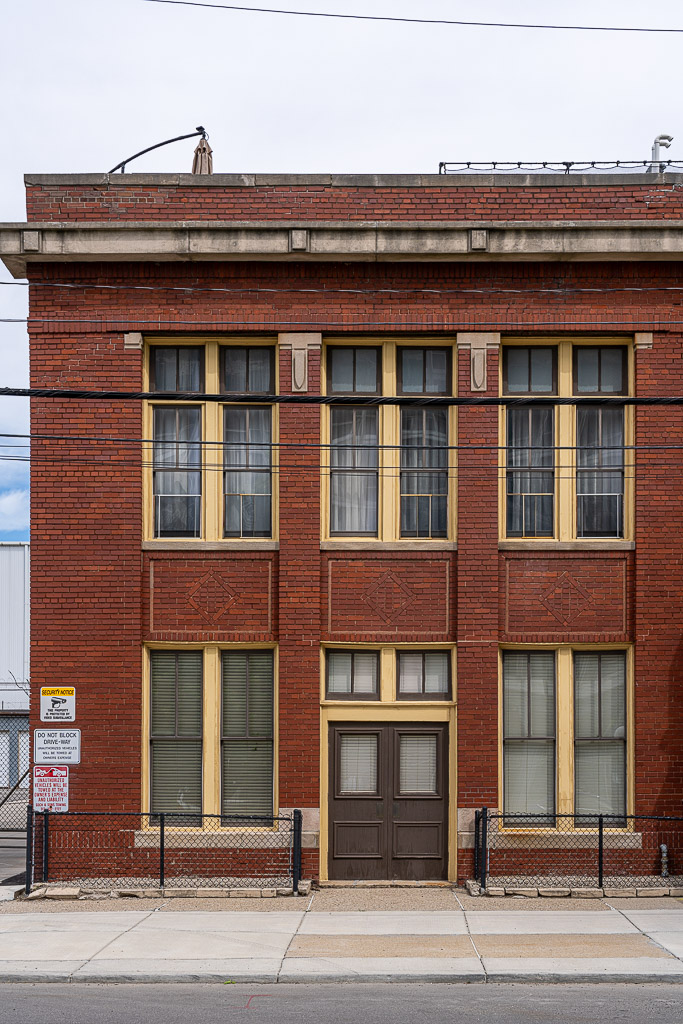
The Leland School is a two and three story, brick public school building built in a reserved Arts and Crafts influenced style that contains references to Tudor architecture and Neoclassicism. The building is L-shaped with a flat roof and a partial third floor over the southeast section. The southeast (front) and northeast elevations are constructed with walls of glazed red brick, the remaining walls of common red brick.
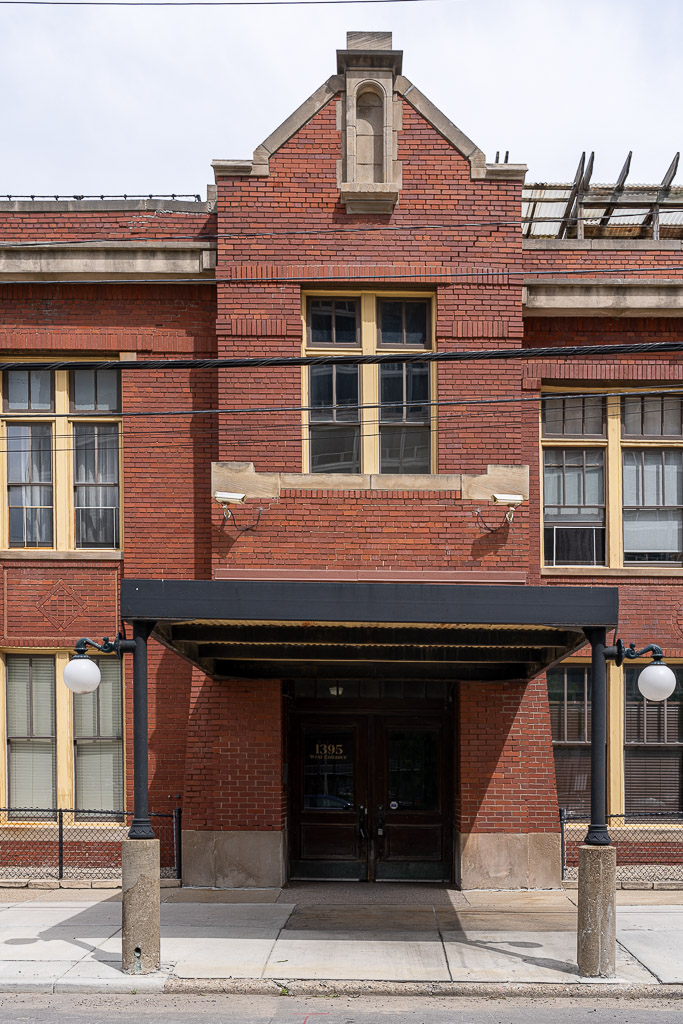
The overall footprint of the building measures 193 feet on the southeast, 153 feet on the northeast, 201 feet on the northwest, and 160 feet on the southwest. The building is two stories in height with a partial basement and a partial third floor. A parking lot sits directly behind the school and a small former playground is located adjacent on the one-ond-one-half-acre site. The building has three main entrances, two on the front (south) elevation and one on the east elevation. The entrances are through buttressed portals, each with a gable that extends upward above the second floor. Each of the three entrance gables has an empty limestone niche. The double entrance doors are of wood with glass in the upper panel. Above the double doors is a seven pane transom window. The entrance portals on the south elevation were slightly altered when steel canopies were added at a later date. The entrance to the auditorium is in the west section of the front façade. The auditorium is located in the west end of the south (front) façade. The auditorium entrance is a simple doorway with wood double doors.
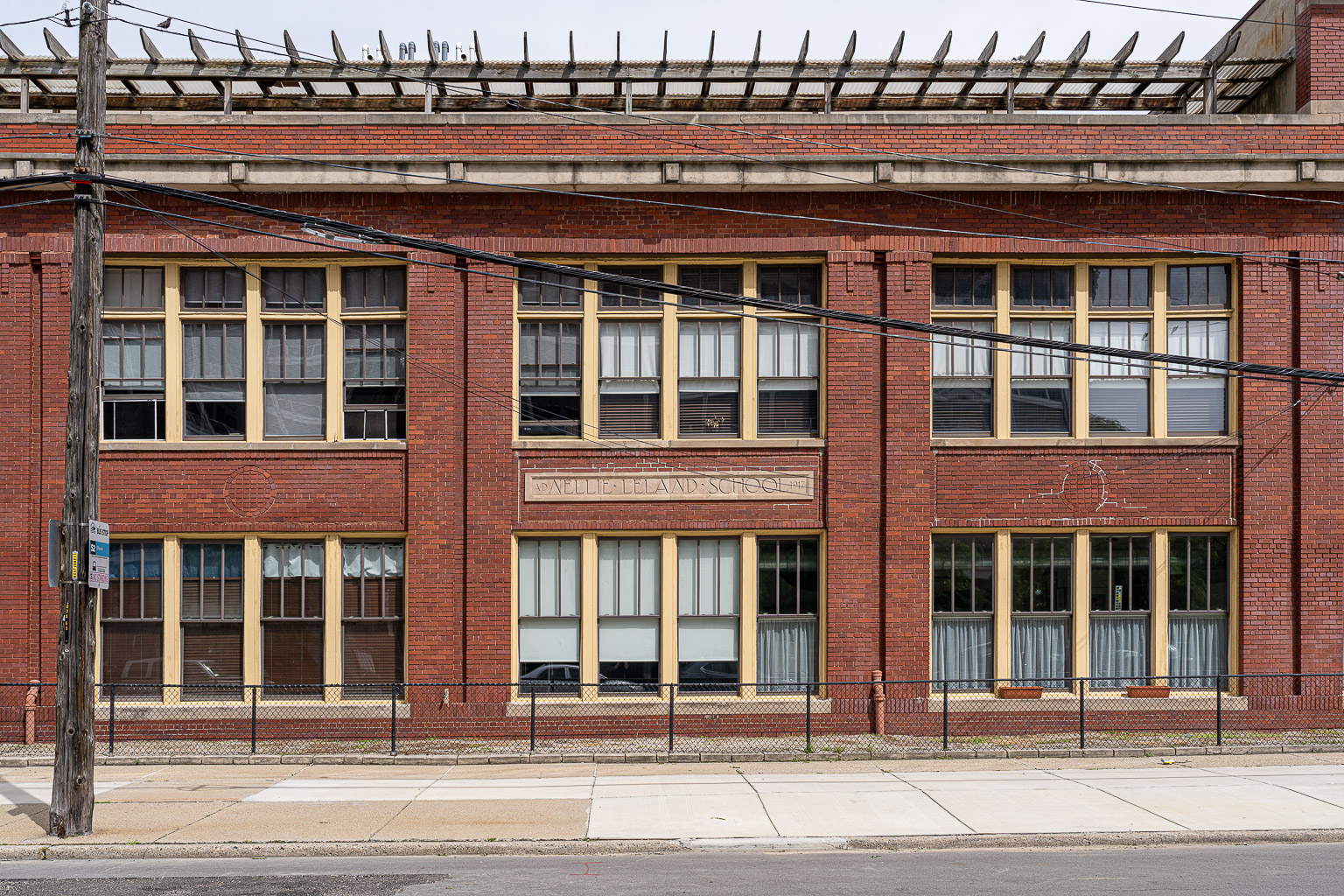
The main façade of the building displays a rhythmic fenestration of broad banks of windows, with clusters of four windows in the center section and paired windows on the two ends. The banks of windows are seperated by the projecting entry portals. The clusters of windows are divided by single antae on the two end sections and by double antae in the center section. The windows are double hung wood windows. The windows vary in different sections of the building between 2/1 or 3/1. The windows on the second floor have transoms that each varies between two or three panes.
The building at one time had cornices above the second floor and partial third floor but both cornices have been removed. The name of the school is carved in limestone in the center section of the front façade and between the two south entrances: A.D. NELLIE LELAND SCHOOL 1917 (see 4th photo below).
The interior of the school has typical large classrooms and long hallways with lockers. The first floor layout included a dining room, arts and crafts room, and a wood shop. The arts and crafts room has a large brick fireplace. The auditorium is located on the first floor in the southwest corner of the building. The stage still exists but the seats have been removed. The second floor included a clinic, library and a playroof in the back. Many of the classrooms still have the original slate blackboards, wood cabinets and trim. The school has long sloping ramps from the first to the third floor for use by students in wheelchairs, and doors that opened to the roof to allow fresh air circulation and access to the playroof. The ramps are located in the center inner elbow of the building. The third floor had a cot room for students to nap.