Palms Apartments Local Historic District
Palms Apartments is located at 1001 East Jefferson Avenue. You can read details about the Palms Apartments Local Historic District in the Proposed Palms Apartment Local Historic District Final Report (local copy), which I recommend highly to anyone interested in Detroit's history.
HISTORY: [+ expand]
On May 22. 1901, & building permit was issued to the architectural firm of Mason & Kahn for the construction of a six-story apartment building at Jefferson and Rivard. The estimated cost of the structure was given as $80,000.
The building was intended as a high-class residence for people of means who did not desire to maintain a separate house. This concept was relatively new at the time, and The Palms was a pioncer in this field in Detroit. The investors involved were members of the Palms and Book families, related by marriage, and the building was named in henor of Francis Paims, who had lived not far away on Jefferson.
In the early years, the building enjoyed tenants whose names often bring recognition even today, such as James B. Book, Frances Sibley, and Maurice McMillan. The elegance of the larger apartments and their unusual size made units in the building the equivalent in space and amenities to a large house, without the responsibilities of home ownership.
Far more important, however, in the historical importance of the building is its place in the history of reinforced concrete as a building material. The Detroit architect Albert Kahn, who was in partnership with George D. Mason when the building was designed, is world famous for his work in reinforced concrete and the development of practical and efficient factory design. Building No. 10 at the Packard Plant on East Grand Boulevard is widely recognized as the pioneer building of its type; the use of concrete in such buildings solved a number of problems which modern industry brought to the stardard mill constructien factory with its wooden floors. Concrete improved the load-bearing capacity of the factory, and in addition, did not soak up machine oil as wooden floors did, thereby creating a fire hazard.
The use of reinforced concrete prior to Building No. 10 is brief, and much of it is European. However, Mason & Kahn had designed two buildings prior to the Packard Plant which made use of the material. One was the Engineering Building of the University of Michigan in Ann Arbor. The other was The Palms.
An apartment in Paris built in 1903 by Auguste Perret is world-famous as a pioneering use of reinforced concrete; several other buildings are known to have been constructed with the material at about the same time. The technique of reinforcing concrete with steel was new, and standard formulas for structural strength were well in the future.
Therefore, the use of the material in The Palms gives the building a niche in the world history of construction technique; note that the Perret building is dated 1903, while the permit for The Palms was issued in 1901. Even so, the use of reinforced concrete in The Palms was a tentative step, for the walls of the building are load-bearing masonry; only the floors are of reinforced concrete. Kahn's brother, Julius Kahn, an engineer, was responsible for taking the techniques used at The Palms and in Ann Arbor and developing the "Kahn System" of concrete reinforcement -- a great improvement in the technique. In 1903, about the time The Palms was being completed, Julius Kahn formed the Trussed Concrete Steel Company in Detroit to manufacture the steel bar that had been developed for concrete reinforcement. Shortly thereafter, the "Kahn System" was used to design the structure of two enormous Atlantic City resort hotels, and in 1905, Packard No. 10 was built. Reinforced concrete has been established as a structural material.
The Palms remained a gracious and claborate residence until the 1930's, when economic conditions forced the subdivision of the original apartments. There are now about 50 units in the building; fortunately the division of the original units was possible without much loss of the original decorative detail. While the apartments are much smaller now than they were, few rooms have been badly treated; the original hallways within the large apartments simply became public hallways, and apartments were formed out of the rooms on either side.
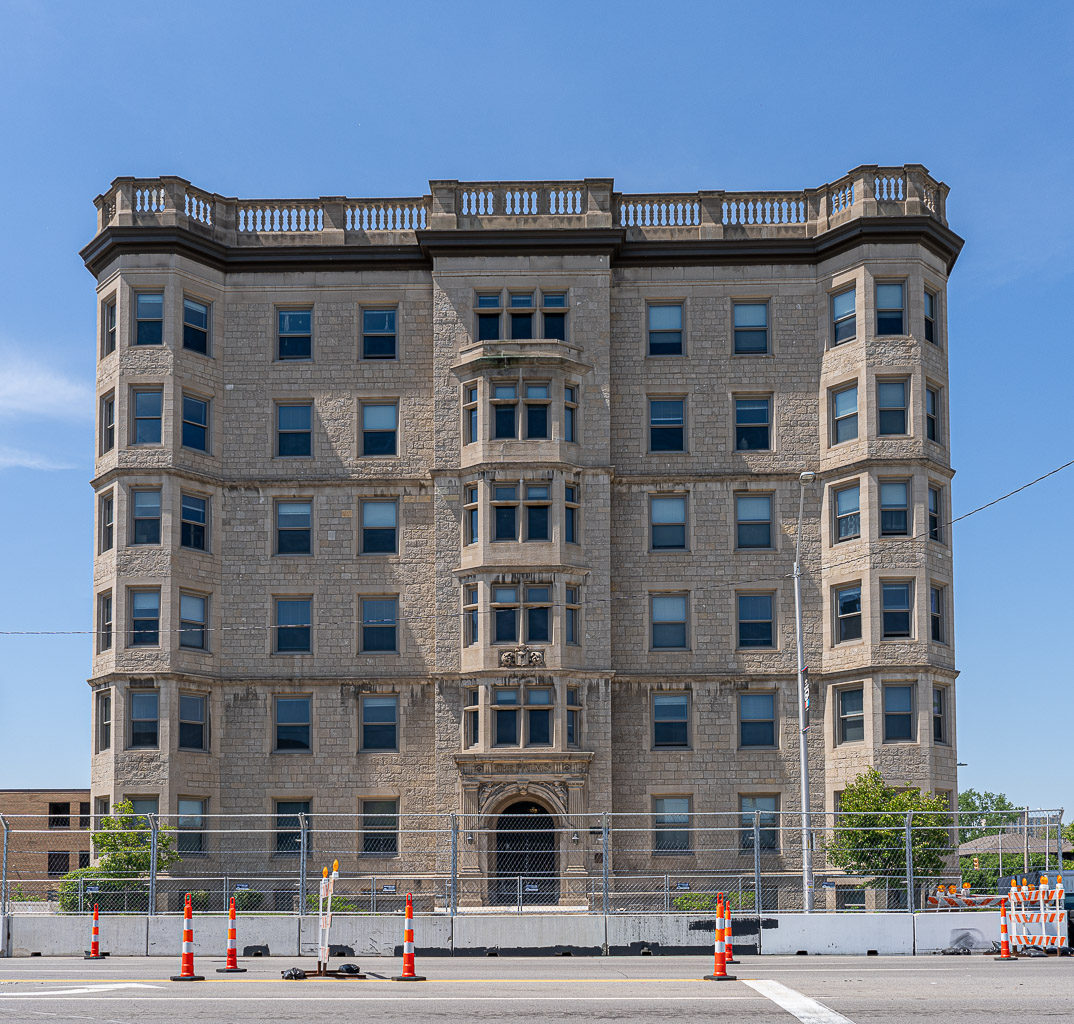
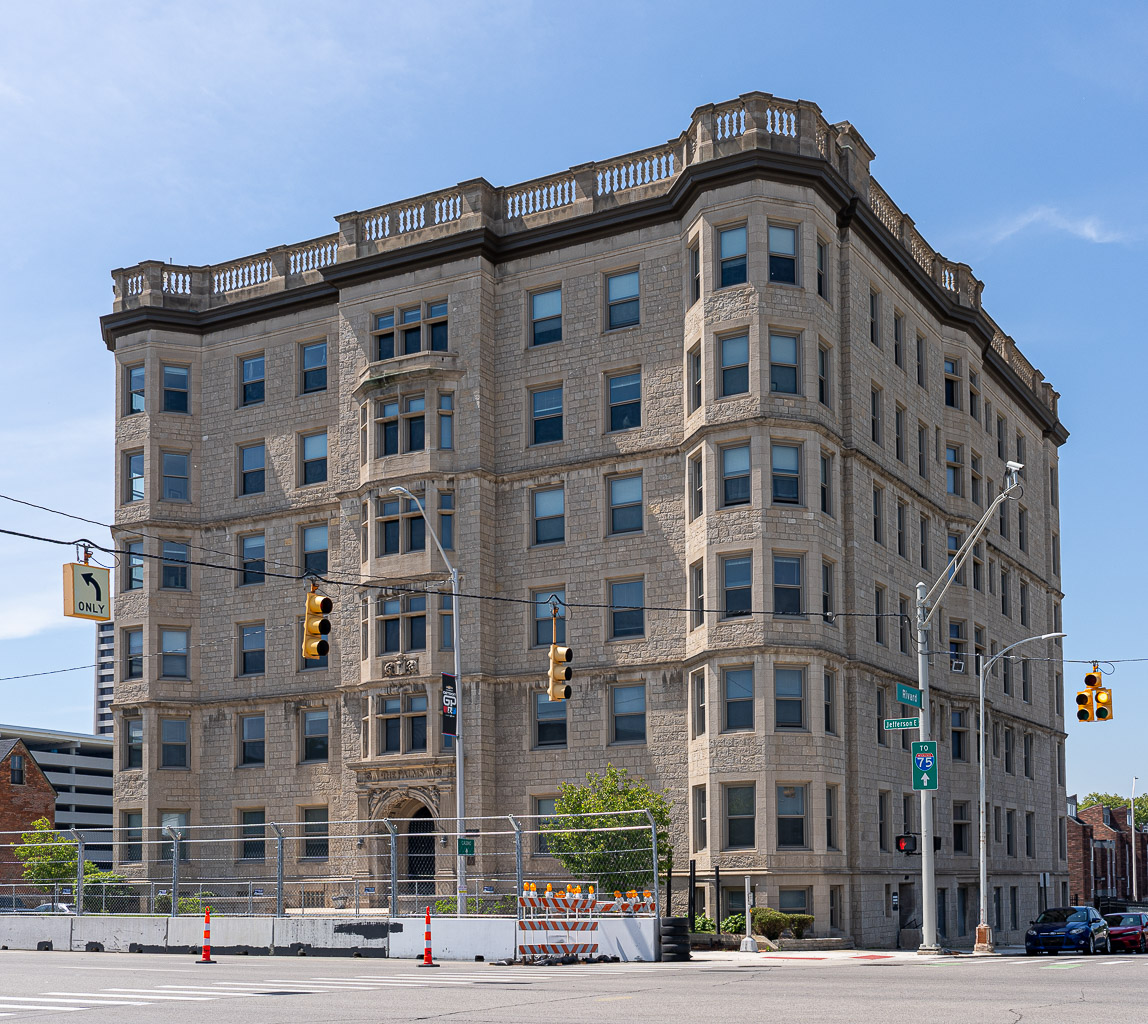
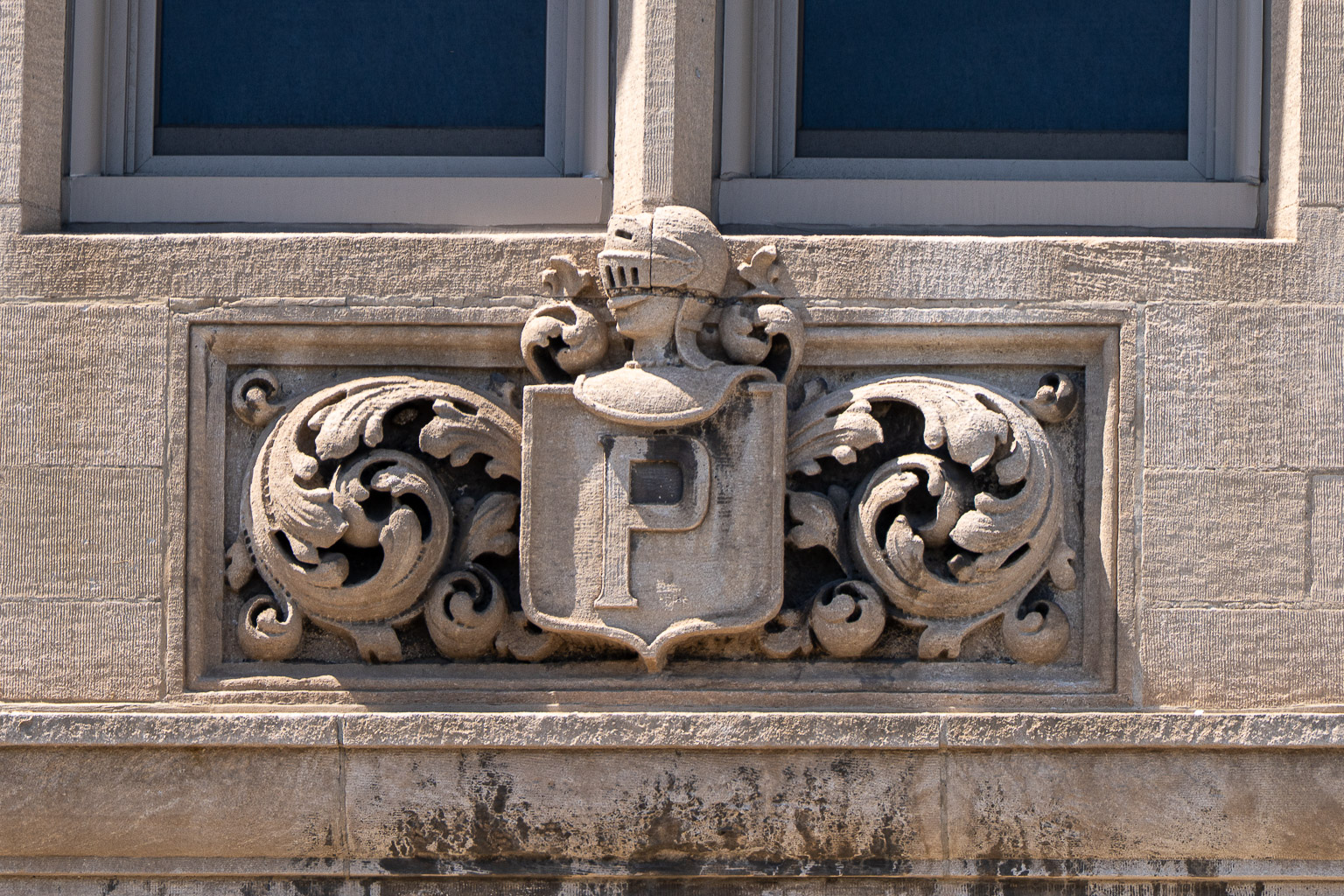
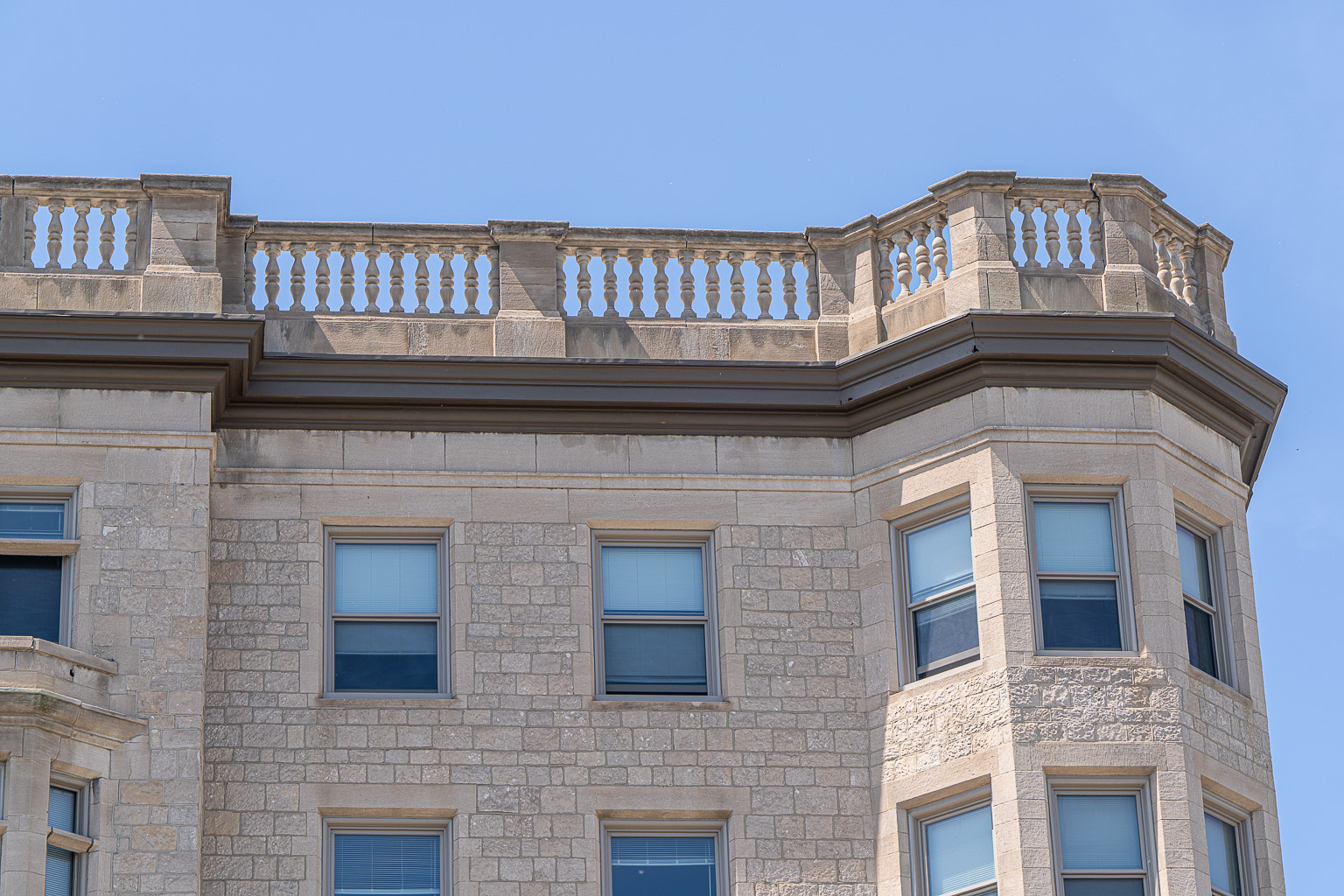
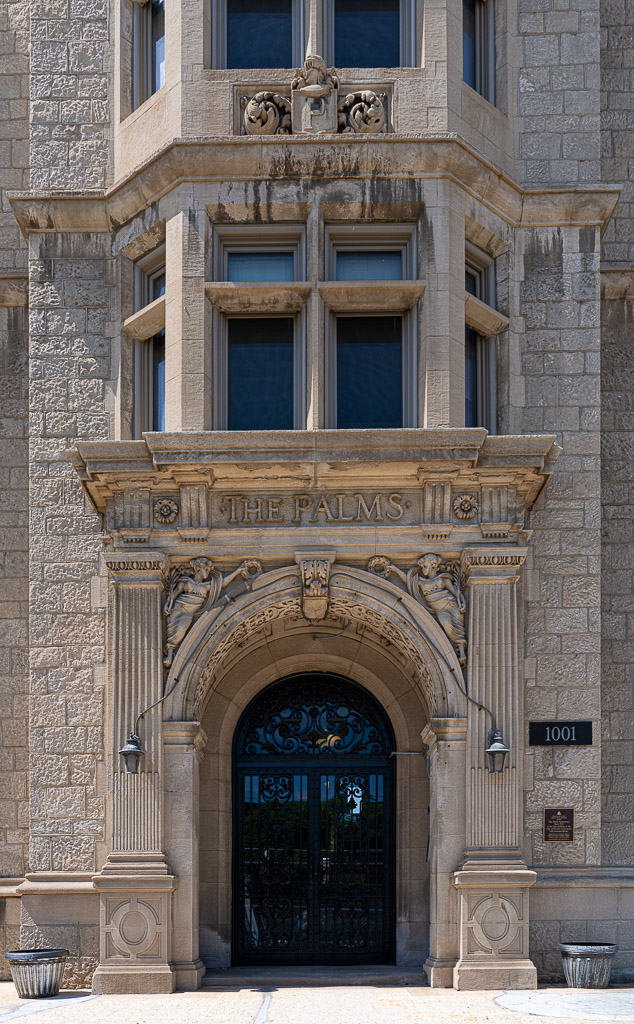
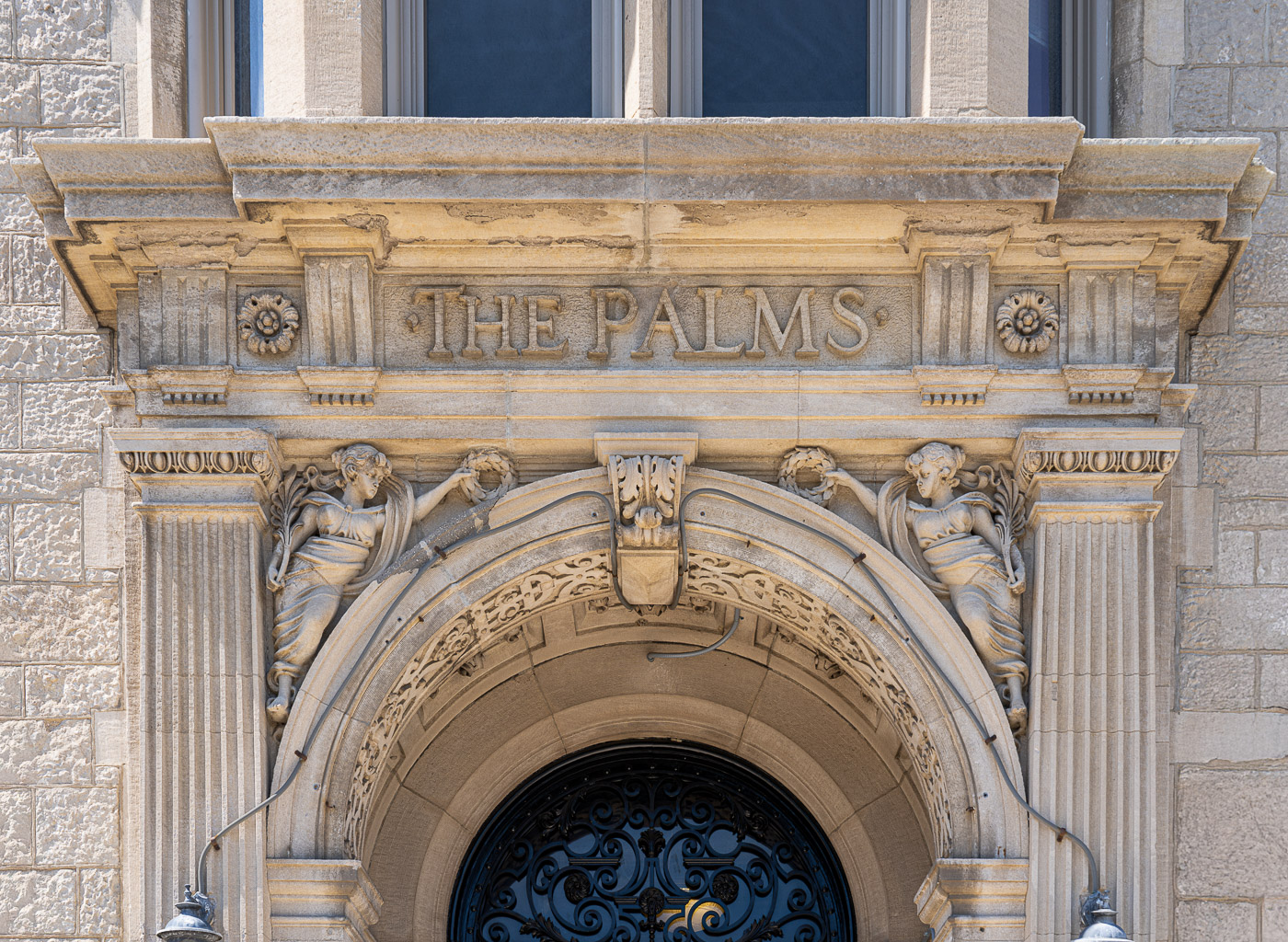
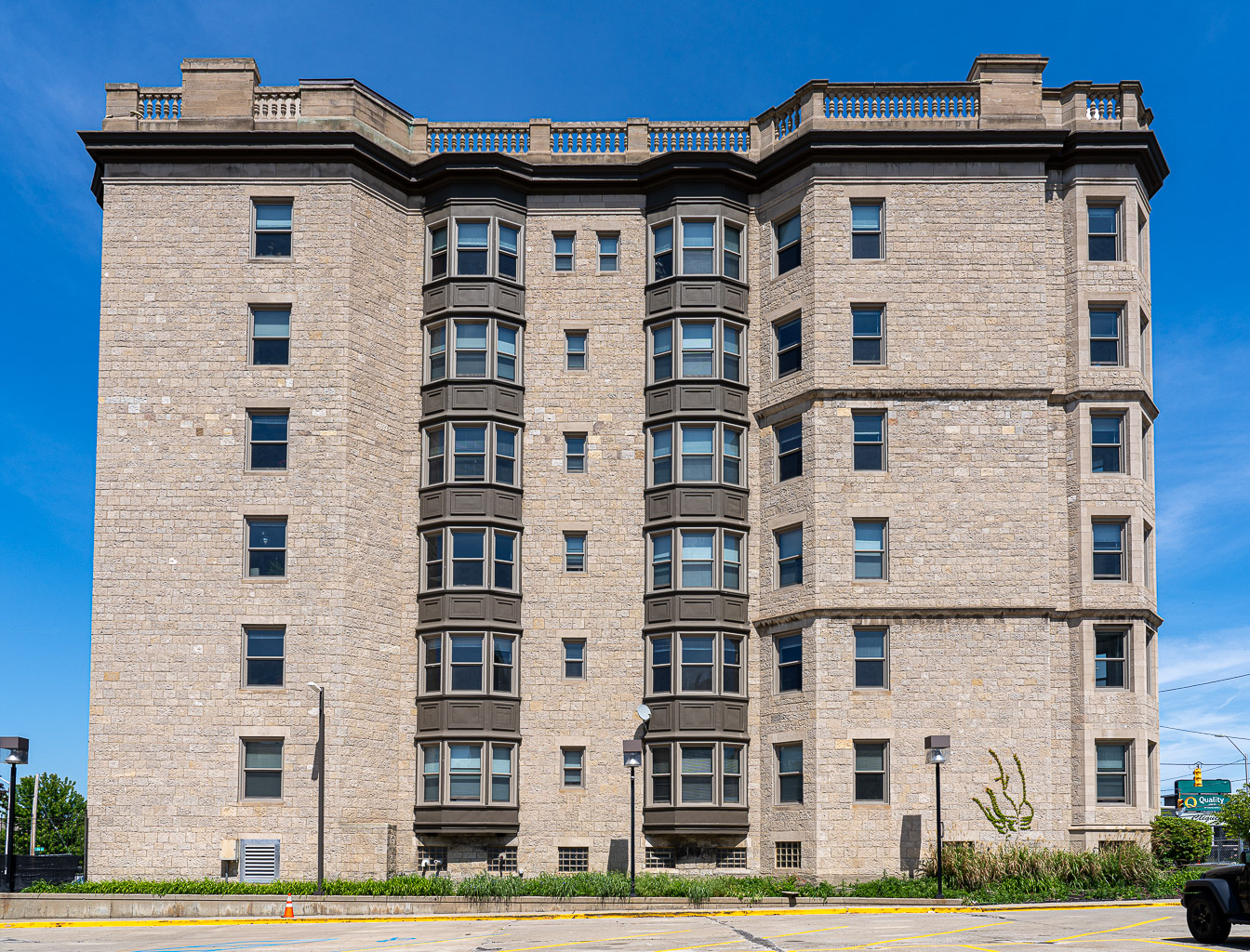
PHYSICAL DESCRIPTION: The Palms faces Jefferson Avenue; the main entrance, centered in the facade. is surrounded by carved limestone ornament. The walls of the building are solid masonry, faced with limestone. The general stylistic influence is English Renaissance, and it may be that the talents of George D. Mason had considerable influence on the design. The Jefferson facade is symmetrical, with engaged octagonal toxers at the corners and a cornice and balustrade at the top. The land slopes down toward Larned, with the result that the high basement of the front facade become a fully-exposed floor at the rear. Along the side of the building on Rivard there is an entrance door leading to the basement level: running along the Rivard side in the basement is a finely decorated room with leaded glass windows which originally served as a tea room; this is now the office of the owning company.
The building is "U" shaped, the two main wings running north and south flanking a court between which is open to the rear. Service stairs are at the rear of both wings, leading to the original kitchen areas. The land behind the building has been associated with the property for many years; the 1923 Atlas of Detroit shows a garage and unidentified frame building on the land; it is now vacant and used for tenant parking.
Inside the main entrance, a partial flight of stairs leads to the stairwell and elevator lobby; these spaces are elaborately decorated with panelling and moulded plaster ceilings. Much detail remains in the apartment units; panelling, fireplaces, carved woodwork and the like are still attractive features in the smaller units now in use. Originally, a major apartment occupied the whole of a wing, running from a double parlor in the front corner of the building to a dining room with fireplace in the rear corner. Between were bedrooms, libraries, baths, and service spaces, with kitchen areas facing the court in the rear. The units in the center front of the building were always of small size.
Exterior changes have been minimal, being limited to the addition of some small windows in the side elevations which resulted from the subdivision of the units, and some changes to the appearance of the rear of the building, which was not intended as an architecturally complete facade in any case.
More photos and more description of this building can be found at HistoricDetroit.org, and this Facebook post, and also this Facebook post.