The Park Avenue Local Historic District runs on both sides of Park Avenue, from West Elizabeth Street to the West Fisher Freeway Service Drive. You can read details about the district and its buildings in the Proposed Park Avenue Local Historic District Final Report (local copy), which I recommend highly to anyone interested in Detroit's history. In the subheadings below, a number within brackets, like [1] means this building is #1 within that report. A Wikipedia Page also describes the district.
Contents:
- 2030 Park, Cliff Bell's Bar
- 2033 Park, Hotel Charlevoix, Charlevoix Building
- 2119 Park, Women's City Club
- 2138 Park, Blenheim Apartments
- 2110 Park, Detroit Life Building, Detroit Building
- 2233 Park, Wormer & Moore Building, Iodent Building
- 2305 Park, Royal Palms Hotel, Park Avenue House
- 2310 Park, Colony Club Building
- 122 West Elizabeth Avenue, Mera Hotel
- 111 West Montcalm Avenue, Engine Company Number 1, Detroit Fire Department
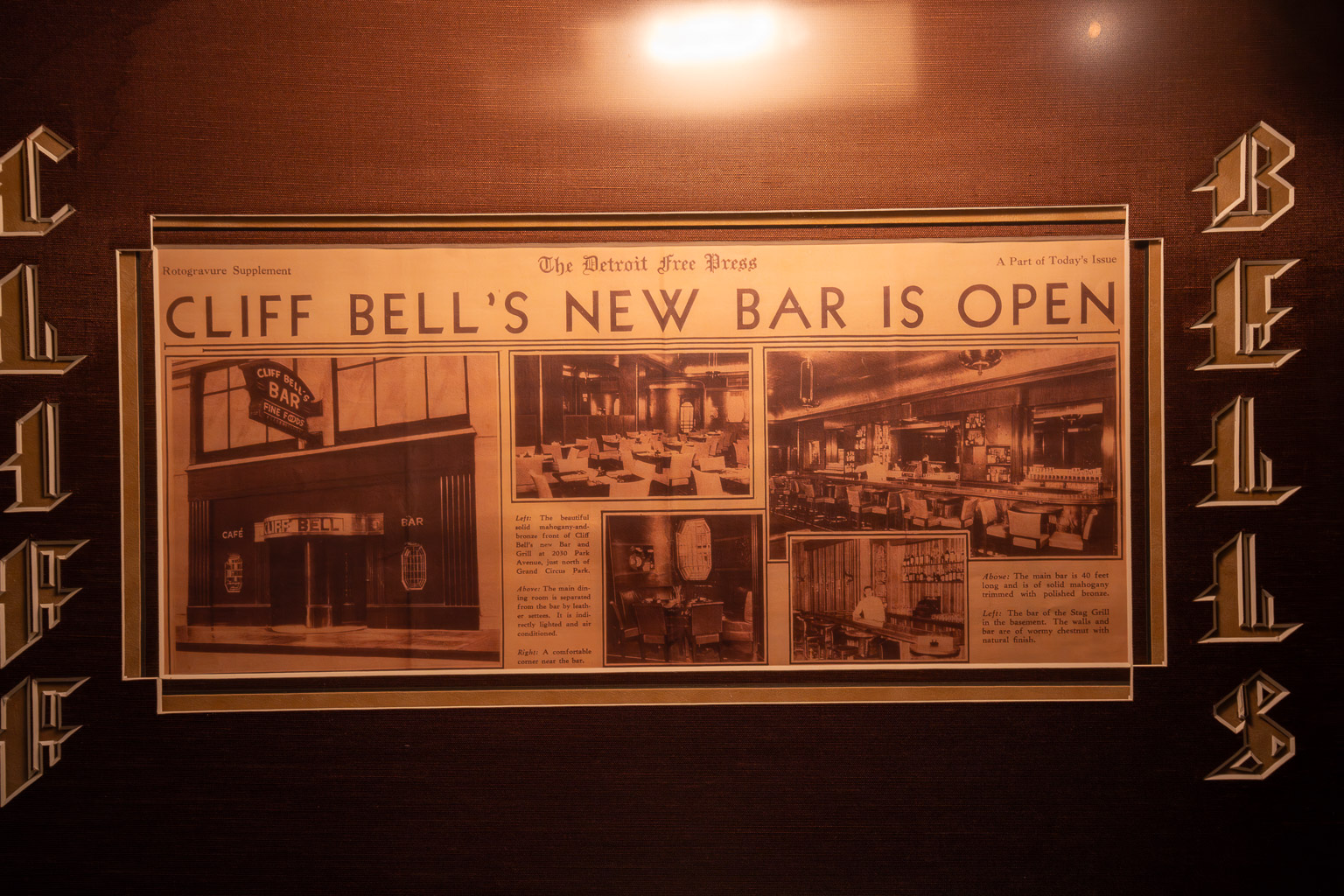
The building at 2030 Park Avenue has been known from 1935 to the early 1970s, and 2005 to present (2026) as the home of Cliff Bell's Bar. But let's start at the beginning, in 1920.
This building is significant in that it represents two of Detroit's prominent early-century commercial businesses, the A. M. Campau Realty Company and the Edson & Moore wholesale goods house. The A.M. Campau Realty Company represented one of Detroit's oldest families. As Clarence Burton put it, the name Campau was "inseparably interwoven with the history of Detroit...." Three members of the Campau family were affiliated with this realty firm: Charlotte Campau Copland, president; M. Woolsey Campau, vice-president, and A. Macomb Campau, secretary and treasurer. Prior to being located on Park Avenue the firm was located at 1412 MacDougall. By 1925-26, the firm had moved onto Park Avenue in the Wormer & Moore Building, and then in 1931-32 it moved to the building at 2030 Park Avenue, although at its Elizabeth Street address.
In 1925-26, the vice president of the firm became Gaylord Gillis, who was chairman of the board of the Edson & Moore wholesale dry goods firm, which his father Ransom Gillis had participated in organizing in 1872. Gaylord Gillis was also the first treasurer of the Park Avenue Association, which promoted the development of Park Avenue during the early 1920s boom years.
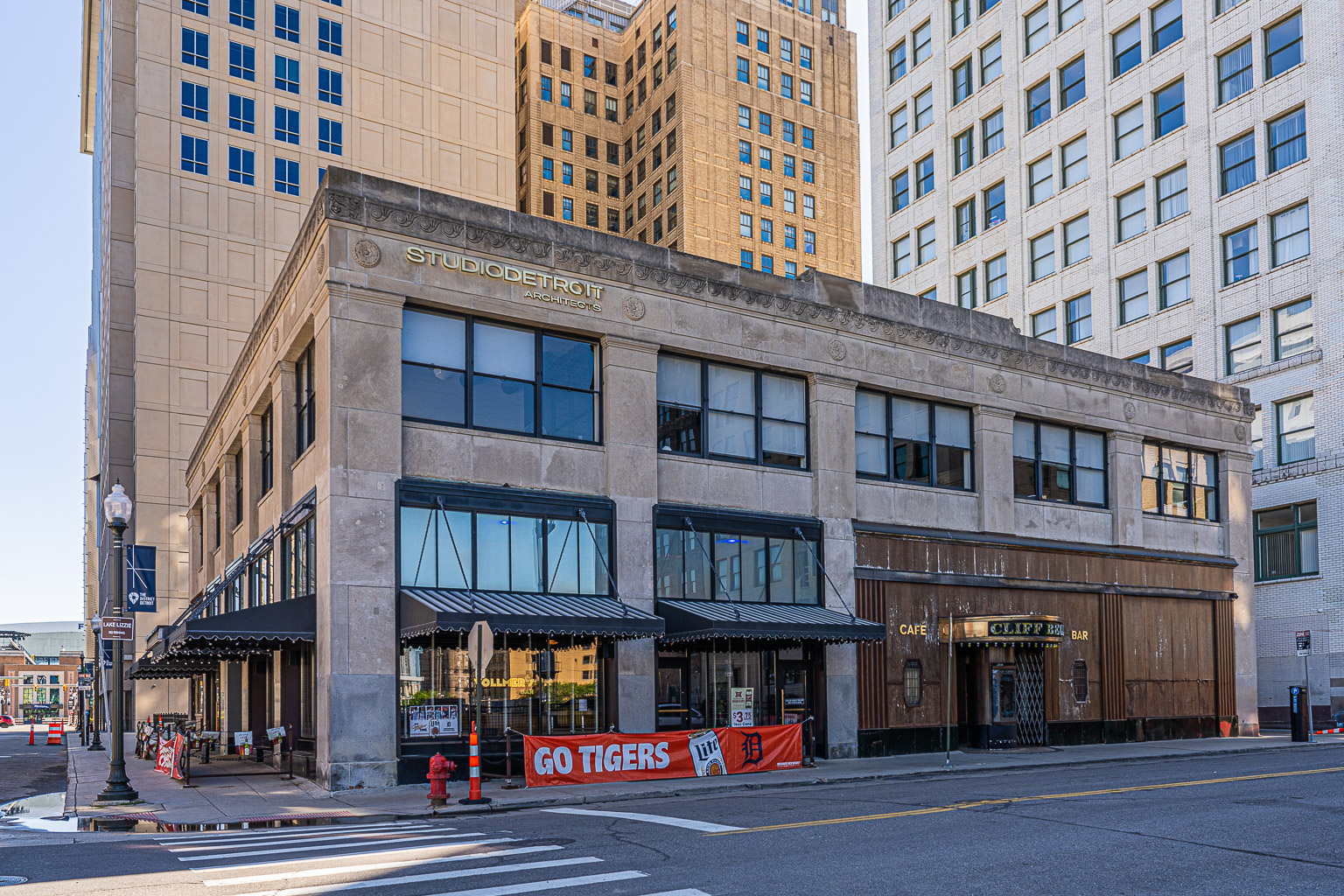
The permit for 2030 Park Avenue was #10894 and was issued on September 9, 1920. The building at 2030 Park Avenue is two stories high, and has a limestone masonry exterior. Numerous changes have been made to the street level facade, and it has recently (2005) been redone for its rebirth as the location of Cliff Bell's restaurant, one of the most elegant and elite in the city from 1935 to the early 1970s.
Exterior photos of the building are below. Cliff Bell's occupies the right (southern) half of the building, and Vollmer's Bar (a great place for lunch or dinner) occupies the north half:
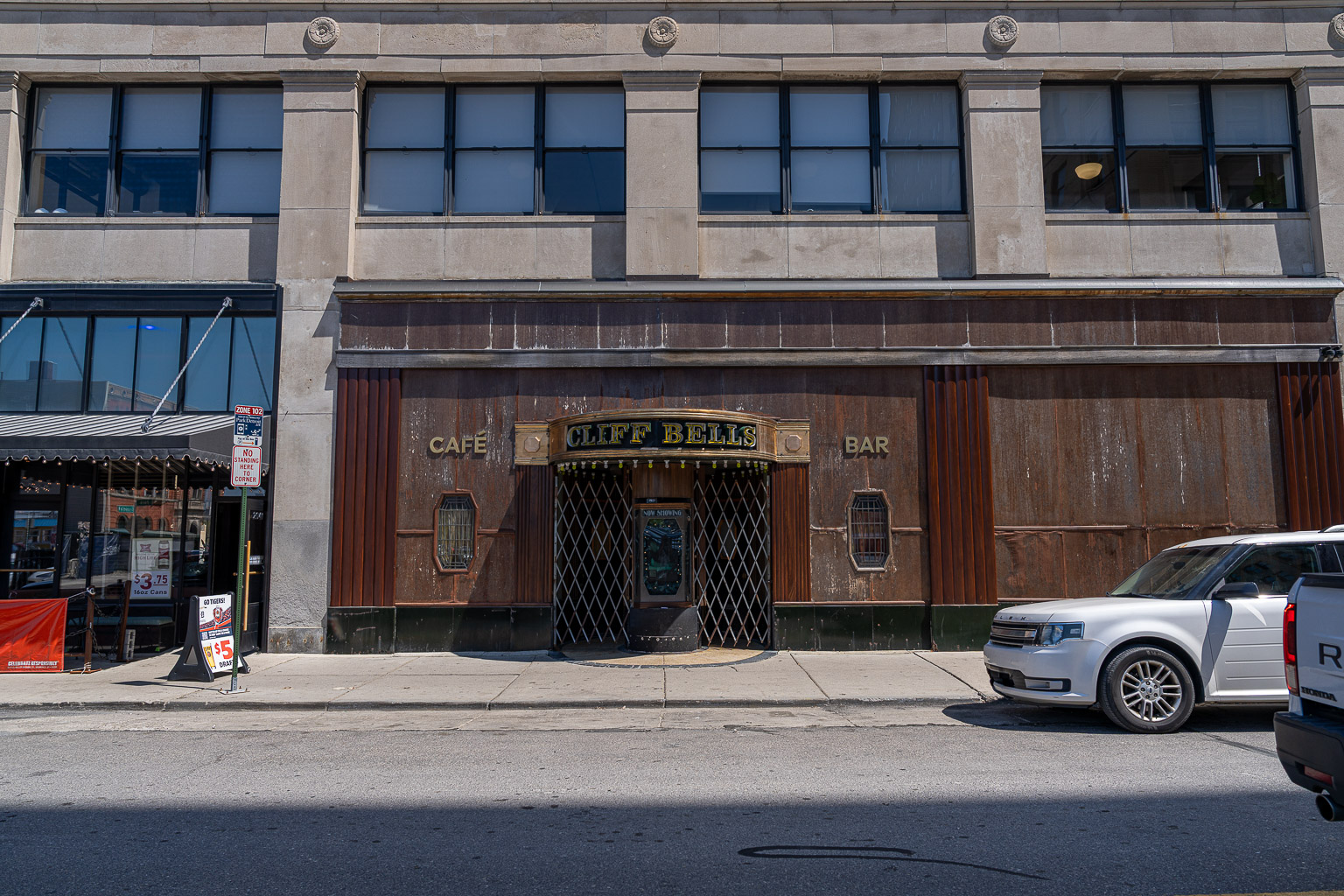
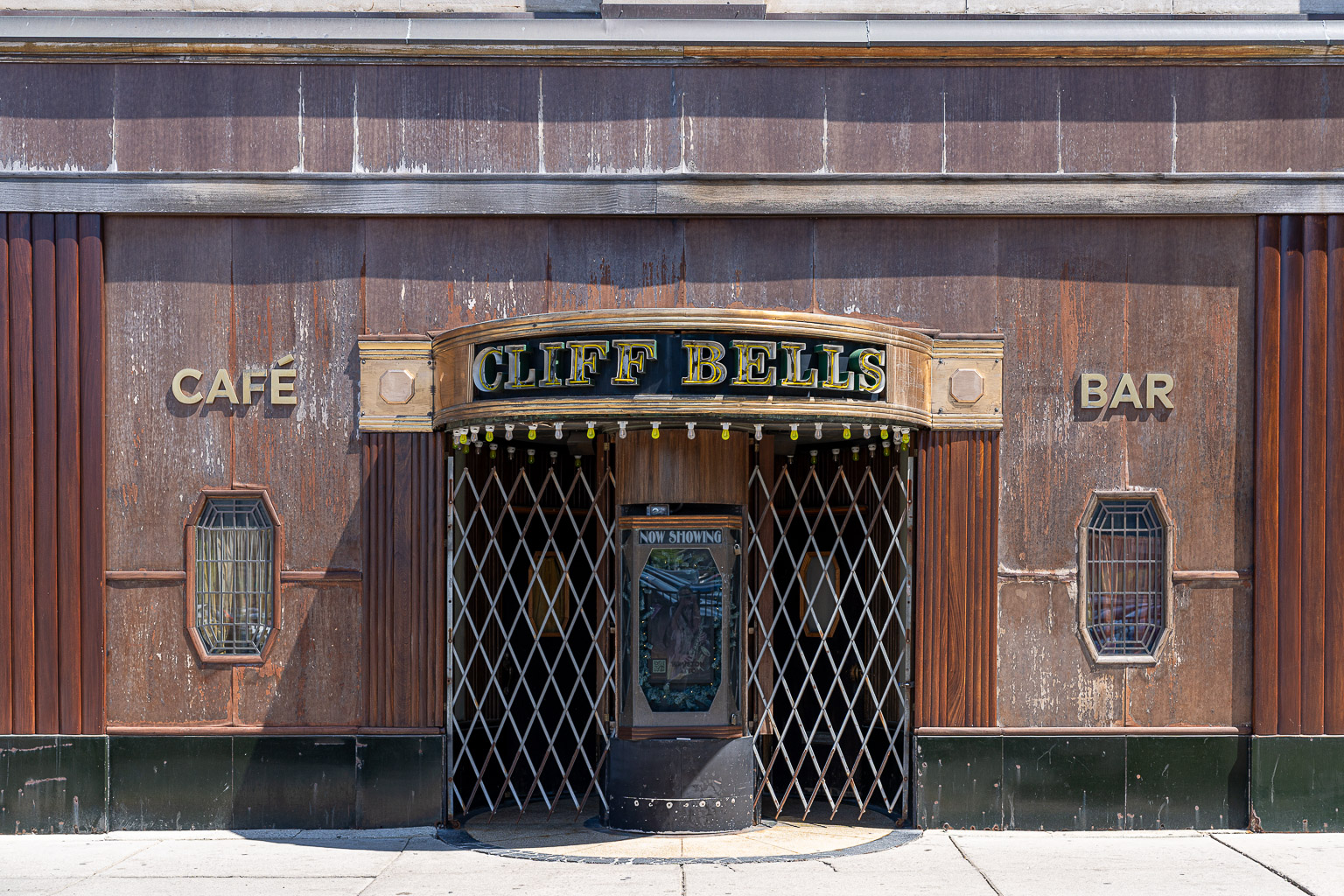
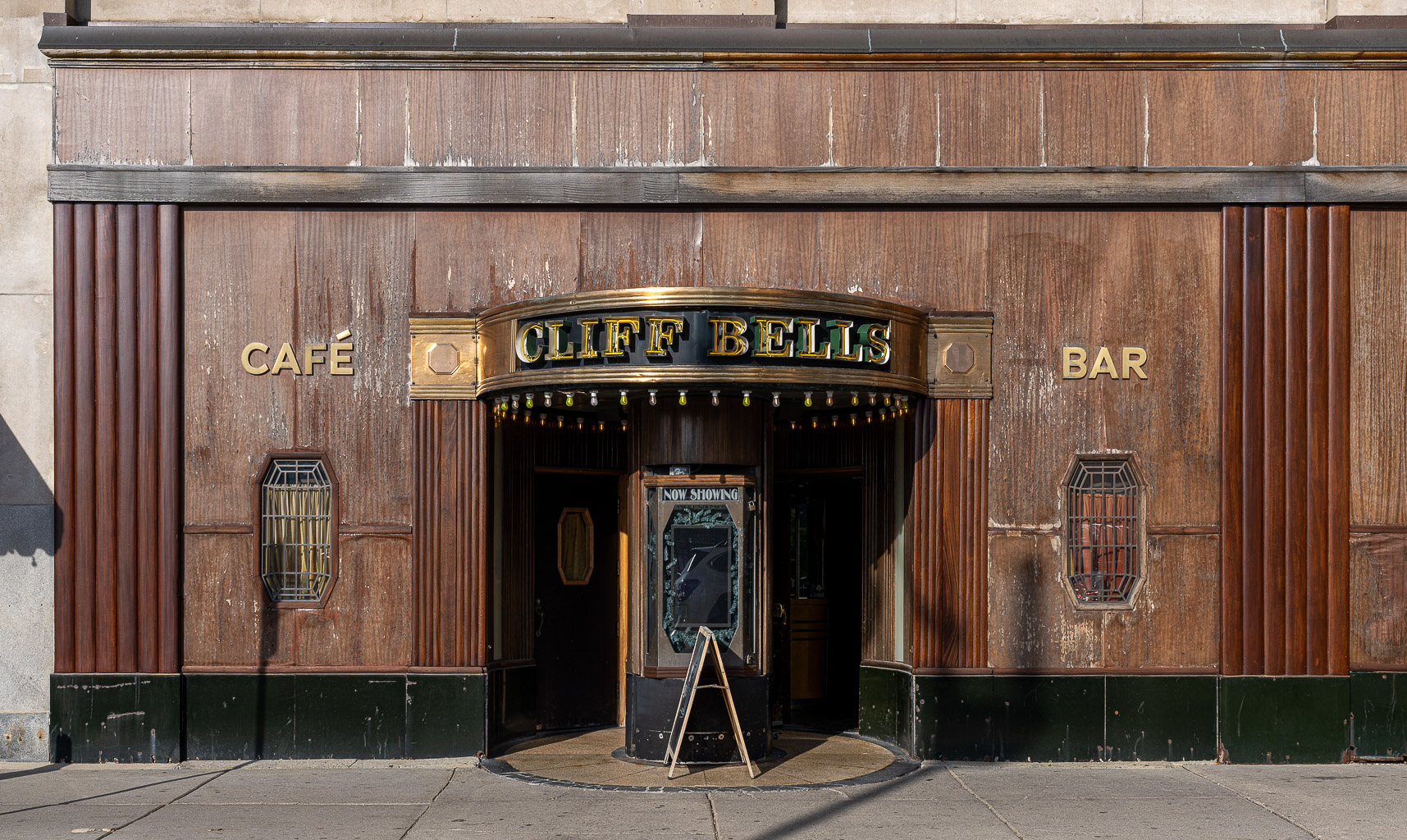
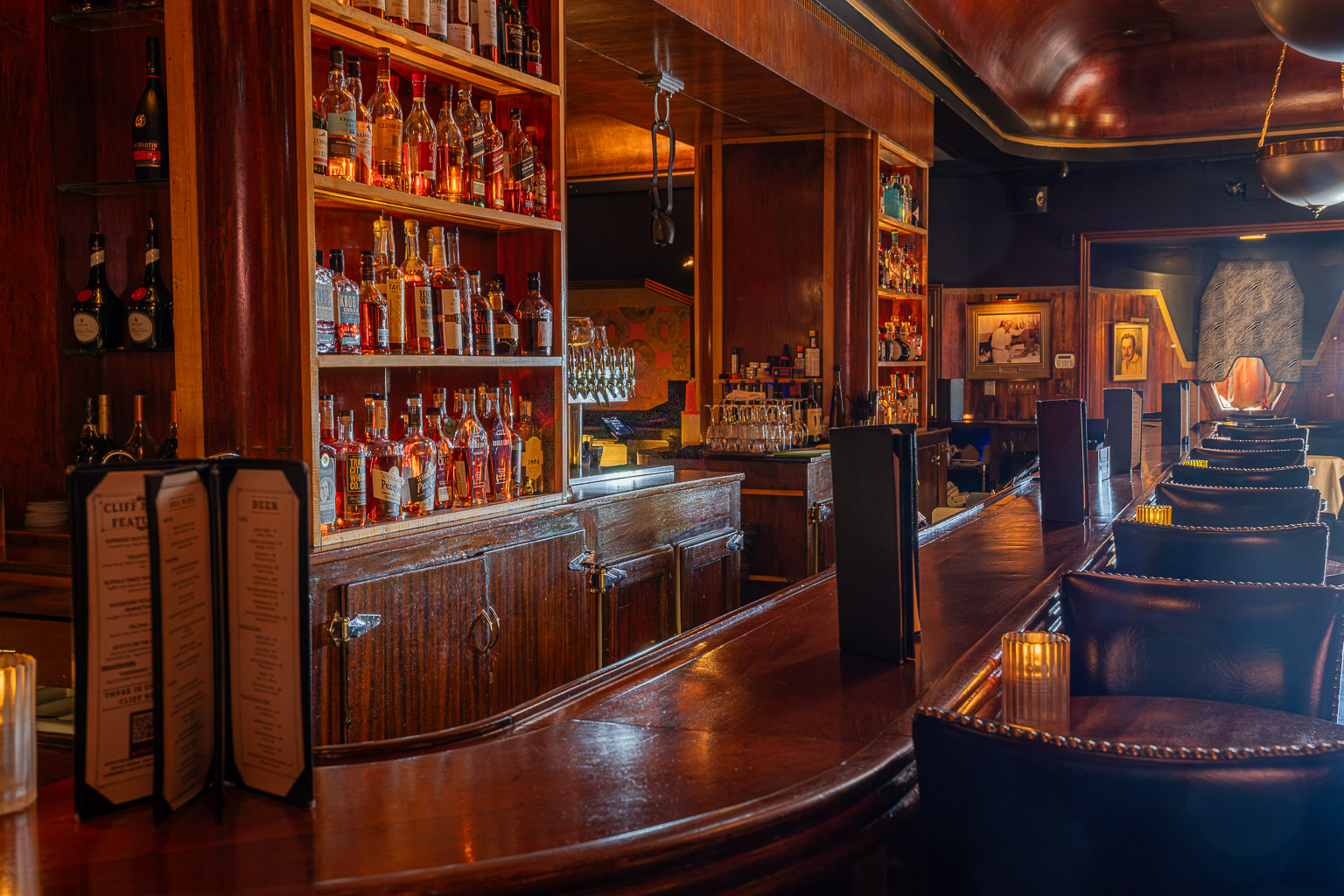
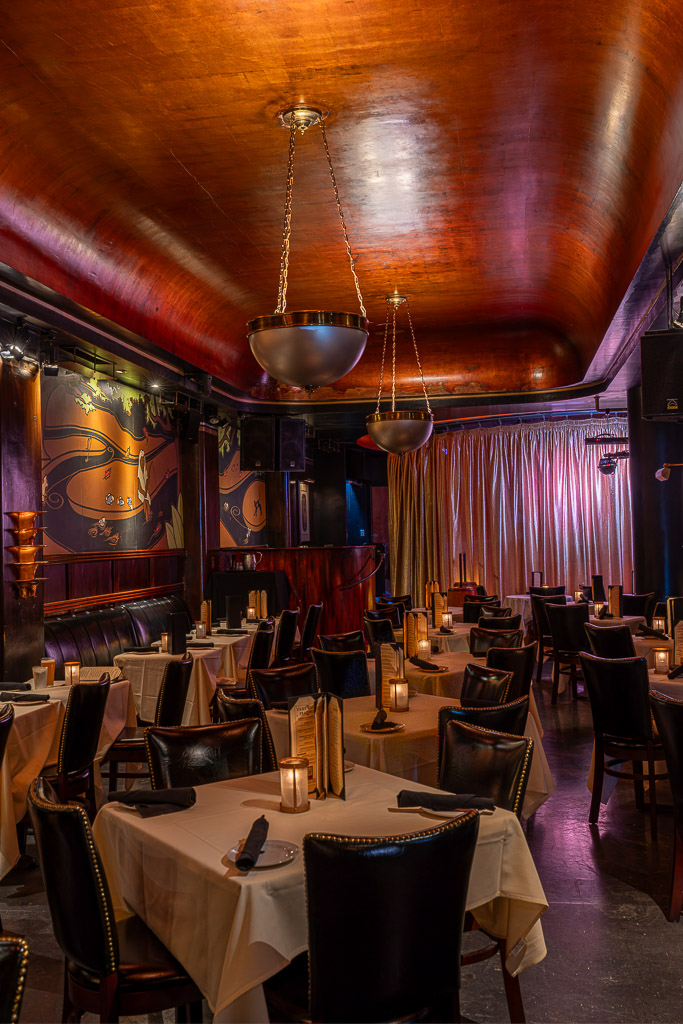
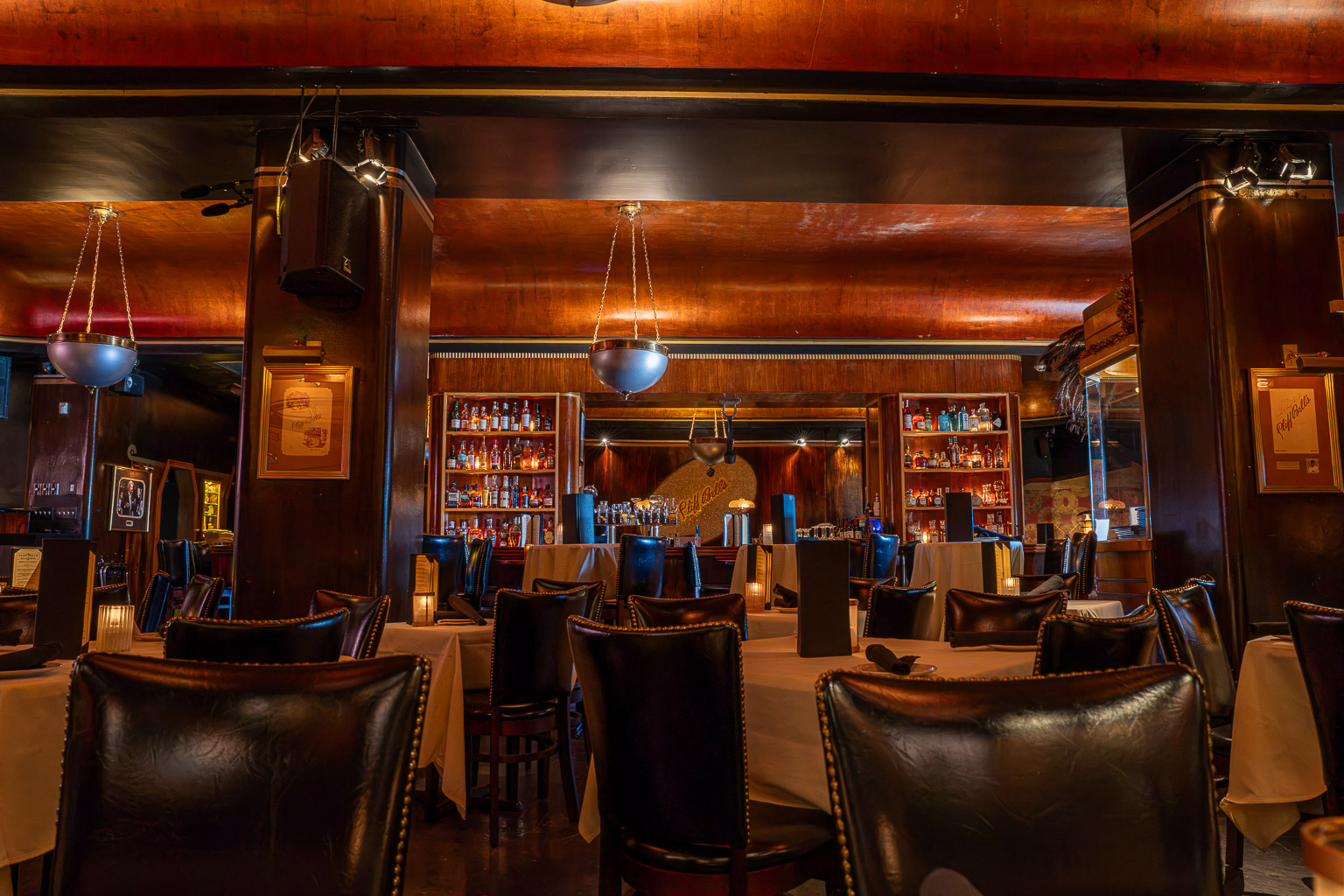
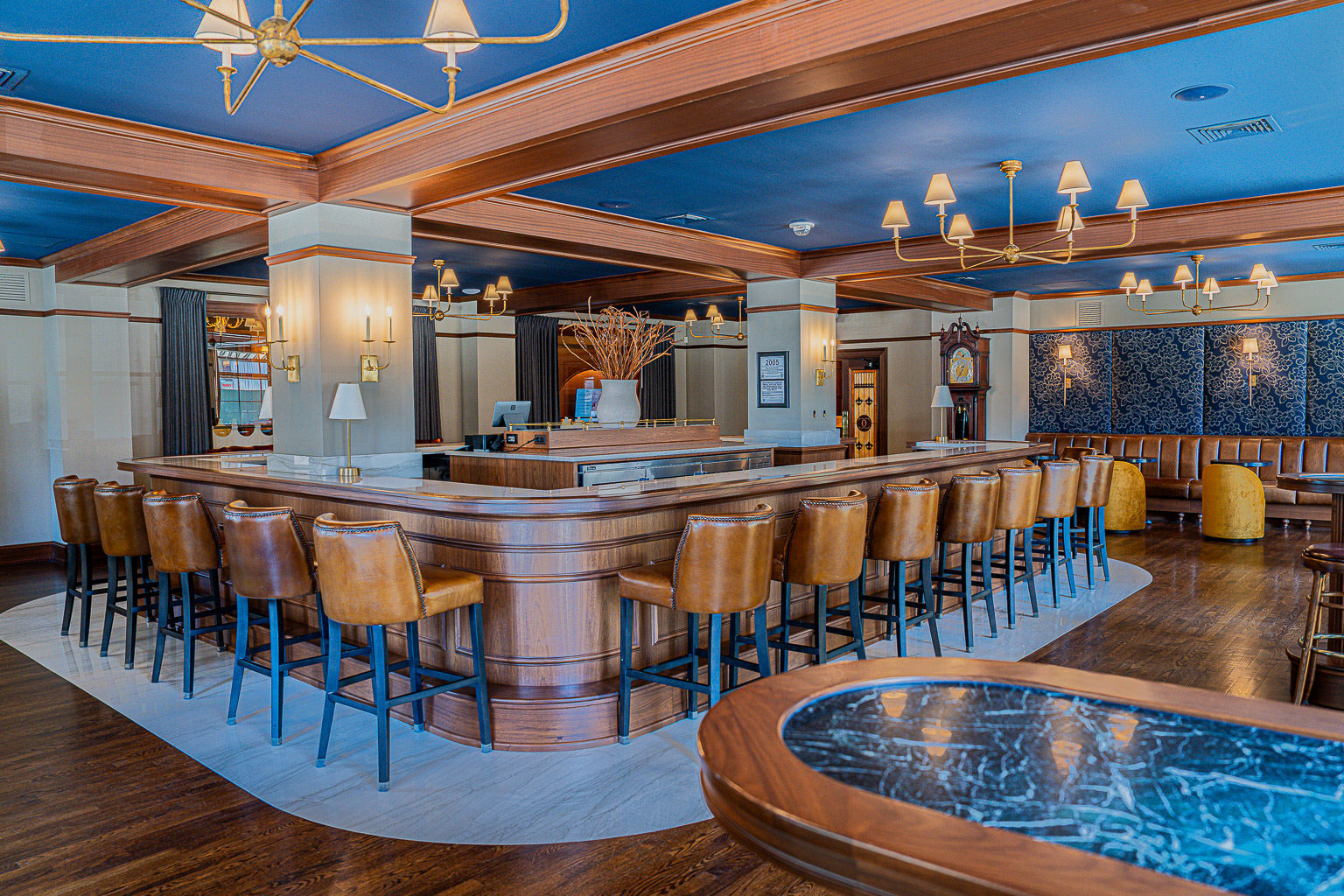
If the Art Deco interior of Cliff Bell's Bar isn’t enough to make you swoon, Cliff Bell’s nightly jazz performances will definitely leave you feeling as though you took a step back in time. Below are photos of the interior.
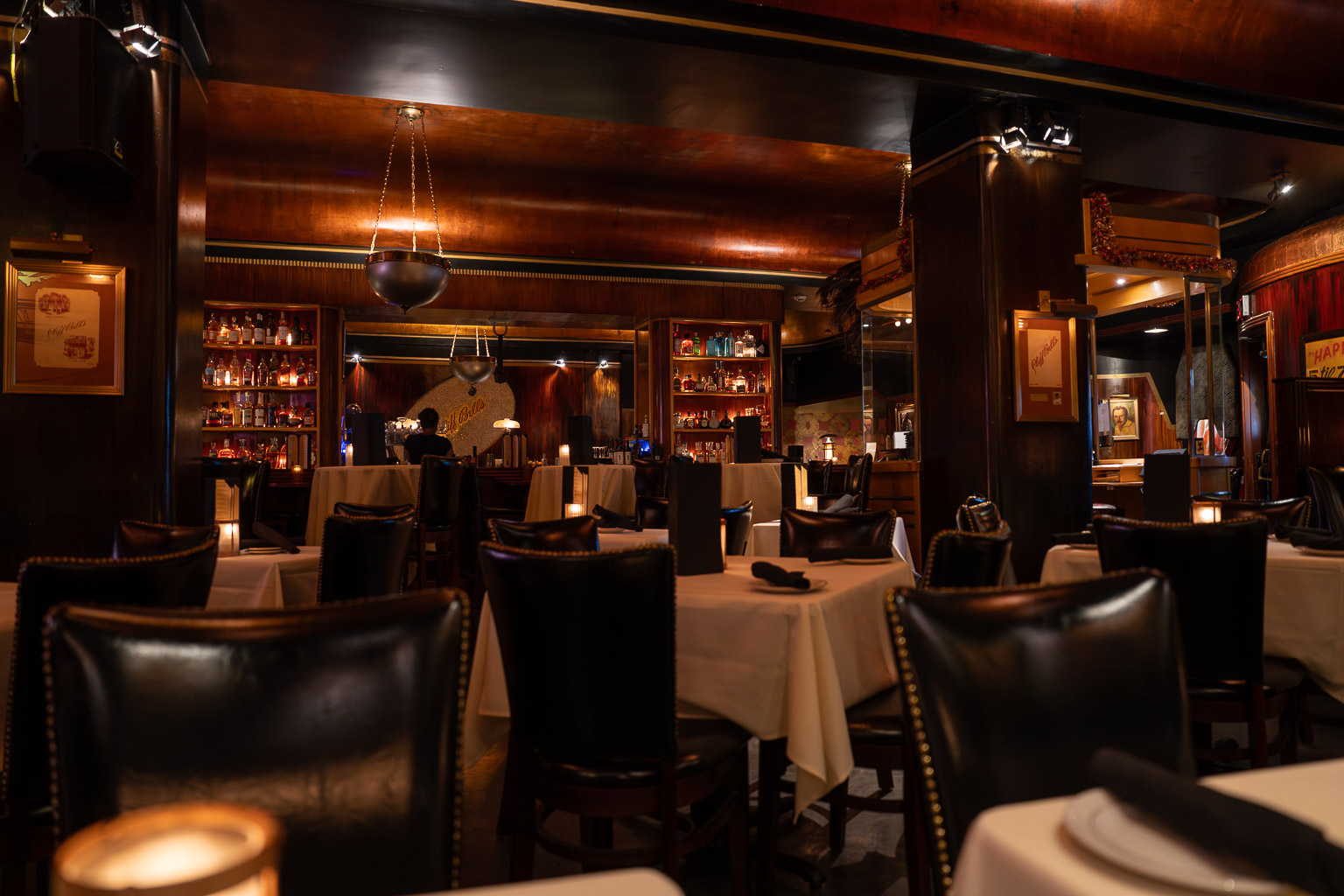
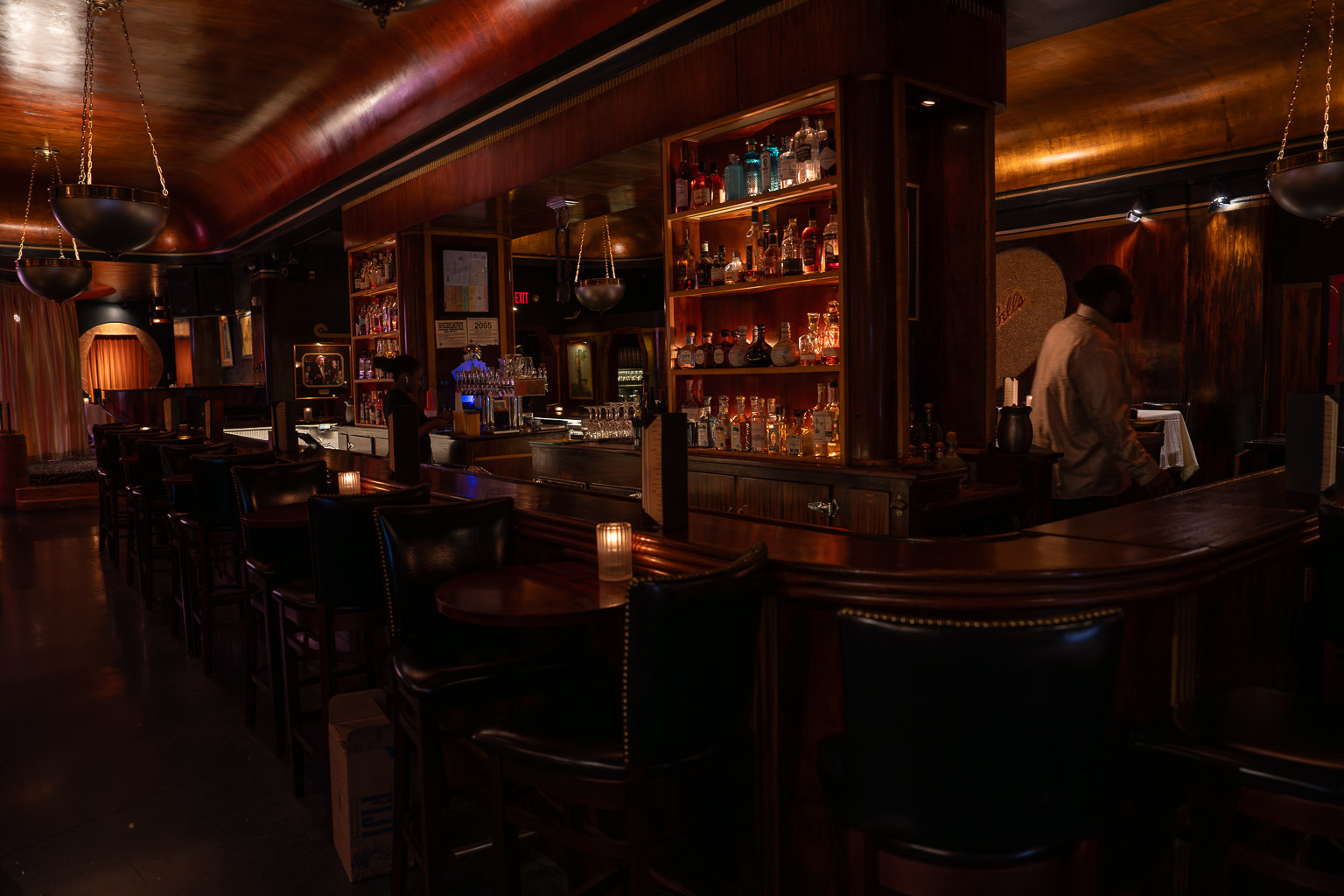
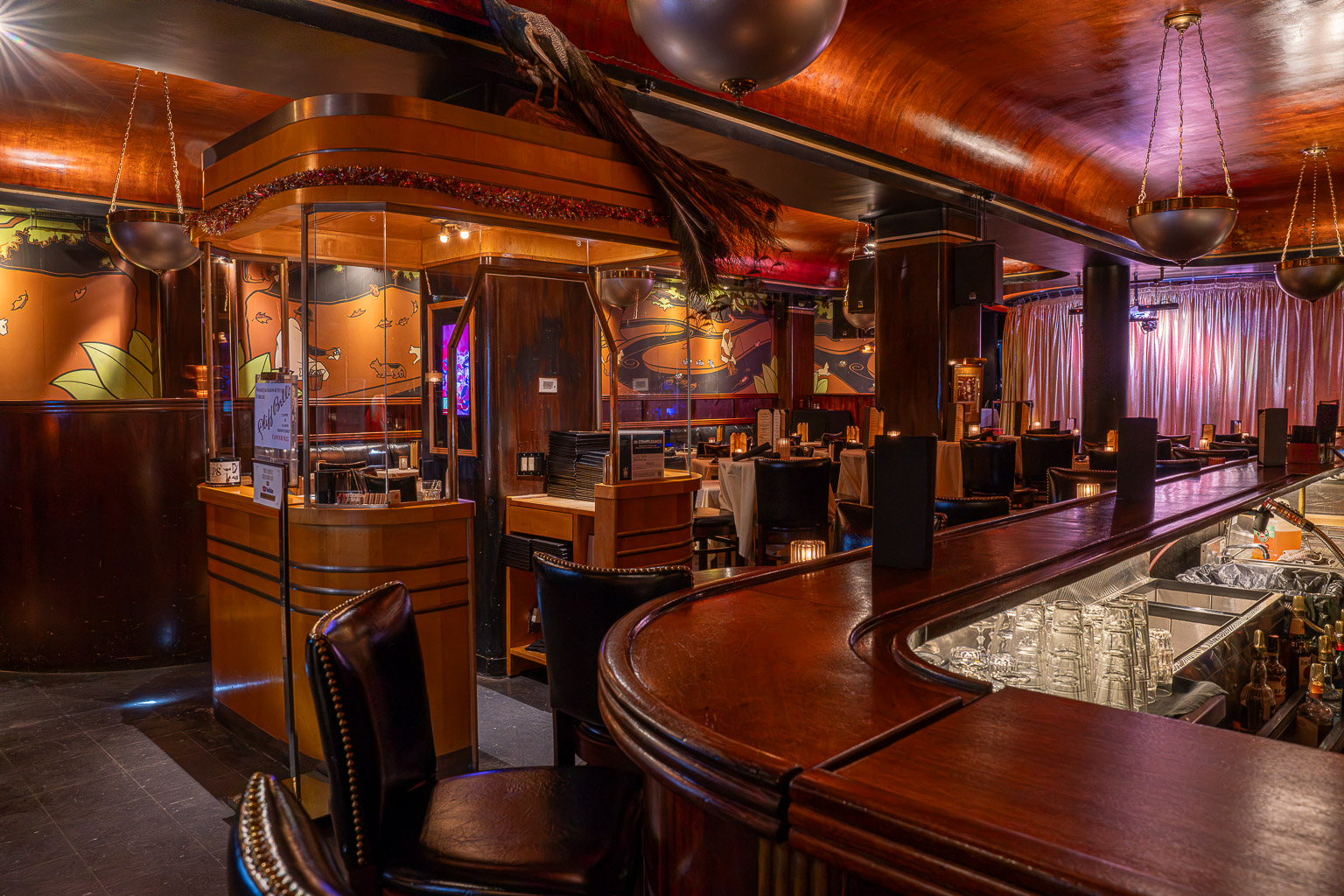
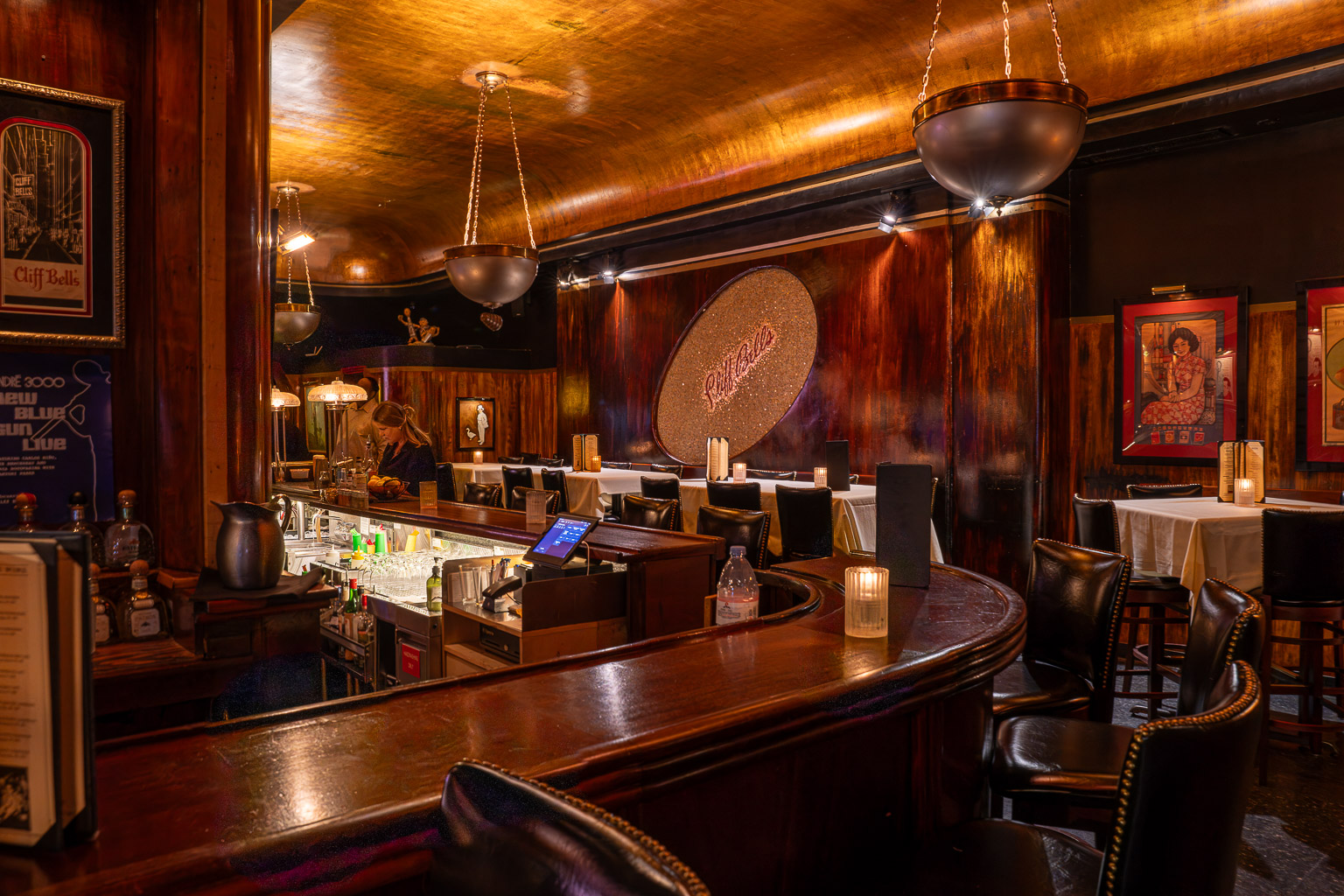
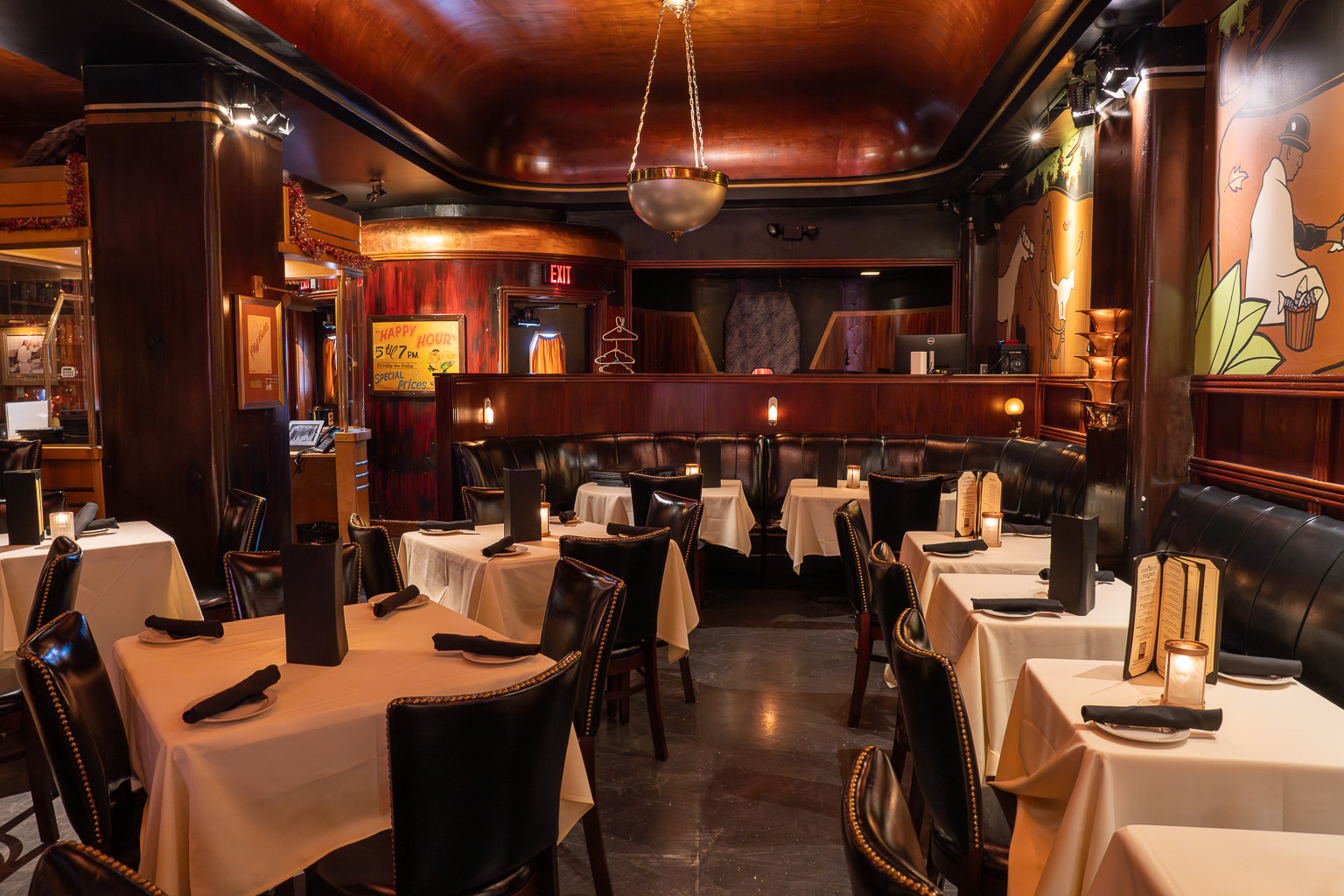
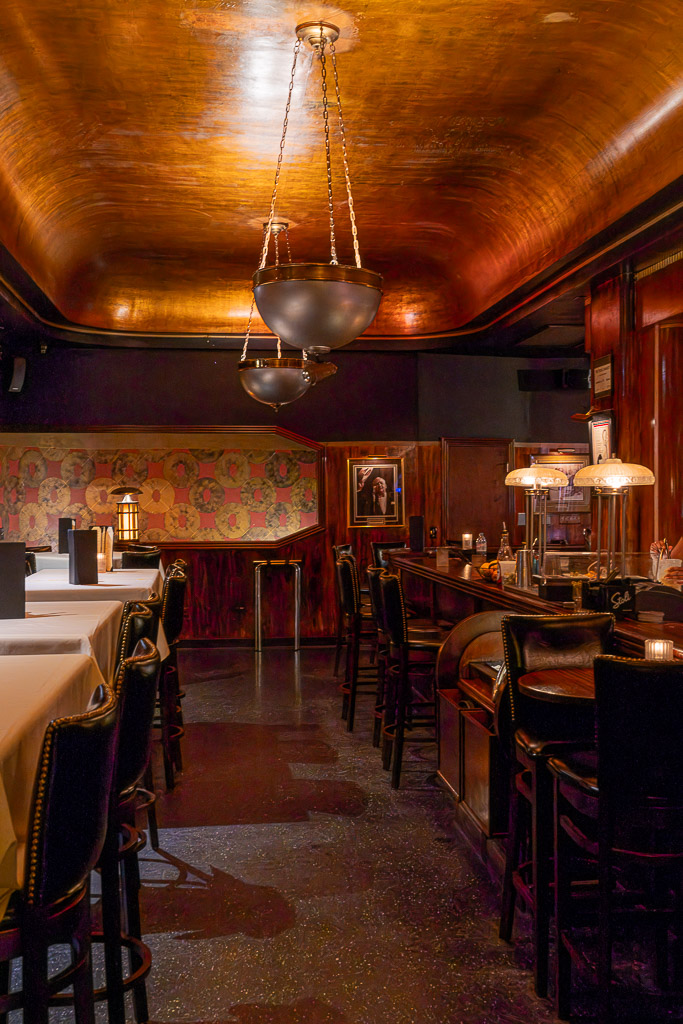
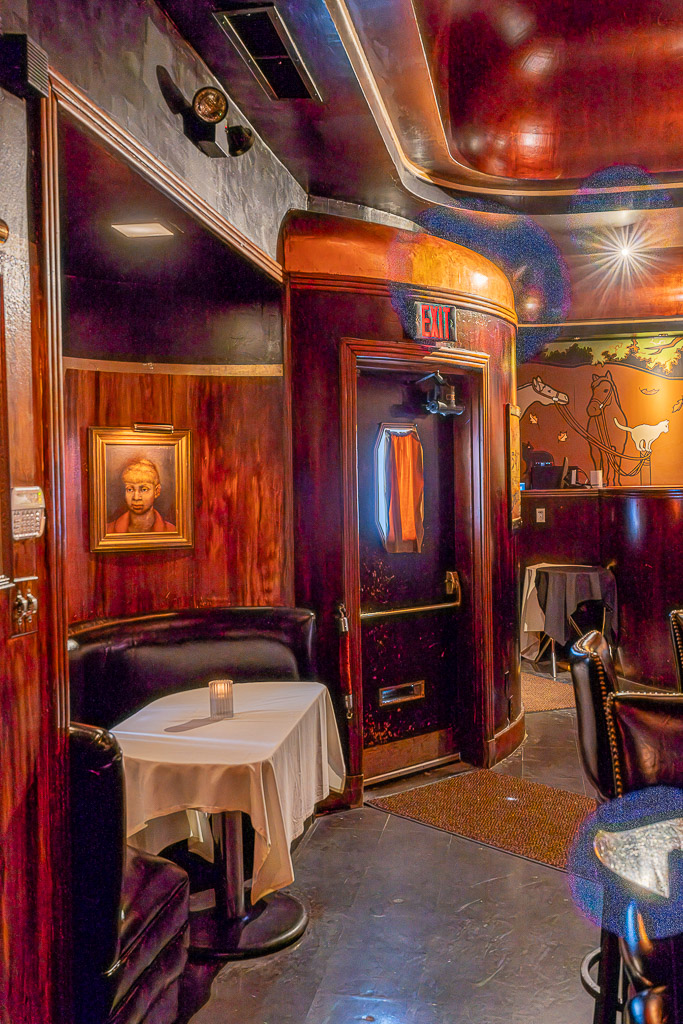
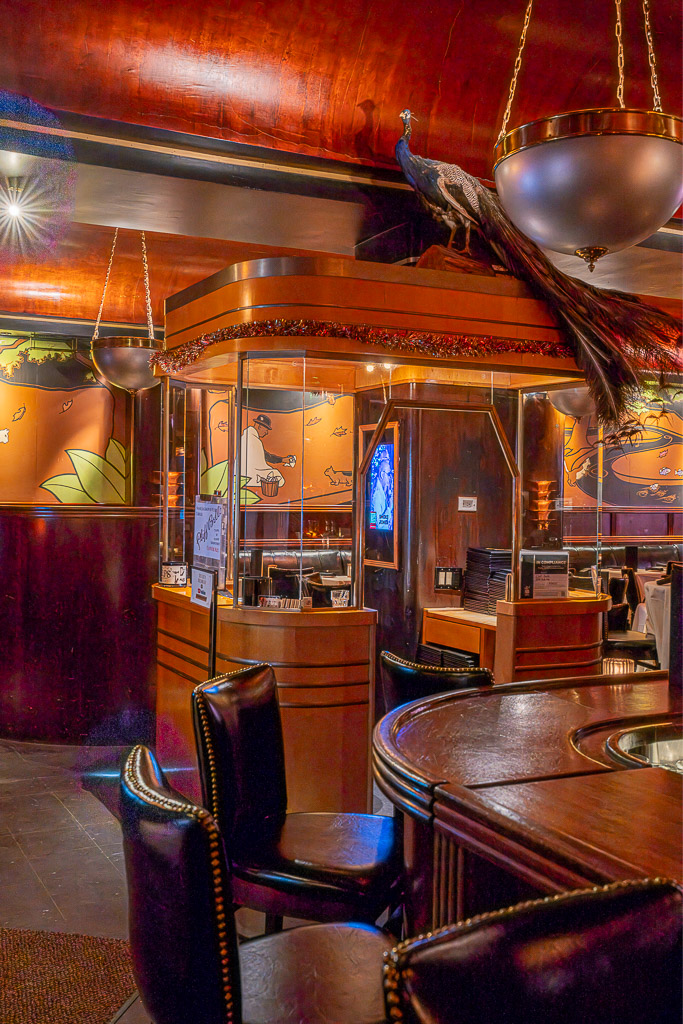
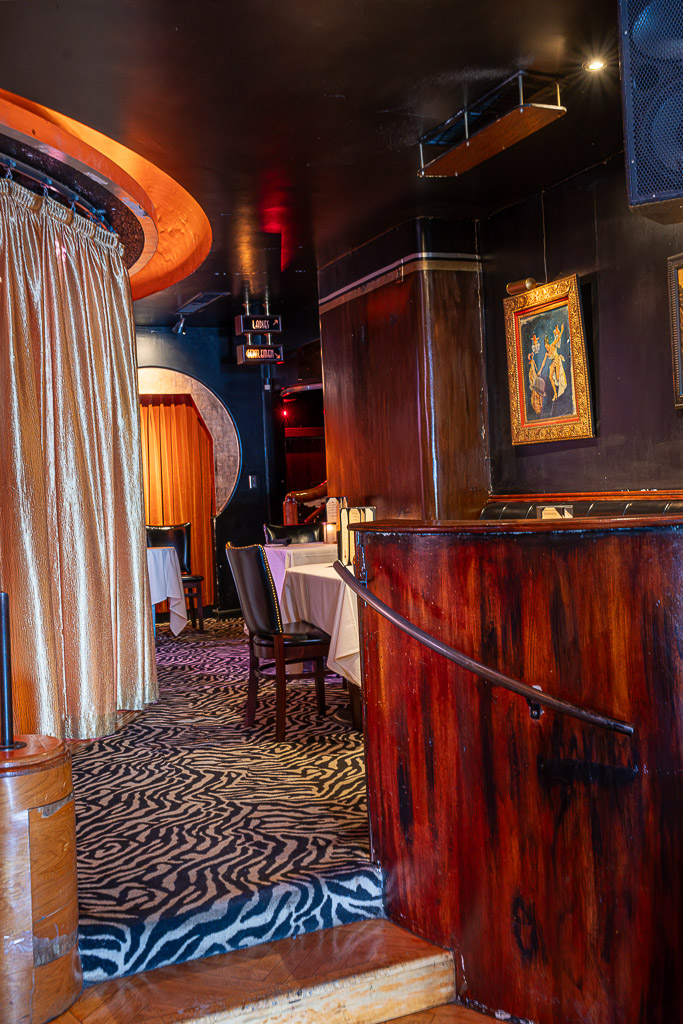
More photos and details about Cliff Bell's can be found at Cliff Bell's History and Cliff Bell's Website and this Facebook post.
When I finally got around to visiting the Hotel Charlevoix to photograph it, in May of 2026, I found an empty lot. The hotel has been razed. Actually, it was razed long ago, on June 23, 2013. But below is the historical information despite this.
The Beaux-Arts style Hotel Charlevoix stands at the southwest comer of Park Avenue and West Elizabeth. It is a significant example of Beaux-Arts architecture in Detroit, erected in 1905, particularly as applied to a multiple-story residential building. It was notable in its day in that it appears to be the first building in Detroit to have had an iron marquee that fully covered the sidewalk to the street. The writer for the Detroit Free Press felt compelled to explain it: "A distinctive feature will be a glass-roofed 'marquis' or entrance extending clear across the sidewalk to the street, after the latest New York style." A Manning Brothers photograph from just after the building's construction shows the marquee had a balcony-like railing, and the word "Charlevoix" in lights.
The permit for the Hotel Charlevoix was issued on July 6, 1905 to the realty firm Tufts & Strong. It was one of the first skyscrapers in the Grand Circus Park area, and the first on Park Avenue above Adams. It rose simultaneously with the 13-story Tuller Hotel one block south on Park and Adams, which had received its building permit on May 31 of that year. The permit was issued for a brick, steel, and concrete structure at the corner of Park and W. Elizabeth Street. The dimensions listed were 90 feet in width by 80 feet in depth; its estimated cost of construction was $200,000. It would serve as a "dwelling" of 90 apartments, and have ten stories. However, the structure was ultimately eleven stories high.
The driving force behind Tufts & Strong, and the construction of the Charlevoix, was Charles W. Tufts. Tufts was a developer of several major early Detroit apartment houses, including the Madison and the Pasadena. Tufts & Strong apparently purchased a partially- completed building owned by the People's Telephone Co., razed it, and constructed the Charlevoix on the same site. They hired William S. Joy as the architect. Joy, born in Detroit on June 28, 1864, studied architecture in the office of Mortimer L. Smith in 1880. He began to practice independently in 1894. His significant works in Detroit, aside from the Hotel Charlevoix, included the Wellington Apartments, the Vendome, Marlborough Flats, the Chipman Annex, and many municipal buildings. His office was located in the Ferguson Building on Woodward Avenue. Shillinger Brothers was the contractor for the building, and the structural steel was supplied by Russel Wheel & Foundry Company. Charles Tufts died suddenly in 1906, and responsibilities for the Charlevoix seem to have been transferred to another realty firm, the Vinton Company.
In response to the changing uses on Park Avenue, the Hotel Charlevoix was converted into an office building, and became known as the Charlevoix Building. The Charlevoix remained an office building for the remainder of its operating life. When the Great Depression hit, vacancies in the building increased substantially, as reflected in the building's listings in the Detroit City Directory. During the 1950s period ground-floor commercial tenants in the building included Petcoff Furs, the Paddock Bar and Chop House, and Western Union. The Charlevoix building was vacated in the late 1970s and remains so today.
The Hotel Charlevoix is a symmetrical, double-winged building fronting Park Avenue. At the time of its construction the Charlevoix had a single front entrance to the lobby. A café, parlors, office, and manager's quarters were accessed from this central lobby, as were the elevators, directly to the back in the lobby from the entrance. The space above the lobby forms the gap between the two wings, and the bank of elevators bisects the building. An elevator penthouse rises on the roof above the 11th floor. Just south of the elevator bank a stairwell rises the full height of the building, and has a decorative wrought-iron railing. The ceilings in the lobby have decorative dentiled plaster molding.
On the exterior, the building has a two-story limestone base that was capped by a cornice. Originally the street level windows were in groups of three. The pane inside the lower sash of each of these windows had decorative window tracing and the letter "C" inside a wreath. On the second floor, the window sash pattern is divided in two.
The main body of the Charlevoix runs from the 3rd to the 7th floors and is defined by a series of piers of rusticated brickwork. These were capped by console brackets that supported a second cornice. They form frames for sets of three-unit windows. The 7th floor windows are arched below the cornice on the Park Avenue side. On the Elizabeth Street side the three-unit windows alternate with sets of two-unit windows.
The upper portion of the Charlevoix is both complex and ornate. Above the 2nd cornice the 8th floor features square sets of three-unit windows, no longer framed by columns. On the Elizabeth Street side the window pattern is the same as floors 3-6, but without the column framing. The 8th floor was capped by the 3rd cornice, the largest, which was dentiled. Above the 3rd cornice the 9th and 10th floor window patterns are sets of two single-paned windows on the Park A venue side and the same on the Elizabeth Street side, after the pattern of the floors below. The 10th floor windows are all arched. Above the 10th floor the 4th cornice was also supported by console brackets, and are also recessed at the building's corners. The eleventh floor penthouse windows have diamond-shaped decorative leading. There are sets of three-paned windows on the Park Avenue side, and follow the pattern of the floors below on the Elizabeth Street side. The final cornice on the top of the building consists of evenly spaced amphineans.
Changes to the exterior took place in the 1920s and 1950s. During the 1920s conversion to an office building, the marquee was removed and new entrances were opened directly onto Park Avenue for converted commercial space on the first floor. These changes can be seen in an advertisement that Mathews & Fisher, Inc. placed in The Detroiter magazine in 1922. In the 1950s, when the City Council passed an ordinance requiring the removal of cornices, every cornice on the building was removed and replaced with metal stripping, including where the console brackets were attached at the 7th floor.
Historical photos and more description of this building can be found at HistoricDetroit.org.
The Women's City Club of Detroit was founded in 1919 by nine civic minded women as a downtown club for women. The aims of this Club are best expressed in Article II of the By-Laws:
The object of this Club shall be to promote a broad acquaintance among women through their common interest in the welfare of the City of Detroit, and the State of Michigan; to maintain an open forum where leaders in matters of public important civic interest may be heard frequently, and to provide a club house where its members may meet informally.
The club expanded rapidly in membership and activities, and soon outgrew the rented space in the Bigsby Building at 141 Bagley Avenue. By 1922 a building committee was formed, which found the present site, and engaged the architect William B. Stratton to build its new home. Club women also arranged the financing, and the new club building was occupied in 1924. With a membership of close to 8,000 the club eventually became the largest women's club in the world.
Over the years nationally prominent women have come to the City Club for help with their causes. Lillian Russell asked for assistance in the drive to register women voters; Jane Addams came for aid in feeding the starving children of Europe through the Herbert Hoover Fund. Other local and national figures came to the building to give concerts and lectures and to exhibit arts and crafts in the Art Corner. The club maintained a professionally produced monthly magazine and sponsored civic affairs forums with local civic leaders.
The Club served as a focal point for the activities of women in other organizations. Among those groups meeting regularly in the building were: Altrusa, D.A.R., League of Women voters, School of Government, Board of the Women's Association of the Detroit Symphony Orchestra, Pro Musica, Musicians League, Native Detroiters, Pan-Hellenic, Detroit Women Writers Association, Women's National Farm and Garden Club and Zontas. The City Club worked with various civic enterprises, including ethnic programs, the United Foundation, Keep Detroit Beautiful, the Red Cross and Women's Suffrage. For its members and residents there was a wide variety of classes, programs, dinners, swimming, library, etc., using the Club's incomparable facilities.
When, in December, 1975, the Women's City Club, then greatly reduced in membership, removed to new quarters more suitable to its situation, the old club building entered a new era of significance to women. Taken over and operated by the Feminist Women's Club, the building was revived as an active social, cultural and residential facility at the forefront of the movement to enhance the role of women in society. It was purchased by developer Chuck Forbes in 1984 and leased to the Detroit Police Department for administrative offices. It is now vacant.
The Detroit Society of Arts and Crafts played a nationally renowned role in the arts and crafts movement in American art and architecture. The Women's City Club building owes its form to two of the leaders in that Society, Mary Perry Stratton, chairwomen of the club's building committee and founder of Pewabic Pottery, and her husband, architect William Buck Stratton, designer of the Women's City Club as well as Pewabic Pottery and the Society of Arts and Crafts building. The result of this collaboration is a building of extreme sophistication that would be as much at home on New York's Park Avenue as on Park Avenue in Detroit. Inside and out is a work of carefully studied understatement, a quality which progressed as the final form developed from a preliminary concept that was more elaborate and vaguely Spanish in derivation.
The building highlights craftsmanship with the mark of the hand left on the material. The exterior brick was selected from a kiln in Ohio for the handmade quality of its texture and the way in which its subtle coloration picked up the rich western sunlight. Handcrafted, wrought iron light fixtures and brilliant Pewabic tiles were used sparingly throughout, as with the unique Pewabic swimming pool and Pewabic tiles of the auditorium stairway, dining room and cafeteria window sills, drinking fountains and enframement of the main entrance.
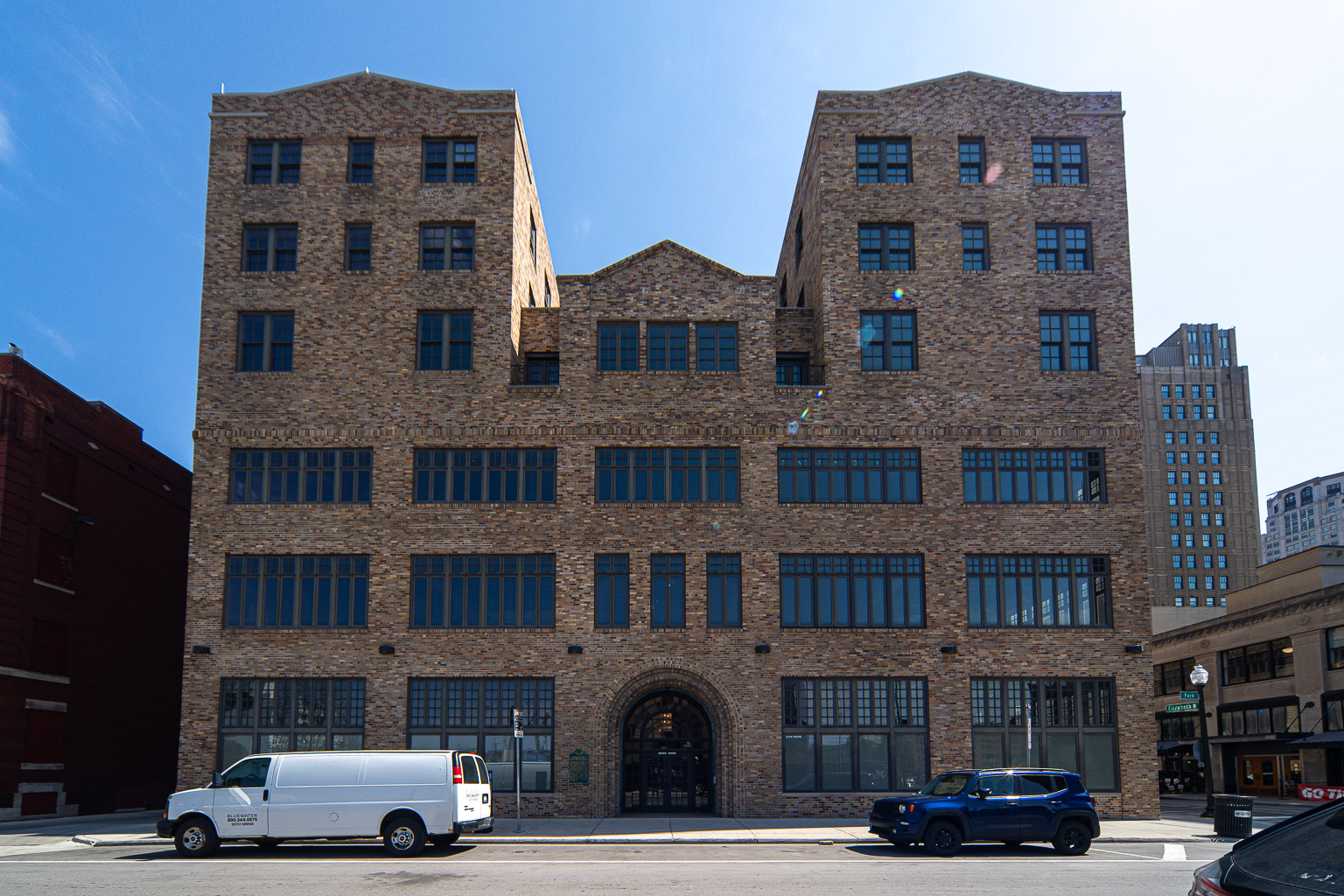
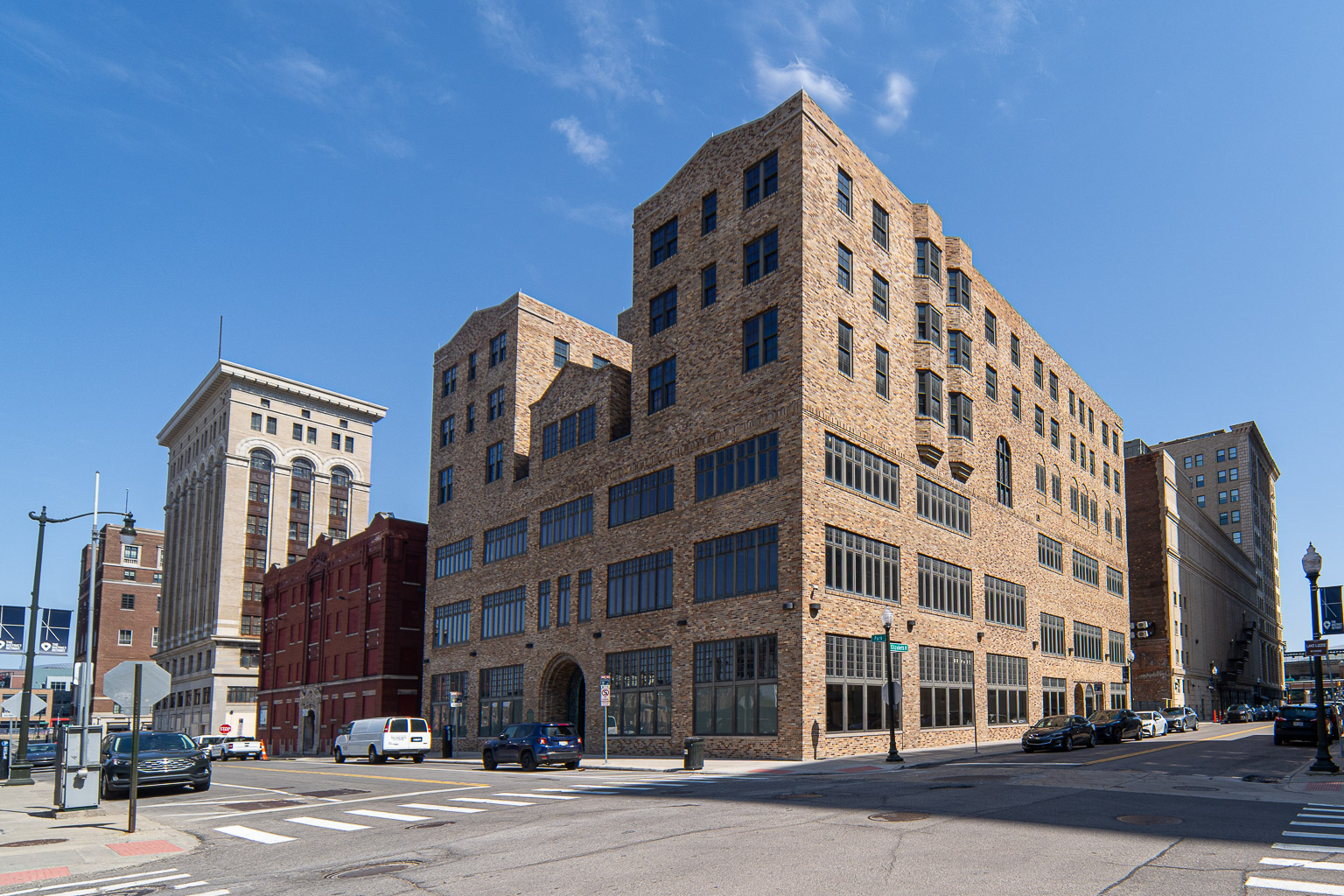
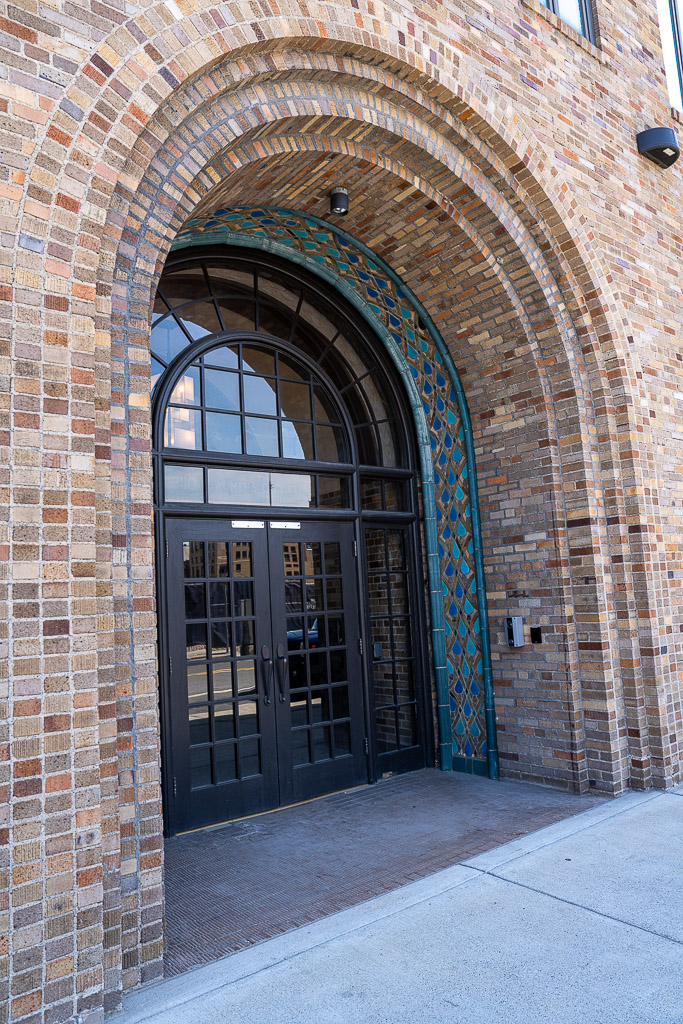
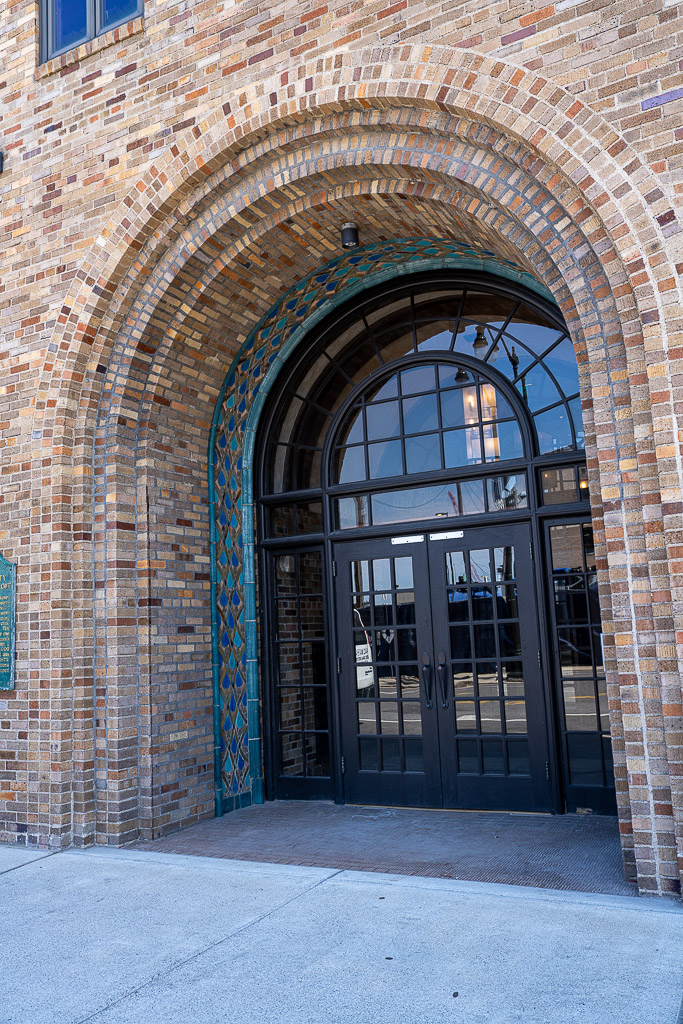
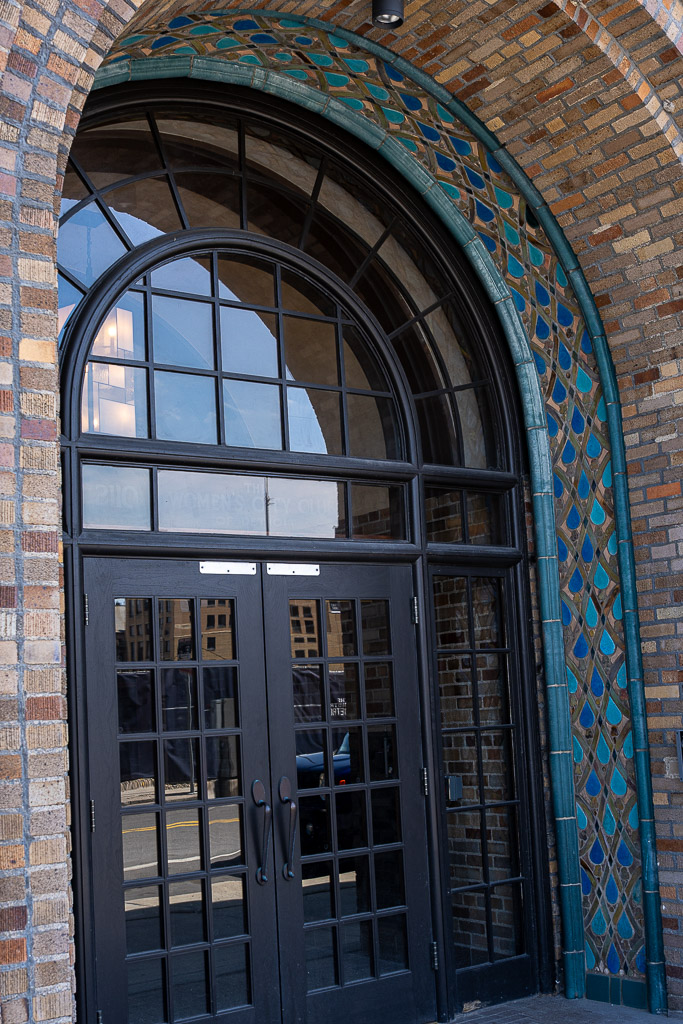
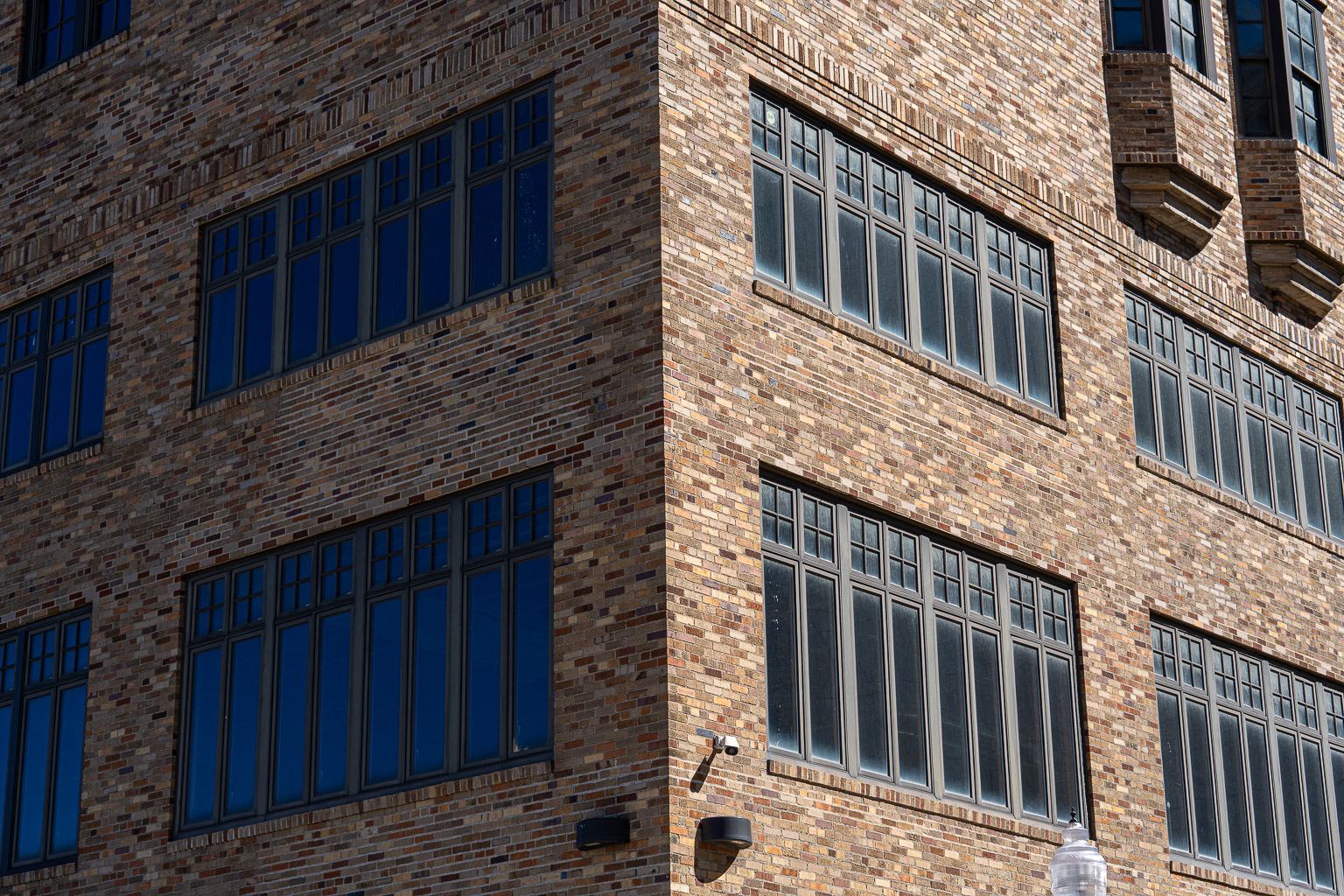
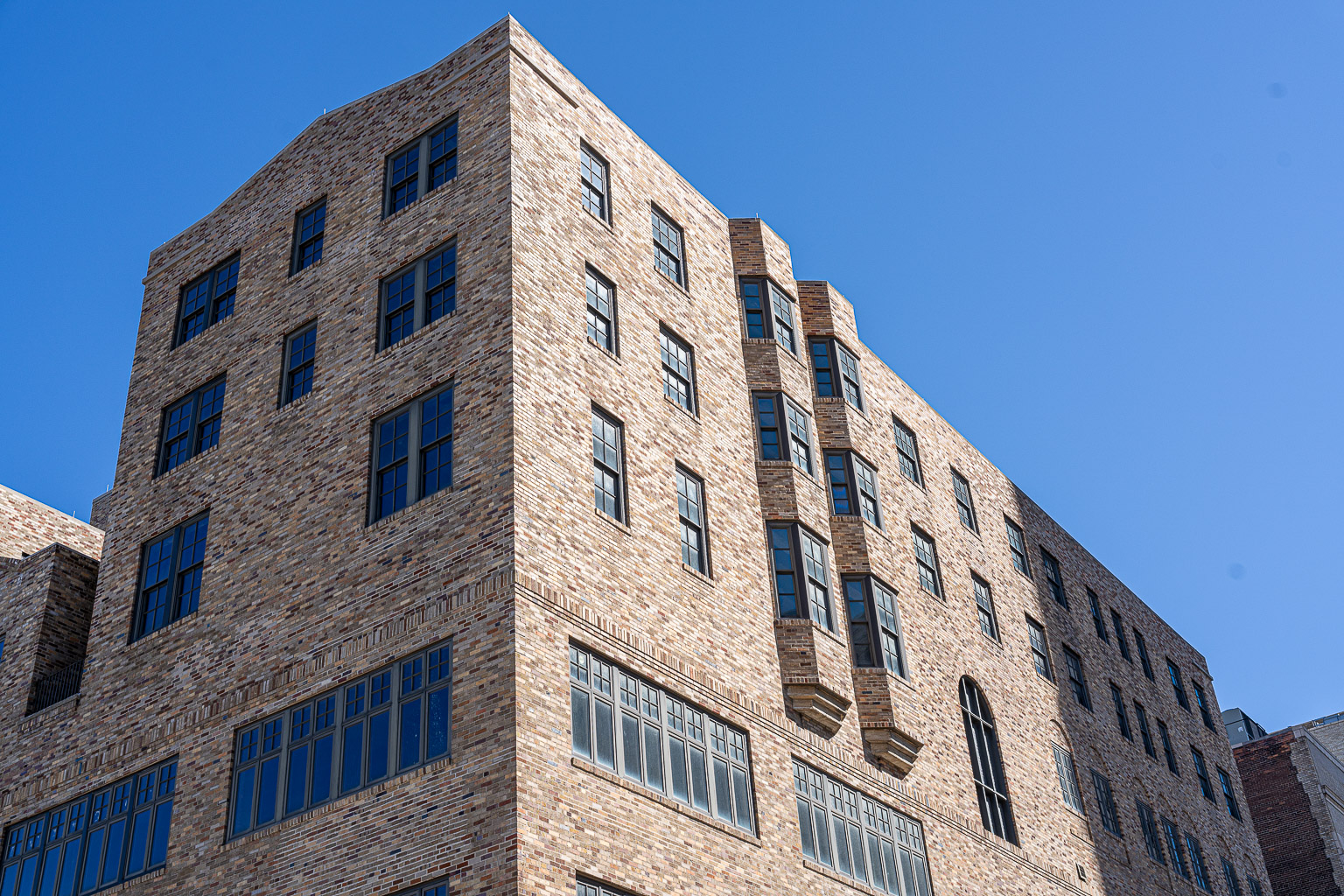
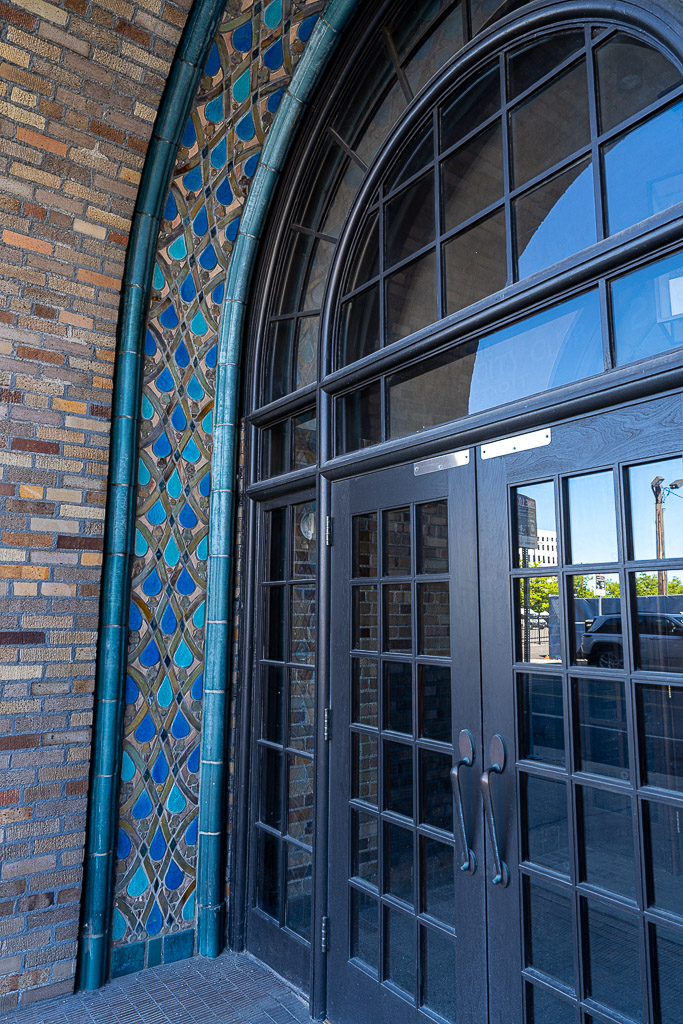
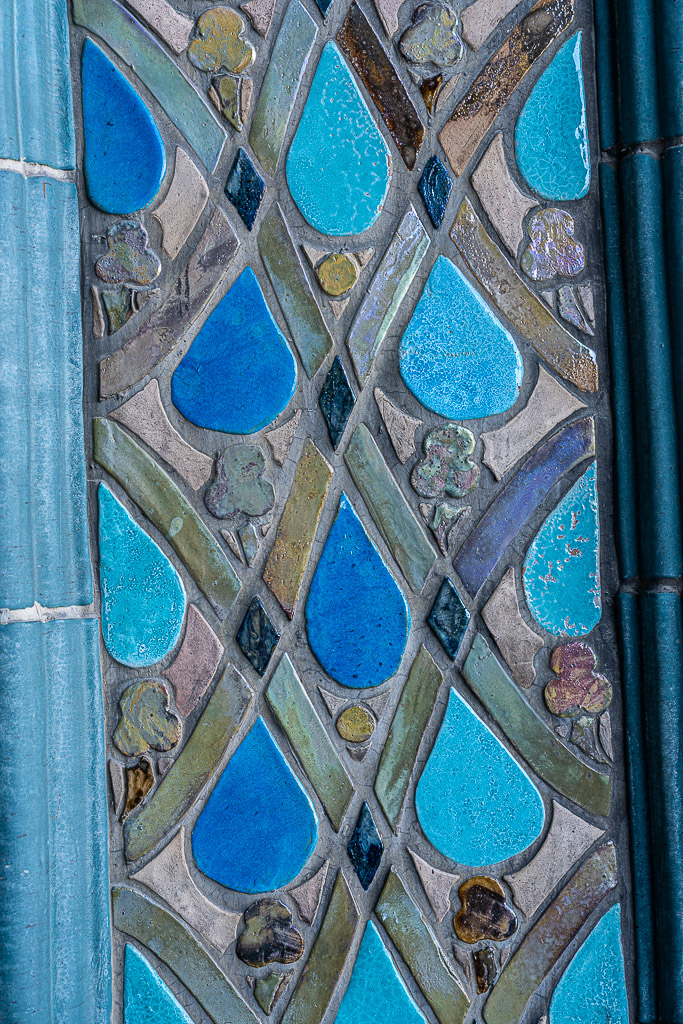
More photos and more description of this building can be found at HistoricDetroit.org.
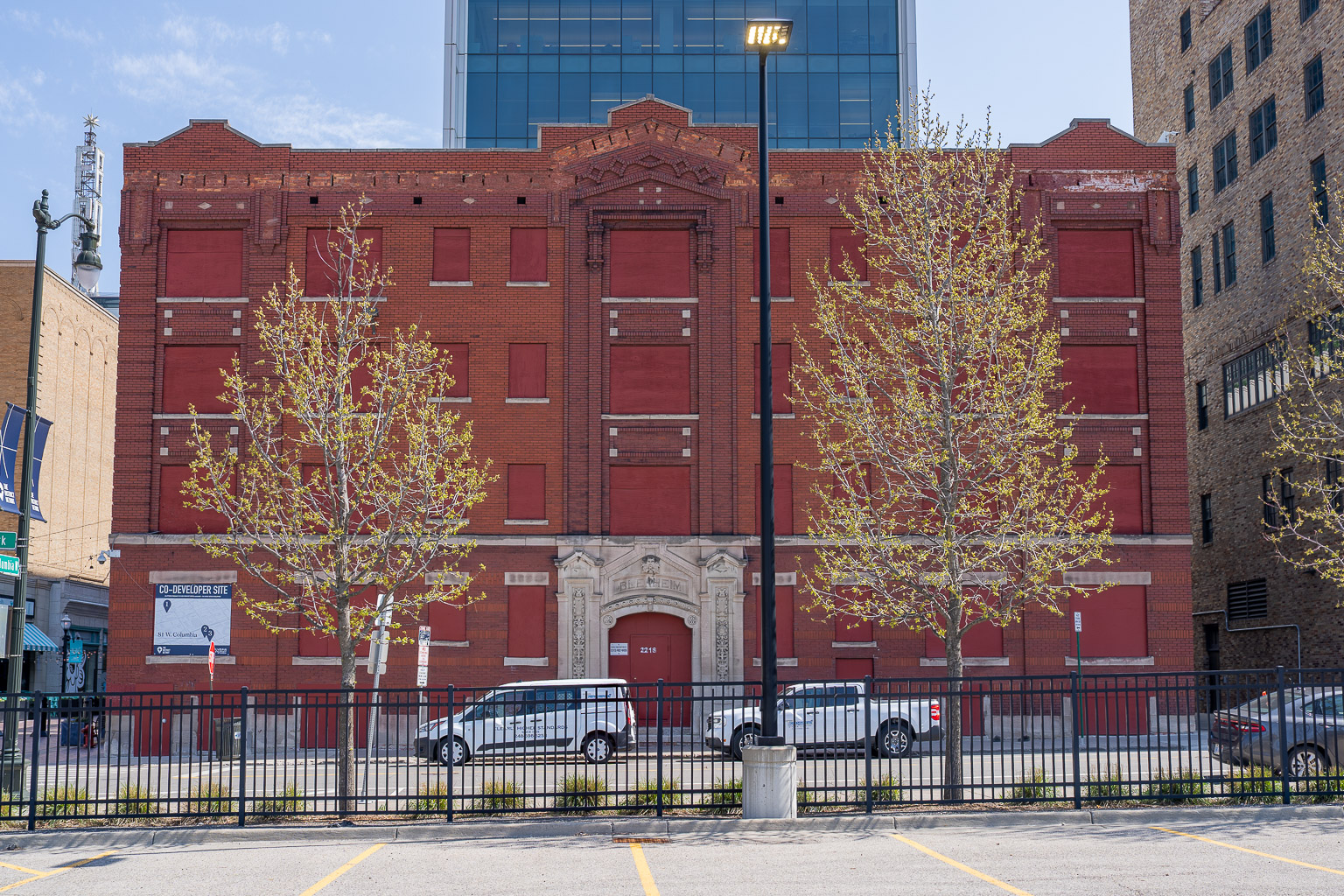
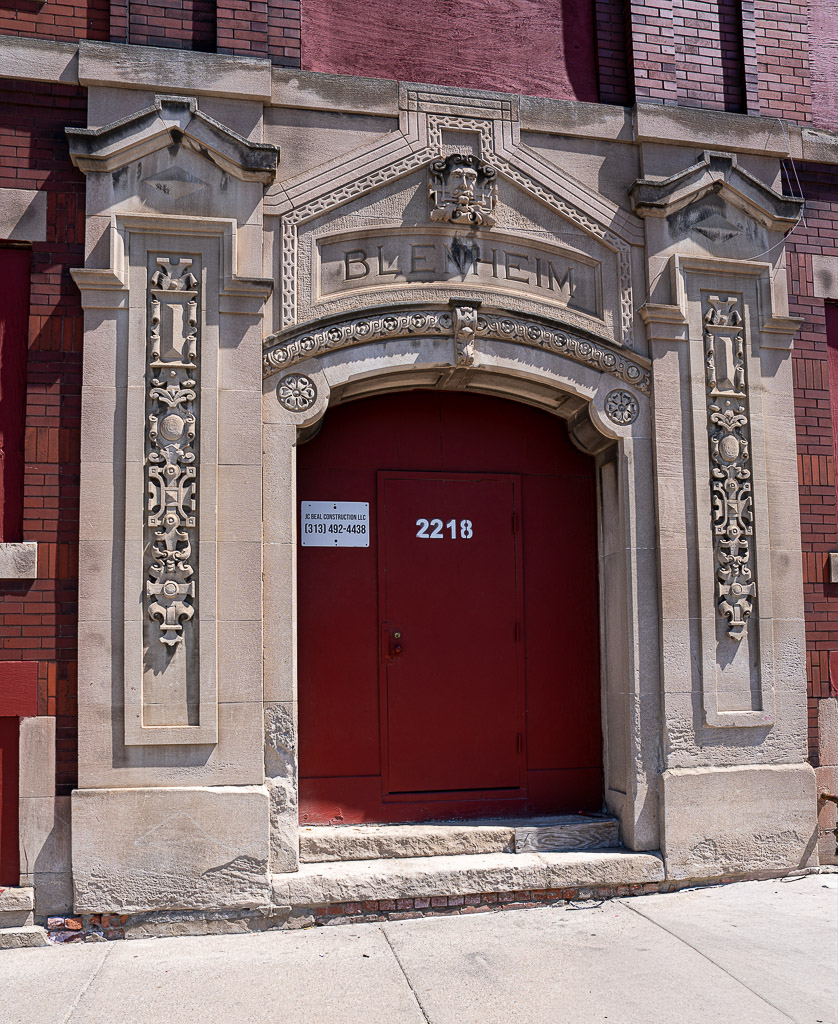
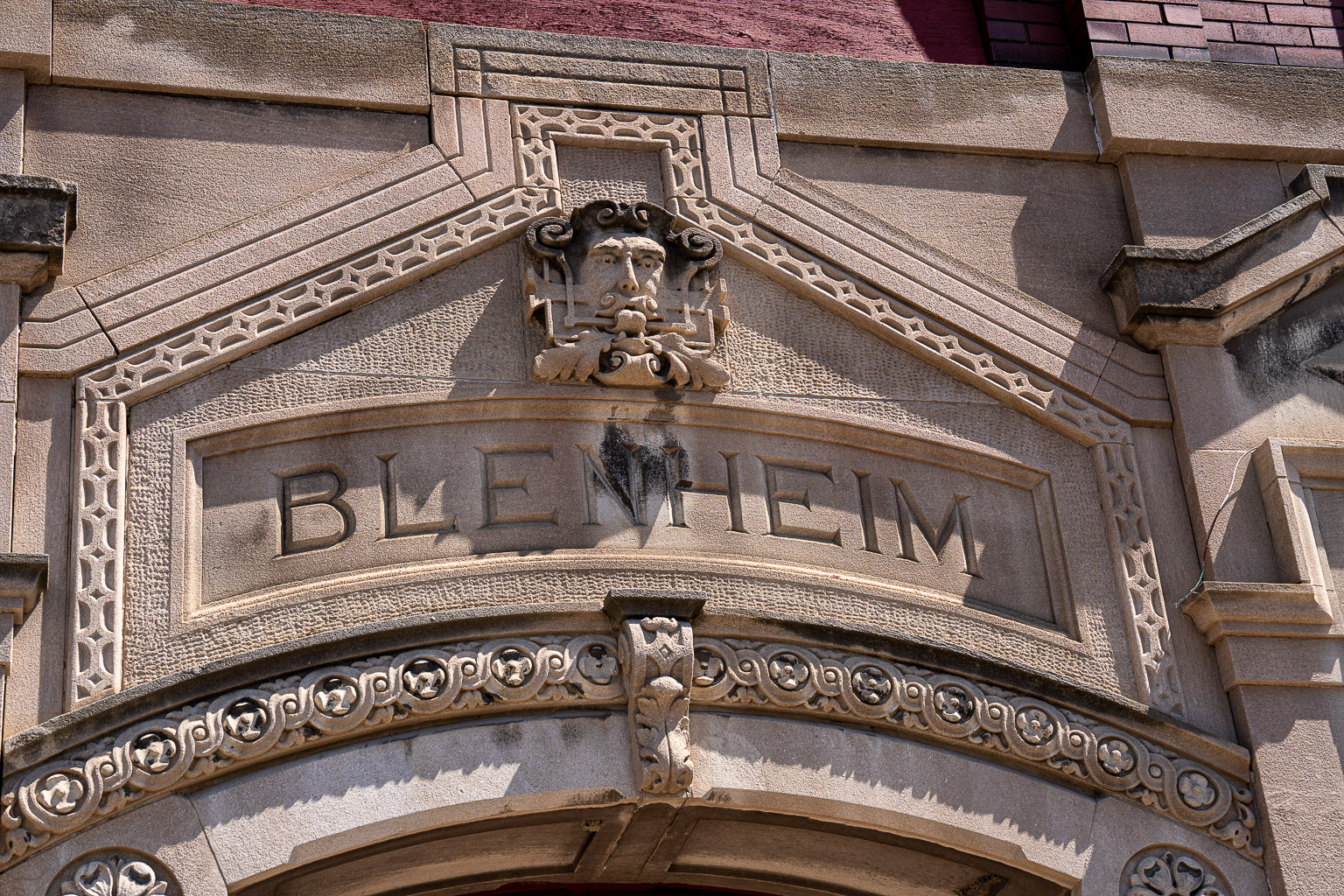
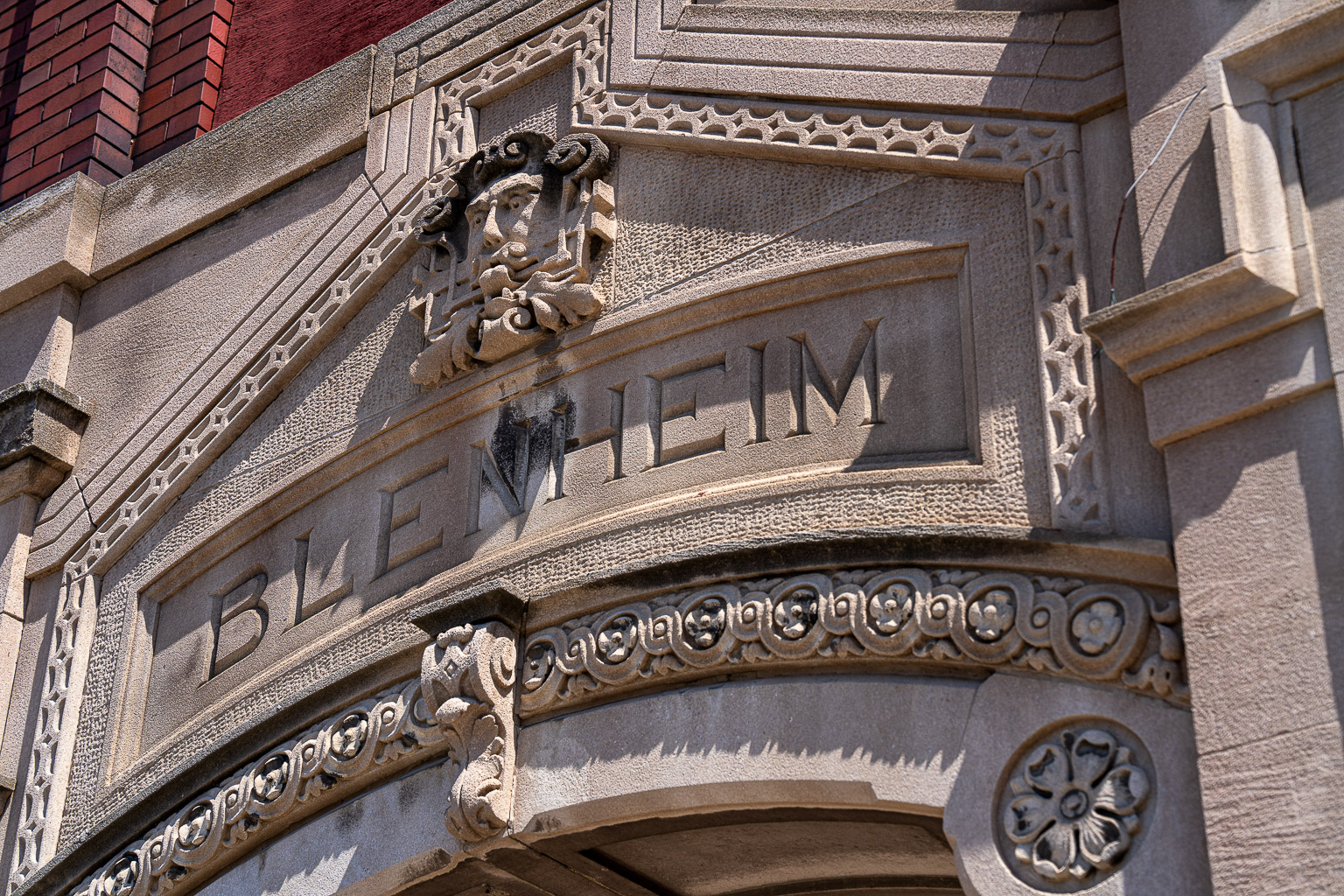
The four-story Blenheim Apartments stands at the southeast corner of Park and West Columbia. The symmetrically-arranged brick building features an ornate center arched entrance and sets of double-sashed windows running up the center in a column. On each floor, two sets of single-sashed windows flank the column, and each edge of the building are again respective sets of double-sashed windows. Above the second floor these are framed in quoined brick. The brick parapet is capped with cut stone.
Baxter and O'Dell were the architects of the Blenheim, erected in 1909. That firm mastered this type of building in the early 20 th Century; in addition to the Blenheim, Baxter & O'Dell designed several apartment buildings in the North Cass Corridor, including the Forest Apartments, a court apartment building at Second and West Forest (1905); the Rosalie Flats (4632 Second Avenue, 1905); the Renaud Annex (W. Hancock, 1905); the Touraine Apartments (4746 Second, 1906); the Chesterfield Apartments (3566 Cass Avenue, 1911), and the LaBelle Apartments (4727-4729, Second Avenue, 1912).
The building permit for the Blenheim Apartments was issued to Baxter & O'Dell, architects, on January 25, 1909, and the owner was listed as Frank Munger. At the time, Munger was the senior partner of the prominent Detroit wholesale dry-goods firm Edson, Moore & Company. Its estimated cost of construction was $26,900.
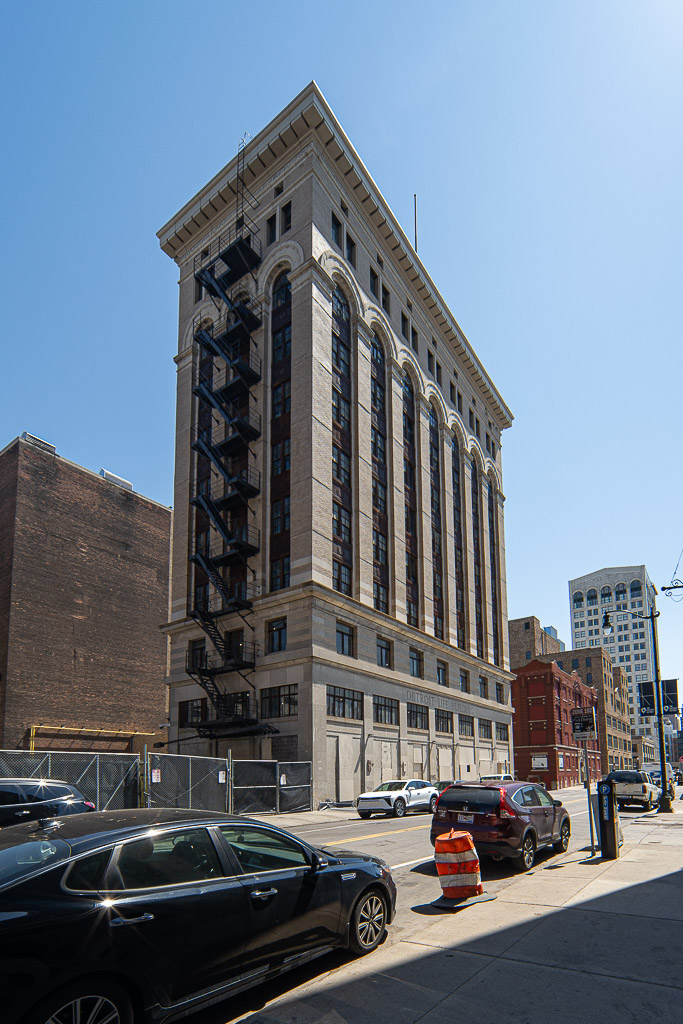
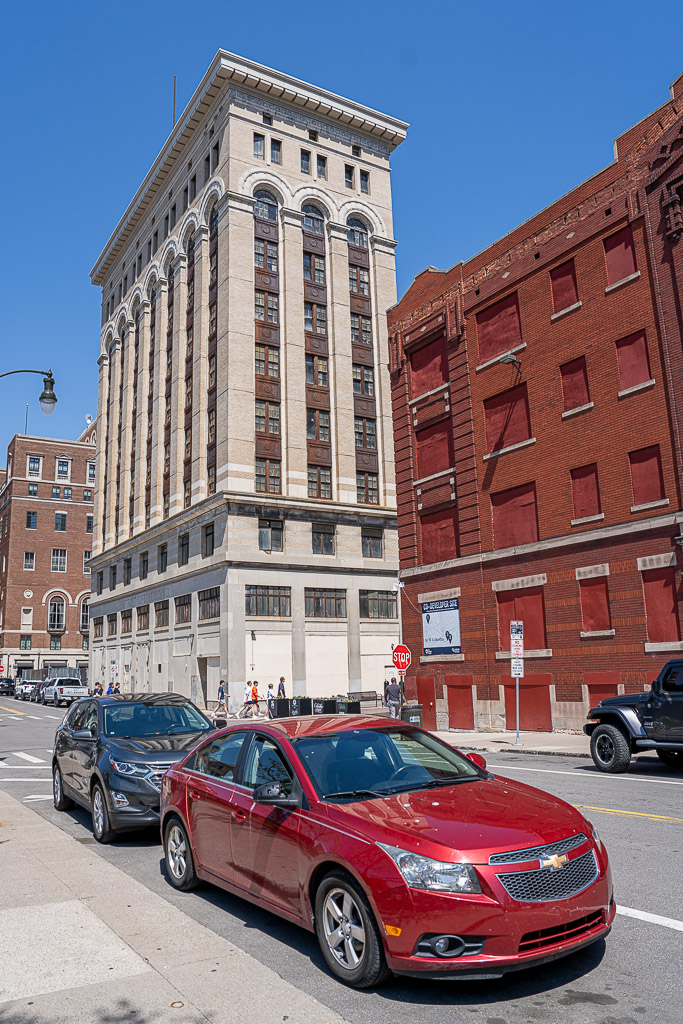
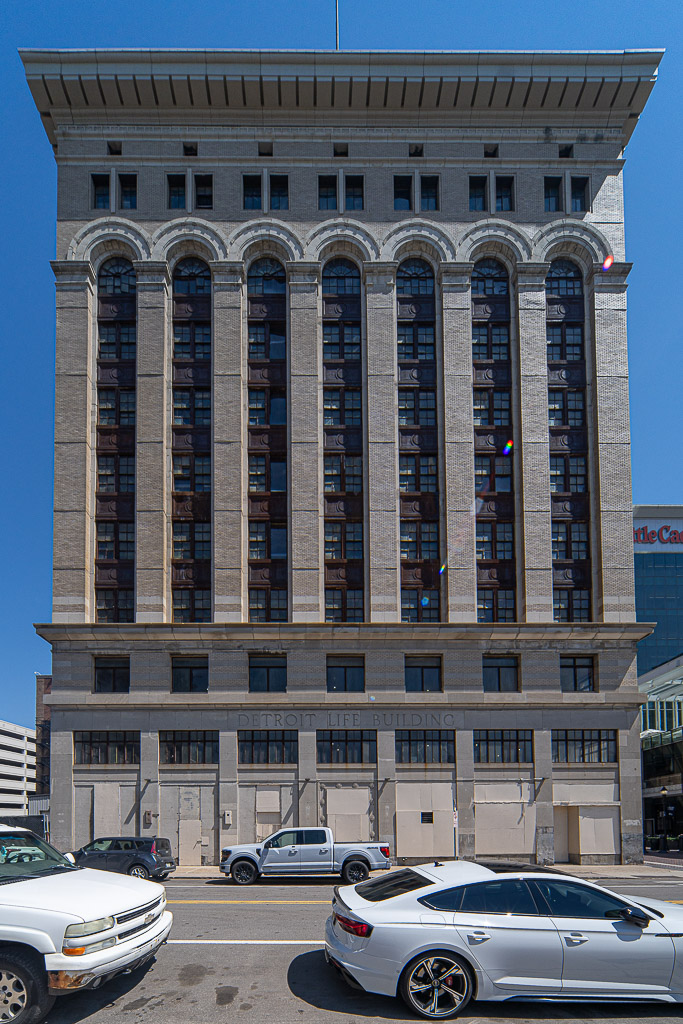
The Detroit Life Building stands at the northeast corner of Park Avenue and Columbia Street. The reinforced concrete and steel structure with limestone cladding is ten stories high on concrete foundations. The style of the building is the traditional base-column-entablature theme of the Chicago school. The base has two layers, the first being two stories high and the second layer being one story high. The column section runs from floors 4 through 9, and each set of double-paned windows are separated by columns; the 9th-floor windows are arched. The 10th-floor penthouse constitutes the entablature: its fenestration features, above each 9th-floor arch, a double-set of windows capped by a single window. A dentiled cornice overhangs the structure. Seven sets of windows face the Park Avenue side, while the Columbia facade has three sets of windows.
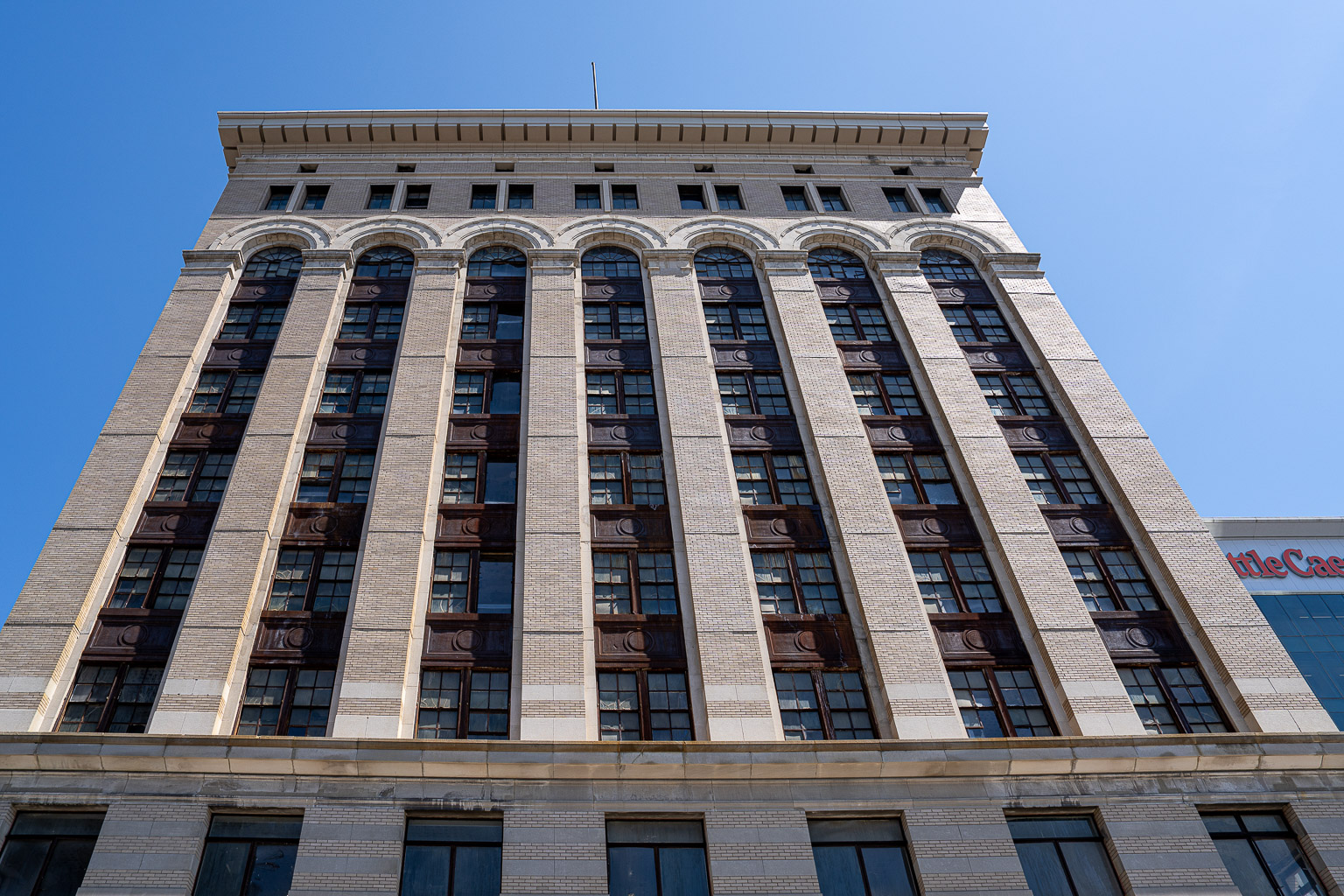
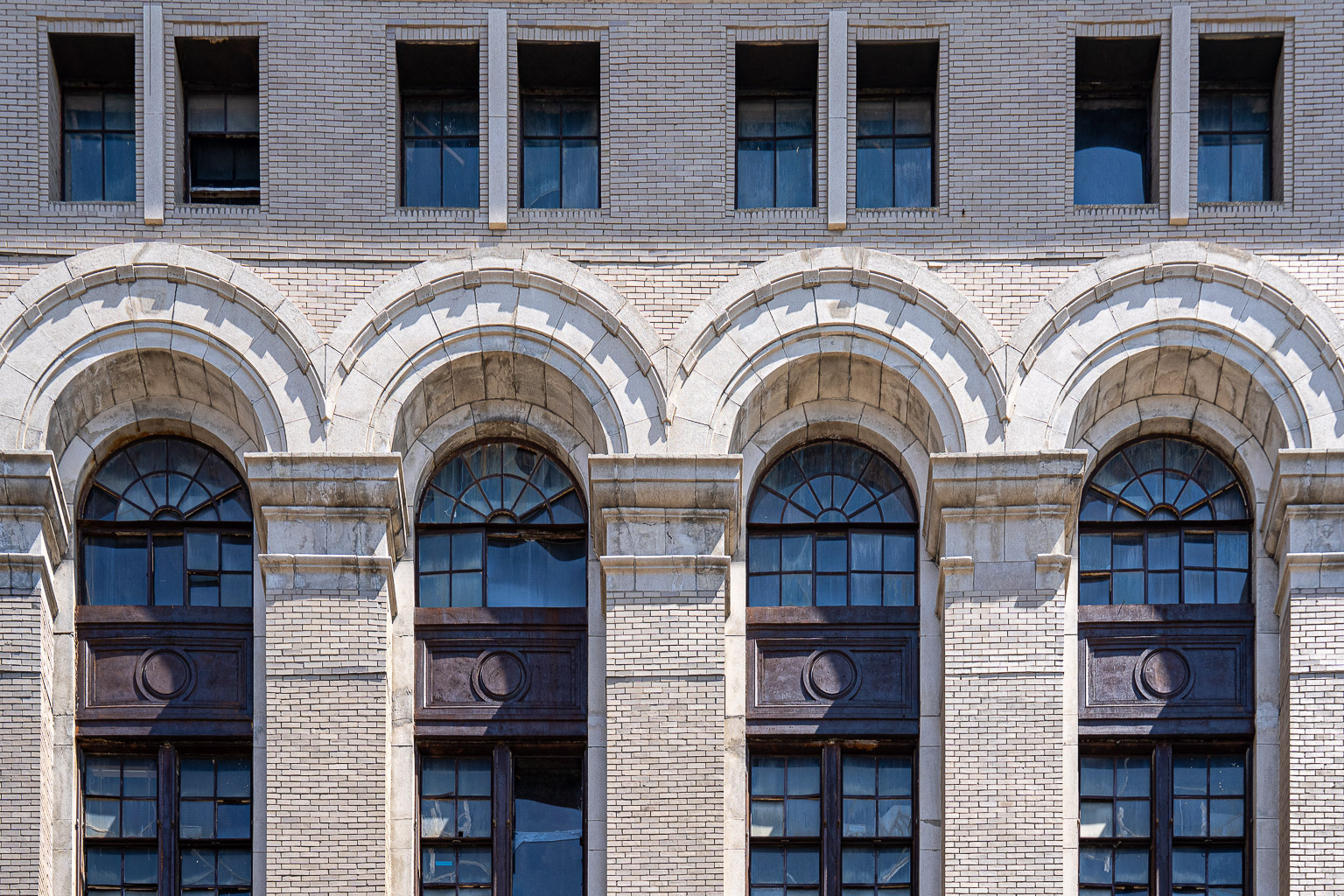
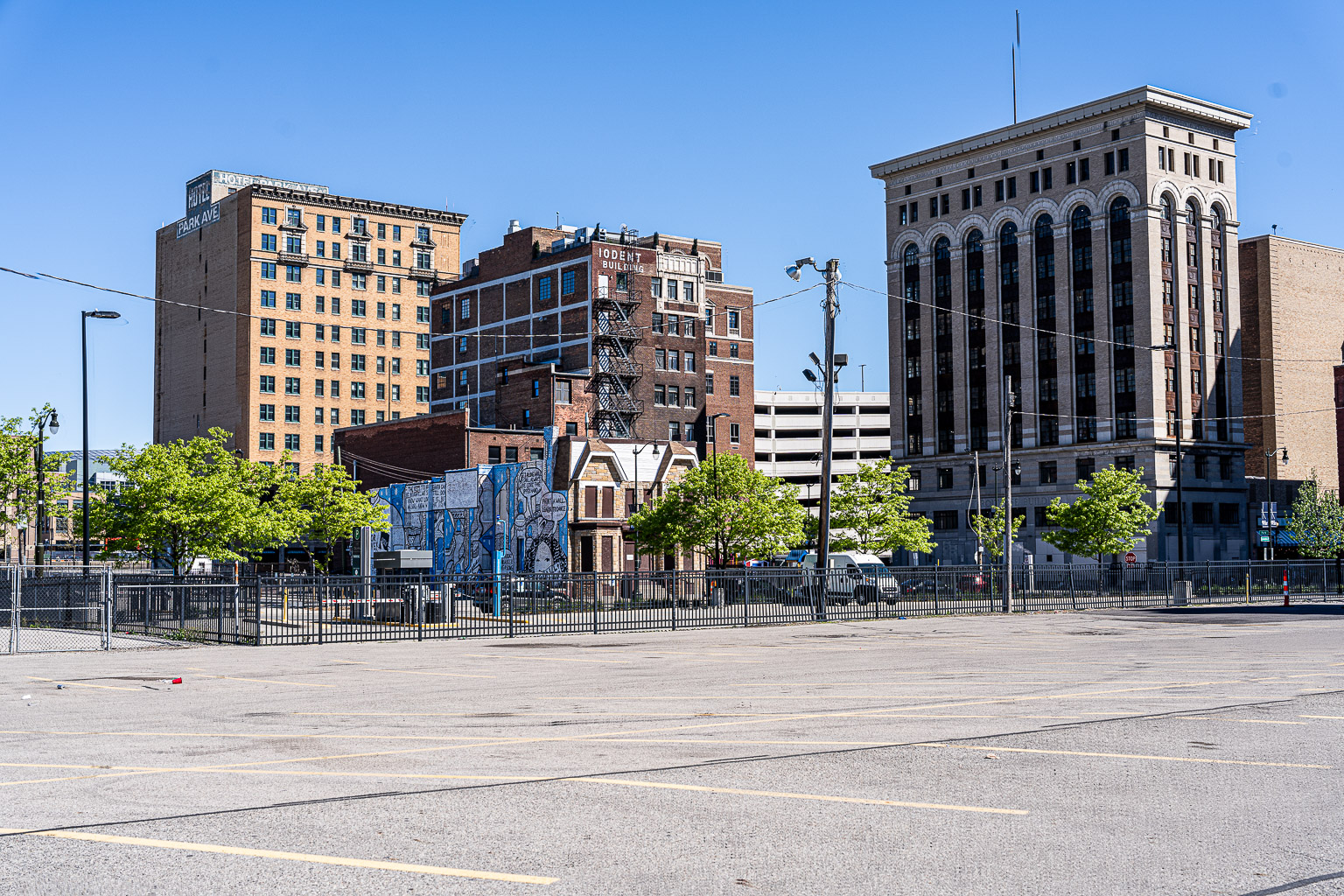
The construction of the Detroit Life Building was a reflection of the leadership and dynamism of the president of the Detroit Life Insurance Company, Michael Edward O'Brien. According to Clarence Burton, O'Brien was born in Osceola, Michigan, on September 21, 1877, a son of Patrick J. and Mary O'Brien, who immigrated to the United States from Ireland in 1856.
In 1893 Mr. O'Brien graduated from Sacred Heart high school in Calumet, and in 1898 entered the field of insurance, becoming a member of the firm Webb & O'Brien, writing general insurance and handling life insurance as agents for the Northwestern Mutual Life Insurance Company. In 1900 he was made district agent for that company and three years later became their general agent for one half of northern Michigan. In 1907 he established his headquarters at Laurium, Michigan, and while there organized and became president of the First National Bank of Laurium and the director of the First National Bank of Hubbell. He severed his connection with the Northwestern Mutual Life Insurance Co. in 1910 and came to Detroit as vice president of the Detroit Life Insurance Company, in which capacity he served until June, 1911, when he was made president and general manager. On February 4, 1903, O'Brien married Nellie V. Harrington, and they became parents of seven children. Politically he was a Democrat, Catholic in faith, and a member of organizations such as the Elks, Knights of Equity, Knights of Columbus, and the Fellowcraft Club.
According to Burton, the development and progress of the Detroit Life Insurance Co. was synonymous with the business advancement of O'Brien. When he became president in 1911 it had less than $50,000 worth of insurance in force. On June 30, 1921 the company had over $24,000,000 of insurance in force. By 1928 this figure had mushroomed to over $74,000,000. Burton suggests that the company was one of the leading life insurance firms in the entire state, and that, with one exception, it led all other Michigan companies in the amount of new insurance paid in the seven years leading up to 1921. O'Brien was also a board member of the Park Avenue Association.
The Detroit Life Building became the symbol of the success of the Detroit Life Insurance Co., as evidenced by the fact that a photograph of the building appeared in the company's magazine advertisement. The permit, with a building cost listed as $287,000, was issued on September 5, 1922 to the architecture firm Arnold & Shreve, whose principals were Everett B. Arnold and Ralph F. Shreve. Shreve had recently served as the structural engineer for the construction of the Ford River Rouge plant. Arnold & Shreve appear as a firm in the Detroit City Directory only one year, during which the Detroit Life Building was under construction. The firm contracted to lease and manage the property was Paterson Brothers & Company, whose offices were located in the Penobscot Building; they advertised the Detroit Life Building as an "[i]deal location for the offices of Railroads, Lumber and Coal Companies, Architects, Contractors, Advertising and Insurance Agencies." An analysis of the building's tenancy during the decade does show realty and insurance companies, as well as attorneys. In June of 1923 the Detroit Life Insurance Co., calling itself "The Company of Service," announced the move from its former headquarters at Forest and Woodward to the new building on Park Avenue. Through the rest of the decade, the company is listed in the Detroit City Directory on floors 7-10 with O'Brien as president and Frank H. Watson as vice president and associate counsel.
The Detroit Life Insurance Co. did not survive the Great Depression. After 1929, the year of the stock market crash, O'Brien is no longer listed as company president. He was succeeded, according to Detroit City Directory listings, by Irving Moss and then John A. Reynolds, who lasts through 1935, the year after which the company disappears. Beginning in 1936, an apparently reconstituted company appears as the Life Insurance Company of Detroit, with Thomas F. Lawrence as president and Theodore Levin as vice president and general counsel. Levin is a particularly significant figure in Detroit history. He later became chief judge of the United States District Court in Detroit, and this courthouse has now been named after him. He was the father of retiring Michigan Supreme Court Justice Charles Levin, and the uncle of current U.S. Senator Carl Levin and Congressman Sander Levin. The Life Insurance Co. of Detroit remains in the City Directory through 1940; in 1941 there is only a token "manager" presence on the 6th floor, however the 8-10th floors are vacant.
Beginning in 1934, the Detroit Life Building became the headquarters of another significant tenant: the Winkelman Brothers Apparel Company. They moved to this building from their first Park Avenue headquarters, the Charlevoix Building. Through the rest of the decade the company, founded by brothers Moses, Alvin, Isadore, and Leon, occupied the 2nd-3rd, and then the 2nd-4th floors. They remained in the building until 1946, when they moved to a new headquarters building on Parsons and Woodward. During the 1950s, the Detroit Life Building became the Detroit Building, and the word "Life" was covered over the Park Avenue entrance with a the number indicating the building's address, 2210. Beginning in the late 1950s, though, as suburbanization began, substantial vacancy began to appear in the building. This trend accelerated in the 1960s: in the 1965 and 1968 directories four floors are vacant. In the 1973 directory, after the Detroit riot had spurred mass flight out of the city, there are only two listings, a typewriter supply company and the offices of a parking lot management company. The present owner, Olympia Development, is anticipating the rehabilitation of the building.
More photos and more description of this building can be found at HistoricDetroit.org.
The Wormer & Moore / Iodent building stands at the southwest corner of Park Avenue and Montcalm streets in downtown Detroit. It is eight stories high and built with a reinforced concrete and steel structure. The building has Arts-and-Crafts-influenced decorative details in cut limestone on the facade at the two-story base and on the top floor. The entry doorway on Park Avenue has classical Greek elements on its frame. The second floor windows are arched. The body of the building, floors three through seven, has an exterior of dark brown brick. The fenestration pattern of the upper floors consists of banks of paired windows. The interior of the building has decorative elements such as plaster molding and stained-glass windows.
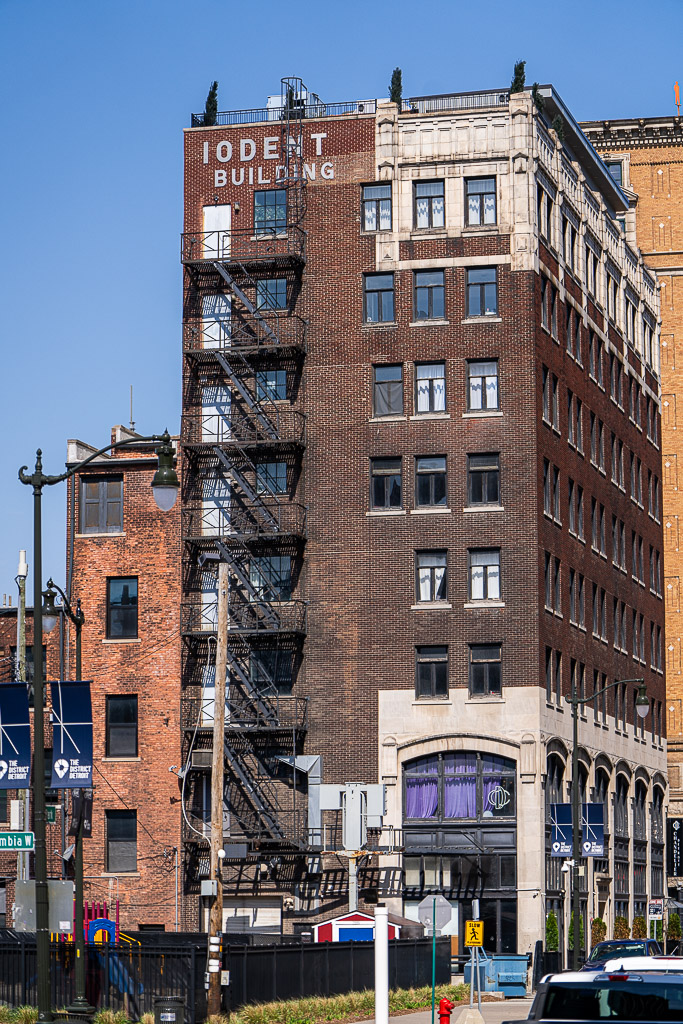
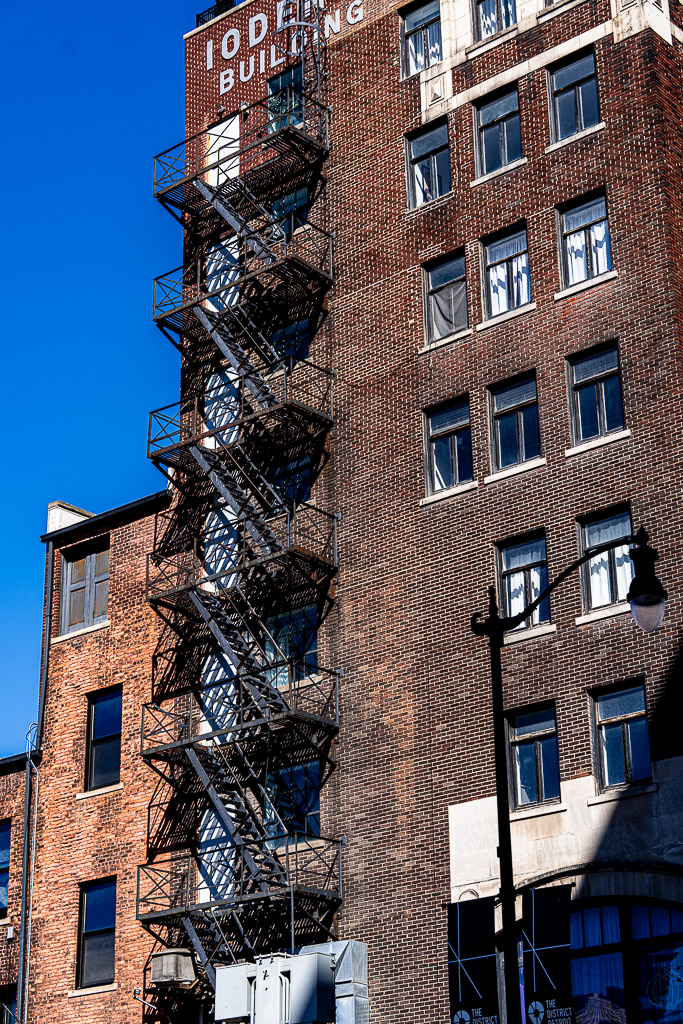
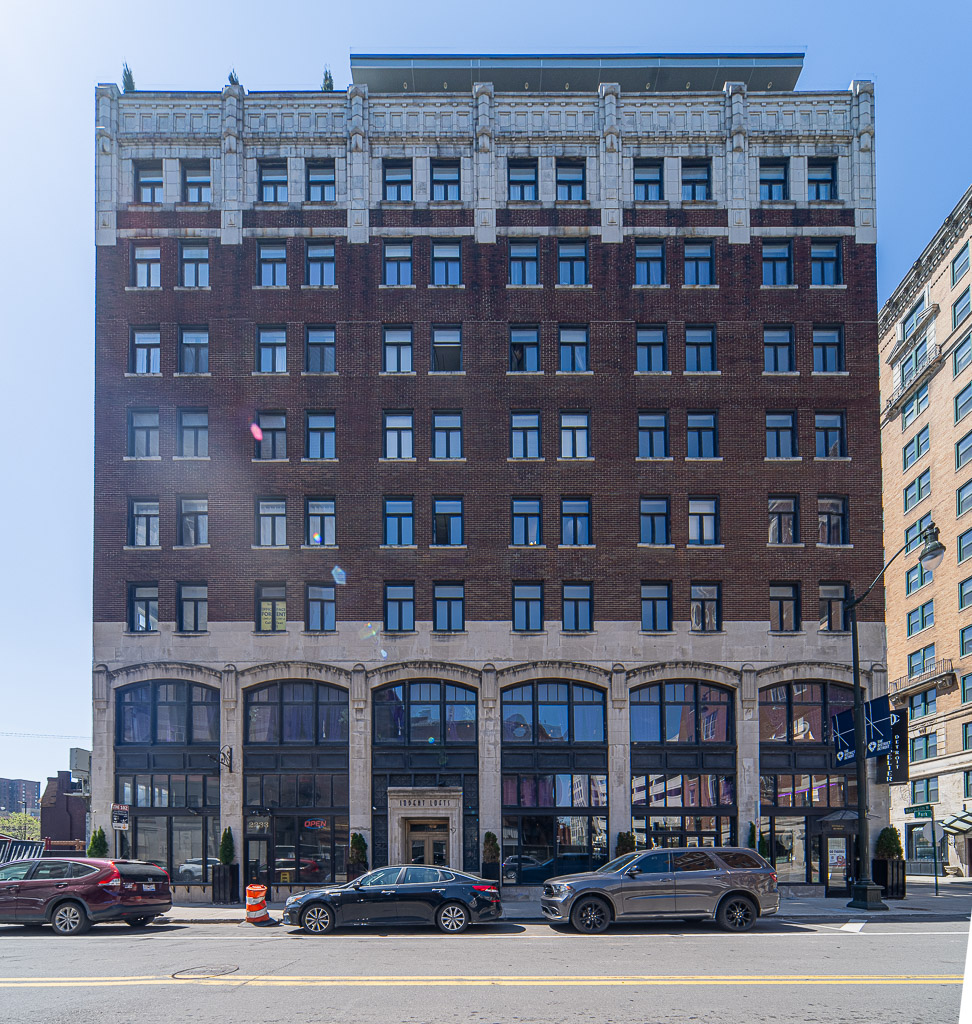
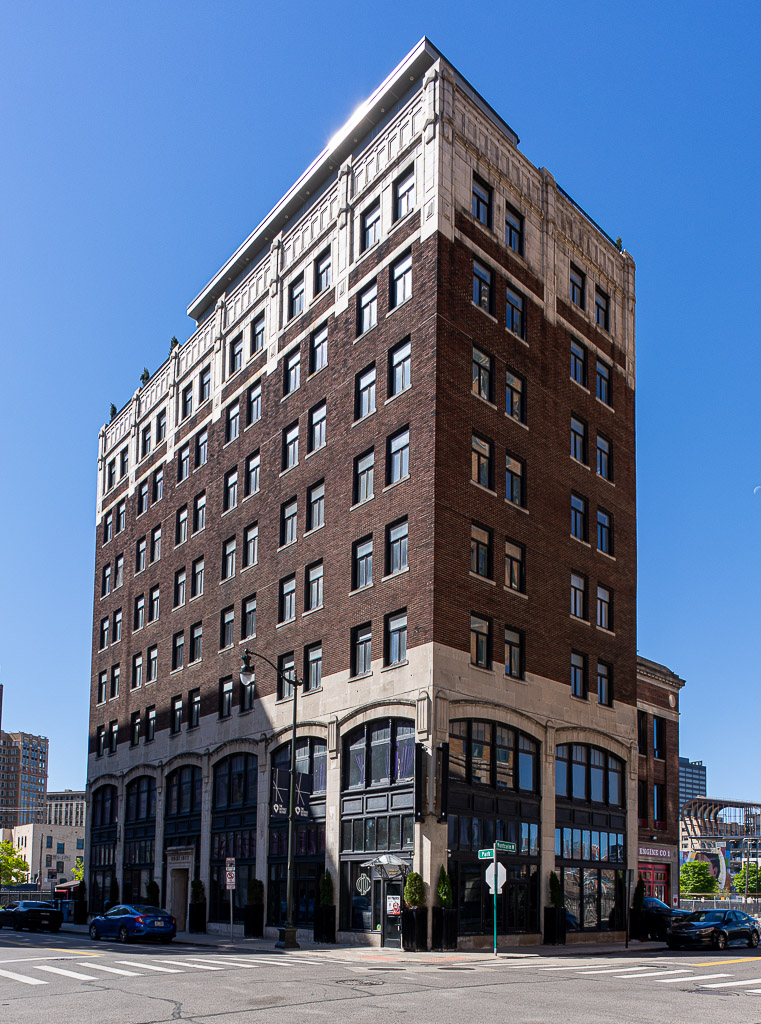
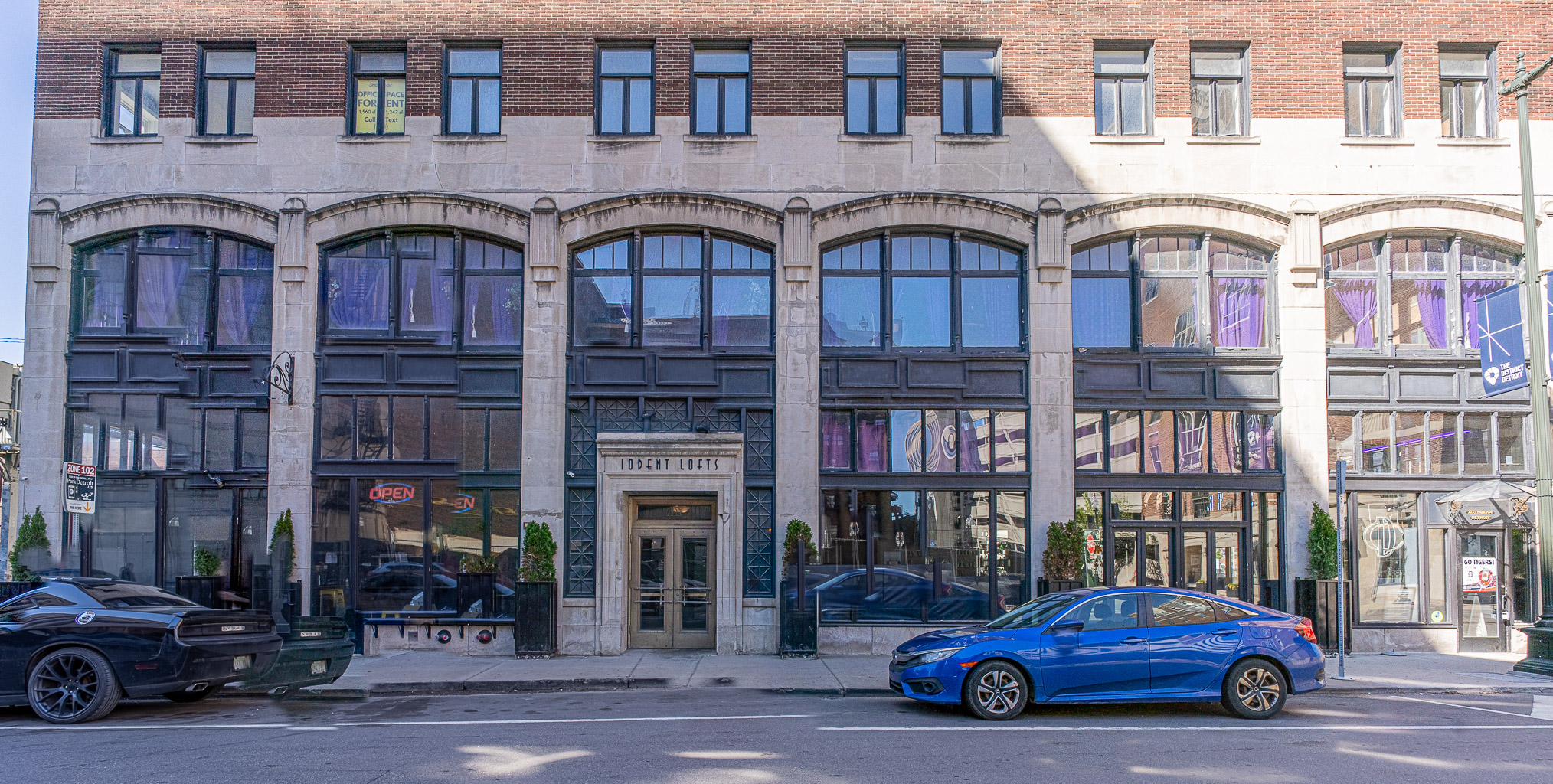
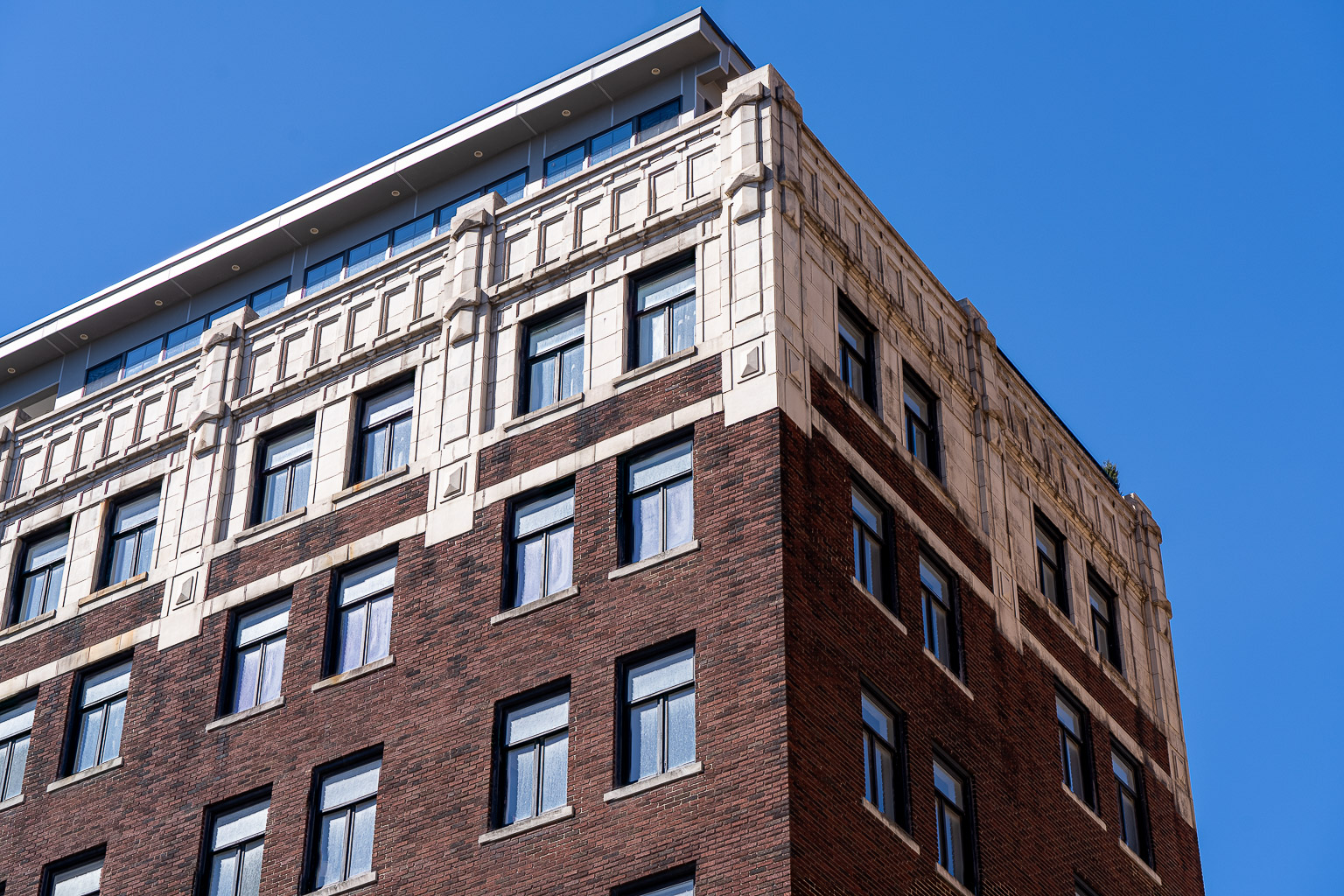
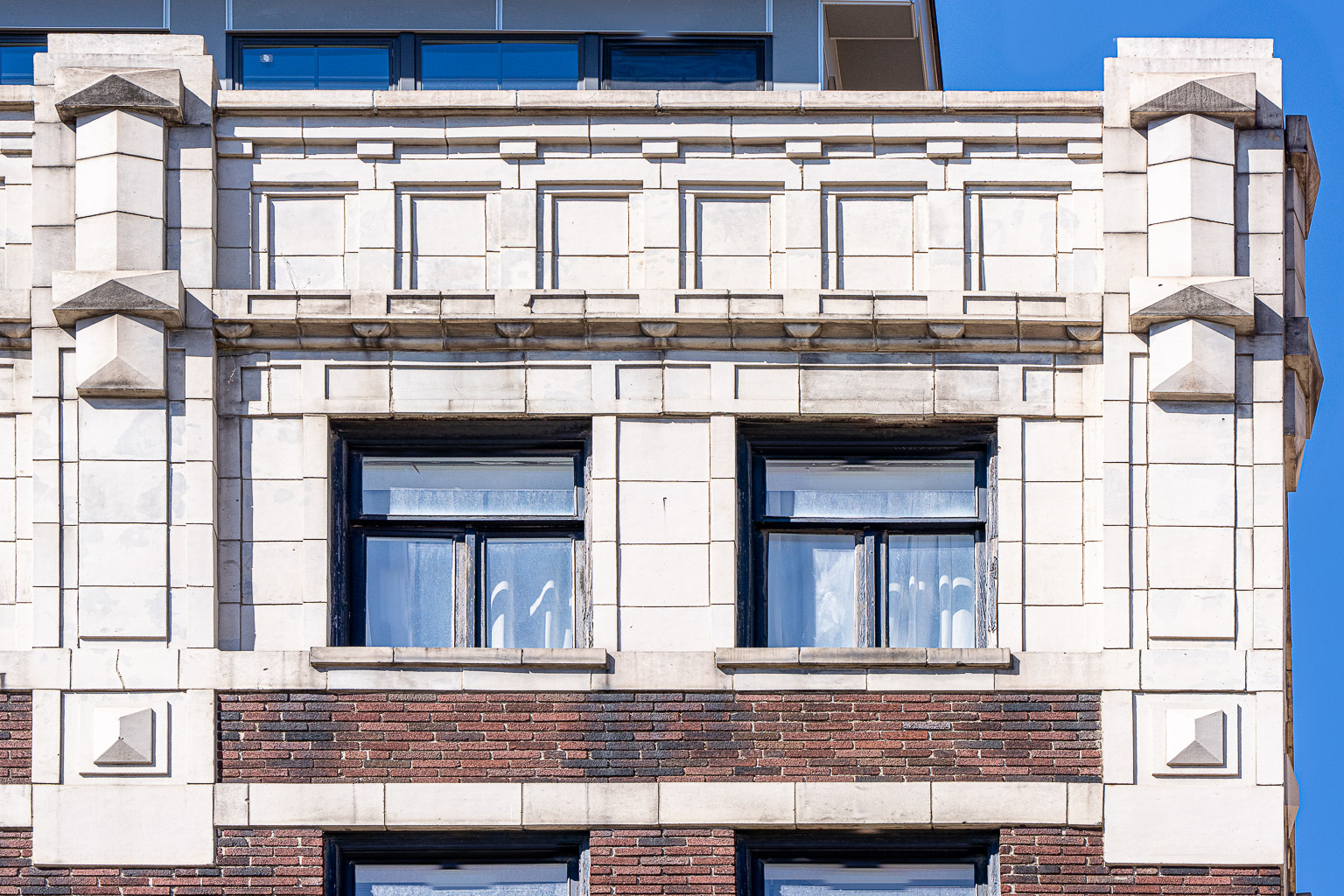
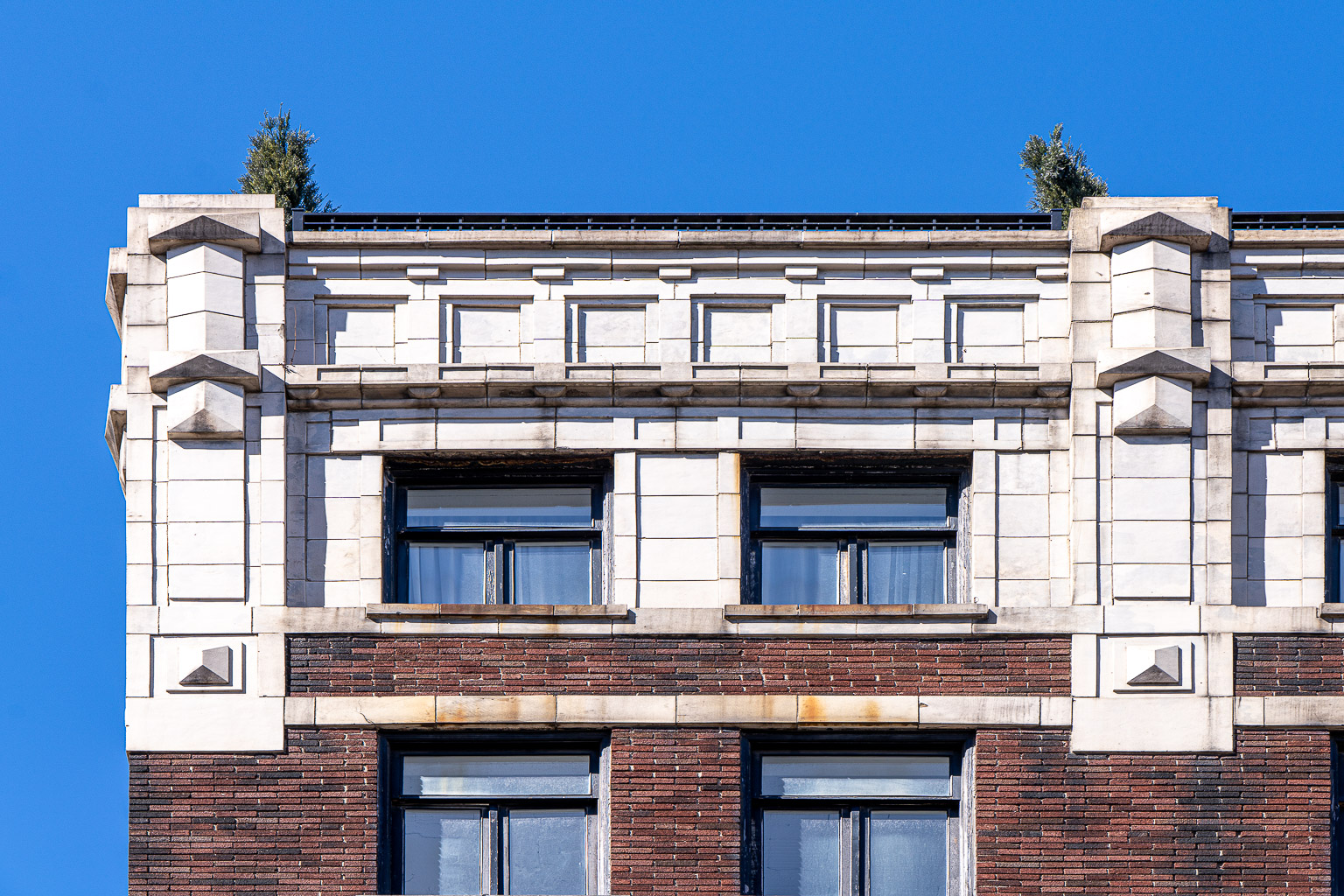
The permit for the Wormer & Moore office building was issued on December 14, 1922 to the architecture firm of Bonnah & Chaffee. Its estimated cost of construction was $136,000. Constructed by the Wormer & Moore real estate company, the firm's flagship building and headquarters on Park was led by the partnership of Clarkson C. Wormer, Jr. and Lucian S. Moore, Jr. Moore's brother, Kenneth L. Moore, served as vice-president. Financing for the building reflected the speculative capitalism of the "Roaring Twenties:" Bonds were issued at 6.2% interest by the Straus Brothers Co. of Detroit.
The Wormer and Moore families' prominence in Detroit business and industry reached back well into the nineteenth century. The fathers of the partners of the real estate firm were also business partners. Clarkson C. Moore, Sr. had been the president of the C. C. Wormer Machinery Company, and Lucian S. Moore, Sr. had been vice-president. C. C. Moore, Sr.'s father Grover S. Moore was himself a prominent machinery business representative when he arrived in Detroit in 1854. In 1857 he founded G. S. Wormer & Son. He later became a colonel during the Civil War, and shared an office at Fort Gratiot with the father of Thomas Edison. C. C. Moore Sr. became a partner with his father and brother in 1873 and the firm became G.S. Wormer and Sons. The firm lasted until 1884, when G. S. Wormer retired. The C. C. Wormer Machinery Co. was then established in 1889 and represented over 40 U. S. machinery manufacturers. C. C. Wormer retired in 1912.
C. C. Wormer, Jr. was born in 1883, graduated from Union College, and entered the real estate field in 1906. Lucian S. Moore, Jr. was born in 1885, graduated from the University of Michigan in 1907, and entered the real estate field in 1909. The two formed the real estate firm of Wormer & Moore in 1919. Kenneth L. Moore, who was born in 1891, graduated form Yale in 1914, and served in the armed forces during World War I, joined the firm after his honorable discharge in 1919. The Wormer & Moore Building, where the firm established its headquarters, was erected in 1923. The firm was one of the most prominent realty houses in Detroit, and specialized in downtown property. Wormer also served as the first vice-president of the Park Avenue Association, which promoted the development of the street during the 1920s boom years.
The Wormer & Moore Building first appears in the 1923-24 Detroit City Directory, at near capacity, and continues this way through the 1920s. However, the Great Depression seems to have hit the building hard, because listings for the upper floors of the building disappear as of the 1932-33 directory, through to the 1940 directory. The only enterprises listed at the building's addresses are the Parkmont Cut Rate Drug Store and the Mayfair restaurant. This vacancy made the building a candidate for sale, and the Wormer & Moore Building later became the manufacturing facility and headquarters for the Iodent Toothpaste Co. The Detroit City Directory was not published in the 1940s, but it is likely the sale occurred during these years; the building appears as the Iodent Building in the 1950s.
The Iodent Chemical Co. first appears in the Detroit City Directory in 1919 on Woodward Avenue in Highland Park. The driving force behind the company was its president, Dr. Alfred J. Lautmann. Its primary brand was Iodent Toothpaste, but the firm manufactured other toiletries. During the twenties the firm relocated to 1011 Lafayette in Detroit, and in the thirties it was at 1535 6th St. Dr. Lautmann was still listed as president in 1958, after which the president listed in the directory is his son-in-law, Lawrence Weisberg. Dr. Lautmann died in 1968. There are still large industrial toothpaste mixers on the fifth floor of the Iodent Building. The Iodent Co. appears in the directory through 1973. Shortly thereafter the company moved from the building and donated it for tax purposes to Shaw College at Detroit. It last housed the Broadway Market.
More photos and more description of this building can be found at HistoricDetroit.org.
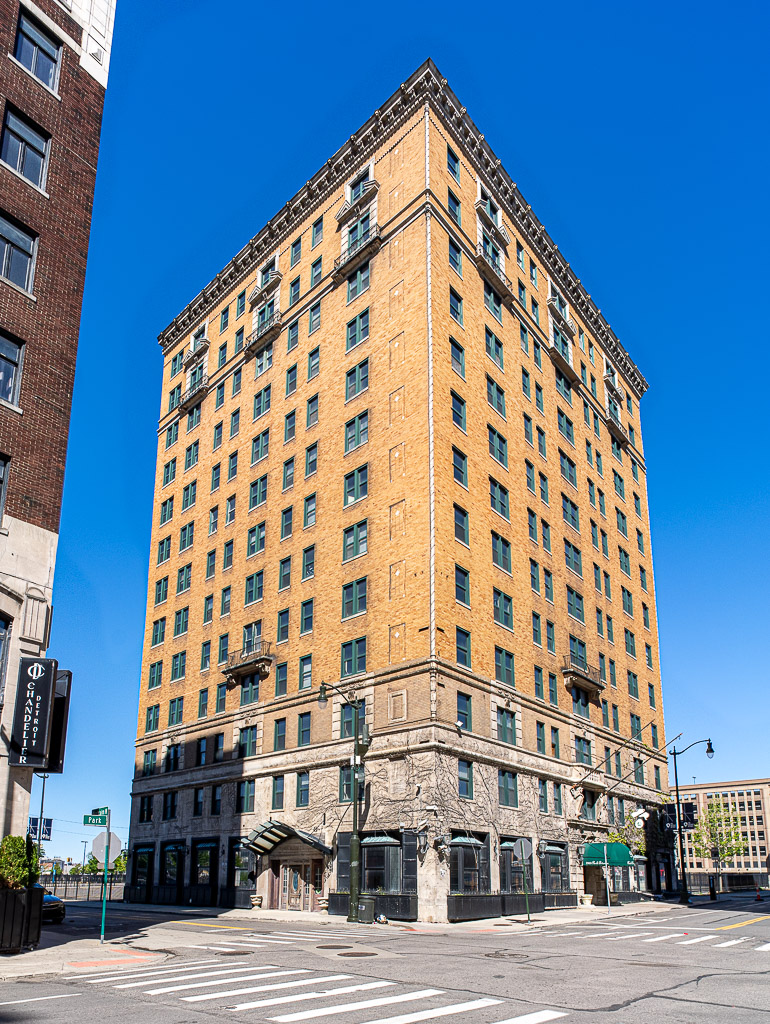
The Royal Palm Hotel (now The Park Avenue House) is a thirteen-story brick and masonry building with Italian Renaissance details located on the northwest corner of Park Avenue and Montcalm. Since its construction in 1924, it has been in continuous use as a residential hotel. Although the building has undergone some alterations over the years, it is in excellent condition and still retains its original character as "a downtown hotel with a home atmosphere".
The overall footprint of the building is rectangular, measuring ninety-two feet wide and eighty feet deep. The exterior facade material is orange brick on the east (front) and south elevations and yellow brick on the west (rear) and north elevations. On the front and south facades limestone is used at the base on the lower two floors and stone detailing appears on the upper two floors.
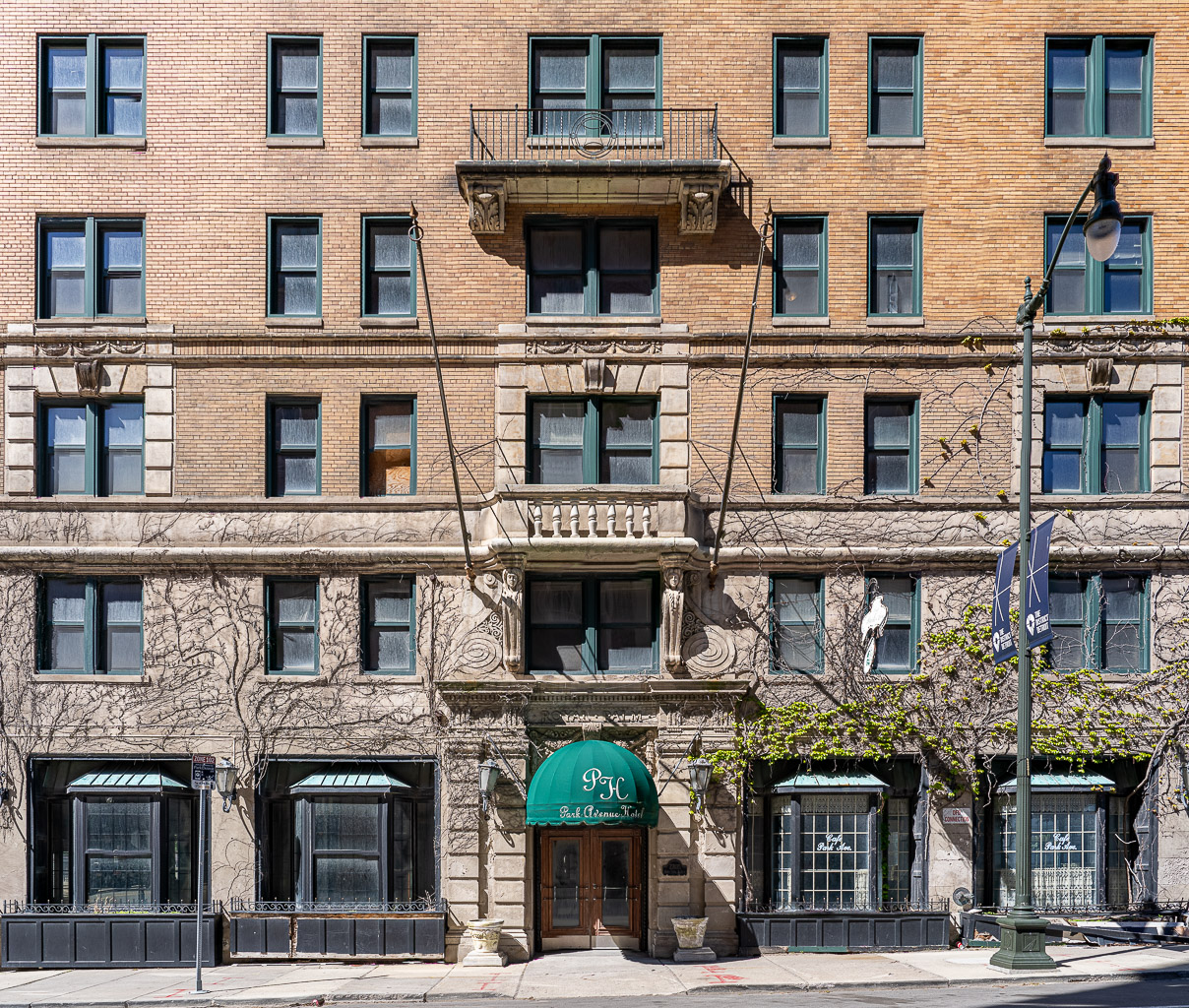
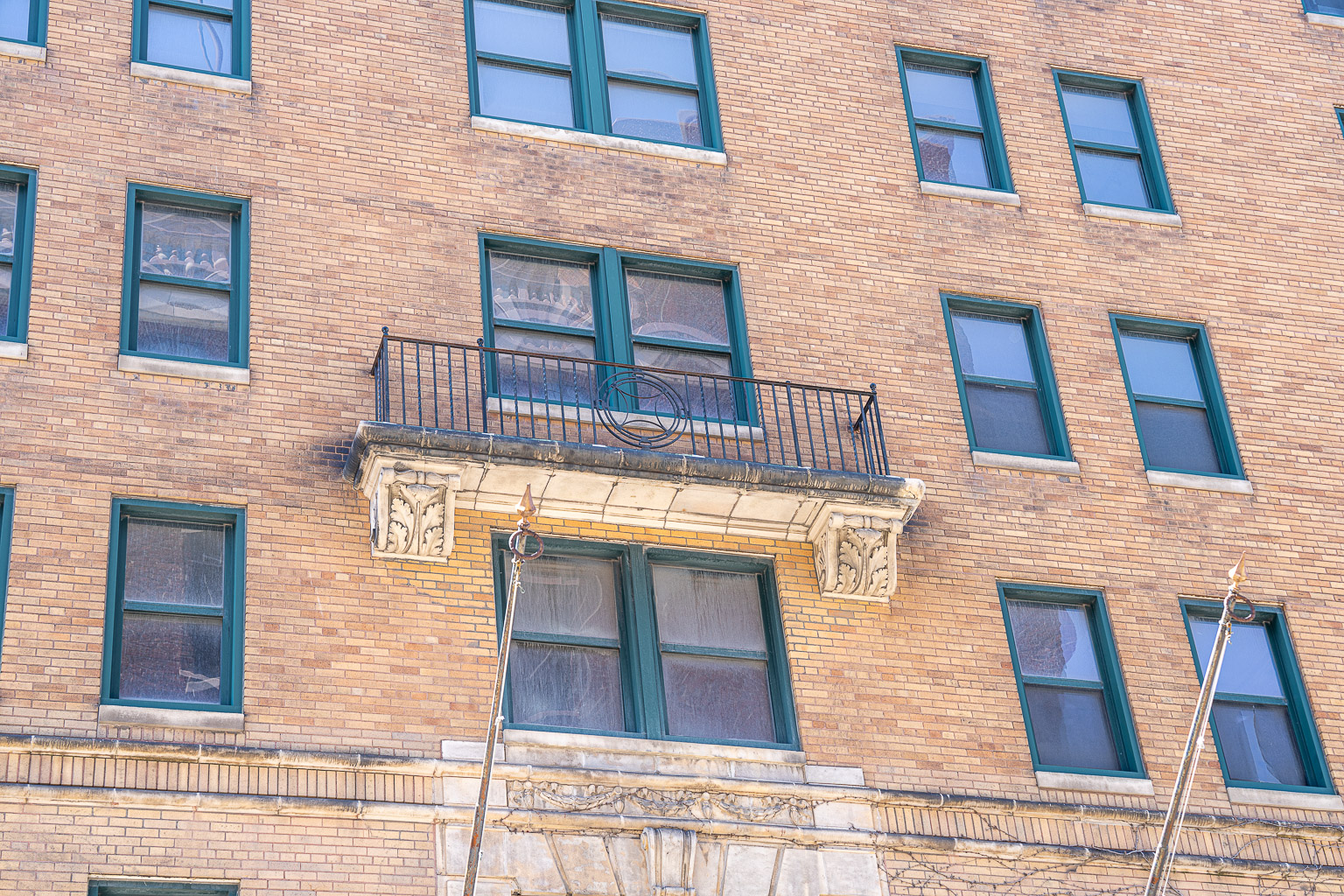
The Royal Palm Hotel exhibits the vast expanse of the plain wall surface of the skyscraper relieved with decorative Italian Renaissance detailing. The lobby floor has a series of commercial metal recessed bay windows with large wood window boxes at sidewalk level and decorative street lamps between the bays (1st and 2nd photos below). (These bays are a later alteration and replaced the original storefronts). The 1st through 12th floors of the front elevation exhibit a symmetrical facade composed of seven bays with double-hung wood sash windows (1st, 2nd and 3rd photos below). Different window treatments emphasize the first, second, fourth, eleventh and twelfth floors. The second, fourth and sixth bays on the second floor have windows with rusticated stone surrounds with flat keystone arches that support a frieze with decorative festoons (4th photo below). The center window on the fourth floor has a console-supported stone balconet with an iron railing (4th and 5th photos below).
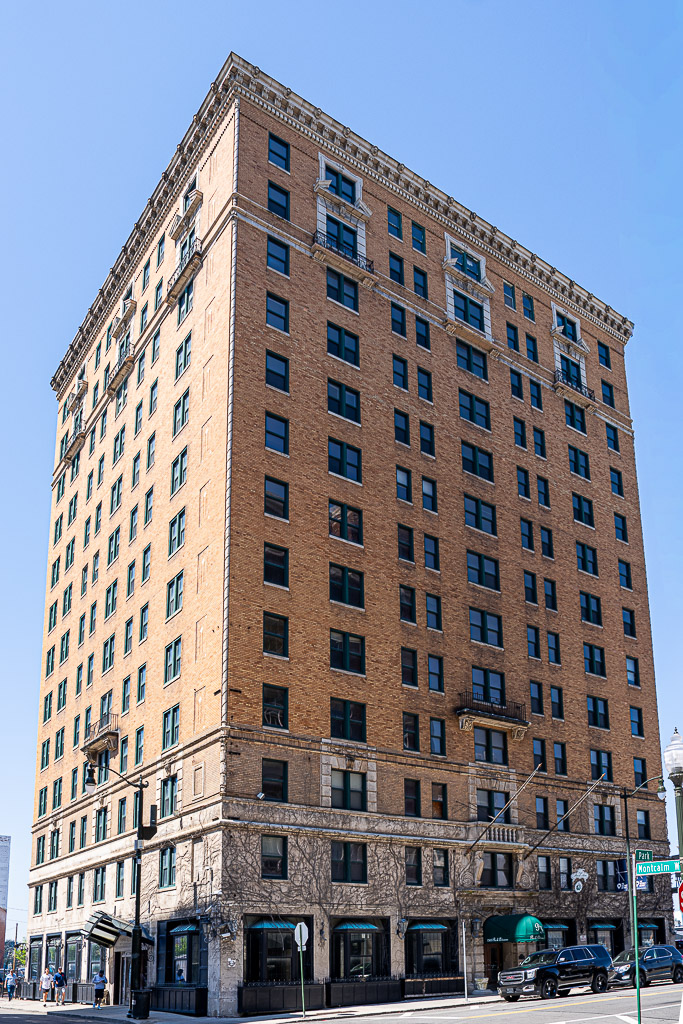
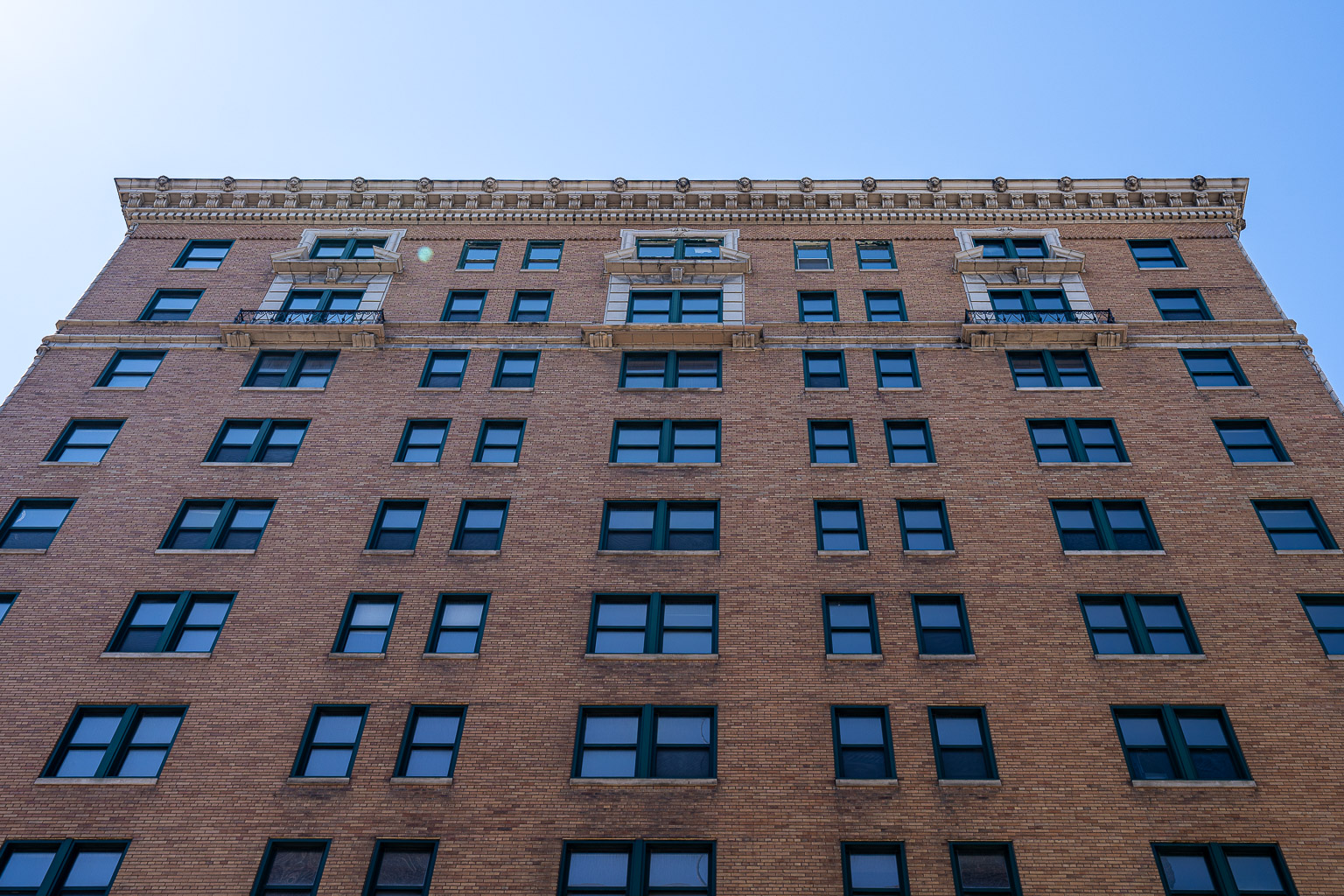
The second, fourth and sixth bays on the eleventh floor have windows with iron railing balconets and rusticated stone surrounds with broken pediments that support windows with flat keystone surrounds on the twelfth floor (1st and 2nd photos below). The building is crowned with a denticulated terra cotta cornice that has a line of stone lion heads in the cymatium (1st through 4th photos below).
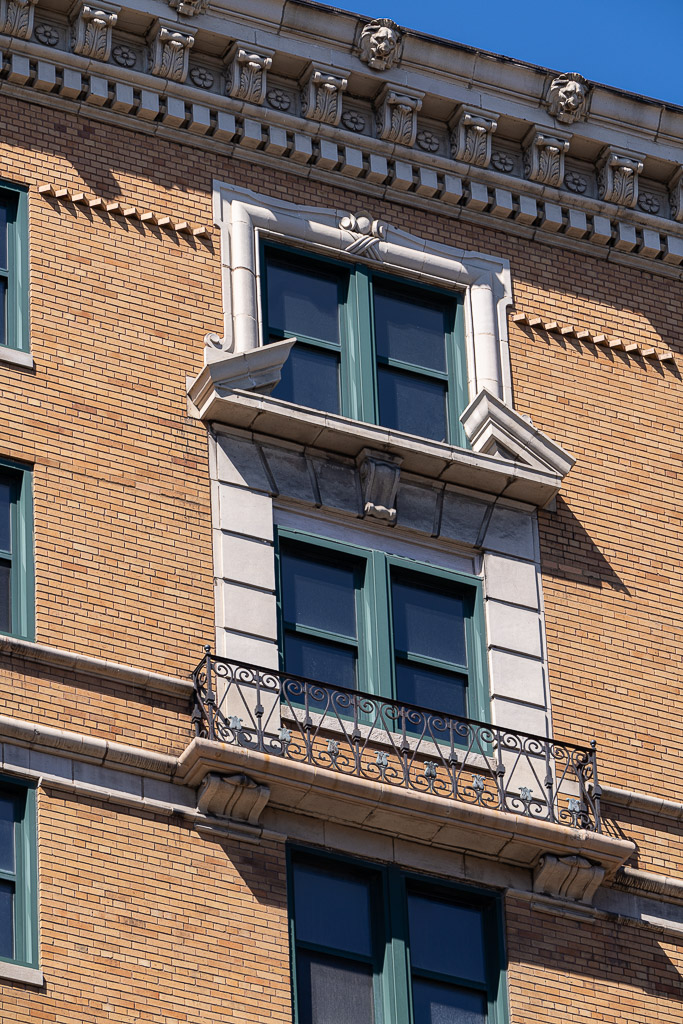
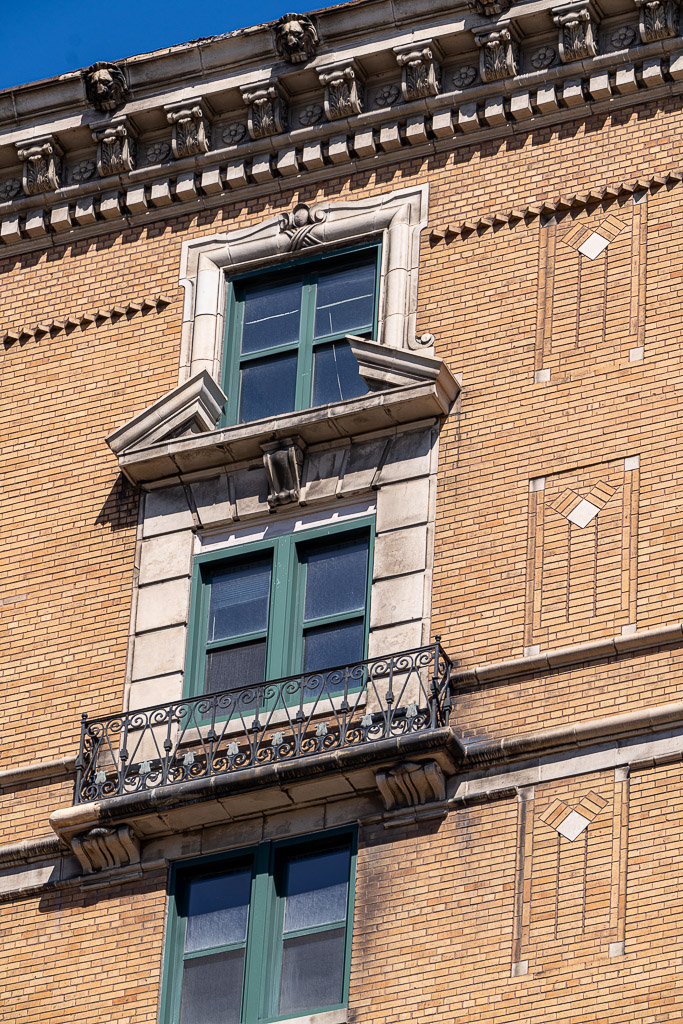
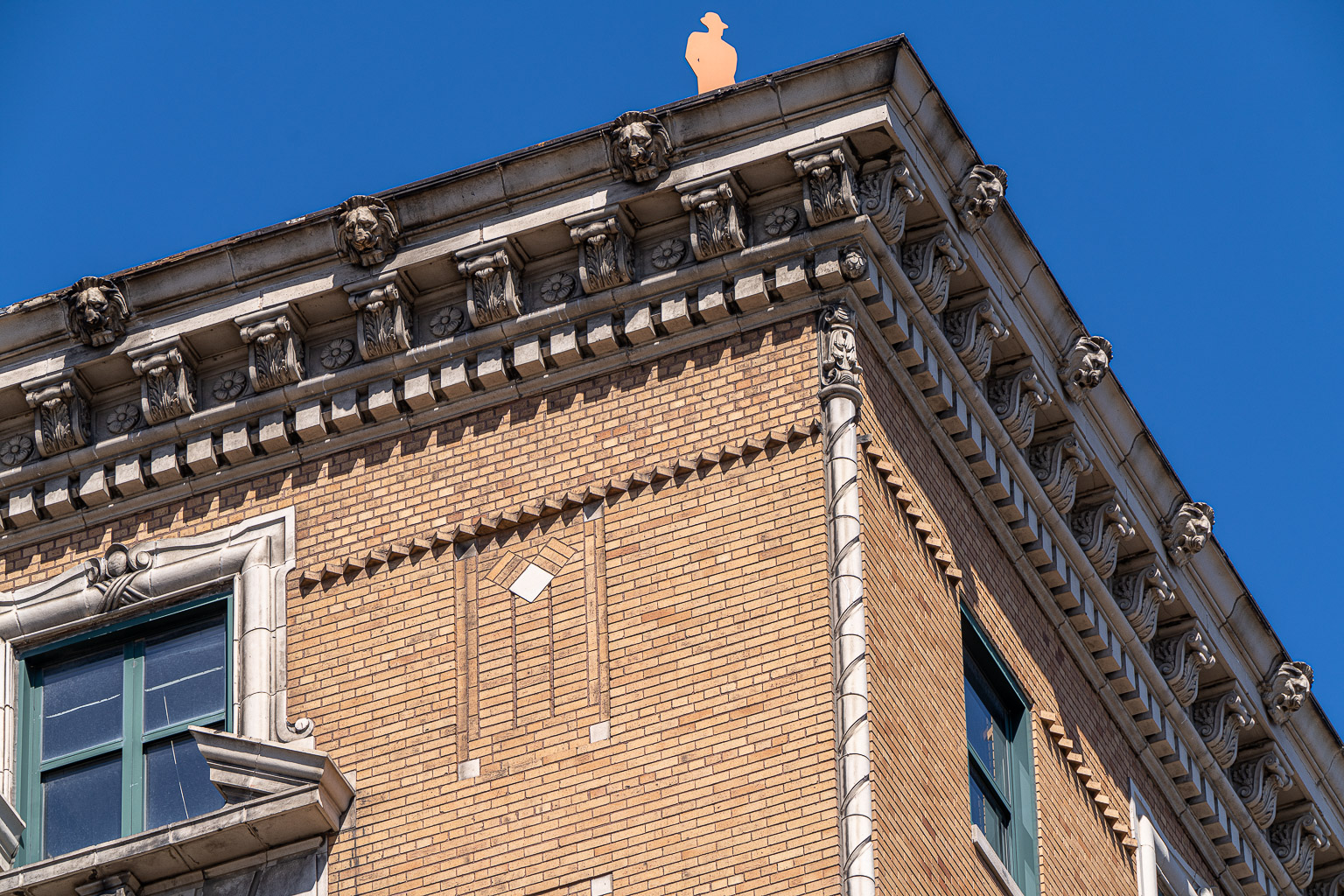
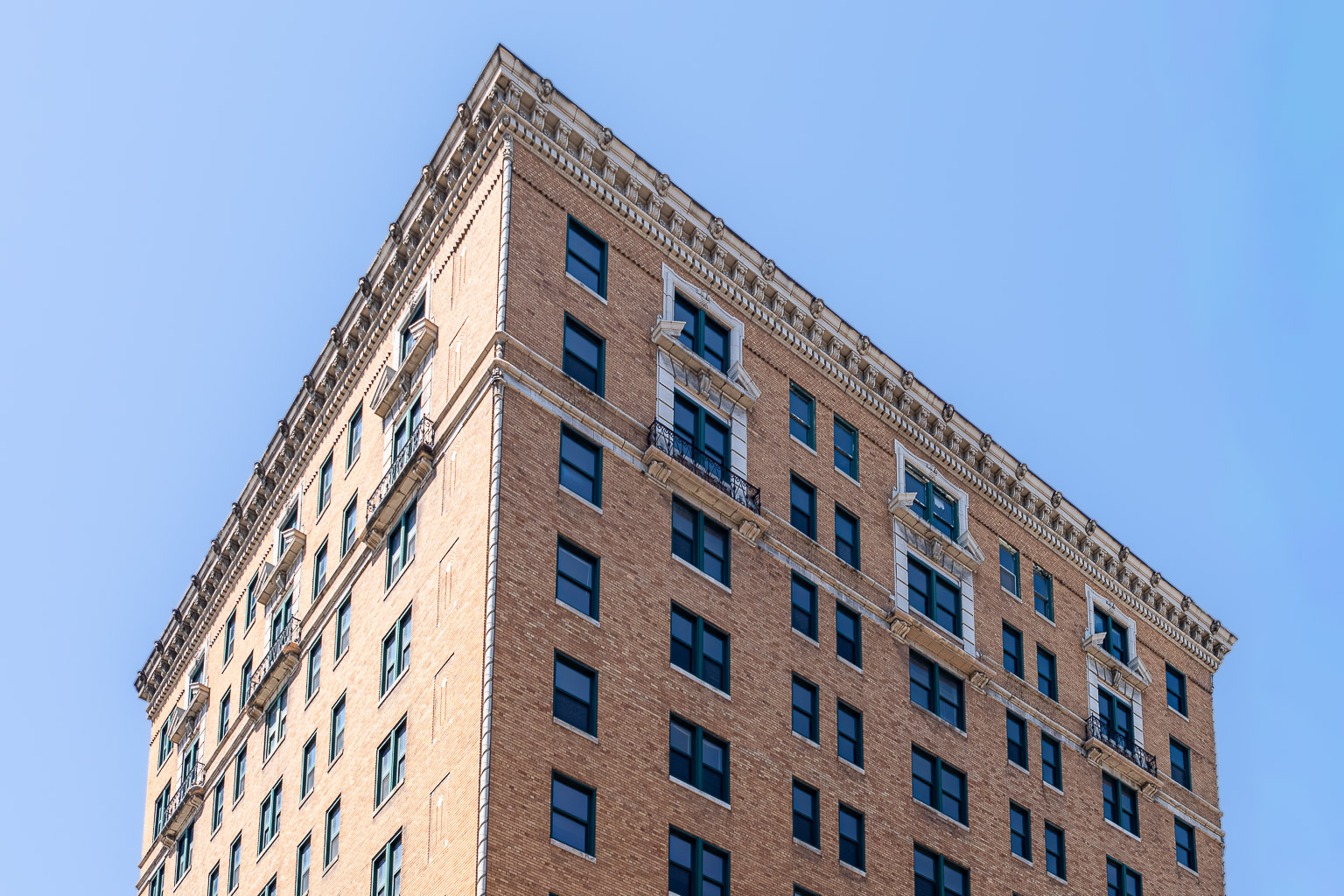
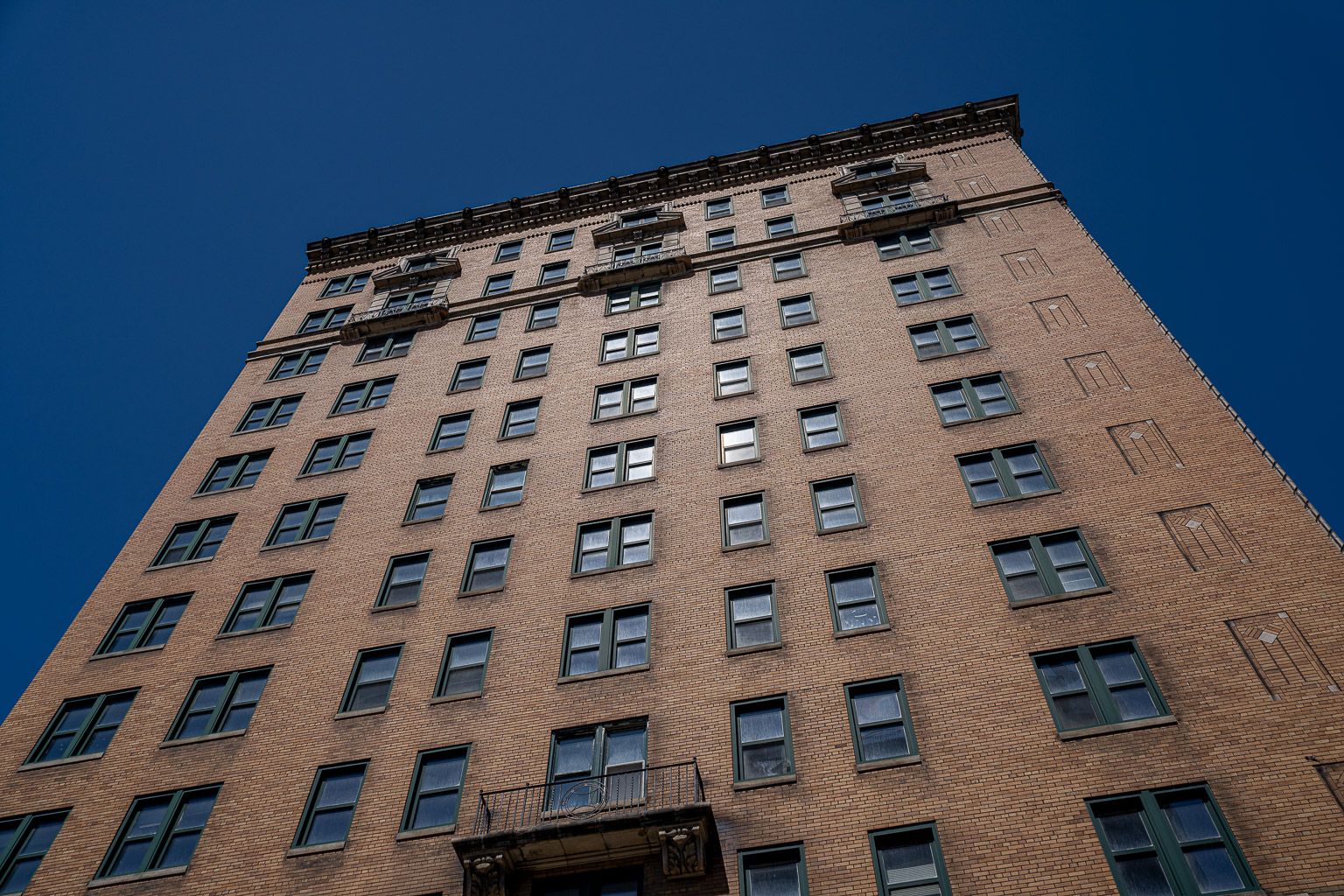
The main lobby entrance is through an elaborate Renaissance arch doorway in the center of the front facade (1st photo below) that has an arch flanked by rusticated pilasters supporting a Doric frieze. The frieze consists of triglyphs and metopes, and bears the name Royal Palm carved in stone in the center (2nd photo below). The frieze supports a denticulated cornice (2nd photo below). Double wood doors with a large single pane of glass sit under a semicircular fanlight in a decorative arch with festoons and keystone. On the second floor directly above the doorway the central windows are flanked by two feminine termini supported by an exaggerated reversed scrolled ancon (3rd through 5th photos below). This assembly in turn supports the balustraded window balconet of the third floor center window (6th photo below). Two flag poles extend from shield-patterned supports flanking the second floor central window.
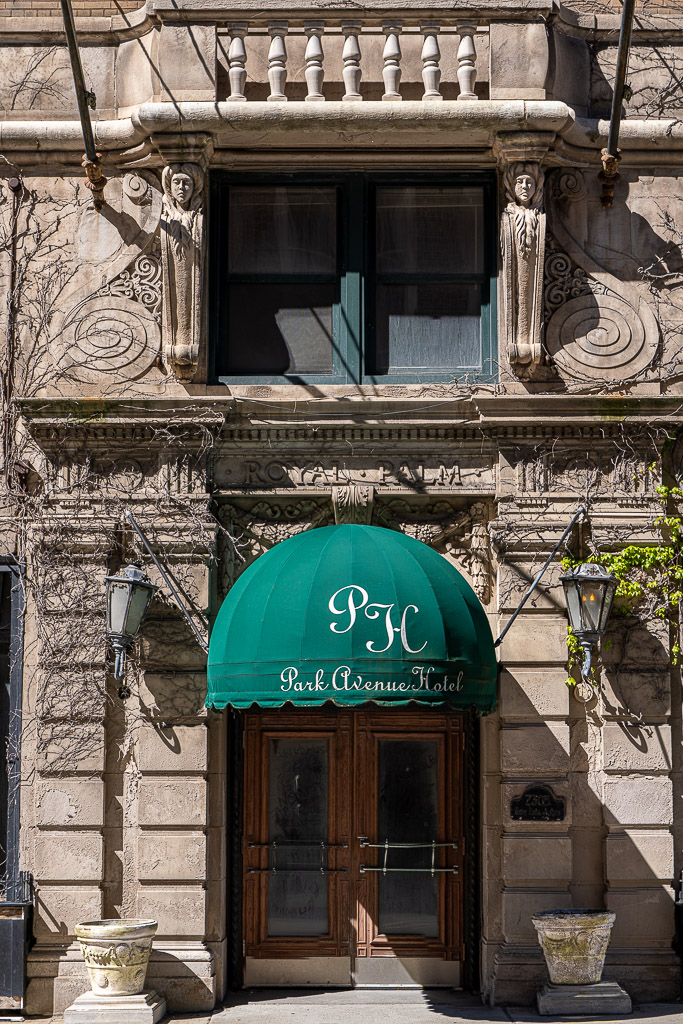
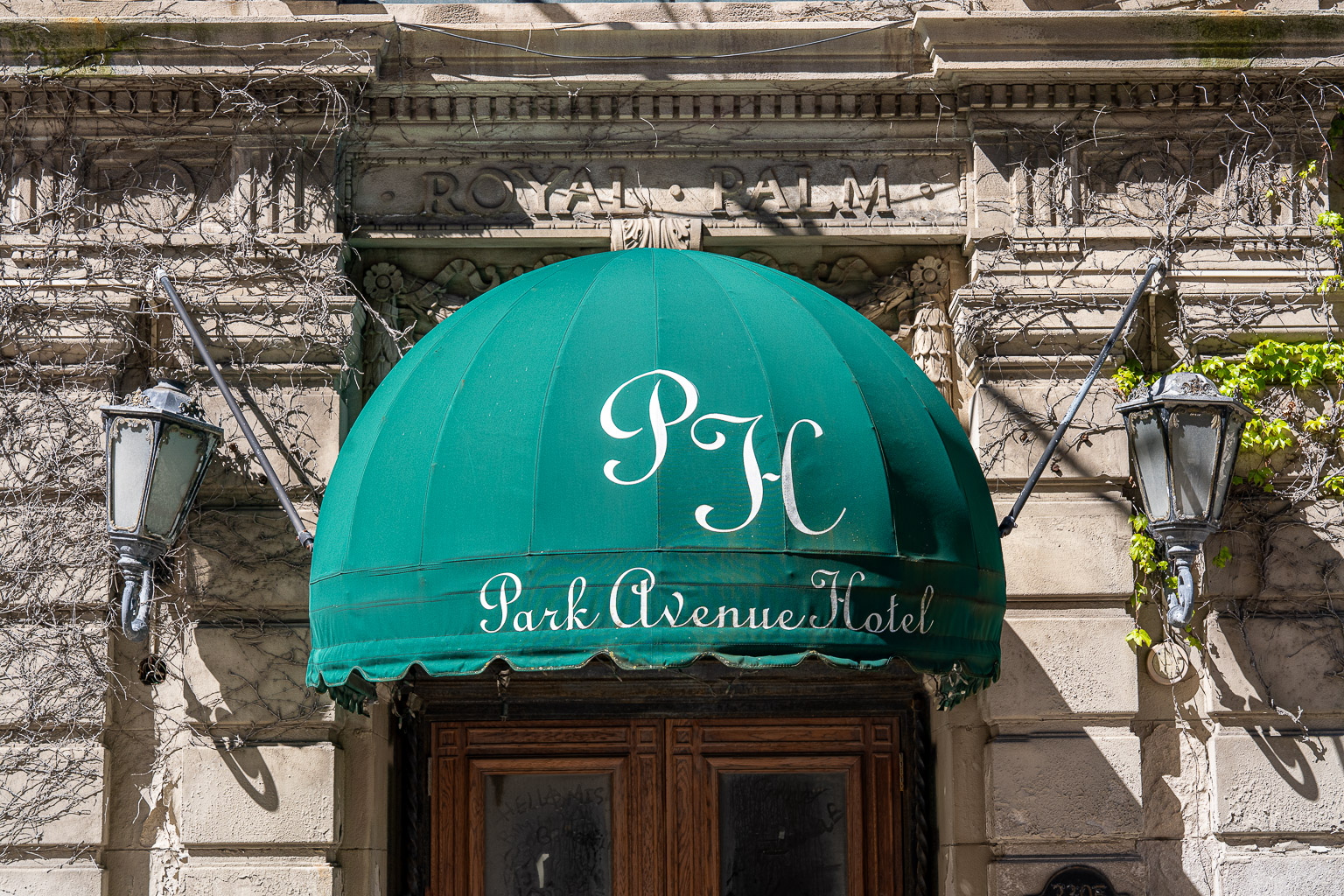
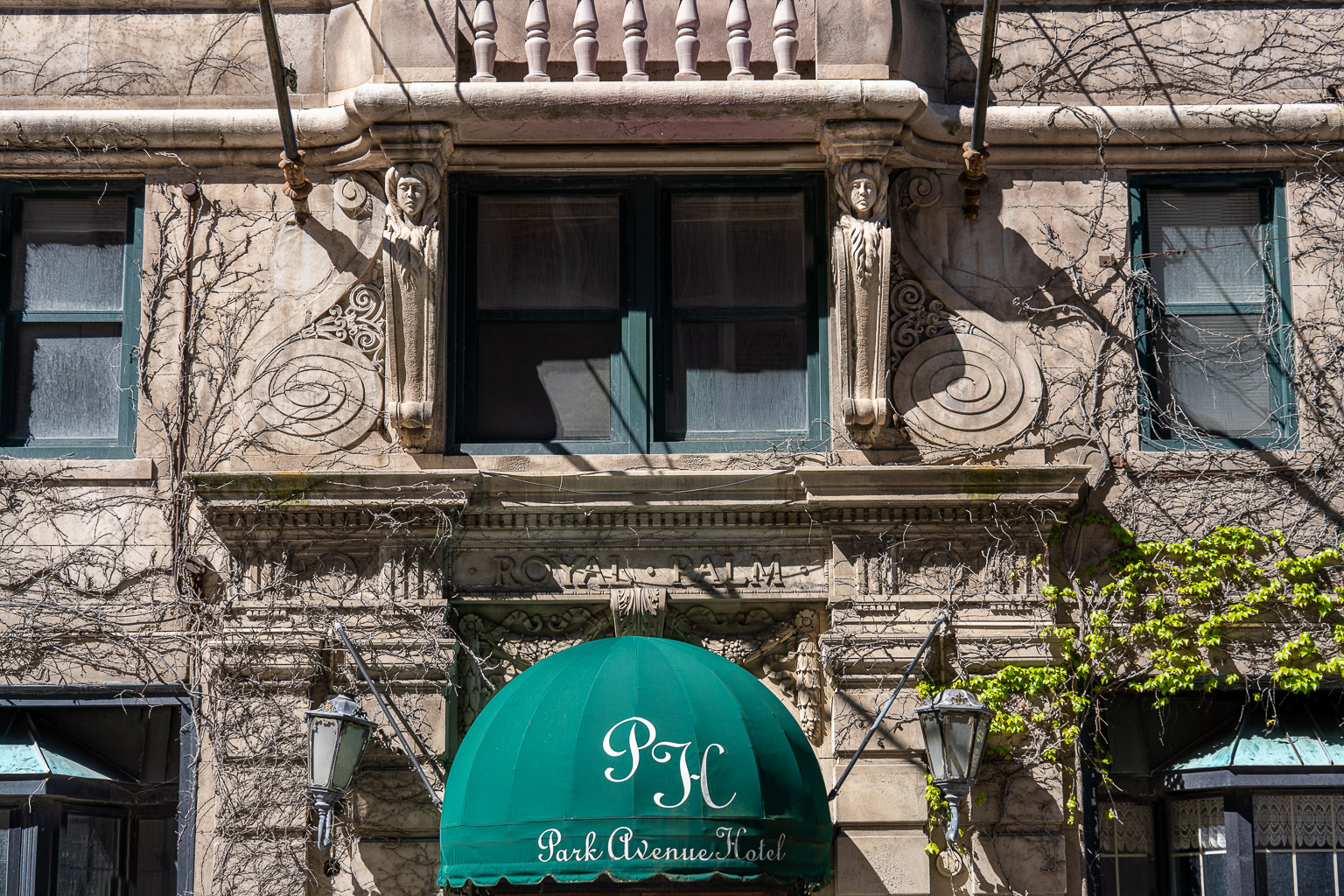
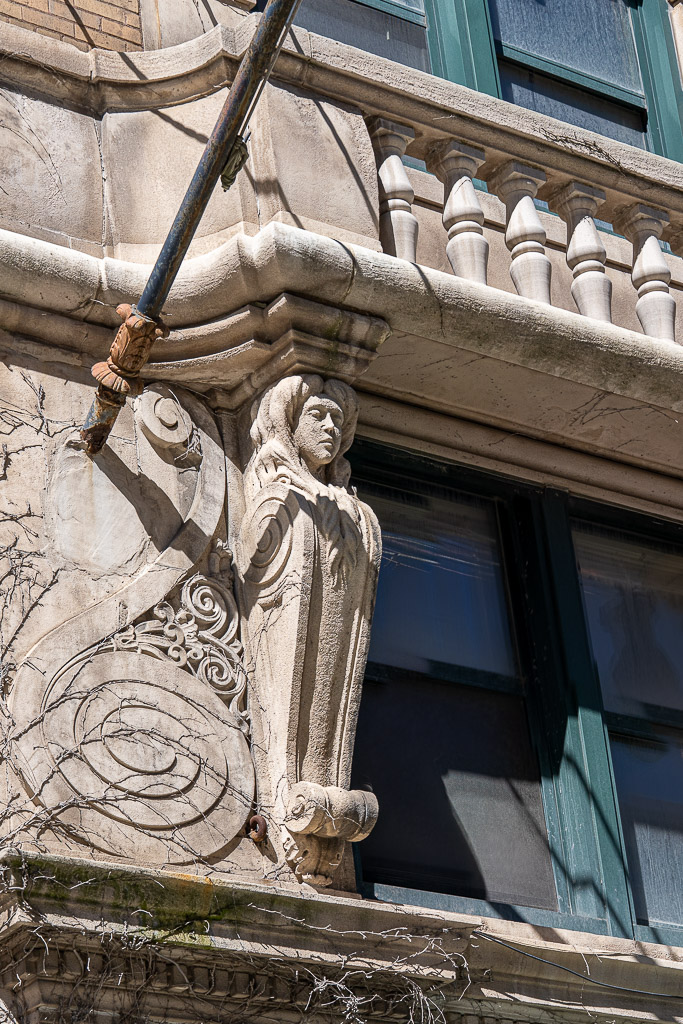
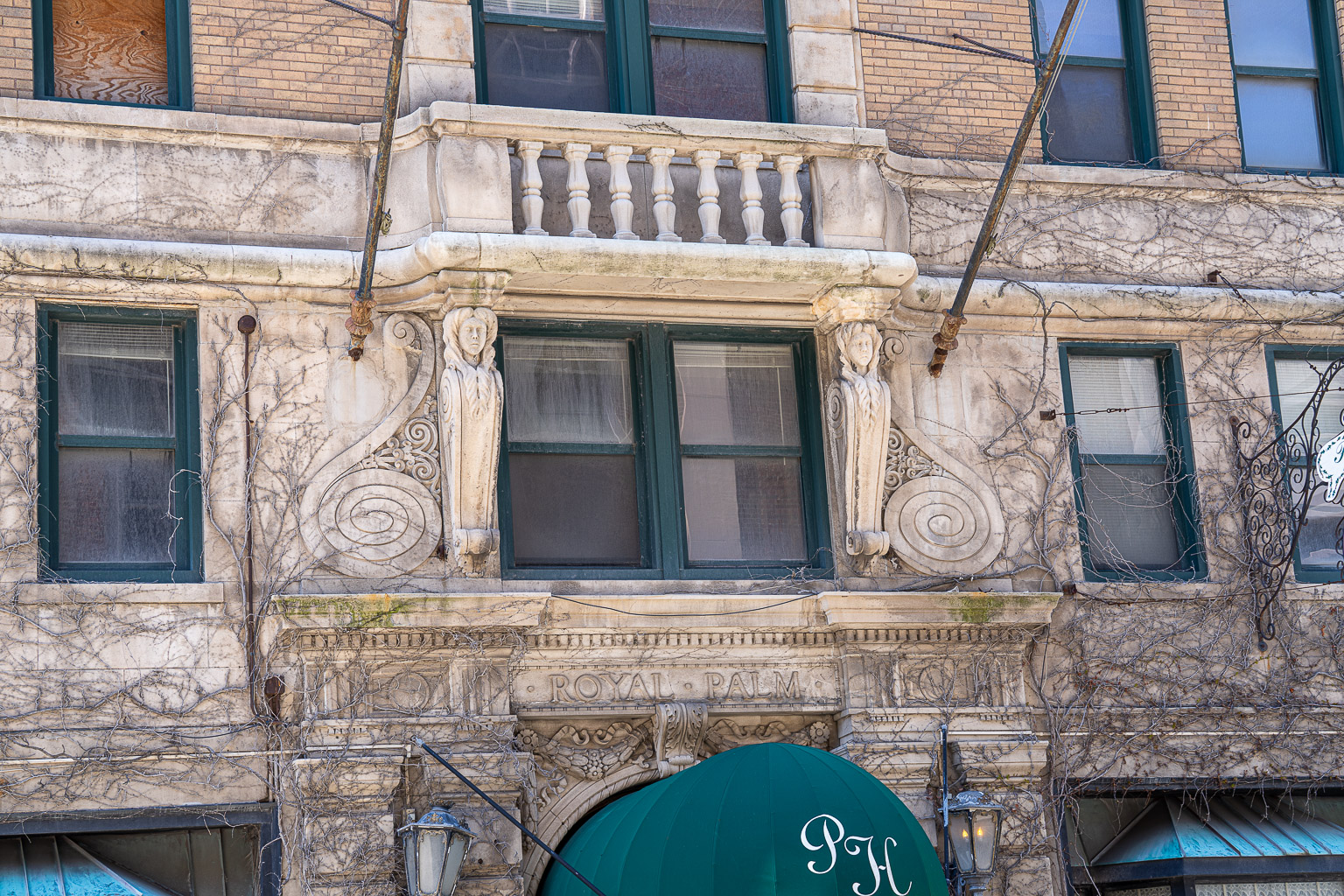
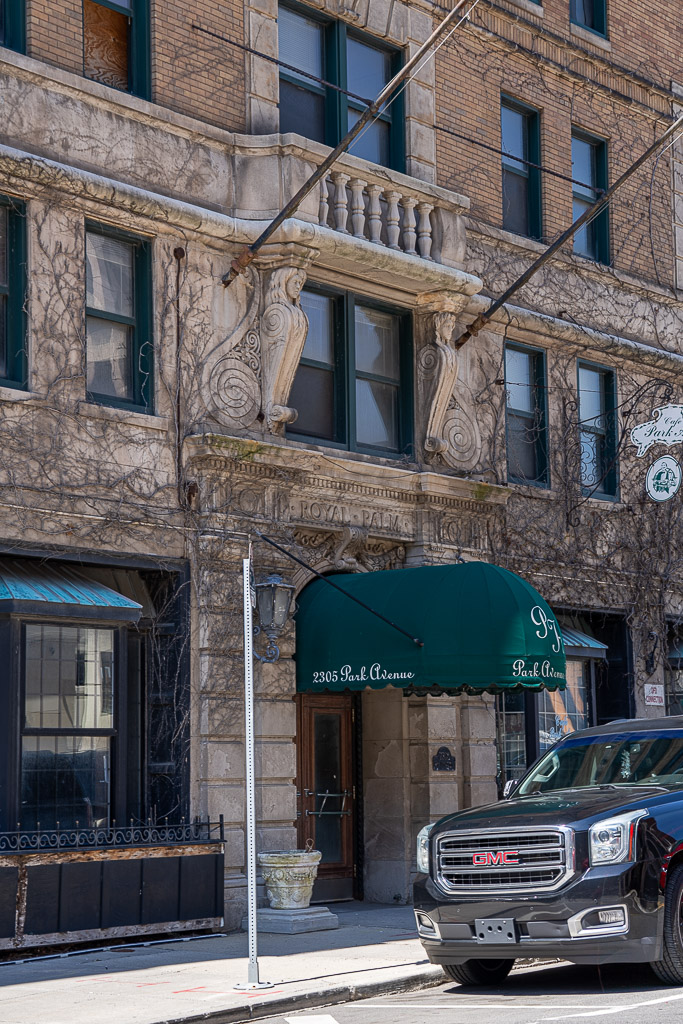
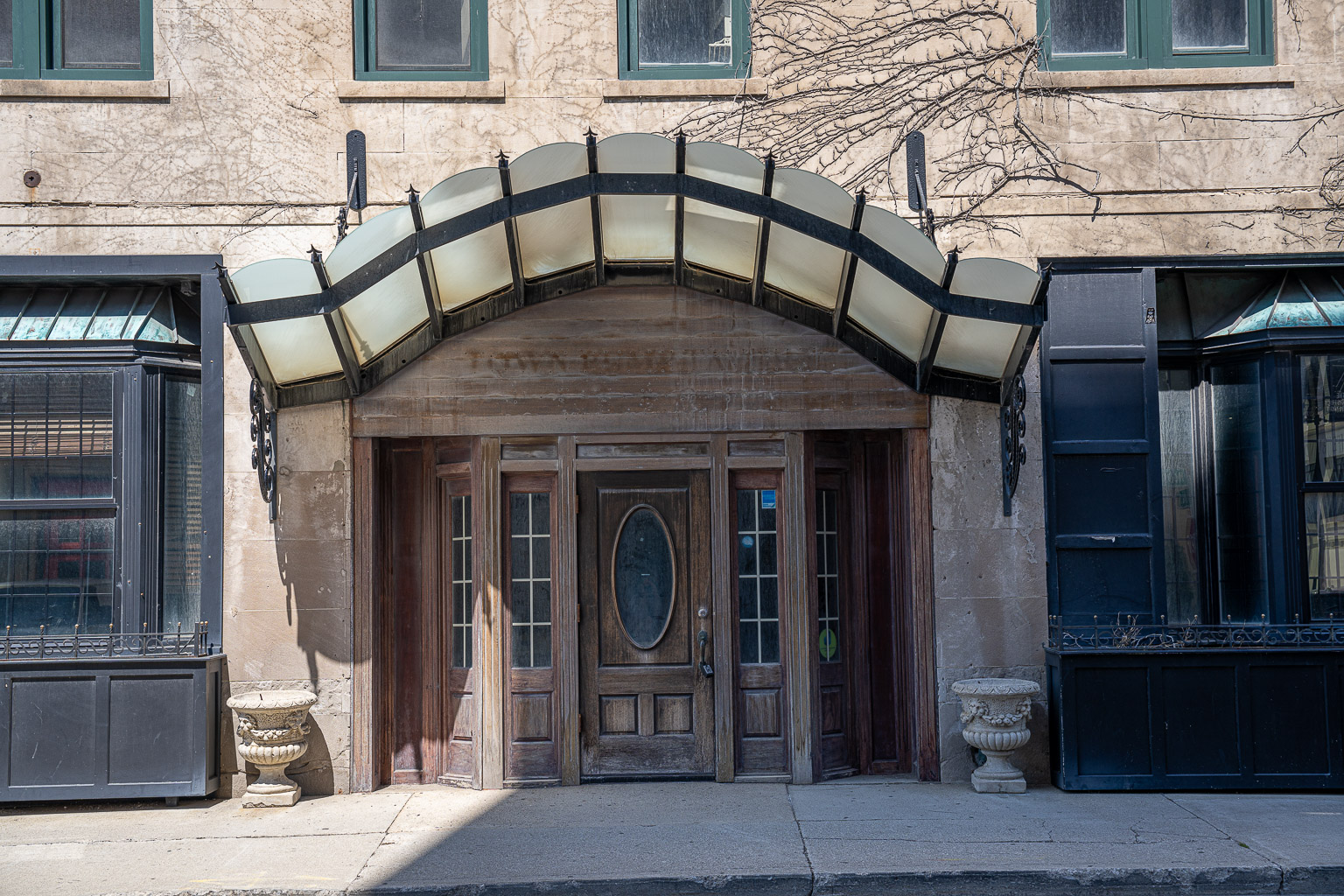
The doorway on the south (Montcalm) side of the building is shown in the 1st photo below, and the back of the building (in shadow) is shown in the 2nd photo below.
Louis Kamper, architect, designed the Royal Palm Hotel in 1924 for Lew Tuller, a noted builder of hotels and apartment houses in Detroit. Amongst his hotels were the Tuller Hotel on Grand Circus Park (1905, demolished), and the Eddystone Hotel and Park Avenue Hotel north of the Fisher Service Drive on Park Avenue. Louis Kamper came to Detroit from the offices of McKim, Mead and White in New York City and established his own office here in 1888. He was a devotee of the Italian Renaissance style which he introduced to Detroit buildings in an attempt to combine monumental beauty with the commercial style. He was also responsible for the grand design and development of Washington Boulevard and several of its buildings, including the Book-Cadillac Hotel, for the Book brothers.
Tuller apparently overbuilt in Detroit's hotel market; in 1928 he lost the three Park Avenue hotels in foreclosure and was forced into receivership by the Security Trust Company. In that same year Security Trust sold the Royal Palm and the Eddystone to David P. Katz, a Detroit financier who made his wealth through hotels and extensive real estate transactions. He owned five Detroit hotels and one in Miami Beach. He retained the Royal Palm until 1966 when the discovery of a $2 million fraud against him caused the collapse of his business and his health. He died two years later. In 1967 Wilbur Harrington purchased the hotel and renamed it the Park Avenue House. In 1990 he transferred ownership to Harrington Properties, Inc. and his son, Sean Harrington, operates the building today. The Town Pump, a neighborhood pub, occupies the southern side of the building.
More photos and more description of this building can be found at HistoricDetroit.org and on this Facebook post.
A historical description of the exterior of the Colony Club comes from Michigan Women magazine of November 1929:
The refinement and repose of the Georgian exterior reflects the simple dignity of the interiors and also expresses the various units of the plan.
The first story, forming the base of the façades, is of limestone, appropriately framing the separate shop fronts, which, with their muntined windows and delicately detailed ironwork, lend an air of pleasant intimacy to the lower story.
A molded stone architrave with a carved shield of the Club emblem above it, accents the main entrance on Park Avenue, and, with its interesting frame, and leaded glass fanlight, the door presents an inviting appearance. The ballroom entrance, marked by a marquise extending to the street, is on the Montcalm Street side, removed from the heavy traffic of Park Avenue.
The facade above the base is of a mellow red brick, contrasting pleasantly with the buff limestone trim, and the windows with their flush wood frames and muntins.
The Park Avenue side is accentuated by a decorative slender Ionic pilaster treatment over the main entrance, appropriately framing the three large circular windows of the ballroom.
An unbroken surface above these bays forms a transition to the increased play of light and shade afforded by the Solarium Terrace with its stone balustrade flanked by the brick gables and pedimented stone openings ...
(end of magazine quote)
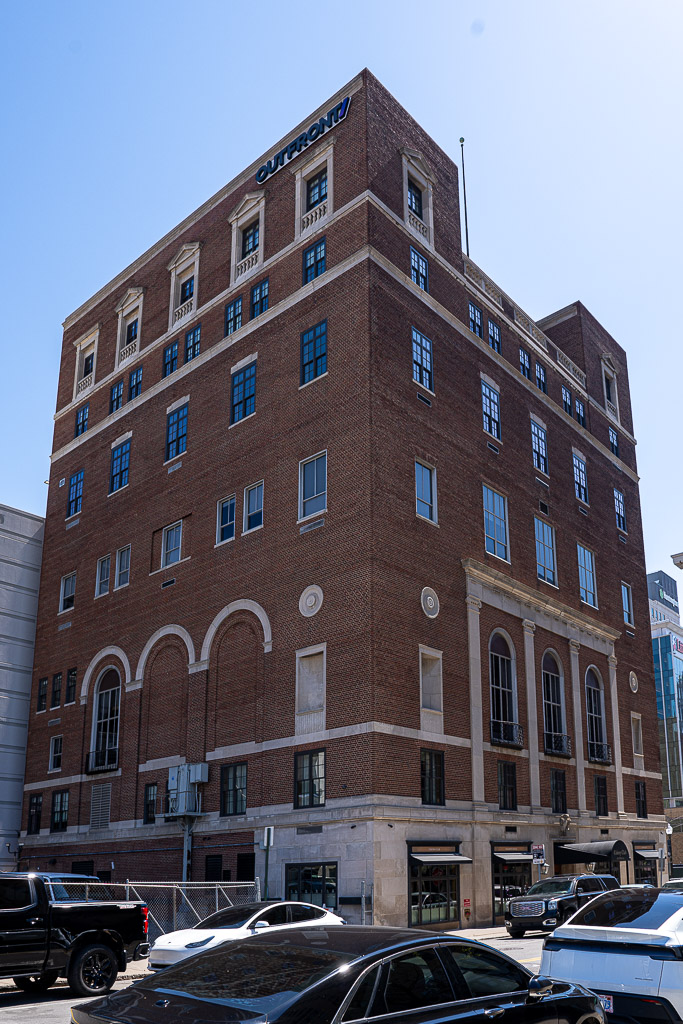
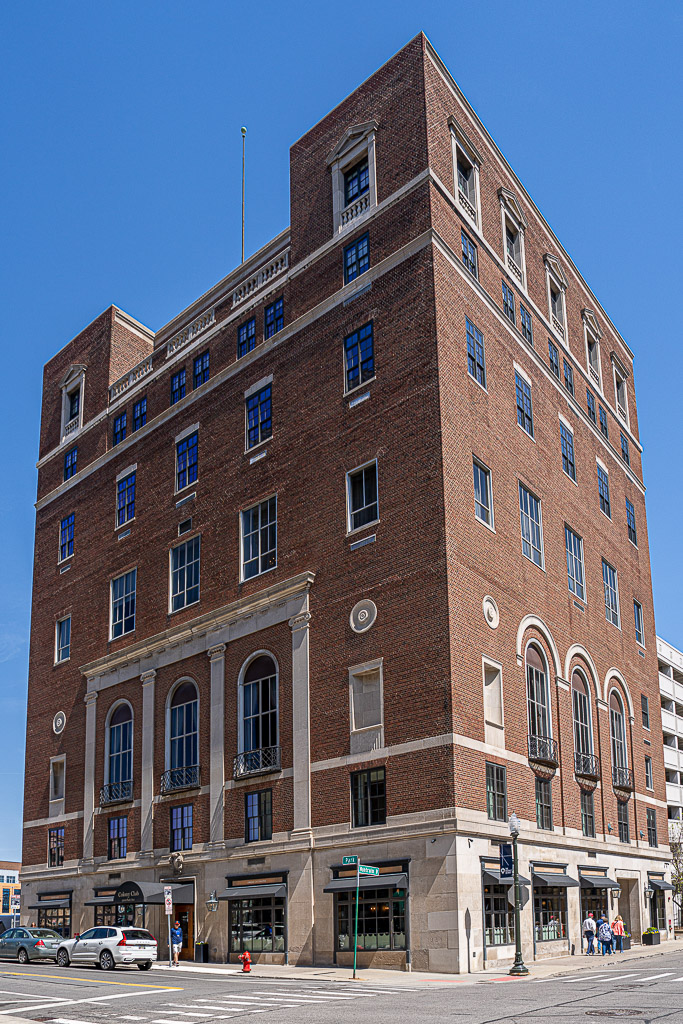
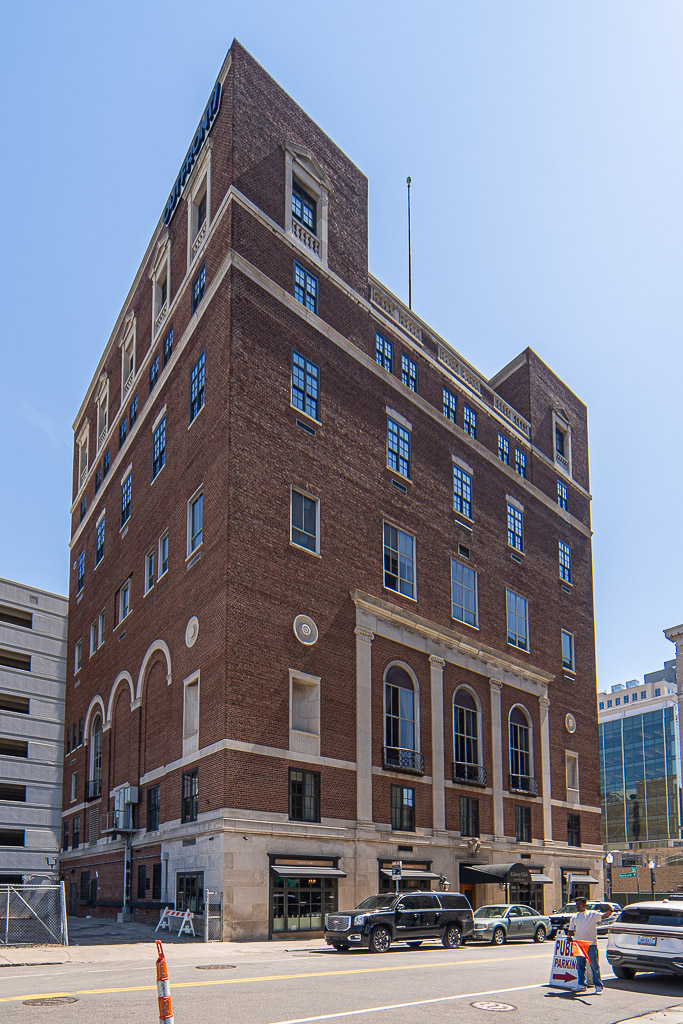
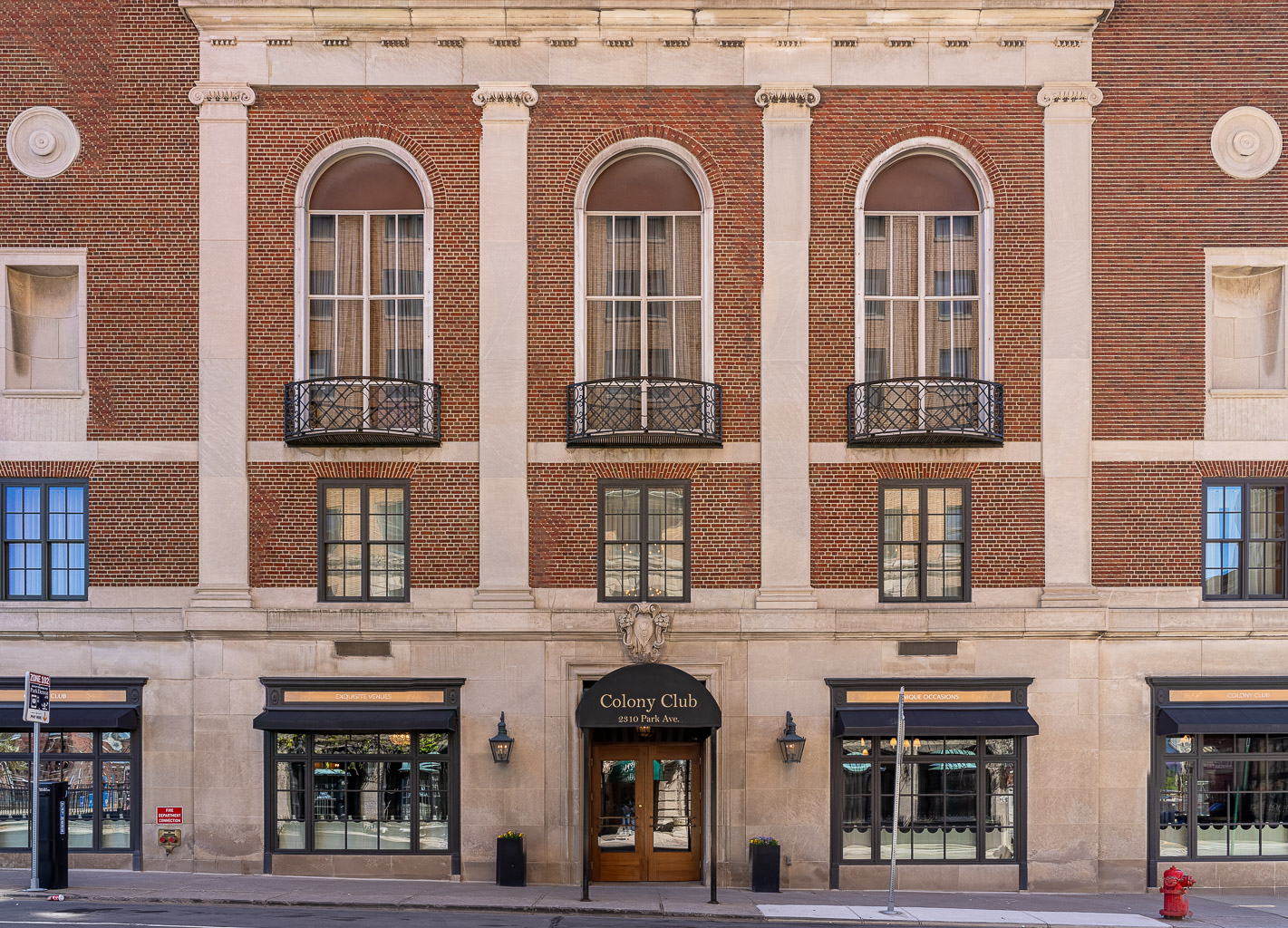
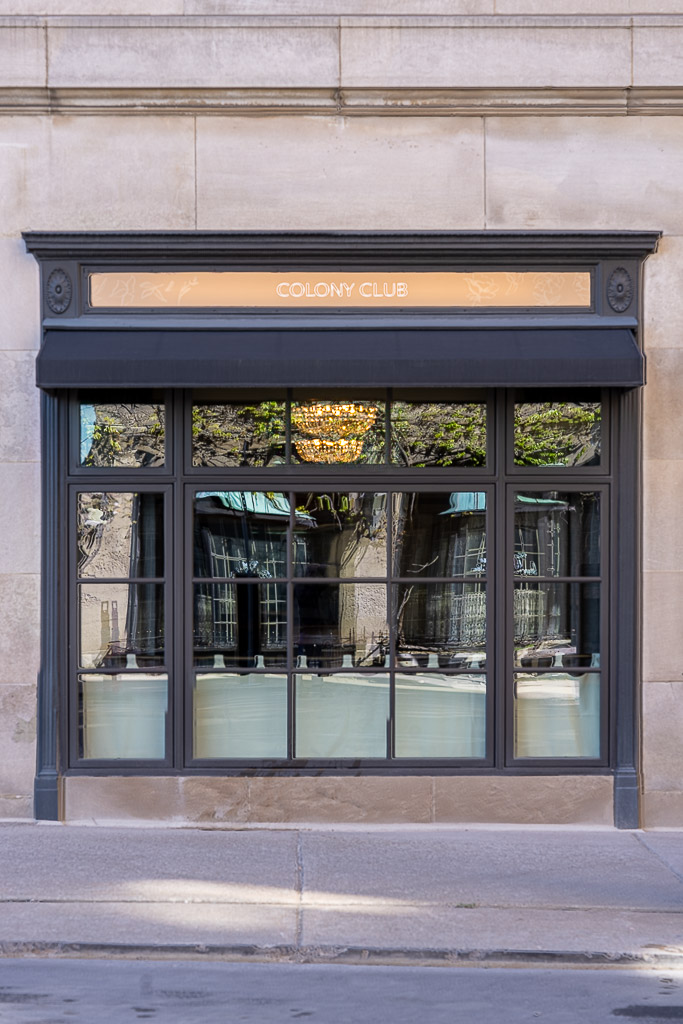
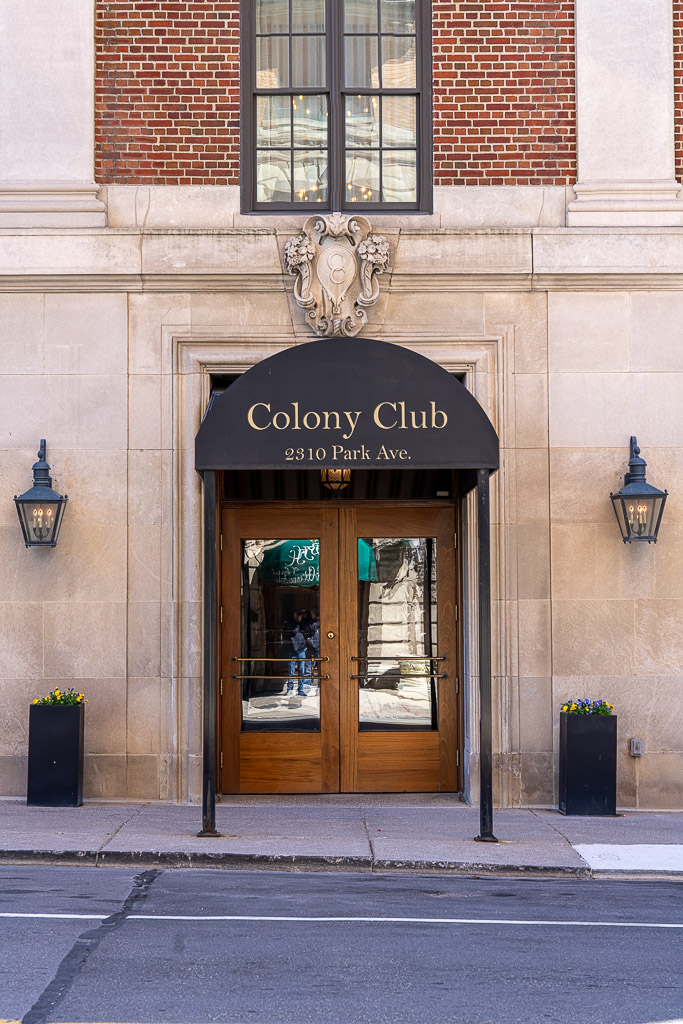
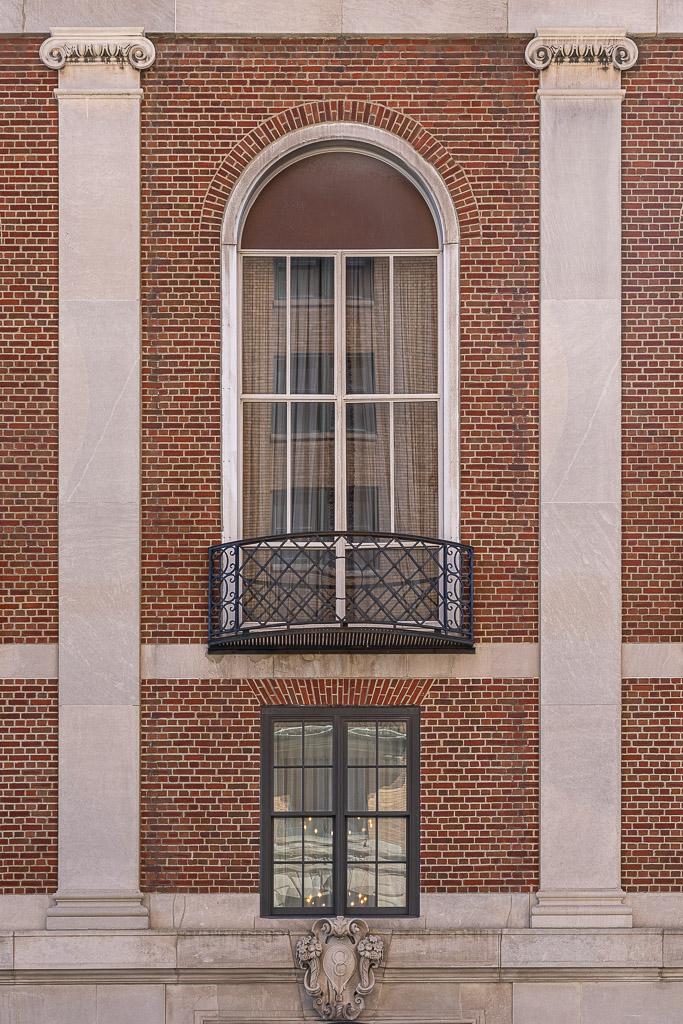
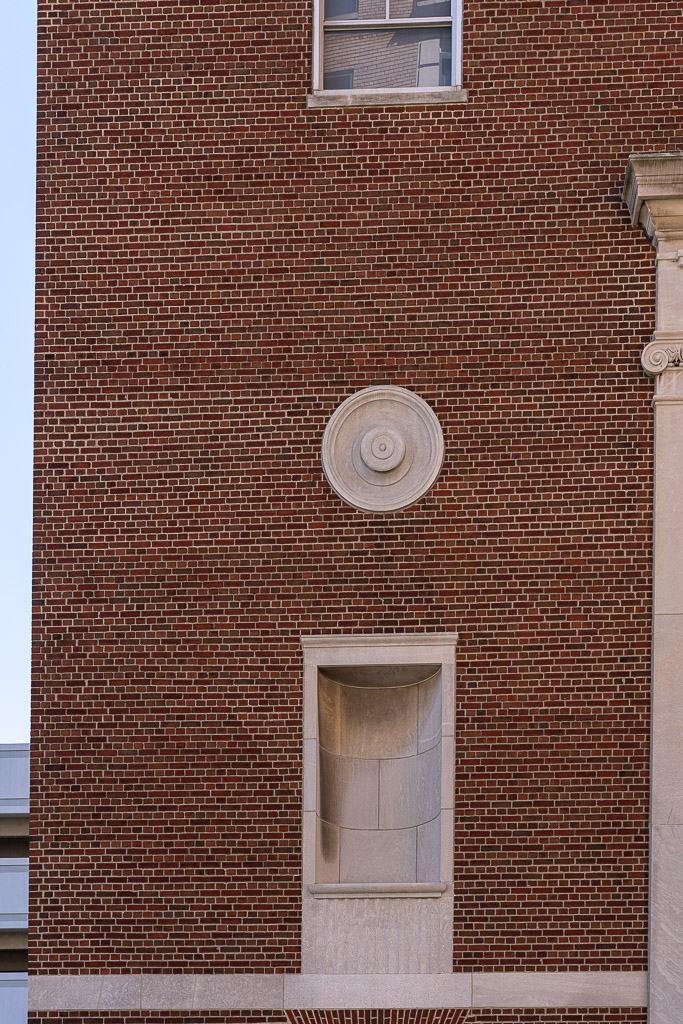
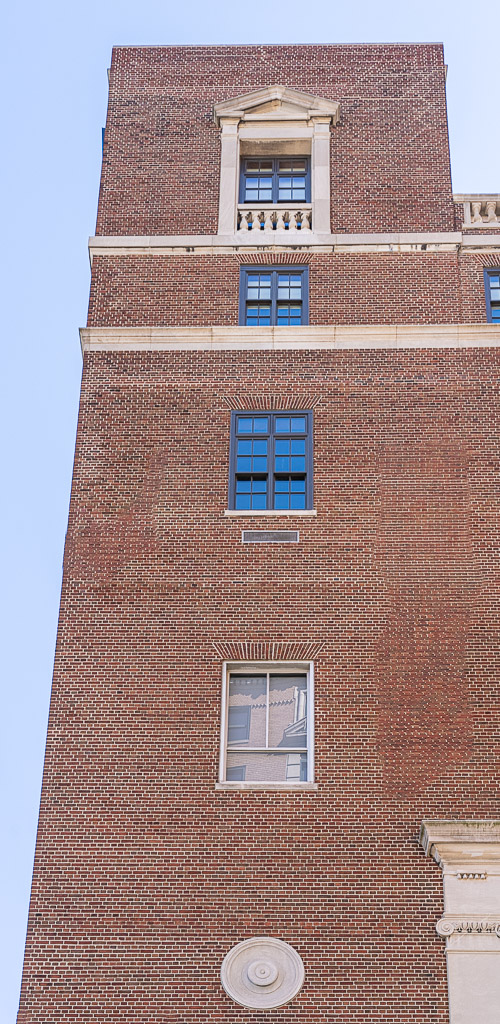
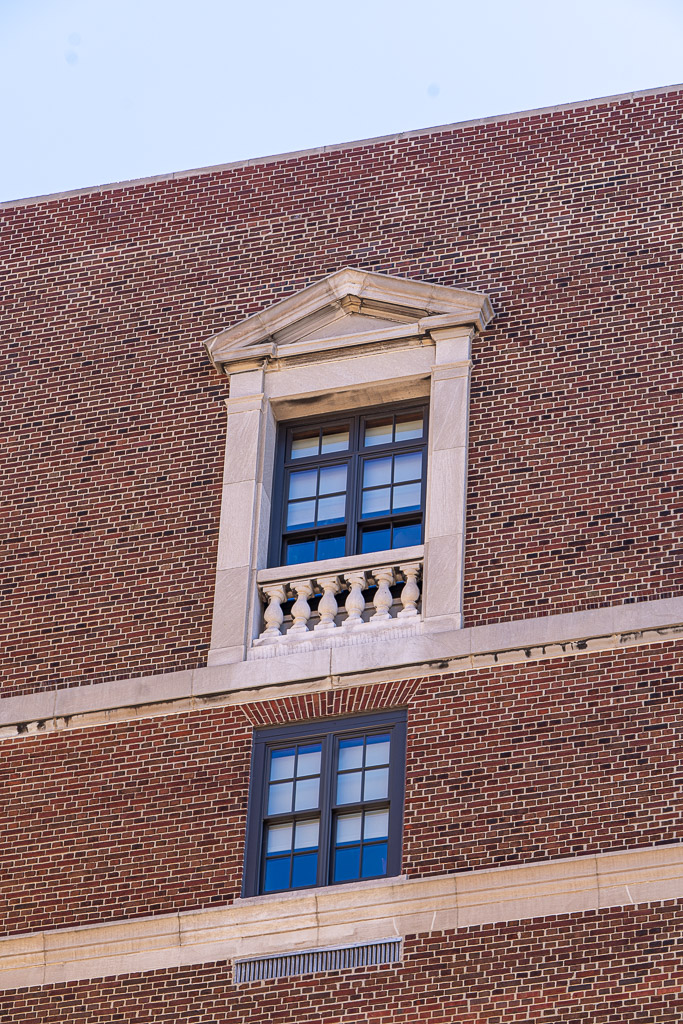
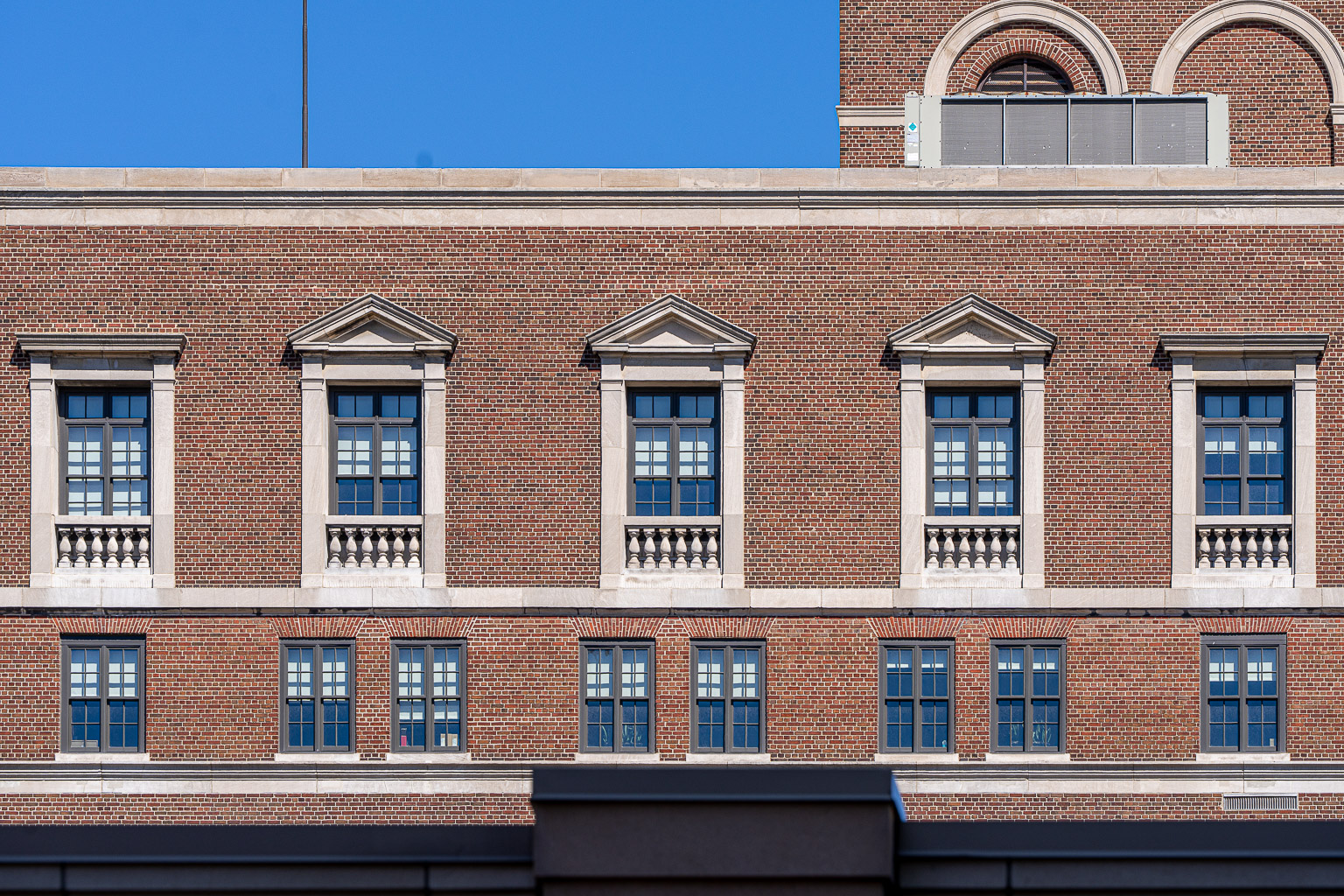
Today the exterior differs primarily by the replacement of the original windows. An interior description of the formal rooms with their elaborate Louis XVI décor can also be found in the same source. Today, the interior of the Colony Club Building looks very institutional, reflective of its recent past as an educational complex for the Detroit Institute of Technology and Wayne County Community College, and the Detroit Police Academy. Walls have all been painted over, and the floors tiled with linoleum. The ballroom, used as a testing hall for police cadets as well as a sort of gymnasium for defensive tactics training, is still in excellent condition.
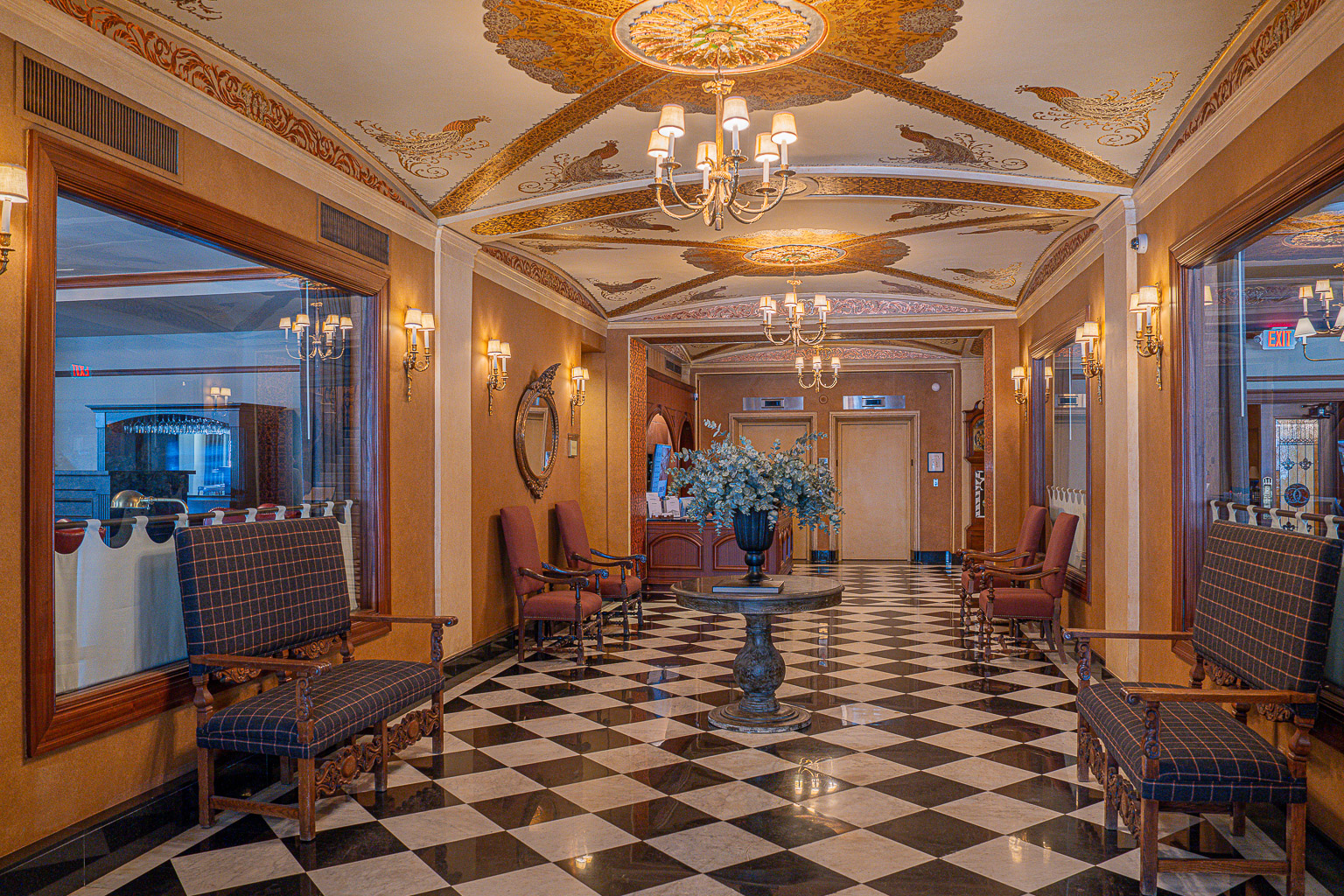
The Colony Club was formed by women who wanted a club with smaller membership than the Women's City Club down the street. Membership was exclusive, and included women with names from Detroit's elite: Newberry, Alger, Briggs, Fisher, Ford, Leland, Booth, Palms, etc.
Smith, Hinchman, & Grylls were retained as the architects; the wives of the principals were members of the Colony Club. Palms, Stoepel & Co. (again wives of the principals were club members) were selected as realty agents to select a suitable site. Three sites were considered: Bagley Avenue at First, Madison Avenue at Randolph, and Park at Montcalm. The Park Avenue site was selected as the most desirable, according to it first president as reported by Michigan Women magazine in February 1929:
We consider this site to be exceptionally fine, as it is in the heart of a newly developing business and shopping district, within a block of the Vernor Highway, near Second Boulevard, and therefore accessible to those who approach from the eastern and northern sections of the City.
The permit for the Colony Club building was issued on November 17, 1928, #53309, with an estimated cost of construction of $600,000. The groundbreaking took place on September 17, 1928. Walbridge-Aldinger served as contractor. The cornerstone was laid on November 20, 1928.
The Colony Club had the sad irony of holding its three-day grand opening on October 24- 26, 1929, just days before the Stock Market crash that marked the onset of the Great Depression. In the few years of its existence, the Colony Club was very active, and its activities -- the lectures, luncheons, debuts, balls, etc. -- are amply documented on the pages of Michigan Women magazine. On March 31, 1931, for example, club member Clara Bryant Ford, president of the National Farm and Garden Association and wife of Ford Motor Company founder Henry Ford, gave a lecture on farms and gardens.
However, by April 1931 the magazine was openly reporting the negative effects of the Depression on the Colony Club's finances. By June Michigan Women reported that the club had just escaped receivership, memberships were off, and an audit conducted showed that "the Club was not being operated economically." The club took remedial measures, including offering "Class B" memberships. The Colony Club did not survive, however, and by 1935 it disappears from the Detroit City Directory.
During the late 1930s the building housed Antler Post No. 334 of the American Legion and Elks Club BPOE Detroit Lodge No. 34. By 1941, the building entered its second era of significance, when longtime Detroit & Wayne County Federation of Labor president Frank X. Martel made the building the union's headquarters. The Detroit Labor News wrote in 1955, "Unionists of the city are proud of this temple, which is regarded as a veritable monument to Frank X. Martel, whose motivating influence and resourcefulness were chiefly responsible in procuring this elaborate edifice as a house of 1abor." Aside from the offices of Detroit Labor News, the building housed a number of union locals under the AFL umbrella, including the Metal Polisher's Local No.1. The Detroit City Directory lists the AFL at this site at least through 1958, so the AFL would have been at this location when the national union merged 1955 with the Congress of Industrial Organizations (CIO) to become the AFL-CIO.
The building is listed as vacant in 1964. From 1965 through the last Detroit City Directory in the Burton Collection, 1973, the building housed the Detroit Institute of Technology. It later housed Wayne County Community College before it was used by the Detroit Police Department. It is being restored by the Forbes Management Company.
More photos and more description of this building can be found at HistoricDetroit.org.
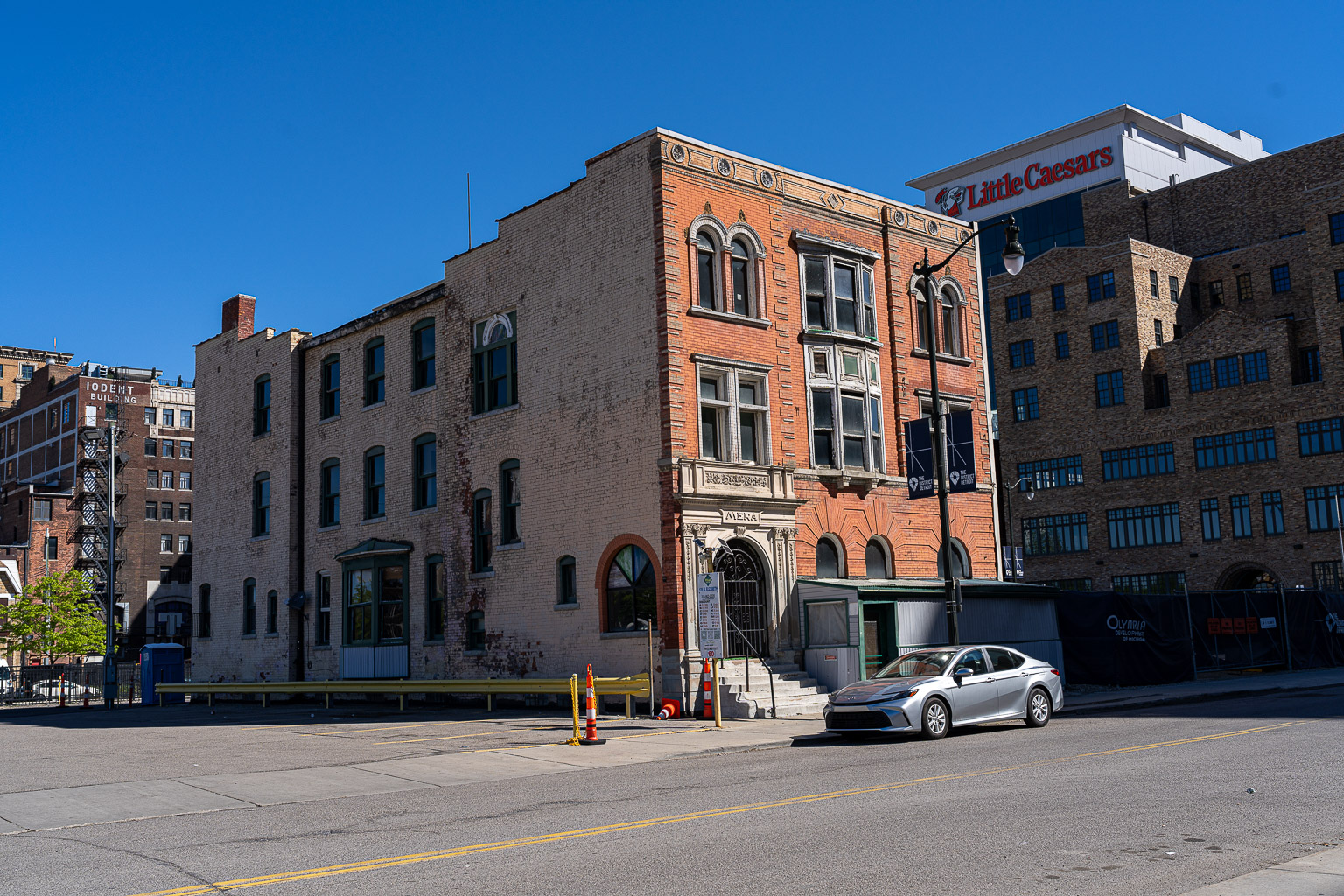
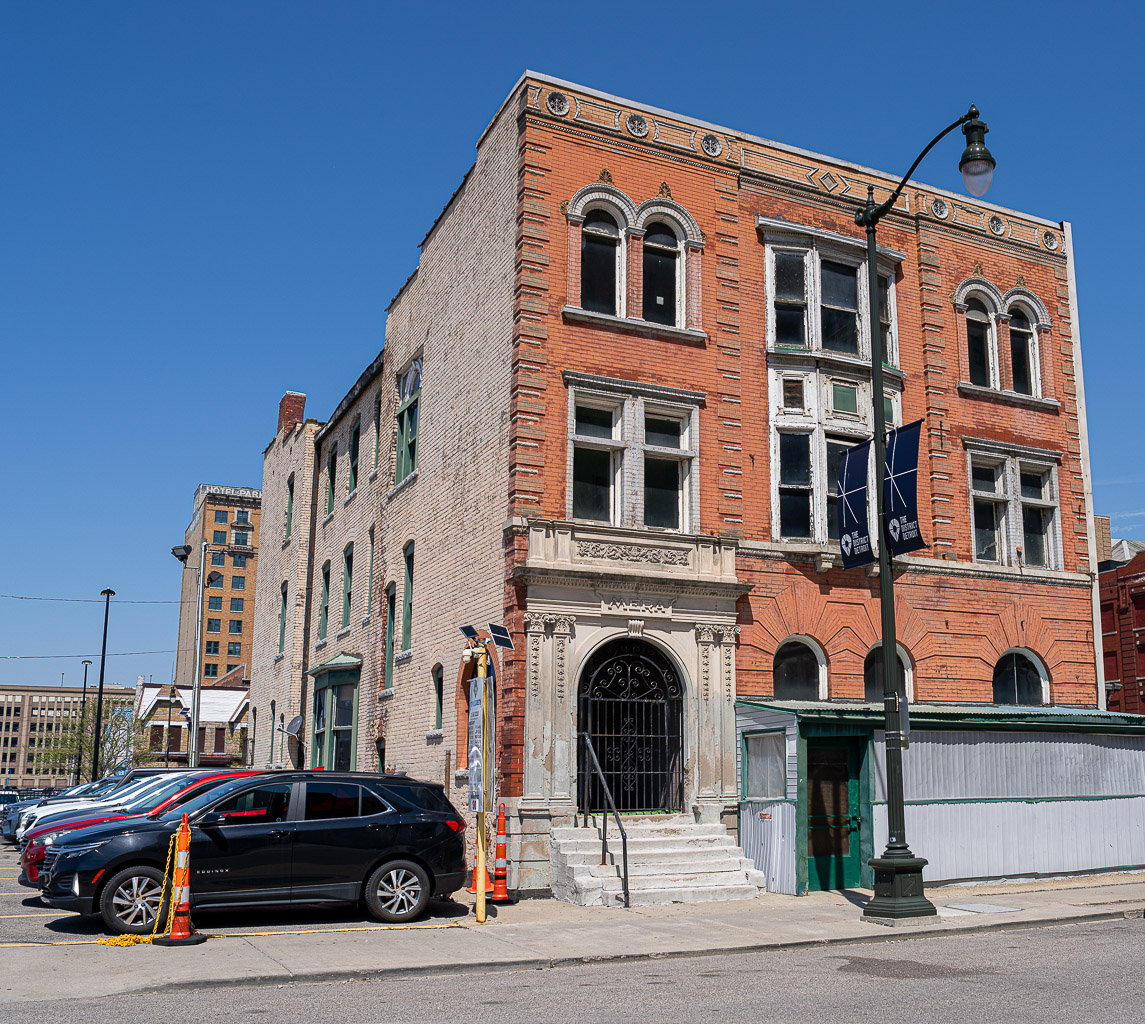
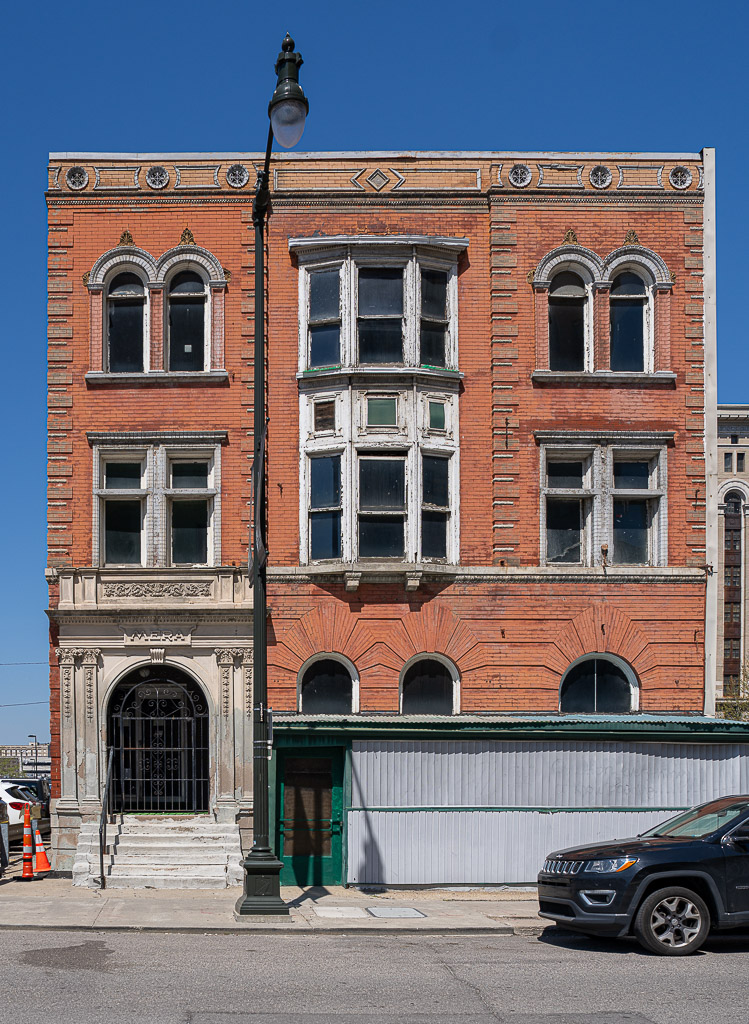
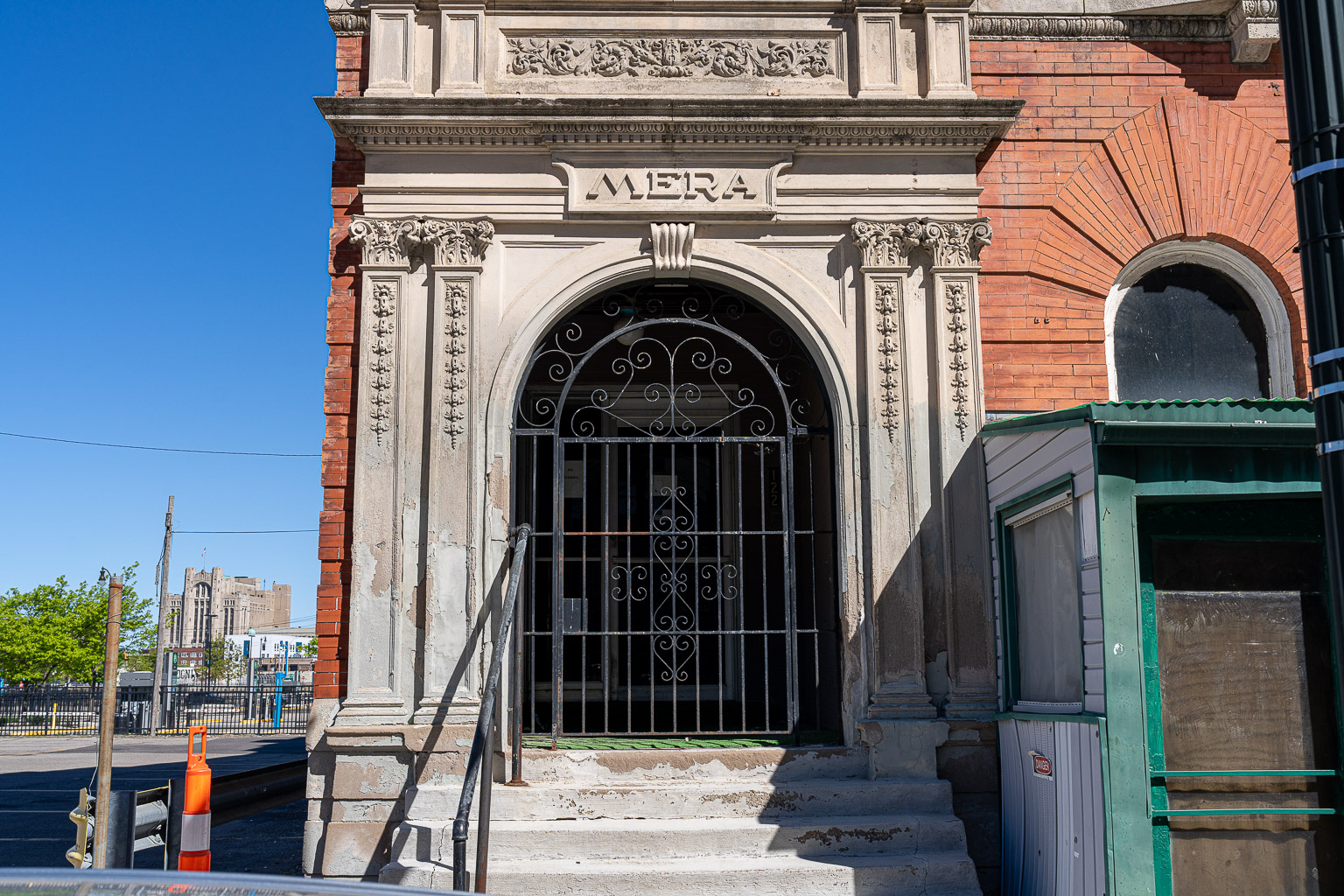
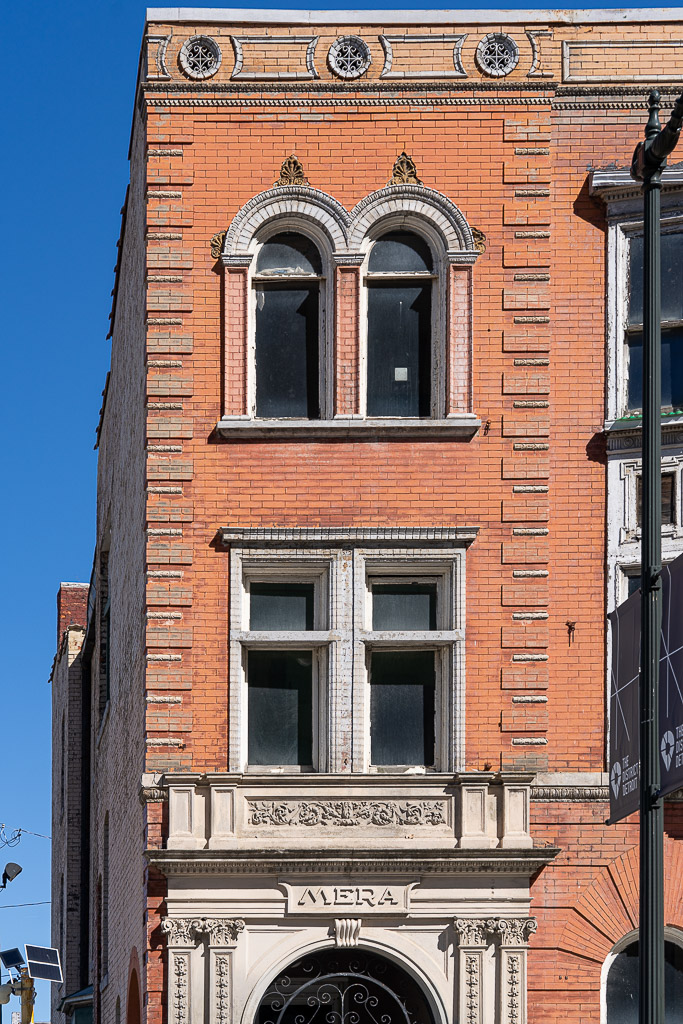
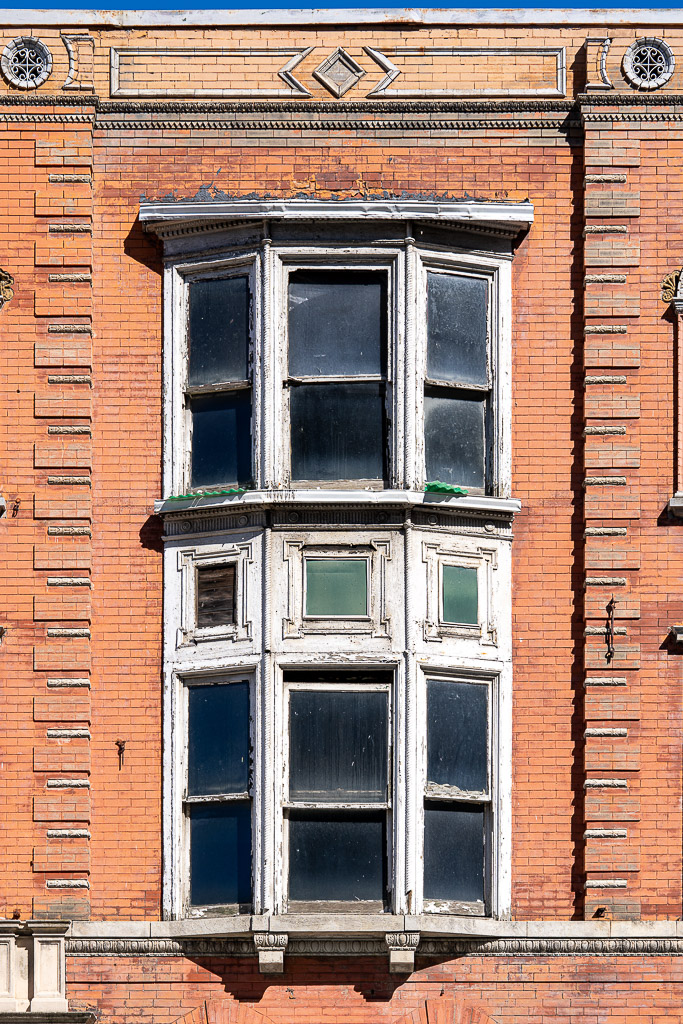
Permit #315 was issued to the architectural firm of Kastler & Hunter on April 13, 1898 for the construction of this three-story brick residential building, measuring 36' x 81' and costing $8,700. Colonial Revival in style, it features a rusticated first story with arched windows and embellished masonry entranceway, a two-story bowed window in the central bay of the front facade, and rondels in the parapet wall. W.E.N. Hunter, one of the architects of the nascent firm, went on to build a career in church design.
The MERA was a small residential hotel. It may have been built by Henry Bartlet, who died at age 75 in 1899. His wife, Amanda, is listed in the city directory as living there in 1900. Its permanent residents in 1905 were the two proprietors, Effie Howe, a widow and Kate C. Sias.
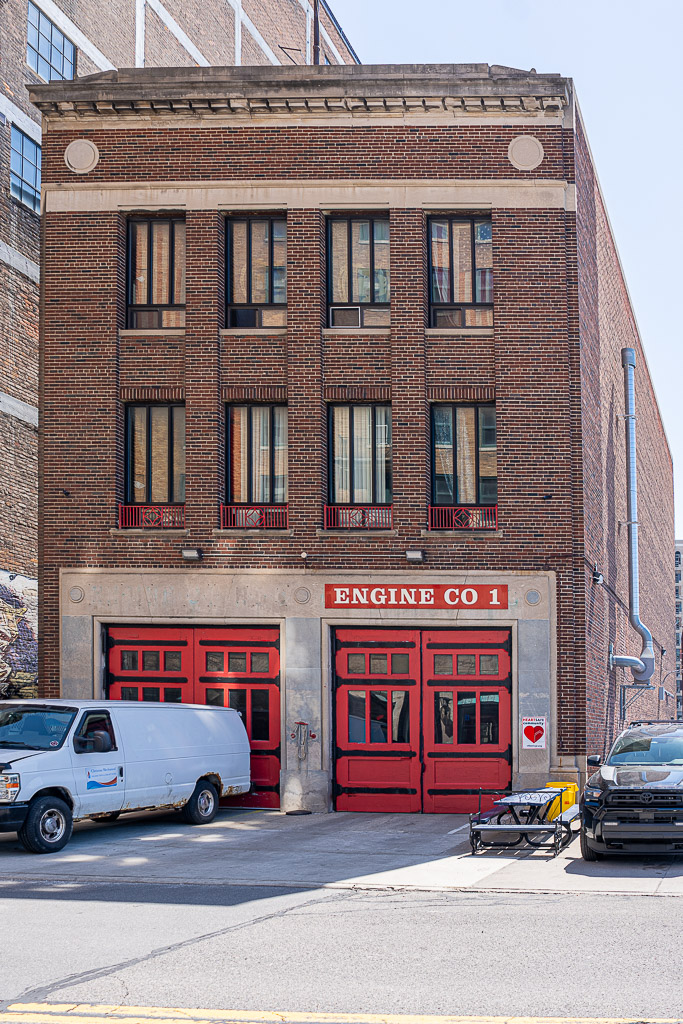
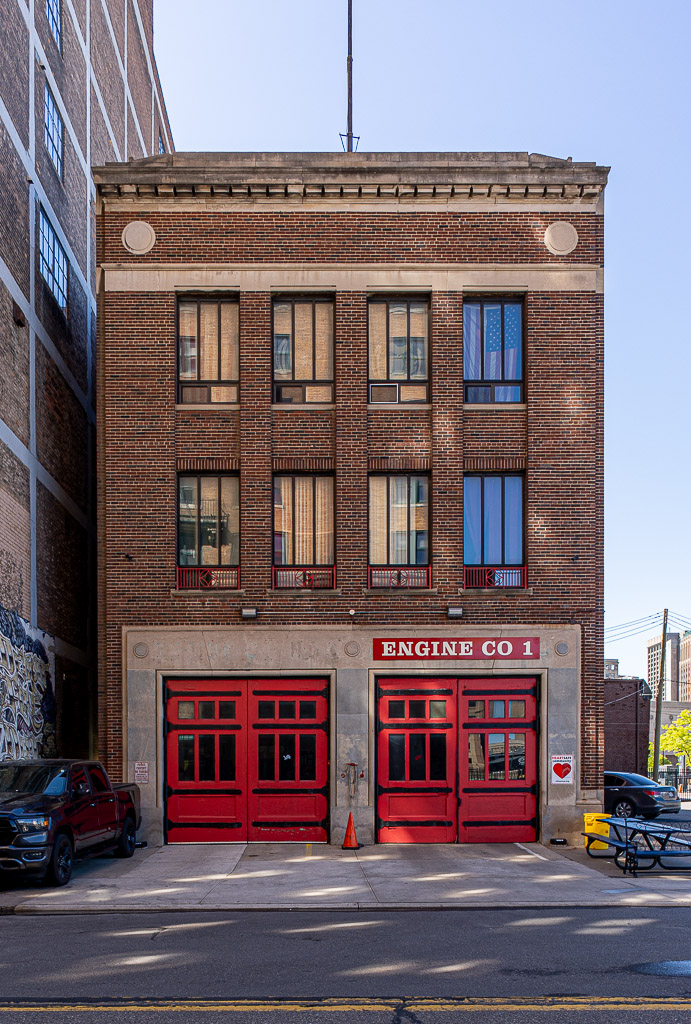
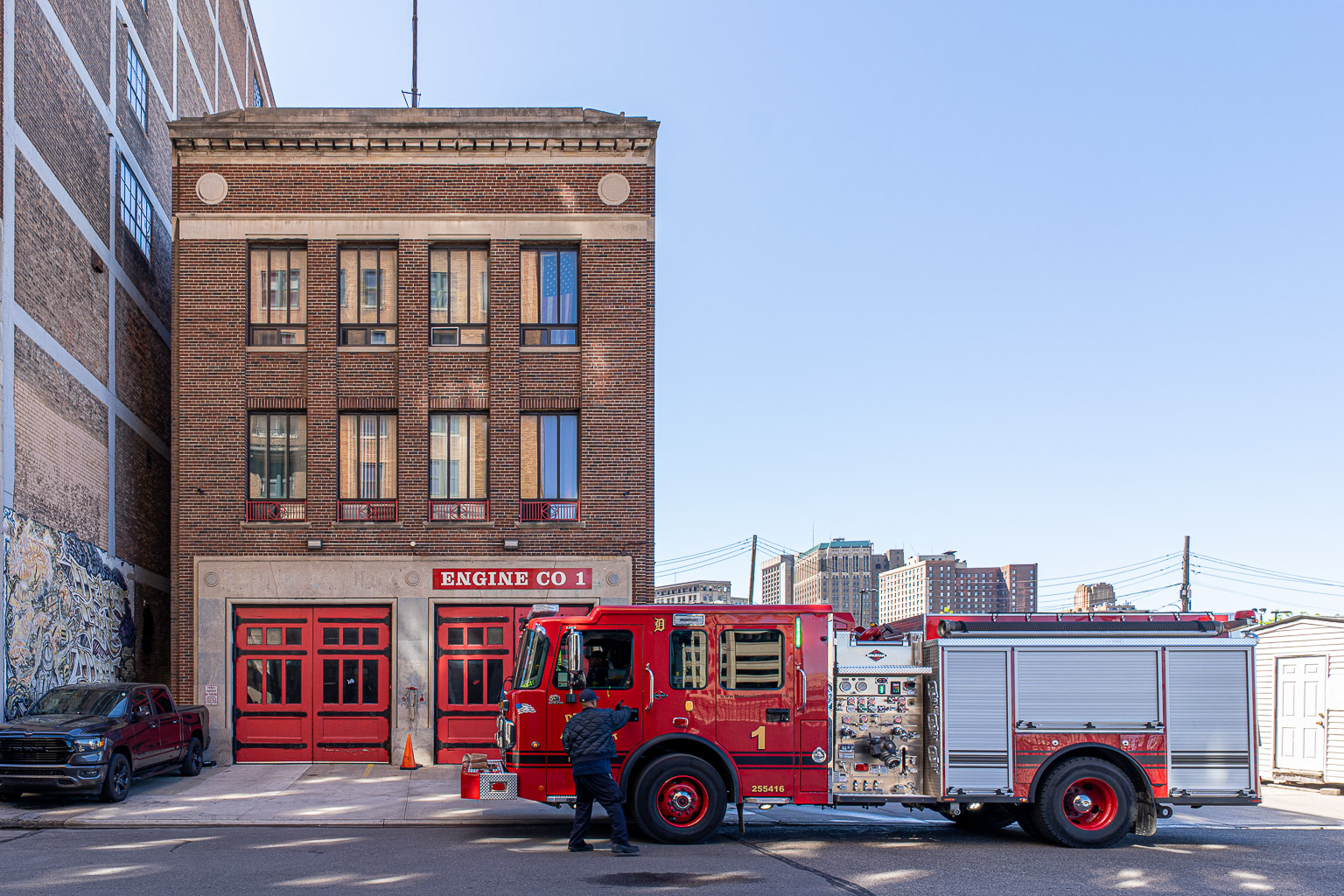
Just around the corner from the Wormer & Moore Building (Iodent Building) at 2233 Park Avenue and practically abutting it is a small-scale firehouse that is still in operation. It is contemporary with its neighbors, having been built in 1926 to provide fire protection to the growing, high-density community around it. Engine Company # 3, founded in 1861, and Ladder Company # 3, founded in 1881, moved here from Woodward Avenue and Clifford. The structure on West Montcalm was designed by Detroit architect Hans Gehrke, who received several commissions from the Detroit Fire Commission, including the five-story headquarters building on West Larned and Washington Boulevard, erected in 1929.
The firehouse is brick, is three stories tall, and has two large doors surrounded by stone frames. Its four bays above feature windows recessed between pilasters with blind rondels at the corners of its parapet wall. It still operates today as a Detroit fire house, with its sign naming it "Engine Company 1".