Parker House Local Historic District
The proposed Parker House Historic District is comprised of one building, at 975 East Jefferson, situated between the Automotive News Building and Lakeside General Hospital. It is located between the Chrysler Service Drive and Rivard Street, just east of the central business district. You can read details about the Parker House Local Historic District in the Proposed Parker House Local Historic District Final Report (local copy), which I recommend highly to anyone interested in Detroit's history.
HISTORY: [+ expand]
The Parker House at 975 East Jefferson (old number 433) is directly across the street from the Sibley House and Christ Church, and is partially obscured from view due to its position between the Automotive News Building and Lakeside General Hospital. Still, it stands out amongst its newer neighbors as a rare example of the Gothic Revival style of residential architecture surviving to the present day in Detroit.
Originally part of the Antoine Rivard Farm which was subdivided in 1841, Lot 1 was alotted to Catherine Rivard Bellair in that same year. Oliver and Catherine Rivard Bellair transferred this property to Armand Gibbs Carpenter in 1866 at a cost of $6,500. A year later, Carpenter sold it at a profit to Thomas Augustus Parker for $9,500.
T. A. Parker was born in Sacketts Harbor, New York into a family of ancient lineage in England. T. A. Parker came to Detroit in 1845 with his older brother, F. F. Parker, and together they formed F. F. Parker and Company on Woodward Avenue. They became very successful merchants in the wholesale grocery trade. In the meantime, Thomas Parker married Elizabeth Jane Maxwell, the daughter of a prominent Quebec banker, in 1853, and together they raised five children. Parker wisely chose to invest the bulk of his profits in real estate after his retirement from the wholesale grocery business in 1888. His holdings, according to the 1895 edition of the News-Tribune, were three stores on the north side of Jefferson between Brush and Beaubien Streets; the Desnoyer block of three stories on the northwest corner of Jefferson and Bates; a block on the northwest corner of Woodbridge and Bates, in which his son continued the wholesale grocery business; stores on the south side of Larned between Bates and Randolph; the cast-iron front Parker Block on the southwest corner of Woodward and State, which was occupied by Mabley, Harvey and Company in 1895, who paid rentals of about $16,000 a year; a store on the west side of Woodward Avenue just south of Clifford; his own residence on the north side of East Jefferson; sixteen small lots on Hale, Scott, Watson, and Illinois Streets on the Joseph Campau Farm; a valuable subdivision fronting on Jefferson and Van Dyke Avenues adjoining the old driving park on the west; and 160 feet of land on the north of Franklin Street between Hastings and Rivard, used by Christ Church. He was said to be worth $750,000 in 1895.
Gordon W. Lloyd (1832-1904) was commissioned by Parker to construct his residence on prestigious Jefferson Avenue in 1868. Lloyd, born and trained as an architect in England but reared in Canada, was predominantly influenced by northern Gothic architecture and English Victorian Gothic. He came to America in 1858 at a time when A. J. Downing was espousing his and his friend A. J. Davis' philosophies on the virtues of the Gothic villa, resulting in the romantic, asymmetrical appearance of residential architecture and landscape design that swept the country in the 1840's, 50's and into the 60's. Lloyd's propensity towards the medieval fit right in with this American architectural fashion. He received some early important commissions, among them Christ Episcopal Church on East Jefferson between Rivard and the former Hastings Streets in 1861, executed in the Gothic Revival style.
An early residential commission was the Alexander H. Dey house at 425 East Jefferson (old number, now demolished), erected in an English medieval style by Lloyd in 1862, one lot to the west of the future site of the Parker House, constructed in 1868. Another residence designed by Lloyd in the Gothic Revival style, the Sidney D. Miller house at 524 (old number) East Jefferson, was built in 1864 from limestone left over from the construction of the nearby Christ Church. Both Lloyd's stone eclesiastic and residential structures project a sense of monumentality although they may be modest in scale.
Parker and Lloyd's association did not end with the Parker House, for in 1883 Parker employed Lloyd to design the Parker Block at the southwest corner of Woodward and State, now the last cast-iron facade building in Detroit. Better known as the B. Siegel Company, the Parker Block has been a landmark for generetions of Detroiters, as has Parker's house, one of the oldest freestanding mansions on East Jefferson.
Parker died in Detroit at the age of 78 on April 27, 1901. At the time of his death he was president of the Detroit Range Boiler Company and had extensive real estate holdings. His heirs, Charles M. Parker, Arthus M. Parker, Edward H. Parker and his wife Eleanor, transferred the property at 975 East Jefferson to Julia Parker (1865-1936), T. A. Parker's daughter, in June of that year. Elizabeth Parker, wife of the late Thomas, passed away in 1904, the year that a memorial organ was presented to Christ Episcopal Church by the Parker family. Julia Parker, listed as secretary of the Parker Estate Company, Ltd. in the city directories, resided in the house for many years after her father's death, but leased it to the Advertisers Bureau and moved to 1764 Seminole in Indian Village in 1920. Julia, the last surviving child of Elizabeth and Thomas, was active in charity work and was a member of the Board of Protestant Orphan Asylum for fifteen years.
The house was sold to the Bureau Building Company in 1928; the Bureau Advertising Company and Russell Legge, artist, continued to occupy it. In 1927, the interior had been altered to better accommodate the art studios and offices. The First National Bank obtained the property in 1937; in 1939 it was sold to Herman F. Scharfenberg and Joseph Faust, who, in 1943, converted the commercial building into an apartment building and art studio. Another major change in occupancy came in 1957, when the Parker House was converted from an art studio and eight apartments to offices, a reading room and a hospital record room and four apartments. Doors to the adjoining hospital building were installed at that time.
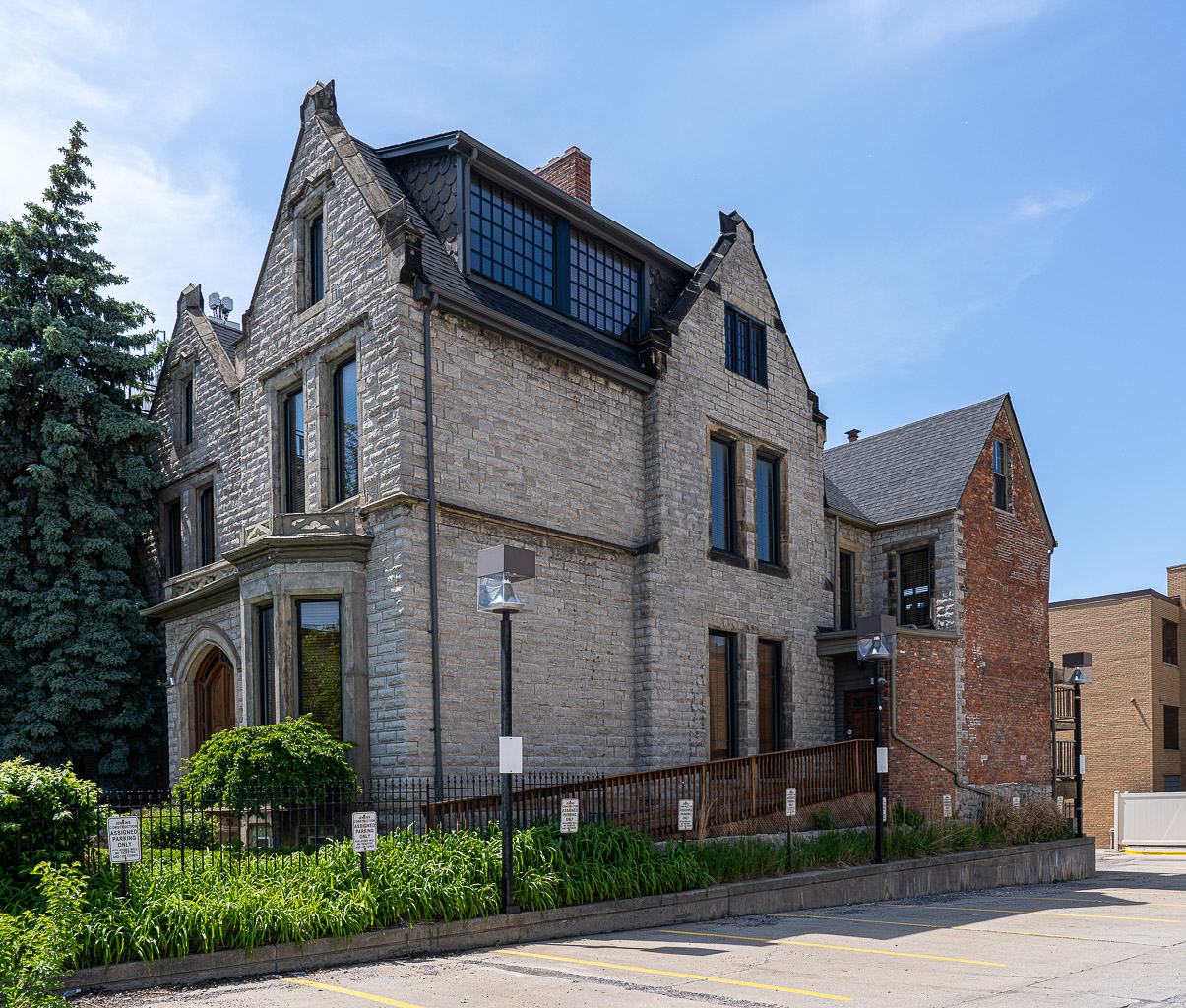
PHYSICAL DESCRIPTION: Only the front of the Parker House, or southern facade, facing Jefferson Avenue is visible from the approach on Jefferson Avenue due to the Automotive News and Lakeside General Hospital buildings abutting its sides.
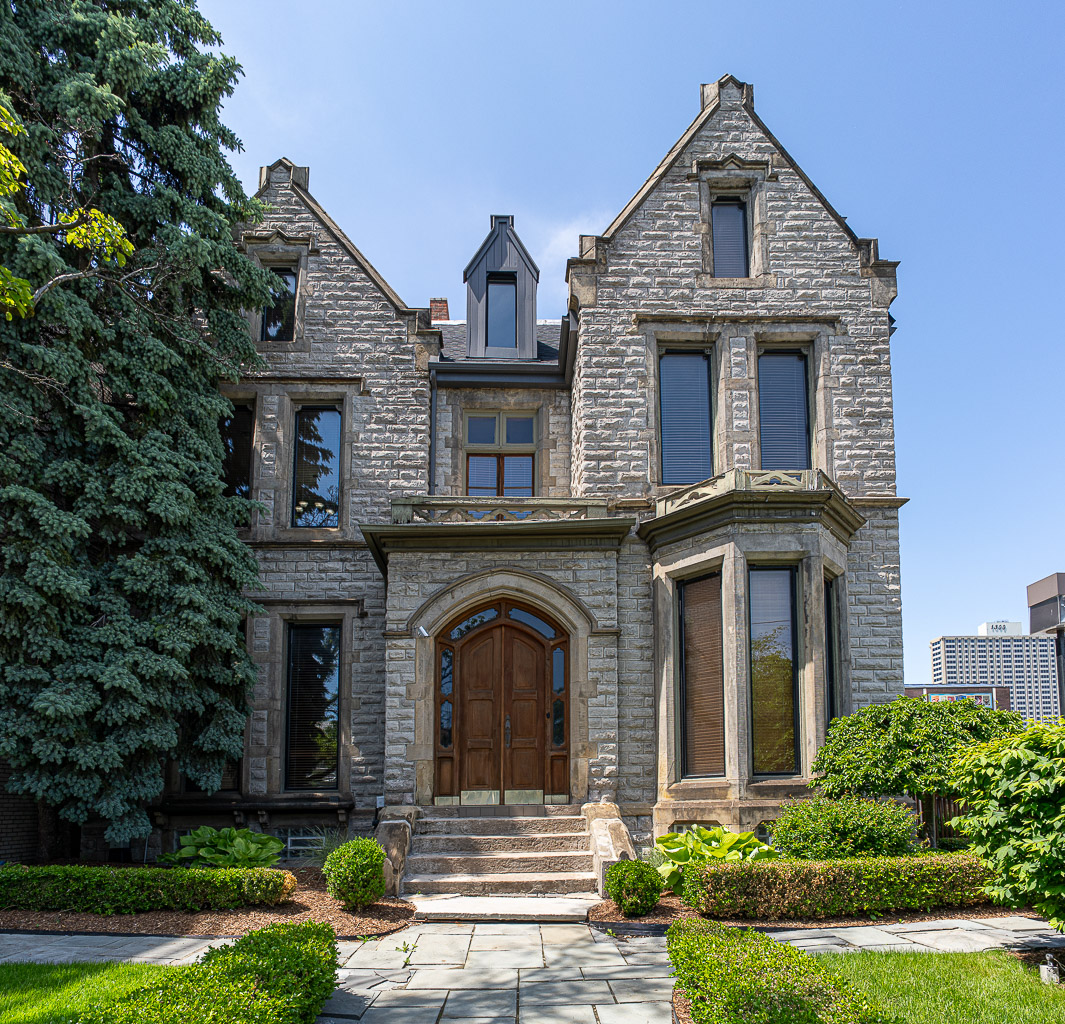
The Parker House, constructed in 1868, is a well-built, substantial building along Jefferson Avenue, once one of Detroit's most prominent thoroughfares. Gordon W. Lloyd, the architect of the Parker House, chose local Kelley Island limestone as the primary material for the two and one-half story residence, a material used extensively for church buildings. In fact, the house presents an interesting study given its location directly across the street from Lloyd's Christ Church, a building of near date (1861) and similar style.
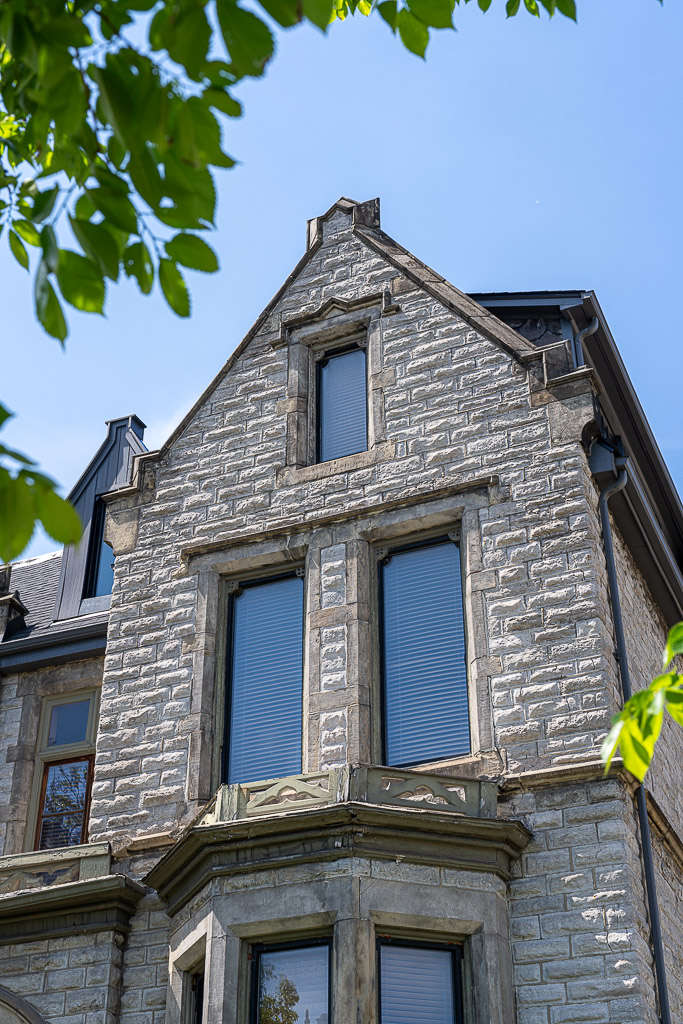
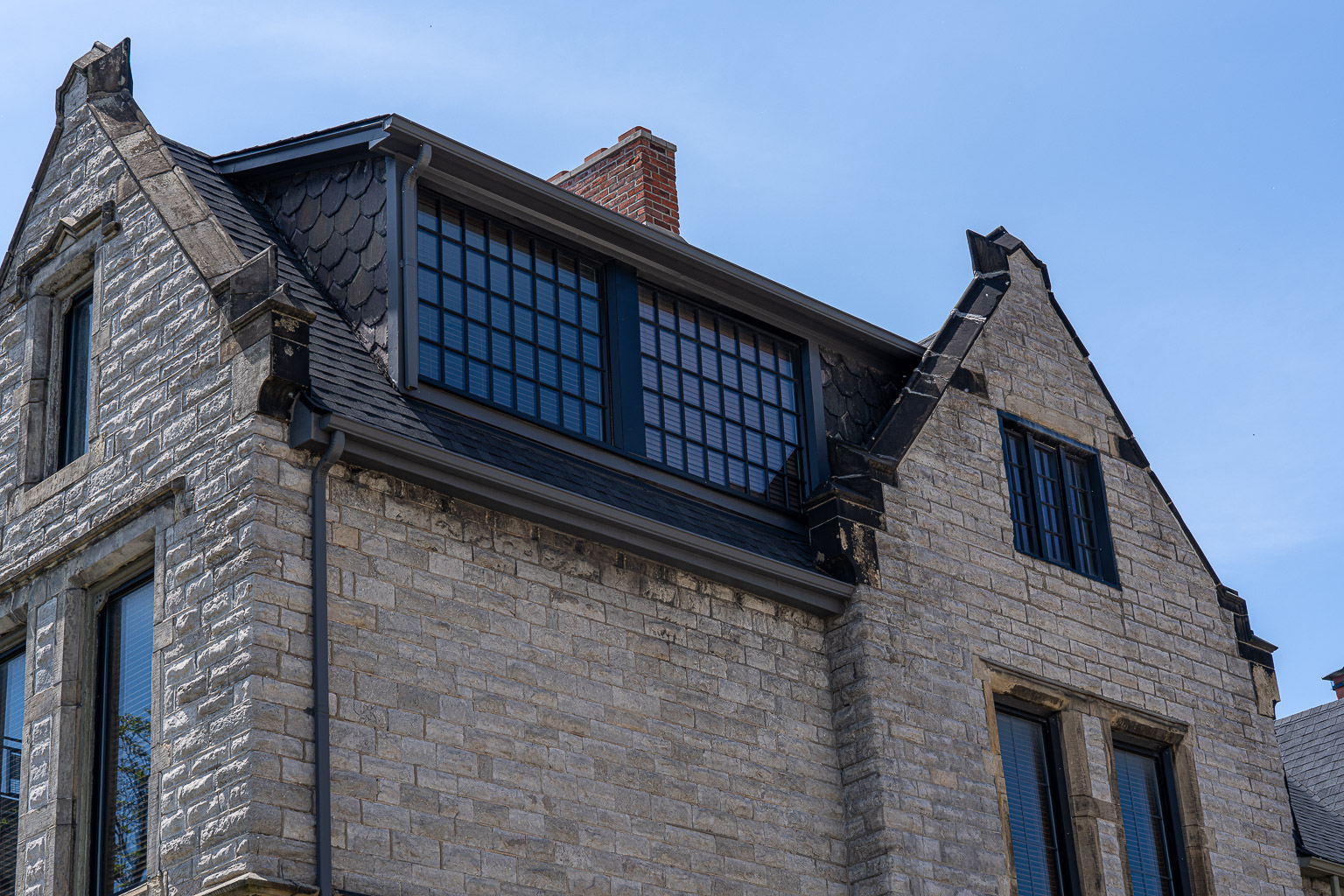
The Parker House is in the Gothic Revival style. It is divided into three bays, with double transverse gables over the east and west bays facing the street. Each gable is punctured with one double hung sash window with a hood moulding above. The facade is asymmetric in design. The east bay exhibits a first floor three-sided bay window with a decorative parapet above. A Tudor arch opening with double doors, transom, and sidelights conforming to the arch shape comprise the entranceway in the central bay. Double French doors lead onto a balcony with a decorative parapet above the entrance, on the second story. The west bay, projecting less than the east bay of the facade, has one pair of windows per floor; the second story of the east bay also has a paired window. The central bay is surmounted by a slender gabled dormer. The Parker House originally had iron cresting on the ridges of its imbricated slate-covered hipped roof. The front facade of the building has remained remarkably intact.
An early two and one-half story brick rear addition to the Parker House now has a three-level porch and staircase attached, which serves as a fire escape.
The interior of the Parker House has been remodelled several times throughout its one hundred-plus years history; it had seen single family, multi-unit residential, office, and studio usage over the years. Its tall ceilings, decorative cornices, and other particular details and original proportions have been restored.