Sidney D. Miller School Local Historic District
Sidney D. Miller School is located at 2322 Dubois Street. You can read details about the Sidney D. Miller School Local Historic District in the Sidney D. Miller School Local Historic District Final Report (local copy), which I recommend highly to anyone interested in Detroit's history.
HISTORY: [+ expand]
Public Schools were not established in Detroit until 1837, when the common council requested that the city attorney investigate steps necessary for the establishment of public education. Under the direction of Henry Chipman, John Farmer, and James F. Joy, who served as school inspectors, the city began to enforce the state’s educational provisions, which included the establishment of a school for each of the city’s wards. Unfortunately, poverty prevented the establishment of schools in some of the city’s poorest sections.
At the time when racially segregated schools were the practice and policy of the Detroit School system, Miller School came to represent the best of the city’s African American community. The legacy of Miller School is as much about Detroit’s emerging African American community as it is about the school itself. Miller School is among the few remaining buildings associated with the city’s early African Americans and the neighborhood they grew up in.
In the late nineteenth century Detroit experienced a massive immigration of Eastern Europeans moving into the city. Many of these newly arrived immigrants initially moved into the area east of downtown. By the turn of the century, the foreign-born residents and their children far outnumbered the number of native-born residents in almost every large American city, including Detroit. From the 1880s through the early 1900s the area east of St. Antoine Street served as the "port of entry and a stopping place for much of the city’s foreign born." By 1910 Detroit’s lower eastside neighborhood had become the most populated and ethnically diverse section in the city, with German, Polish, Italian, Greek and later, Russian Jewish immigrants living side by side in this overcrowded, ethnically diverse community. By the 1920s, Detroit had become the fastest growing city in the country; and by 1930 it was the fourth largest city in America. The majority of Detroit newcomers came to the city in search of jobs and opportunity. At the beginning of World War I, foreign immigration in Detroit had slowed while the migration of African Americans accelerated. The city’s population increased from 725,064 to 1,426,704, between 1910 through 1920 no less than six high schools and several "junior high" schools were built to accommodate Detroit’s phenomenal population growth.
In 1918, ground was broken for Miller Intermediate School. The new building was to be located on the city’s lower eastside at the corners of Dubois and Jay Streets. Miller was to service as a feeder school to address the increased number of students matriculating from Bishop, Bartow and Duffield the three elementary schools in the area. The school was to be initially named Dubois, primarily because of its location on Dubois Street. However, while under construction, there was much talk about renaming the school after the late Sidney D. Miller, a successful Detroit attorney and businessman. At the February 13, 1919, school board meeting, board member John S. Hall moved that the Dubois School be renamed Sidney D. Miller Intermediate (Junior High) School. Board member Samuel Mumford helped to support Mr. Hall’s recommendations and in a quick ballot, the entire Board agreed unanimously to effect the name change. The February 17, 1919 Detroit Board of Education minutes indicated that Sidney T. Miller, son of Sidney D. Miller was notified of the Board’s decision. He responded a few days later in a letter addressed to the board:
Many thanks for your February 17 informing me that the junior high school building being erected at Dubois and Jay Streets is being named in the honor of my father. Our family highly appreciated the consideration shown and would be glad to evidence their appreciation in some way, at a fitting time.
Sidney D. Miller graduated from the University of Michigan in 1848 and graduated from the Harvard University in 1851, with a degree in law and he was admitted to the bar in Detroit one year later in 1852. During his early career Miller held several prominent positions with a number of successful businesses in the city. He served as vice-president of the Eureka Iron and Steel Works; director of the Detroit Savings Bank (1884-1903) and president of the Detroit College of Medicine and Surgery (1883-1885). Sidney D. Miller also held several public offices including U.S. Commissioner for the Eastern District of Michigan, Detroit Board of Education (1864-65, 1869-1870); and president of the Detroit Police Commission and Detroit Health Commission (1876-1879, 1886).
The partially completed Miller School opened its doors in April 21, 1921 to 664 students as the first regular intermediate school built in Detroit. Construction was delayed as plans were revised several times before the building was finally completed. By the fall of 1921, enrollment at Miller had increased to 868 students with 41 teachers. When the building’s eastern wing was completed in 1922, it brought the building’s student capacity to 1,700. An addition including a girls’ gymnasium was completed in 1931 at a cost of $88,651. Benjamin A. Nolan, former principal of Newberry and Norvell Schools, was appointed Miller School’s first principal, a position he held until his death in 1925. In 1928 the number of elementary schools that fed into Miller Intermediate School increased from two to eight and included; Bronson, Everett, Washington, Capron, Roberts, and Jackson ( all demolished) which added to the further overcrowding at Miller School.
By 1930 Detroit’s population had more than doubled from the previous decade from 1,426,704 in 1920 to 2,325,739. At the same time school enrollment grew at an even greater rate than the population as a whole, from 95,000 in 1918 to 255,000 in 1932. High school students accounted for the largest share of this increase, growing in numbers from 9,036 in 1921 to 25,542 in 1929. However, population growth alone did not account for the total growth in high school enrollment. In the span of a single decade, secondary education went from being a privilege enjoyed by a minority to being a commonplace occupation for teenage children. Miller was designated a high school in 1933, and graduated its first class in June, 1935. At this time, the demand for secondary education was increasing and nearby high schools such as Cass Technical, Northeastern, and Eastern were at capacity.
Miller "Detroit’s Black High School" 1934-1957
In 1839 a law was passed which enabled the city to organize a separate school for the "negro children." Although a "colored" school was established in district eight for the city’s African American community, no monies were appropriated to pay a teacher. In 1840, the Board of Education hired Reverend William C. Monroe, pastor of Second Baptist Church, Detroit’s oldest African American congregation. Thus, a separate school was maintained in the church for the city’s African American children until 1869 when the African American community petitioned the school board for equal access to the city’s public schools. When this failed they took their fight to the State Supreme Court, which decided that African American children had a right to admission.
According to the U.S. Bureau of Census Detroit’s African American population had grown from 5,741 to 82,000 by 1925. The African American community grew quickly as the city’s booming auto and manufacturing industry attracted a flood of workers from south. By 1915, Detroit’s African American population had more than tripled. Restrictive covenants, real estate codes and racial segregation forced African Americans into the thirty block portion of the east side neighborhood known as the "St. Antoine District." The area was originally known as "Black Bottom" for its rich soil; the term soon became associated with its African American residents. By 1922 African American children comprised 5% of the total enrollment in the public schools. African American children were the fourth largest ethnic group in 33 of 141 elementary schools in the city. They comprised 15% of those who attended Miller Intermediate School but were only 4% of Detroit’s elite high school, Cass Technical School.
Although segregation in the state’s public schools had been illegal since a Michigan Supreme Court ruling in 1870, discriminatory policies on the part of the Detroit Board of Education established an informal system of discrimination. By the mid-1930s Detroit’s school system had become racially segregated. Even though Detroit school and public officials maintained that there was no policy favoring segregation, many of the formerly integrated schools of the 1920s and early 1930s had become predominately African American. The city’s African American community believed that the public schools were again becoming racially segregated, especially in 1933 when the board decided to transform Sidney Miller Intermediate School into a high school. As a junior high school Miller fed into Eastern High School, which was integrated and overcrowded. The neighborhood surrounding Miller had become predominately African American, restrictive real estate covenants prevented blacks from moving elsewhere. The Board established a liberal policy for the few white students and their parents still in the area who wished to transfer to Eastern or a different high school. This had the effect on concentrating African American students at Miller High School while white students attended elsewhere.
While the Detroit Board of Education justified the creation of the new high school, for the African American students in the area. Detroit’s African American community had no illusions about why the school board had created Miller High School. The importance of race in the board decision was underscored by the fact that, despite the overcrowded conditions of all the high schools in the city, no other "intermediate" school was elevated to senior high status. The African American community was equally aware of the gross inequalities between Miller and other high schools in terms of resources and facilities. They were determined to make Miller High School a success despite the school board policy of segregation and inequality. Miller became a symbol and rallying point for the city’s African American community. They demanded excellent educational leadership and high expectations on the part of teachers who taught at Miller. During the 1934 school year, a delegation of African American leaders and parents routinely attended school board meetings demanding the Board assign African American teachers to Miller School. In the fall of 1935, the first African American teachers were assigned to Miller: Lloyd Cofer, Social Service Counselor; Edward A. Benjamin, Health; and Alvin Loving, English. Miller was accredited by the North Central Association of College and Secondary Schools in 1936. In 1942, Charles Daly became the first African American principal assigned to Miller. Daly is credited with introducing African American studies into the basic curriculum of Detroit public schools. Miller soon became known as the "Detroit Black High School," and more importantly as one of city’s preeminent high schools. Miller served as a high school from 1934-1957. At which time it gained the reputation of an academic and athletic powerhouse that outperformed many white schools. During the twenty-four years that Miller was a high school its goal was to maintain high standards in order to assure that the students received a quality education. The school divided the curriculum into three separate educational tracks. It included a college preparatory, commerce and general studies curriculum. By 1947 Miller was so academically successful that a large percentage of its graduates went on to become successful in their chosen professions.
Miller High School was credited with many years for educating more African American professionals than any other high school in Detroit. Miller High produced a myriad of educators, musicians, and athletes, as well as leaders in the field of science, human services, medicine, and law. Notable graduates and former students include individuals such as Zeline Richard, former leader of Detroit Federation of Teachers and the board of New Detroit; Dr. Cloyzelle K.D. Jones, educator and author of "Historify of Miller;" Melvin Chapman, former administrator Detroit Public Schools; and Ofield Dukes Jr., media advisor to Vice President Hubert Humphrey. Miller also produced nationally known political and civic leaders including Coleman A. Young, Detroit’s first African American mayor; Charles Diggs, Jr., first African American congressman elected from the State of Michigan; and Erma Henderson, first African American women on the Detroit City Council. Miller dominated interscholastic sports in the city and launched the careers of Lorenzo Wright, Olympic gold medallist in track; Eugene (Big Daddy) Lipscomb, player in the National Football League; Charles Primus, College All-American and member of the Harlem Globetrotters; and William Robinson, first African American Division I basketball coach. Miller School’s music program helped to nurture the talents of jazz musicians Kenny Burrell, Milt Jackson, and Yusef Lateef; as well as the classical talents of Brazil Dennard.
Unfortunately, the success of Miller High was bittersweet: it did not change the blatant segregated racist policies by the school board. The African American community continued to monitor the school system and in November, 1947 the Michigan Chronicle ran a month long series on African Americans in the Detroit public schools. What they found was that there had been no improvement for fifteen years and overcrowded, segregated, under funded African American schools remained the same or worsened. In 1948 a group was formed to end segregation in the Detroit Public Schools. Seven years later in 1955 de-facto segregation of Detroit Public Schools ended. Two years later in 1957, Miller High School was re-established as Miller Middle School.
The long legacy of Sidney D. Miller School is distinguished and has brought significant benefit throughout the State of Michigan. From its inception, Miller School served the students who resided on the lower eastside of Detroit, transforming literally thousands of students into productive citizens. It is also significant for its association with the educational uplift and enrichment of Detroit’s African Americans from 1932 until 2007 when the Detroit School Board closed the building. The value of the history and important legacy of Miller High is remembered by the members of the Miller High School Alumni Association who continue to reunite on the second Sunday in August for their annual picnic. The event draws approximately 5,000 people who spend the weekend reminiscing about their time at Miller School on the school campus.
During the "urban renewal" period of the 1950s and 1960s, all of the residential buildings located in the "Black Bottom" area were demolished. Three of the buildings spared were schools: Miller School, Nellie Leland School, and Duffield School. Miller School remained opened until 2007 when the building was vacated and closed.
Architects & Architectural Description
Miller School was designed by the Detroit-based architectural firm of William G. Malcomson and William E. Higginbotham. The firm established themselves as specialists in school architecture and served as the consulting architects for the Detroit Public Schools between the years 1893-1923. They were instrumental in redefining the design of the urban school building to reflect the new educational and social functions assumed by the public school system of those decades. Central High, now Old Main at Wayne State University (1896), Rose School (1896), Maybury School (1910), and Carstens (1915) are among the notable school buildings designed by the firm for the Detroit Public Schools.
Constructed in the years 1919 to 1921, the school was originally surrounded on all sides by a neighborhood of single-family and two-family homes. However, the physical character of the surrounding area has since changed significantly. Originally, Miller School shared its block with Johnson School, an elementary school, as well as several detached homes on the eastern third of the block. The other buildings on Miller School’s block were razed in the 1920s to allow for additions to the building and creation of a school playfield. During the "urban renewal" of the late-1940s and 1950s, homes on all sides of the school were razed to allow the creation of the municipal St. Aubin-Waterloo playfield to the south and west, less-dense residential townhomes to the north and east, and a widened Chene Street. Presently, Jay, Dubois, and Waterloo Streets have been vacated and are no longer open for vehicle use. Waterloo Street retains its brick paving, while the other streets are paved with asphalt.
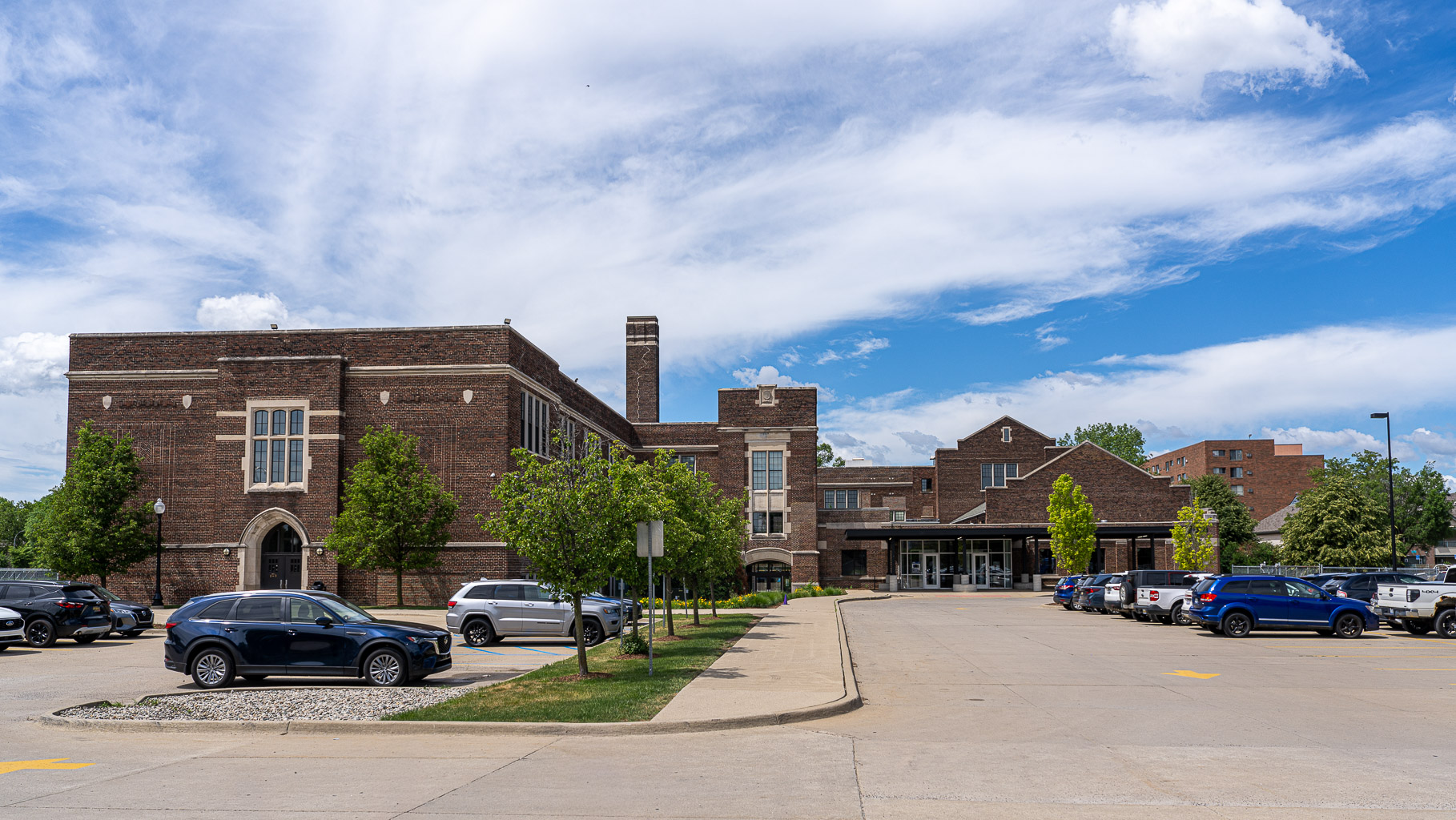
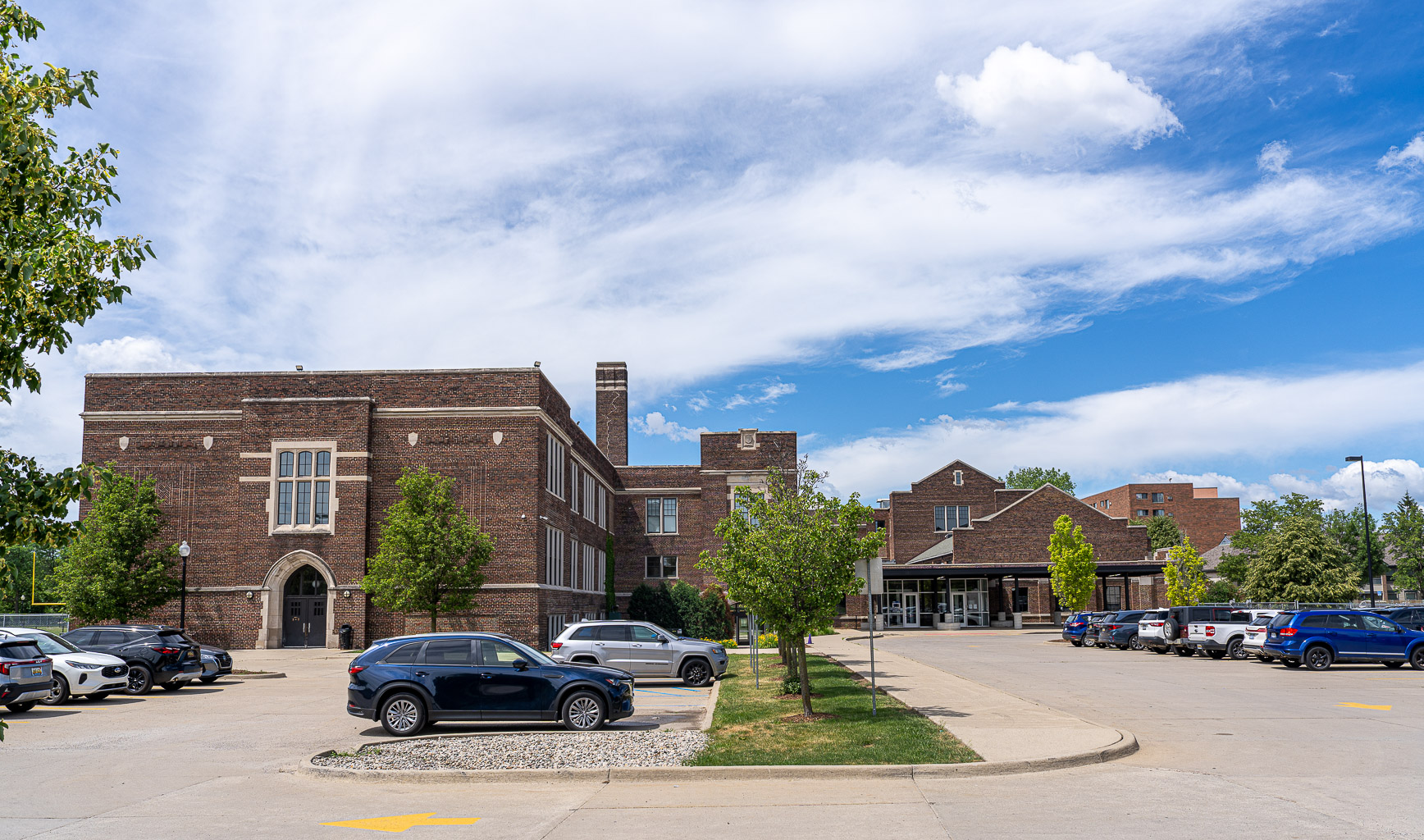
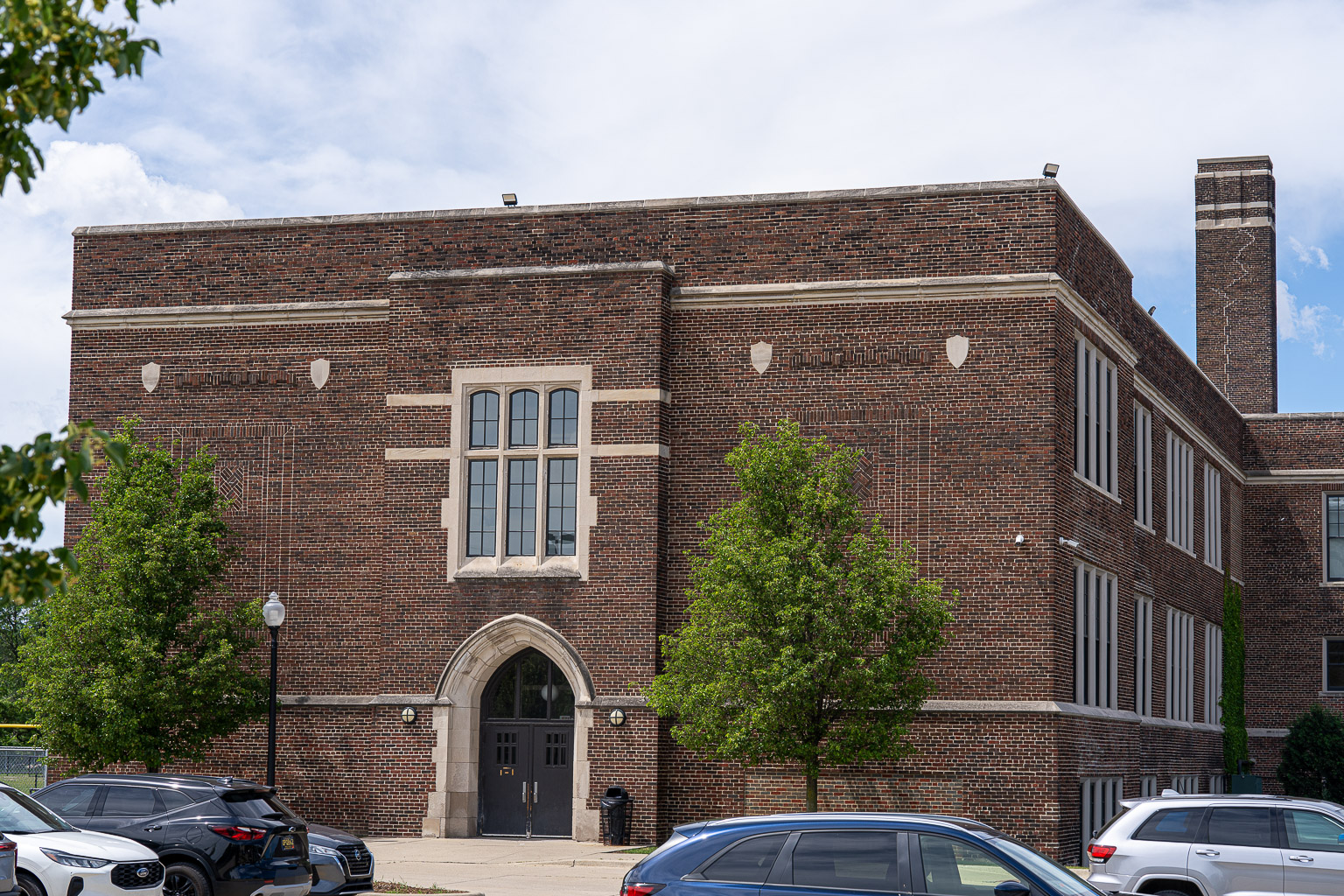
The western two-thirds of the block are occupied by the school building, facing west onto DuBois Street. The flat-roofed, collegiate Gothic brick building is, for the most part, two and a half stories in height. The building is situated about fifteen feet from the street, its shallow setback a reminder of the school’s prior relationship with a densely-populated residential neighborhood which no longer exists. The building’s current configuration, occupying a rectangular footprint and enclosing a central courtyard, is the result of several additions. Originally, Miller School building occupied an L-shaped footprint. The original portion of the building, completed in 1921, is two stories tall, sitting on a high, windowed basement, and features a flat roof over a majority of its area. It is clad in brown common-bond brickwork with masonry trim. It façade (west elevation) is asymmetrical, and articulated into eight bays. Much of the façade is pierced with evenly spaced bays of four windows each, while the third bay (from the north) contains only two windows per floor, adding to the asymmetry of the façade. All of the building’s windows are recent anodized aluminum replacements, and are not presently visible from the exterior due to a covering of protective steel panels. At the north end of the façade is a prominent front-gabled auditorium, gymnasium, and dining hall wing, which projects forward (westward) toward DuBois Street and extends rearward (eastward). Its tall first floor, featuring a high-ceilinged auditorium space, is lit by a projecting, flat roof bay window, topped by a stone decoration suggesting a balustrade. It upper level, housing a dining room, is lit by a large Gothic-arched window. Paired brick buttresses anchor the sides of this projecting section, while a triangular parapet extends upward highlighting a gable roof which exists on this portion of the building only. The building’s fifth bay (from the north) contains the main entrance. Located slightly south of center, it is recessed, two steps above grade, within a Gothic-arched, buttressed, stone surround one and a half stories in height. Protective steel panels presently obscure the doorway itself from view. The words "SIDNEY D. MILLER JUNIOR HIGH SCHOOL" are displayed above the entrance in raised, bronze, serif capital lettering. Beneath these words, the words "AD 1919" exist in relief in Gothic script. Centered directly above the entrance at the roof level is a stone panel depicting a shield decoration. The entire entrance bay projects slightly and is highlighted by stone quoins. Directly south of the entrance is a three-sided projecting, quoined bay, also topped by a stone decoration suggesting a balustrade.
The north elevation of the building’s original section is five bays wide. The bays of windows are separated by buttress-like piers of brick with stone trim. The first floor features tall, mullioned windows surmounted by relieving arches of brick and stone trim. The westernmost bay features a projecting, flat-roofed, single-story entrance pavilion. Its doorway is recessed within a Gothic-arched stone surround, three stone steps above grade, and flanked by brick buttress-like piers.
The south elevation of the 1921 section is five bays wide, its outermost bays projecting slightly. At the west end, an unfenestrated section of wall features two shield-shaped stone panels at the second floor level. To its east, an entrance sits three stone steps above grade within a Gothic-arched stone surround. It is surmounted by a rectangular, mullioned window lighting an interior stairwell. Both the window and door surround are flanked by stone tabs. The remaining bays feature rectangular window openings.
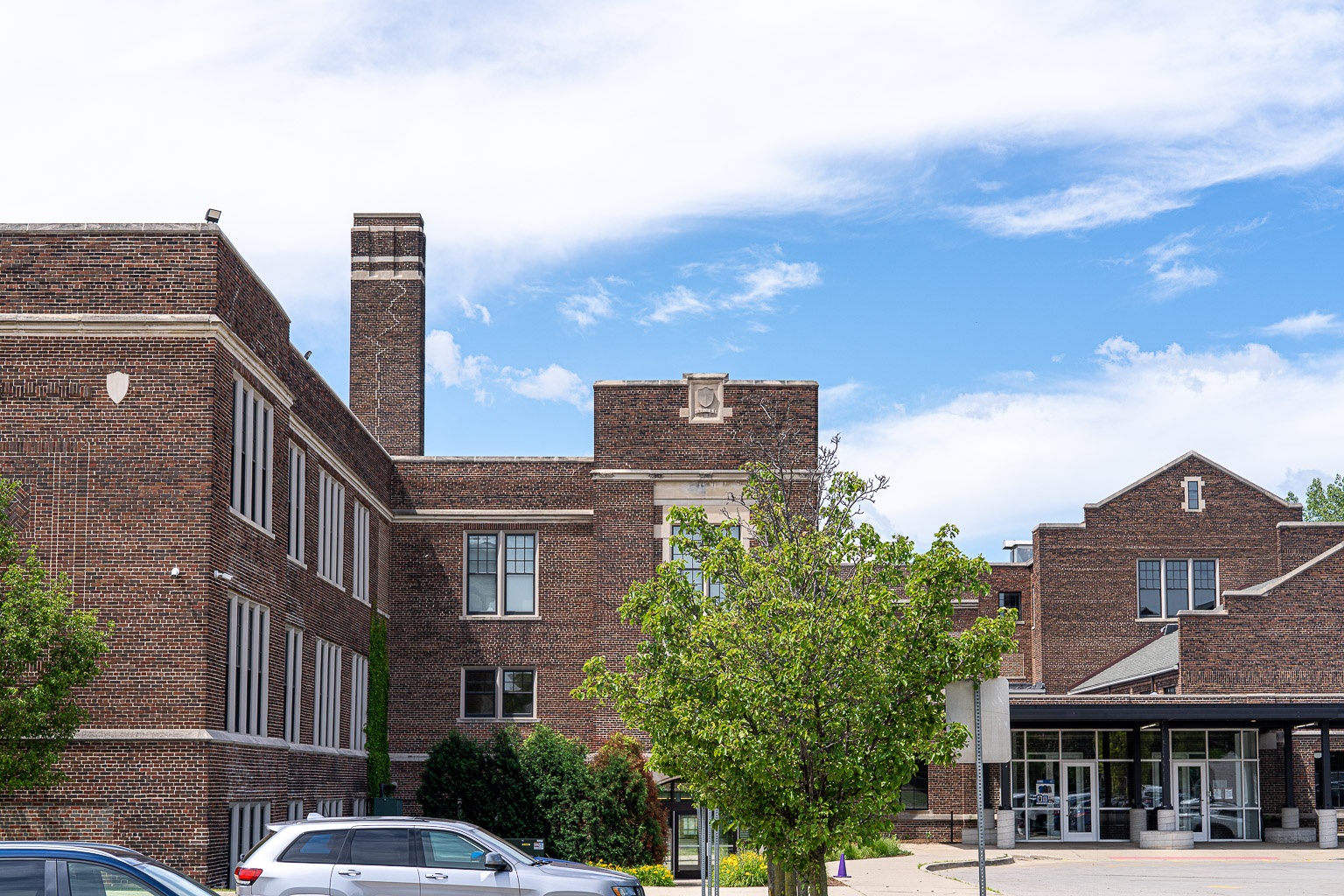
A single story portion of the building, containing a boiler room, is no longer visible from the exterior due to later additions to the structure. A rectangular, brick smokestack rises from this section, embellished near its top with subtle setbacks and four light-colored stone belt courses.
A 1931 addition expanded the building further east, adding a gable-roofed gymnasium directly east of the building’s auditorium, and lengthening the building’s south elevation with additional classrooms. A secondary, south façade crated by this addition features a two-story, asymmetrical, projecting entrance pavilion. It contains an off-center Gothic-arched doorway, four stone steps above grade, and masonry details including quoins, tabbed window surrounds, and a stone panel featuring a shield decoration on the upper story. A parapet wall above features blocks of stone interspersed with brick, creating a checkerboard pattern.
A smaller, single-story addition, added in 1951, completes the building and results in the enclosure of a central courtyard. This addition features evenly-spaced bays of windows and, while it is less elaborate in architectural detail than the earlier portions of the structure, its brick work and stone trim match the building’s 1921 and 1931 sections.
On the eastern end of the block, the school’s former playfield is now a patchwork of asphalt, concrete, and gravel. Miller School was closed and vacated in 2007, but remains in good condition and retains a high degree of historic integrity.
When I visited the school on June 15 2026, school was in session and I stayed outside the security fence to only get photos from afar.