St. John's - St. Luke Evangelical Church Local Historic District
You can read details about the St. John's - St. Luke Evangelical Church Local Historic District in the St. John's - St. Luke Evangelical Church Local Historic District Final Report (local copy), which I recommend highly to anyone interested in Detroit's history.
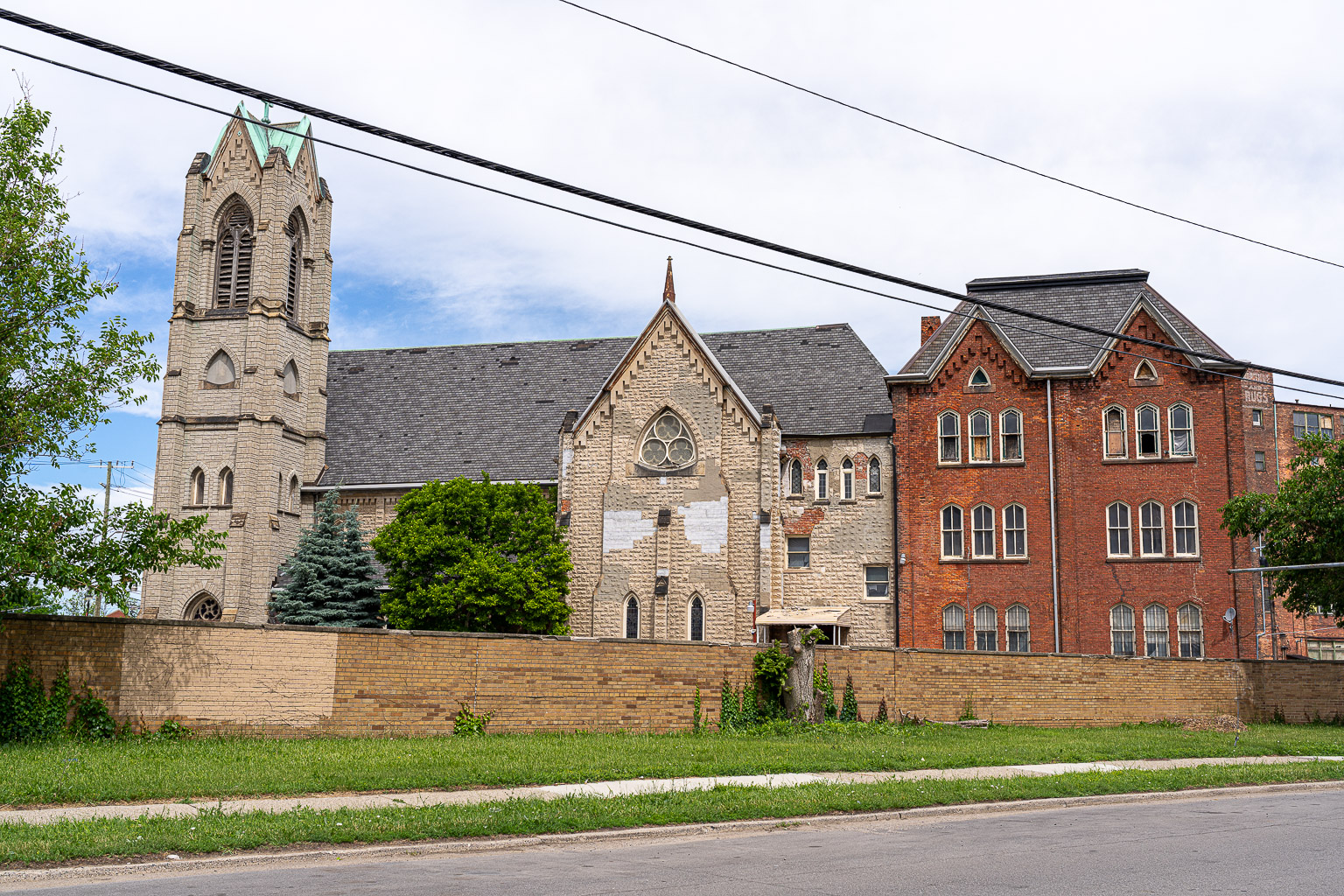
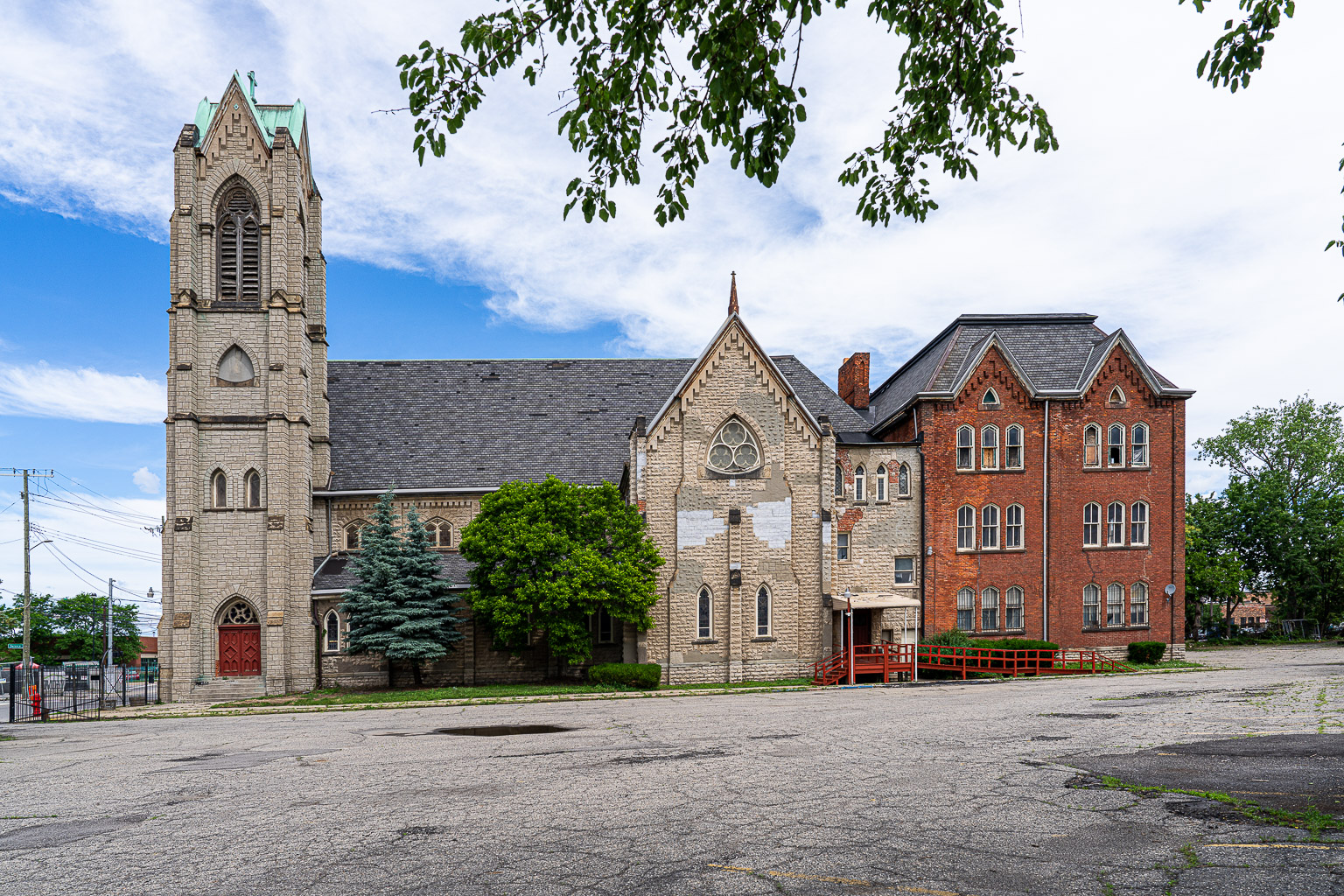
The proposed St. John's-St. Luke Evangelical Church Historic District, at 2120 Russell includes the church, an attached parochial school, and a parsonage. The complex is located about three-fourths of a mile east of the center of downtown Detroit adjacent to Gratiot Avenue, one of Detroit's principle radial arteries. It is surrounded by multi-story, brick commercial and industrial buildings on three sides and abuts a large, park-like, modern urban renewal area residential development, Lafayette Park, to the south.
HISTORY: [+ expand]
St. John's-St. Luke is significant historically as the oldest German Protestant church in Detroit and the progenitor of 12 other German Protestant churches in the city and architecturally as an interesting example of changing tastes and building technologies in the late nineteenth and early twentieth centuries. The interior is a fine example of High Victorian Gothic design with a significant lighting system and a noteworthy organ.
Begun in a carpenter shop on the riverfront of the growing city, St. John's congregation became the fourth organized religious group in the city on August 17, 1833. Reverend Schmid, the so called father of German Protestantism in Michigan, was on his way to Ann Arbor where he had been called to found a congregation and found himself stranded in Detroit on a Sunday. He was begged to stay and preach to a hastily gathered audience that subsequently became the congregation of St. John's. The congregation grew rapidly as more Germans of the Evangelical persuasion immigrated to the city, fleeing religious persecution in their homeland. After occupying several other structures in the Campus Martius area downtown, the decision was made in 1872 to erect a building of significance in the "Germantown" area of the city.
By this time the congregation was already well established in the civic life of the city by right of its Insurance Society, school for immigrants, uncompromising demand for religious liberty, and the involvement of members of the congregation in shaping of the city. At the time of the erection of the present edifice, the congregation numbered some 2,000 members. The Church established itself on the lower East Side of Detroit, adjacent to the Eastern Market, downtown Detroit and what was then a developing German residential area extending to the east and south across the open fields. It quickly became a gathering place for the entire community. Whether the occasion was religious, social, political or civic, German people gathered at the Church to celebrate their common heritage, share in the struggle to "make it" in America and to dream their future.
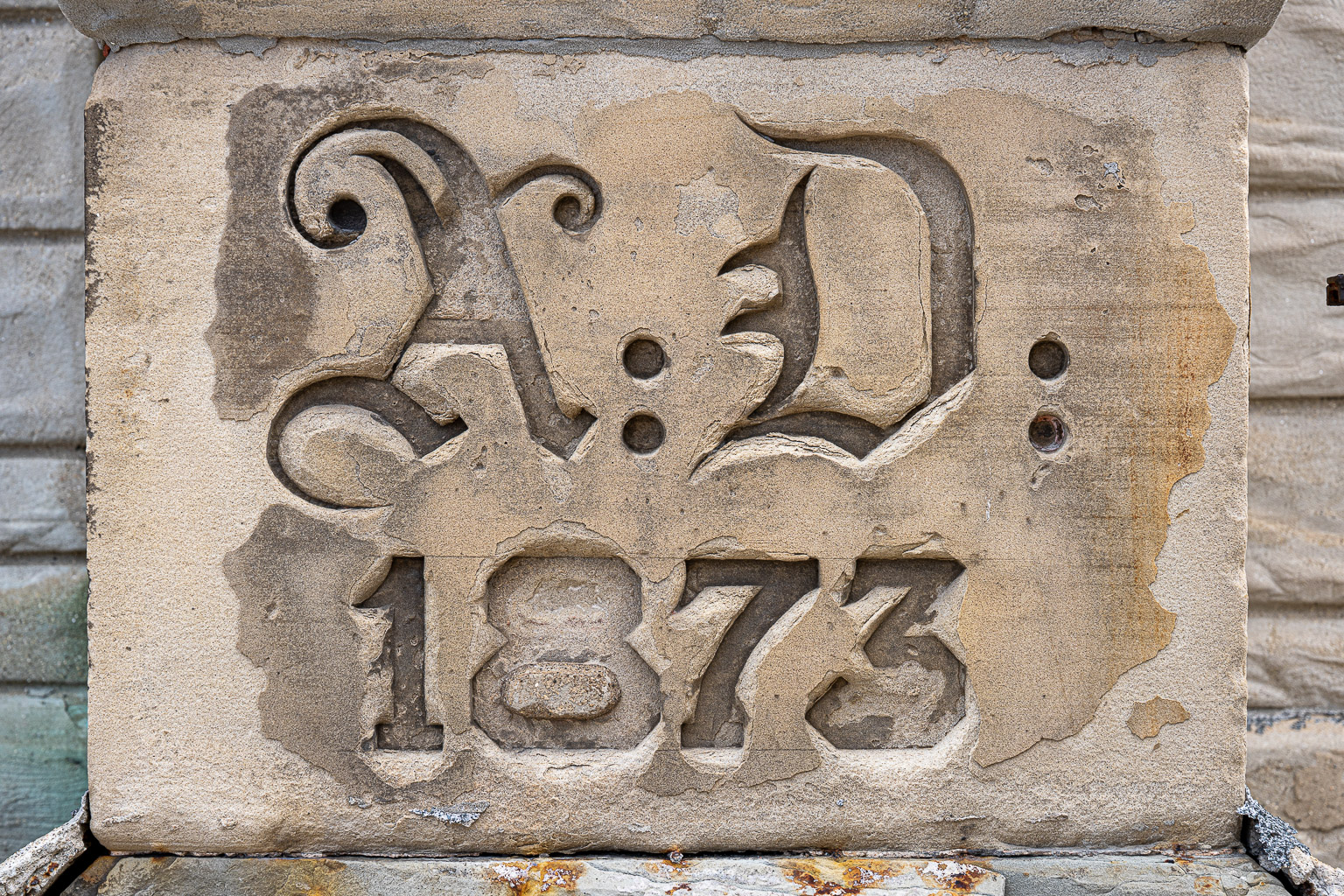
The German school building that was to become an integral part of the new St. John's Church was built on Chestnut Street just east of Russell and opened in 1872. St. John's Church was originally constructed in 1873-74 as one of the city's finest brick Victorian Gothic churches by the significant German-American architect Julius Hess (1841-1899). At age 17, the Swiss-born Hess emigrated to America and, at the start of the Civil War, entered the Army as a second lieutenant in the First New York Regiment of Engineers. Due to illness he returned to Switzerland after a year and a half, continuing to improve himself in the field of architecture.
Upon his return to the United States in 1866, Hess was briefly part of the Milwaukee firm of Koch and Hess, where he participated in the design of the Calvary Presbyterian Church in that city, a church which is a virtual duplicate of St. John's. In 1873 he moved to Detroit, where he remained for the rest of his life.
St. John's was Hess' first major commission completed in Detroit. Among his other substantial architectural projects were Trumbull Avenue Presbyterian Church (1888, Hess and Raseman), Traugott Schmidt Warehouse (1892, Hess and Raseman), and the G.A.R. Memorial Hall on Grand River between Cass and Adams (1896, Julius Hess).
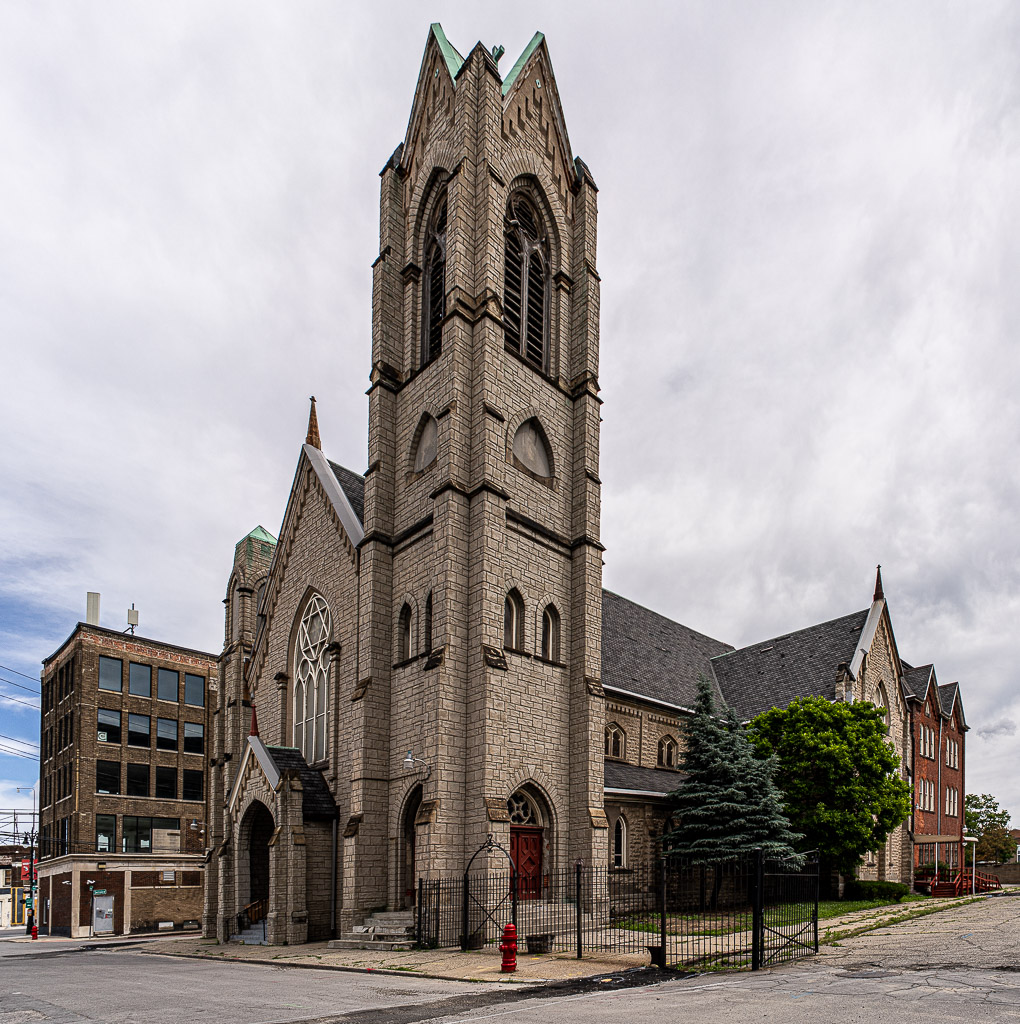
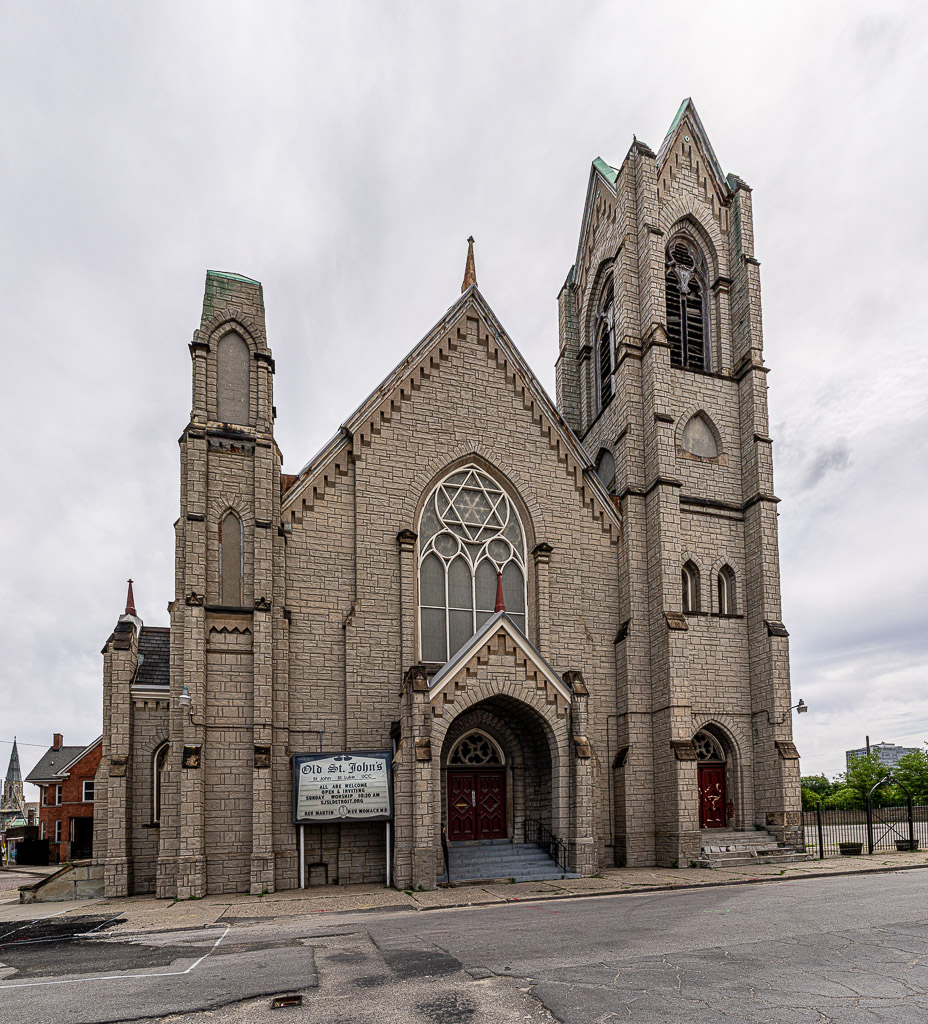
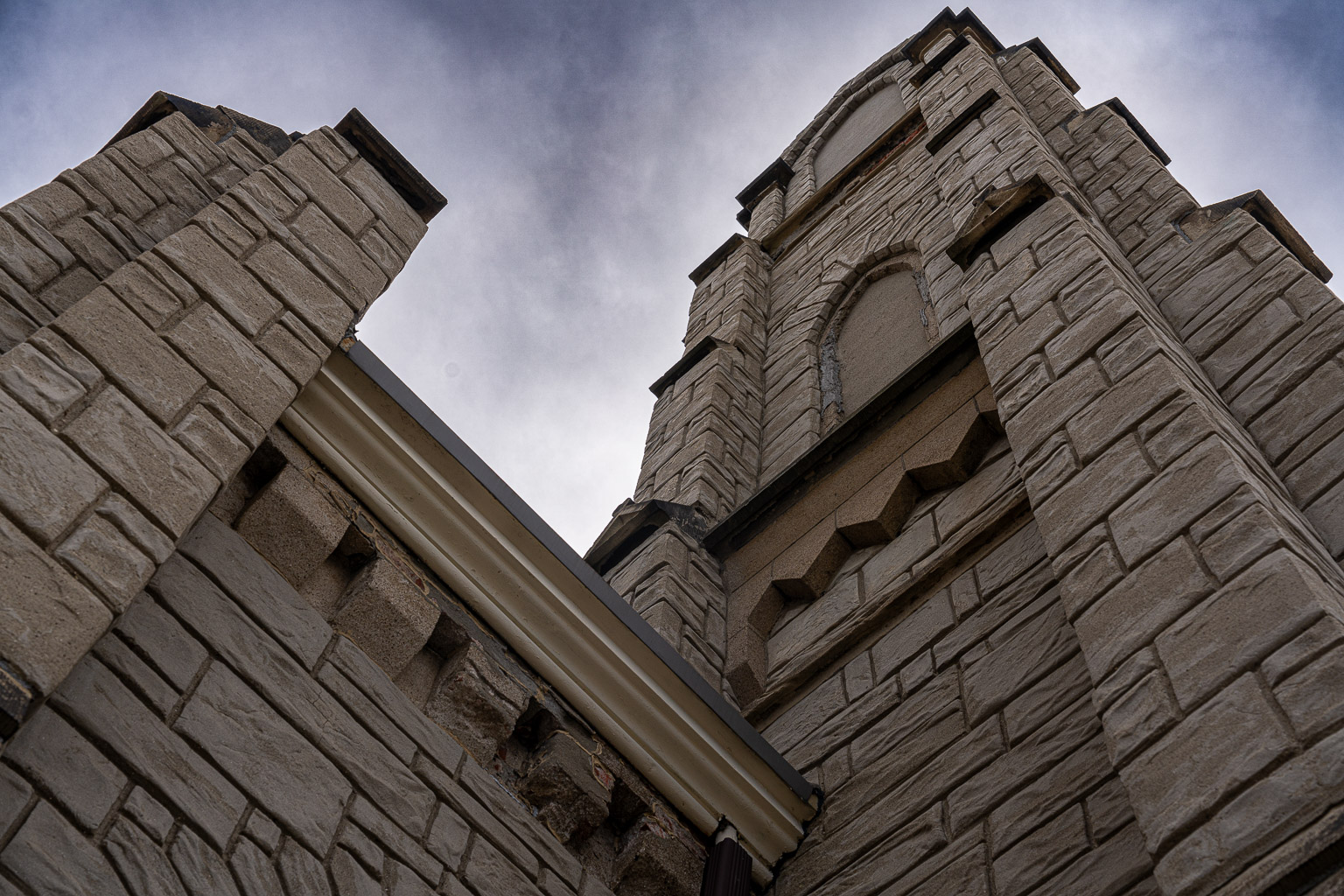
The Parsonage, constructed by the Detroit architectural firm of Spier and Rohns in 1900, was first occupied by Rev. August L. Gehrke and his family. Hans Gehrke, the pastor's son, was away at the University of Pennsylvania studying architecture. Upon his return to Detroit, Hans entered the firm of Spier and Rohns, and in 1908 he became a full partner in that firm. The commission to modernize St. John's came to the firm, renamed Spier and Gehrke after Rohns' death in 1915. The structure was completely re-cast in 1915 in concrete 'Formstone' to resemble a stone church. Although this alteration, undertaken to enhance the prestige of the congregation, tremendously changed the appearance of the structure, the quality of the design, by architect Hans Gehrke (1886-1969), and the technology involved in creating the cladding have taken on significance in their own right. The process by which the 'Formstone' -- a poured-in-place concrete coating tooled to imitate rock-faced ashlar -- was made and applied to the brick walls is no longer known. It is a significantly different technology from the pre-made perma-stone concrete cladding process still practiced today and results in a unique appearance and texture.
Of particular note for the life of the city was the Church's role in the humanitarian concerns. In 1894, the Church purchased the German Protestant Home for Orphans and the Aged which had struggled for existence since the late 1870's and was on the verge of bankruptcy at the time. This is now the Evangelical Homes of Michigan centered on Outer Drive in Detroit, a major facility for the elderly and mentally handicapped. In 1917, the Church similarly was instrumental in founding the still extant Deaconess Hospital on Jefferson Avenue in Detroit, now part of the Samaritan Health Center of Detroit.
With the onset of World War ], the life of the Church was dramatically changed. Partly as a result of the anti-German sentiment of the period, within a span of four years during the war the congregation diminished by 50% and the ethnic identity of its surrounding neighborhoods began to change from German to Belgian to Italian and eventually to Black as the established German Americans attempted to shed their ethnic identity and blend into the greater Detroit community.
As members of the congregation moved to other areas of the city, however, they "took St. John's with them." The Church eventually became the "mother" Church for some 12 other Protestant congregations. Most of these were established in the developing residential area between Grand Boulevard and Eight Mile Road where the former German-town residents were relocating. The Church experienced a brief revival during the 1930's as the pastor pressed for American intervention against Hitler, brought popular German pastors to the city to preach and began an effort to send money to Germany to get Jews out of Europe.
The decline of the neighborhood in the 1940's and 1950's, as the surrounding old Germantown area deteriorated into a blighted slum, threatened St. John's continued existence. The fortunes of the church were bolstered by its merger with St. Luke's Church to form St. John's-St. Luke. Meanwhile, the total clearance of the entire Germantown section for urban renewal and its redevelopment as the handsome Lafayette Park residential area stabilized the church's environment. A recent resurgence of membership has again made St. John's-St. Luke a vital institution. Currently, extensive efforts are underway to restore the church complex to provide a better physical plant for the dynamic new life of the parish. As a result, the congregation is seeking historic designation as a reflection of the church's historic and architectural significance and to aide them in their efforts to secure funds for the restoration.
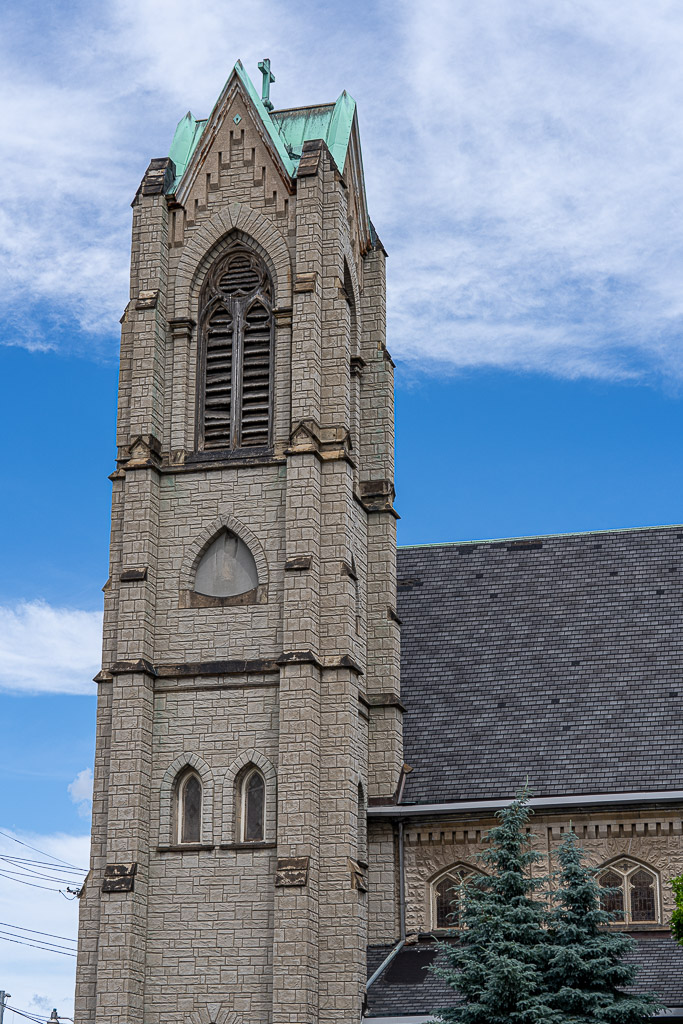
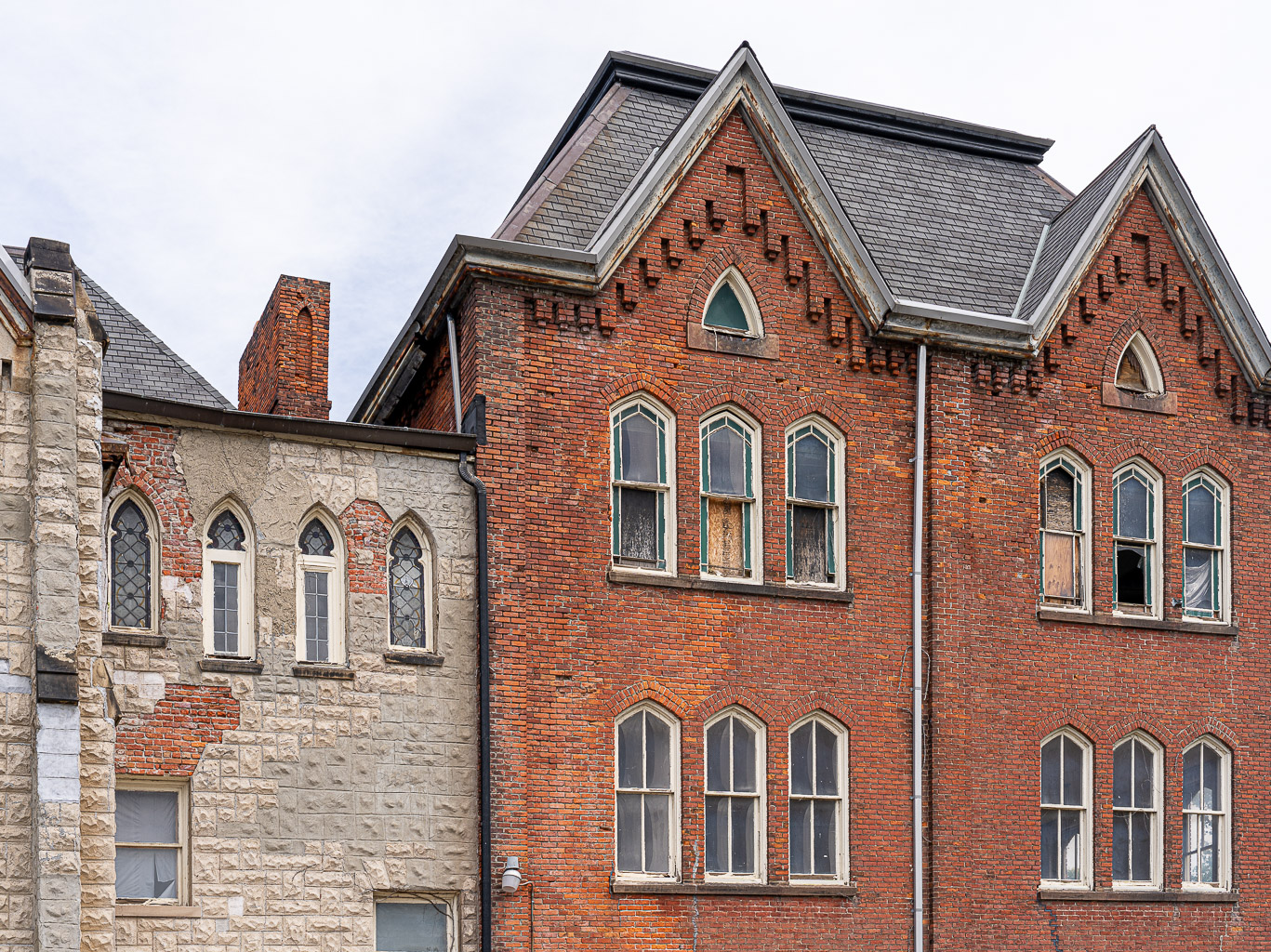
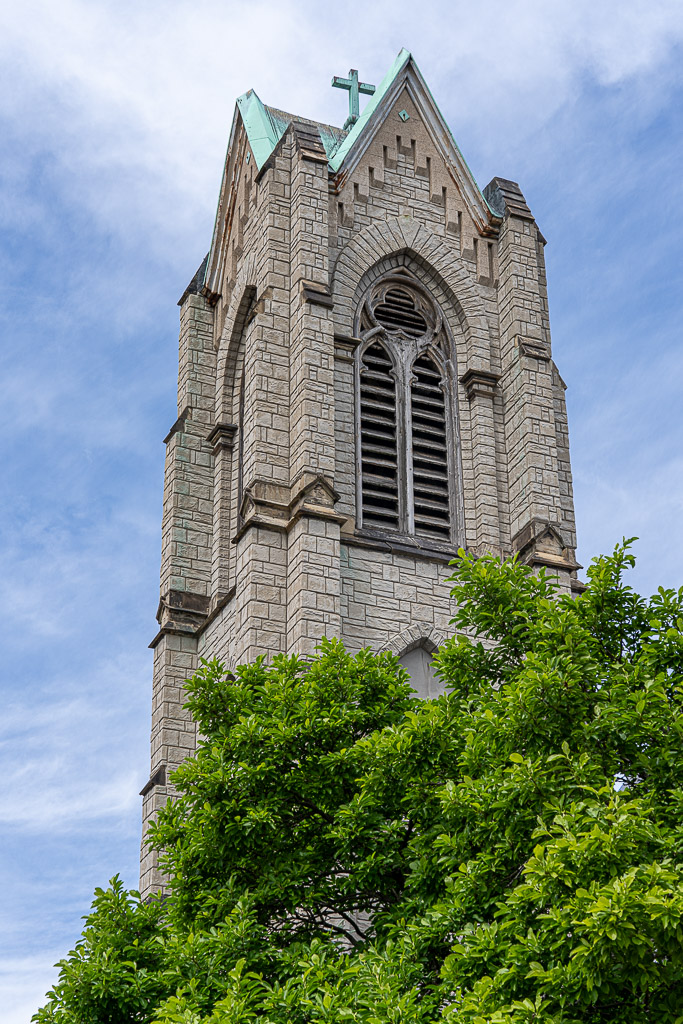
PHYSICAL DESCRIPTION: St. John's-St. Luke Evangelical Church is a brick, High Victorian Gothic church building with a school building attached at the rear and a parsonage adjacent on the north. The church's main facade faces Russell Street to the west. At the southwest corner of the facade is the major tower, and on the northwest a smaller tower, which flank the main portal centered in the facade. The main body of the church consists of a gabled nave flanked by lower aisles. Transepts adjoin the main body of the building near the rear, where the church is attached to the school building. Newspaper reports at the time the church was dedicated in 1874 identified the style as "German Gothic." The High Victorian Gothic design is in fact a typical and highly effective amalgamation of eclectic Gothic detail into an unified whole.
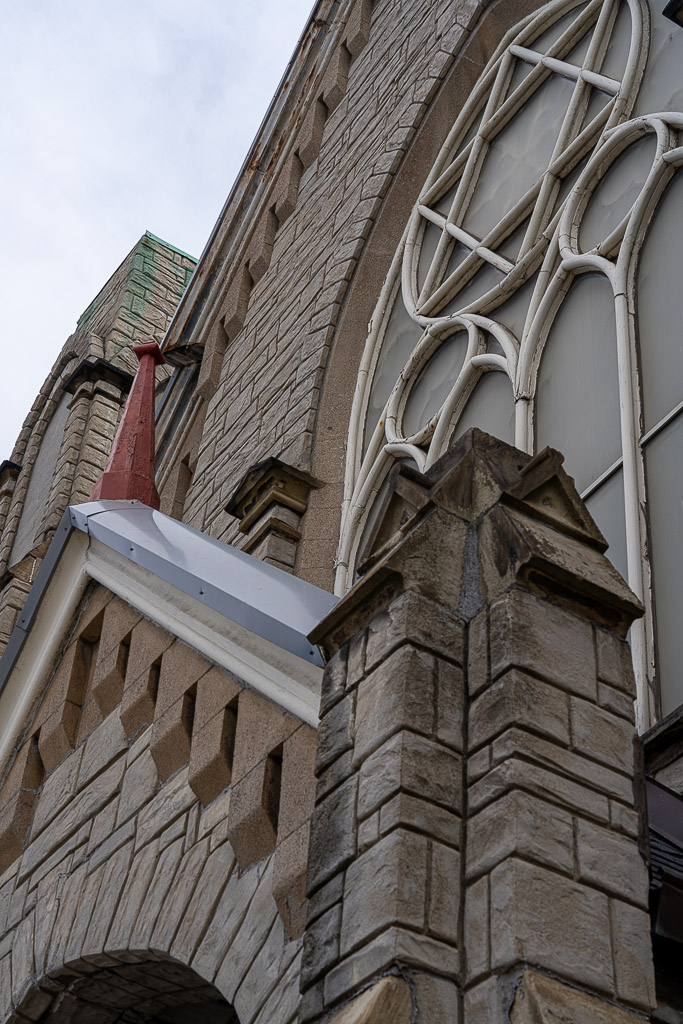
Alterations to the exterior of the church have changed its appearance considerably. Originally, the buildings were of red brick with sandstone trim; the roof was laid in patterned slate, and surmounted by iron cresting. It has since been covered with black asphalt. The details along the gables and roof lines were, in part, of wood, and these have largely disappeared. The slate-covered tower spires have both been removed. The original southwest spire, over 200' in height, was reportedly struck by lightening in the 1930's, leading to its dismantling. Most importantly, in 1914-15, the church building proper was covered with "formstone", an ashlar-patterned, rock-faced concrete covering which completely obscured the original brick. The exterior of St. John's-St. Luke represents one of the two known applications in Michigan of this early twentieth century artificial cladding material. Later, in the 1950's, the original concrete imitation stone was replaced on the west front with actual perma-stone. Thus, the building was given a plainer, more twentieth century Gothic look. No such alterations have been made to the school, finished in 1872. Nearly square in plan, the building has two vertical bays on the east and west facade, each ending in a gable. While some minor detail has been removed from these facades, the covering of the original slate roof remains the major alteration. The east facade is plainer since it was originally the rear of the building.
All doors were locked when I visited, so I could not see the interior.
Inside, the church as been little altered; it retains its original High Victorian appearance. The church itself, about 100 feet long and about 45 feet high, is surrounded by galleries. The balconies are supported on cast iron columns with Corinthian capitals. Between the windows of the clerestory are spring hammer beam trusses which support the roof. The transepts are at the rear of the building, and the seating in the side galleries continues up into them on risers.
The church interior is painted with white and gold on the carved woodwork and light blue on most wall and ceiling surfaces. It is known that much of the white woodwork was originally dark, either wood finish or painted grain. Stencil decoration has been painted over, and the painting scheme is essentially plain. The church is presently undertaking a study to determine the original scheme which finds its origins in a short-lived alliance between William Wright, a prominant Detroit decorating contractor, and Gordon W. Lloyd, Detroit's leading architect of the period. Wright and Lloyd became partners in a firm to provide design services combined with the craftsmanship to carry out the work. Under the present paint in this church lies the only known example of the work of that firm; the church has determined that the scheme should be uncovered and recorded and if possible restored.
Against the rear wall of the church stands the altar area which is encompassed by a wooden railing. On the rear wall behind it is the raised pulpit, accessible only by a flight of stairs concealed in a hallway behind the sanctuary. Above the pulpit is the organ gallery, which is situated over the first floor hallway in the adjacent school. This arrangement of altar below, pulpit above, and organ on top derives directly from north German and Scandinavian Lutheran practice (Cf. Trinitatis Kirche, Copenhagen) and was allegedly intended to symbolize the equality, for purposes of worship, of the sacrament, the spoken work, and song.
Another significant feature of the interior is the electric lighting system, unaltered since its installation in the early days of electrical lighting. Drops on the hammer beams have globes suspended; more startling to the modern visitor are the bare bulbs installed in rows along the bottom of the gallery railings and around the arched opening to the organ gallery. In addition, the three major flats of pipes in the organ case are surrounded by smaller bulbs and the same small bulbs line the organ gallery railing and the pulpit canopy. The somewhat carnival atmosphere which this brings to mind reflects the fact that such lighting is popularly identified today mostly with theaters and amusement parks while more sophisticated buildings that may have originally been illumined this way have been refitted with more subtle lighting. This unusual and intact example of early twentieth century architectural lighting is unique in Michigan as an example of the thoughtful experimentation with a new technology.
The organ in the gallery is a significance on a national basis, for it is the largest surviving instrument known by G. G. Votteler of Cleveland, Ohio. Built for the church in 1873-74, the instrument demonstrates that Votteler knew recent developments in German organ-building, which had been introduced into this country by the mammoth Boston Music Hall organ in the late 1860's. Built by Walcker of Ludwigsburg, Germany, that organ had revolutionized American organ tonal design. Votteler is known to have been a German, but little is known of his life. It is hard to suggest, however, that the Boston instrument could have so strongly influenced an individual builder in a provincial center like Cleveland; most likely, Votteler brought to American through his immigration many of the tonal principles exemplified in Boston. In its construction, the Votteler organ shows a crudity suggestive of the workman without power tools and doing his work largely by himself. That the result was well built is testified to by the continued service of the organ, only slightly altered and unrestored, more than a century after its construction. The significance of the instrument increases with the fact that Votteler was the founder of a firm which later, through changing partnerships, became the Holtkamp Organ Company, still in business today. Walter Holtkamp, Sr., principal of the firm from the 1930's to about 1960, was one of the seminal figures in the reform of American organ building which he, together with G. Donald Harrison of Aeolian-Skinner, began in the 1930's. Votteler's work retains a fair measure of the classical principles of organ building which Harrison and Holtkamp fought to re-introduce following the decadance of the early twentieth century. It is not too much to suggest that Holtkamp might have taken some inspiration and example from the work of the founder of his firm. Housed in a charming Gothic Revival case, the organ at St. John's-St. Luke, with its two manuals and pedal containing 22 ranks of pipes, is the most complete example of Votteler's work known to exist.
The windows in the church were completely replaced in a campaign of memorial donations in the 1940's, the work having been carried out by the now-defunct Detroit Stained Glass Works, whose predecessors, Friedrichs & Staffen, likely made the original glass for the building. Remaining original glass in several locations suggests that the replacement of the original glass was, in fact, a long-delayed culmination of the original intent to provide simple glass which could be replaced at a later time with more pretentious work.
The interior of the school reflects changing use over the years. The first floor was largely rebuilt in 1914-15, providing a large "parish hall" space handsomely panelled and beamed in oak. A kitchen was provided as well as rest rooms and a nursery. On the second floor, two classrooms remain intact, as does an apartment for the sexton. One space in the northwest corner was altered in 1914-15 to provide a locker room facility, connected with the auditorium space above. The third floor was entirely given over to an auditorium almost two stories in height within the mansard roof. A balcony spans the width of the room at the south end. No stage was provided, the main floor space being intended for multiple use. This space has been almost entirely unused over a great many years, and is virtually unaltered from its original state. Stencilled decoration remains on walls and ceilings, and the original colored and frosted glass borders still exist in the windows.