Trinity Lutheran Church Local Historic District
The Trinity Lutheran Church Local Historic District consists only of the church at 1345 Gratiot Avenue named Historic Trinity Lutheran Church. You can read details about the Trinity Lutheran Church Local Historic District in the Trinity Lutheran Church Local Historic District Final Report (local copy), which I recommend highly to anyone interested in Detroit's history.
My photos of this church can be seen in this slide show.
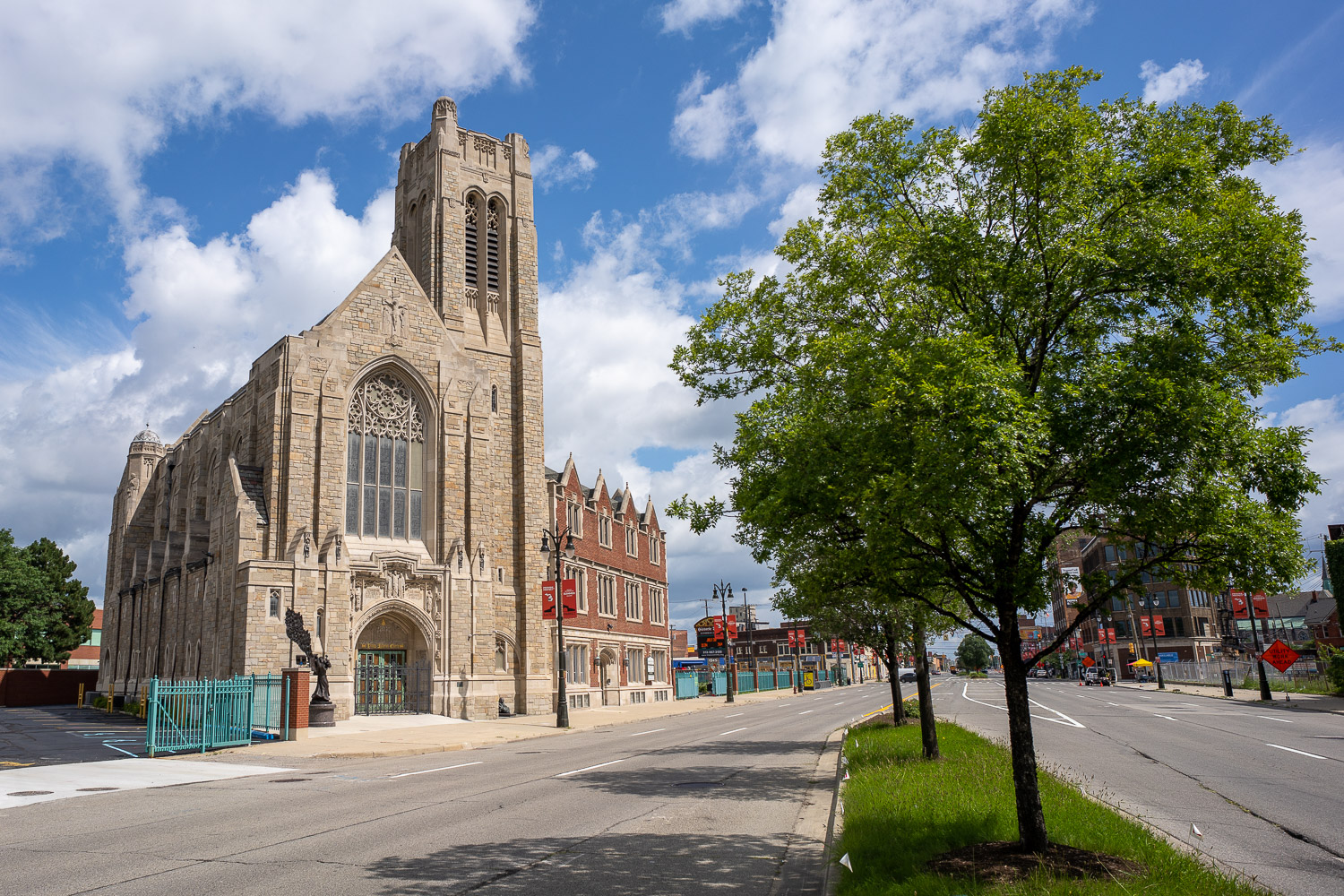
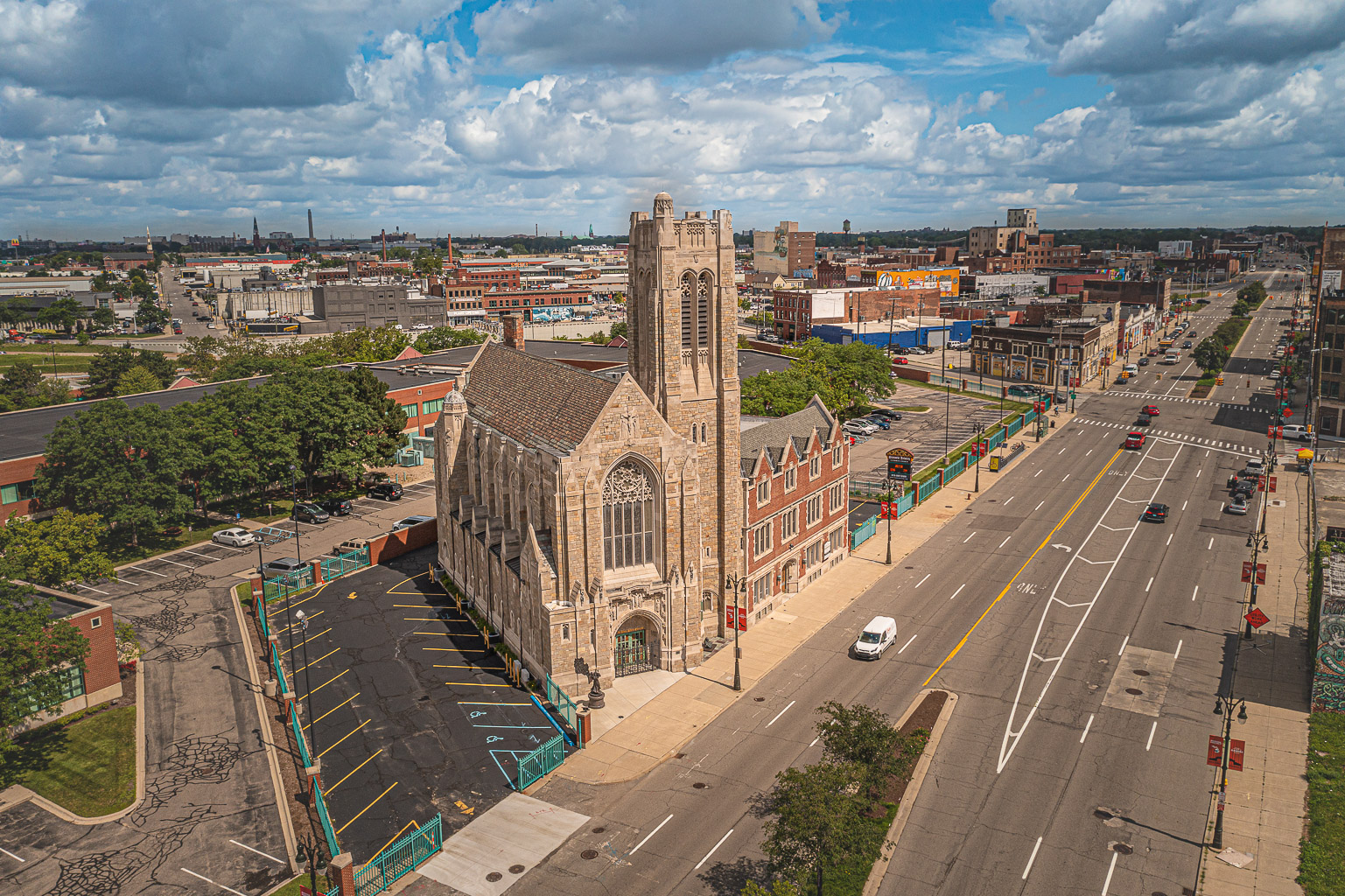
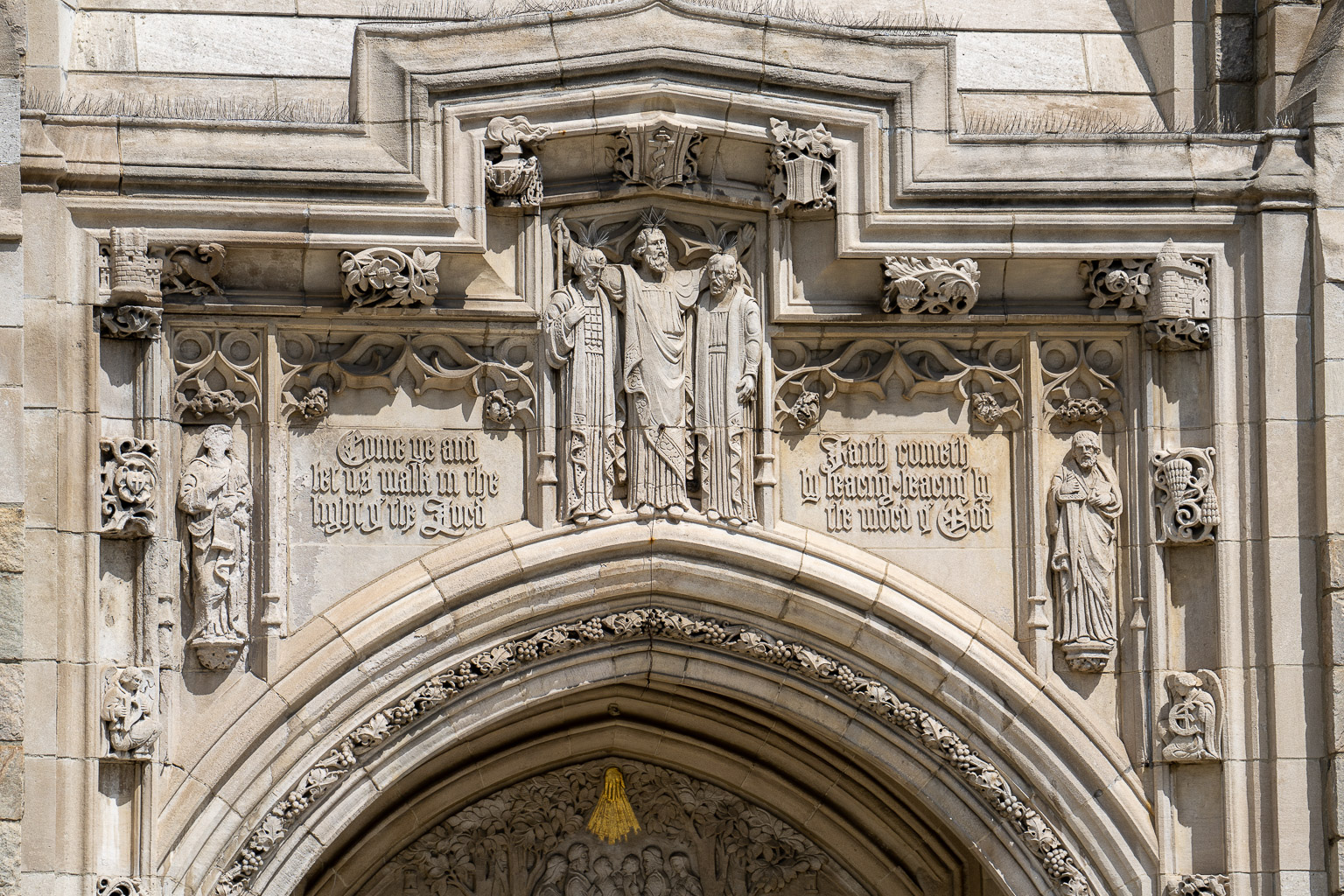
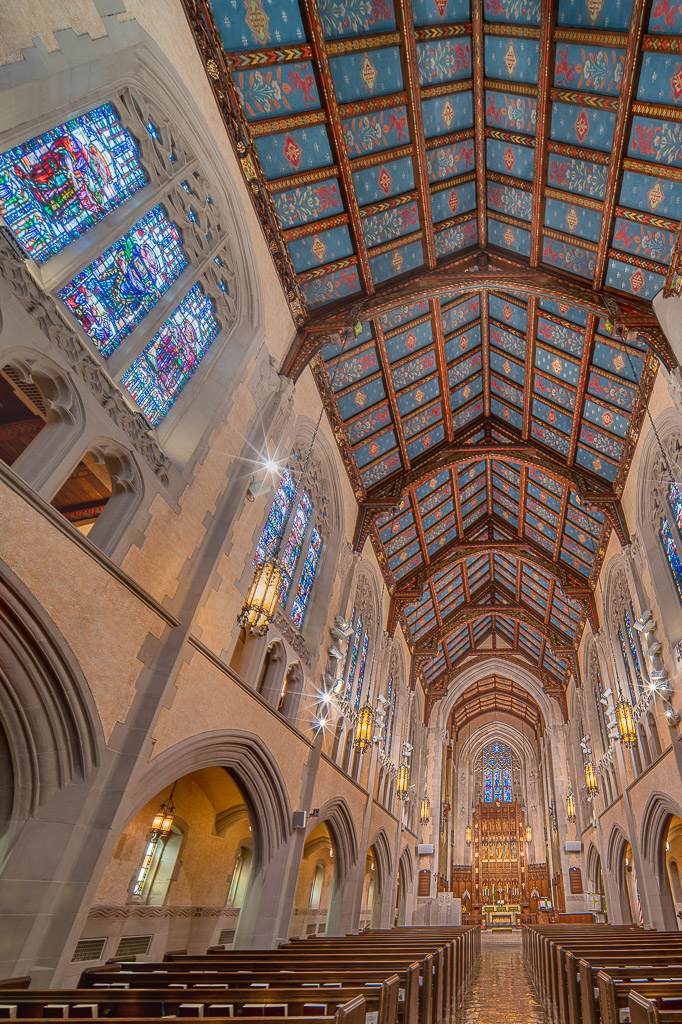
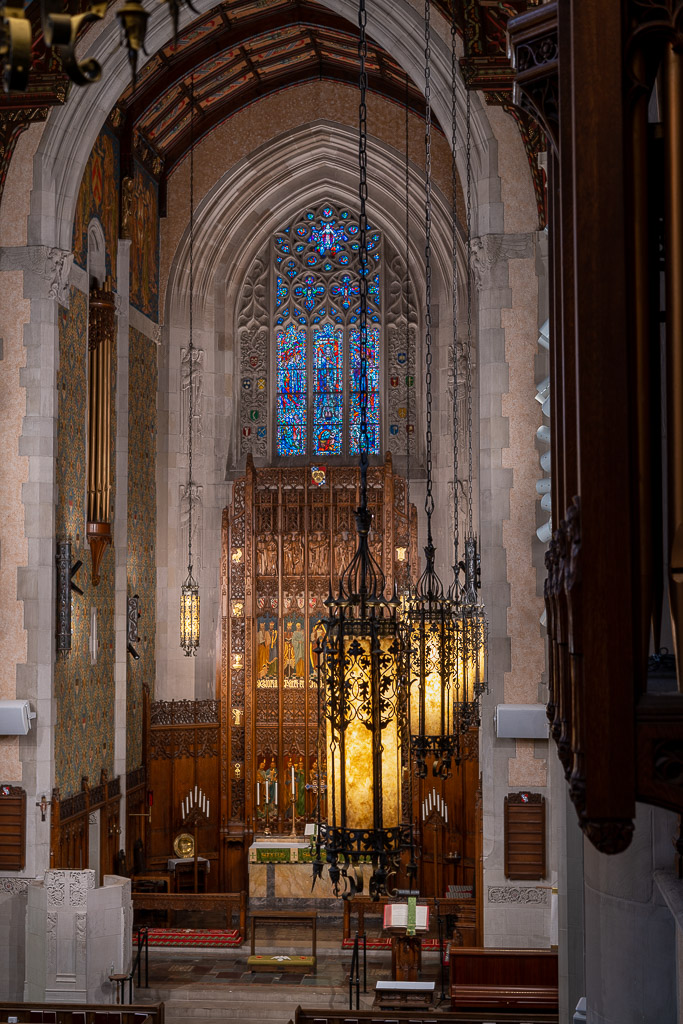
A couple of my favorites are shown below so the page doesn't look so empty, but please view the entire slide show above.
The proposed historic district under study by the Historic Designation Advisory Board consists of a church and parish house located at the northeast corner of Gratiot and Rivard (now vacated). Trinity Lutheran Church's present sanctuary was built in 1930, and the attached parish house in 1927. The congregation has been located on the site since 1866.
HISTORY: [+ expand]
Following a dispute within St. Matthew's Evangelical Lutheran Church Detroit's only congregation of that denomination, a group of former members of that congregation founded the St. Trinity Evangelical Lutheran Church, now known as Trinity Lutheran. On November 10, 1850, the Rev. Gottlieb Schaller was installed as the first pastor. A framc chapel formerly owned by Mariner's Church was moved to a site on Larned between Rivard and Russell and became the congregation's first home. Just two years later, a school was established and an addition to the church provided space for it. The congregation continued to grow, and in 1864. n brick school building was built on Sherman Street. The following year the congregation purchased a parcel at the northeast corner of Gratiot and Rivard, and in 1866 built a brick church on that site. The growth of the congregation and of the city made it inevitable that other Hissouri Synod Lutheran churches would be established, and a number of these are daughter congregations of Trinity, beginning with Immanuel Lutheran on the west side in 1865.
In 1905 a new school and social hall was built on Rivard, and at about this same timc, the growing Americanization of the congregation led to the addition of English language services to supplement the previously exclusively German character of the worship and teaching.
By 1920, the character of the congregation and neighborhood had so reduced the need for the school that Trinity and St. Peter's Lutheran combined their school efforts. Throughout the 1920's, the development of the city made it clear that the former role of Trinity in serving the "Germantown" neighborhood was passing, and Trinity responded by moving toward service to the entire city as a downtown church.
In 1927, the Rev. H. C. F. Otte, who had served the church for many years, died and was replaced with his son, the Rev. Gilbert T. Otte, who still serves the parish today. In that same year, the church took out a building permit for the present parish hall, which was built adjoining the old church on Gratiot.
Late in 1928, when the church was considering the renovation of the 1866 church, a member of the congregation, Mr. Charles Gauss, announced his desire to donate a new church building for the congregation. The congregation moved into the new parish hall for services, and the old brick church was demolished. A building permit for the new church was issued to Charles Gauss on October 17, 1929, and the building was dedicated on February 15, 1931.
Since that time, Trinity has remained a symbol for Lutheranism in Detroit, serving the community at large from its near-downtown location.
PHYSICAL DESCRIPTION: Trinity Lutheran Church is an outstanding example of the Neo-Gothic style of the first part of the twentieth century. Under the influence of Bertram Grosvenor Goodhue, among others, the design of Gothic churches underwent a transformation intended to take the Gothic style, which was seen as eminently suitable for churches, and transform it into an expression of the twentieth century. Lee Lawrie, a sculptor who worked with Goodhue on many buildings, likewise influenced the development of architectural sculpture, and his influence is clearly seen at Trinity as well. The church was designed by the Detroit architect N. Edgerton N. Hunter, who was born at Hamilton, Ontario in 1868. Educated at the Hamilton Collegiate Institute, he worked in Hamilton and Buffalo before coming to Detroit. In Detroit, he worked for Mortimer L. Smith, John Scort, and Nason and Rice before going into business for himself. Known as an architect of churches and private residences, he also designed, among other buildings, the Metropolitan Methodist Church and houses for E. C. Kinsel and F. N. Sibley. He retired in 1939, and died in 1947.
While the church has been represented as being a modern adaptation of 16th Century English Gothic, the form and decoration of the building leave its English antecedants very much in the background. The massive, fortress-like character of the building, combined with the "modern" sculptural decoration, make this a building which could only have been created in the twentieth century.
The church is rectangular, and rather tall for its relatively small size. There is a bell tower at the liturgical southwest corner, between the church proper and the parish house. As is typical of this type of Neo-Gothic, the lower portion of the church is kept low, and the upper portion containing the major windows is quite tall, giving an impression of strength. The facade is dominated by a large window, below which is the main entrance portal. On the four piers flanking the door and window are figures of the evangelists, a reflection of the medieval tradition which placed figures of apostles and evangelists on piers and pillars of churches -- the middle ages understood the term "pillars of the church!"
A Wikipedia Page also describes the church, as well as www.HistoricTrinity.org, HistoricDetroit.org, and DetroitHistorical.org.