Trowbridge House Local Historic District
You can read details about the Trowbridge House Local Historic District in the Trowbridge House Local Historic District Final Report (local copy), which I recommend highly to anyone interested in Detroit's history.
The proposed Trowbridge House Historic District is comprised of the Trowbridge House and property located at 1380 East Jefferson Avenue. The Trowbridge House, one and one-half blocks east of the Chrysler Freeway, is the westernmost of four extant nineteenth century residences between Rivard and Riopelle Streets on the south side of Jefferson. It is said to be the oldest house standing in the city.
HISTORY: [+ expand]
The Trowbridge House derives its significance from the fact that it was built by, and was the residence for over 50 years of a man whose career paralleled the transformation of Detroit from a small frontier community to a thriving commercial and industrial center. Charles Trowbridge began his career in Michigan as a deputy United States Marshall, explorer and ethnographer of native American cultures. By the time he died, he had been successful in banking, town building and railroads. His house is believed to be the oldest residence in Detroit.
Charles Christopher Trowbridge, born in Albany, New York on December 29, 1800, was the son of a soldier who fought in the American Revolution. Charles Trowbridge arrived in Michigan in 1819 at the age of 19 to take a position as Deputy U.S. Marshall. The following year he served as the assistant topographer on the expedition that officially explored and charted the area between the Great Lakes and the headwaters of the Mississippi. Governor Lewis Cass, who headed this expedition, later made Trowbridge his personal secretary. Trowbridge also assisted in recording the 1820 census and, at the request of Francis Parkman, recorded recollections of the remaining French settlers who had lived through Pontiac's uprising in 1763. Trowbridge gained enough proficiency in several Indian languages to become the official interpreter between the government and the Indians in the Michigan Territory. He was also appointed assistant-secretary and accountant for the Detroit office of Indian Affairs.
In 1823 Charles C. Trowbridge purchased property from Louis Moran, Jr., and in 1826, he built a house for himself and his new bride for $2,500. The house was built at what was considered a good distance from town and away from any opened street, although on a line where Jefferson Avenue was expected to open up. Jefferson Avenue was not opened east of Brush until 1828. To reach the house, in which Trowbridge would spend the rest of his life, one had to pass down Randolph Street to the river and follow up River Road until it reached the farm alley, the only means of approach.
When the Trowbridge house was built, access may well have been from what is now the rear. Such houses were often very similar front and rear, with entrances at both ends of a central hallway. The River Road ran behind the house, so the Jefferson Avenue front was possibly originally the rear. The house is, thus, a reminder from the days when the River Road led from town to farm.
Trowbridge had saved $2,000 to build his house. He began by procuring materials; "oak trees were cut down in the rear of town, hauled to the lot, and fashioned into posts and beams with a broad ax, saw, and chisel. When a raft of pine lumber came from Canada, carpenter Mr. Horace Wilson selected some. Mr. Cooper furnished stone and lime from the Sibley quarry in Monguagon, and the mason's contract was taken out by Charles Jackson and Jeremiah Moore." (Personal Memoirs of Charles Christopher Trowbridge, Detroit, 1893.) Locks were ordered from New York, and glass was gotten from Boston. When the house was almost complete, E. S. Sibley wrote in a letter to Mr. Trowbridge, "I presume your house must be nearly finished by this time; you will be able, I suppose in a month from this time, to move into it, and commence keeping house, a business, I expect, you will find more troublesome than keeping the Bank, tedious as it is." (MS/Trowbridge, CC., 9/24/1826). The Trowbridge House was considered to be the finest frame house in the territory when it was completed. He moved into the house in January of 1827 with his family, consisting of his wife, his mother, his sister, Julia, his niece, and Charles A. Trowbridge, his nephew.
Trowbridge retained his position as accountant in the Indian office when he began his career in banking in 1825. Starting as cashier in the newly formed Bank of Michigan, he became president of that insitution in 1839. In the meantime, Trowbridge's financial activities expanded to include real estate speculation, town development and railroads. He was a shareholder in the company that laid out the townsite of Allegan, Michigan in 1833, and he served as president of the Oakland and Ottawa Railroad Company during the 1840's and 1850's.
At several times during his career, Trowbridge served as an alderman of Detroit. During the cholera epidemic of 1834 he served as mayor but later resigned that position. The Old City Hall on the Campus Martius had been built during his administration. In 1837 he was nominated by the Whigs as their choice for governor; he lost the election by a narrow margin. Although he never again ran for public office, he remained a Whig until the Republican party was organized. In addition to sitting on the boards of several charitable organizations, he served on the Board of Regents of the University of Michigan for several years.
Charles Trowbridge passed away on April 3, 1883; in 1886 two daughters, Mrs. Elizabeth C. Wilkins and Mrs. Sarah S. Hendrie, sold their share of the property to their brother-in-law, Sidney D. Miller. In 1893 Herbert Bowen sold his acquired interest to Miller, so that the house was owned by two remaining daughters, Katherine S. Miller and Mary A. Trowbridge, and Sidney Miller, husband of Katherine and executor of the C. C. Trowbridge estate. Sidney and Katherine Miller passed away in 1904 and 1905 respectively; their share went to their son, Sidney T. Miller, a lawyer like his father, who owned the Trowbridge House with his aunt, Mary Trowbridge, until her death in 1913, when her half interest went to her niece, Kathleen S. Trowbridge. Thus, until 1940, the estate was in the possession of two grandchildren of Charles C. Trowbridge. In 1940, when Miller died, his half interest was held in trust to his daughter, Elizabeth Miller Mitchell Byrd. In 1942, Kathleen waived her one-half interest and the property was sold out of the Trowbridge family. As was the way with many Jefferson Avenue houses, the Trowbridge House was converted to a rooming house in 1936; it was converted back to a single-family dwelling in 1942 by its then new owners.
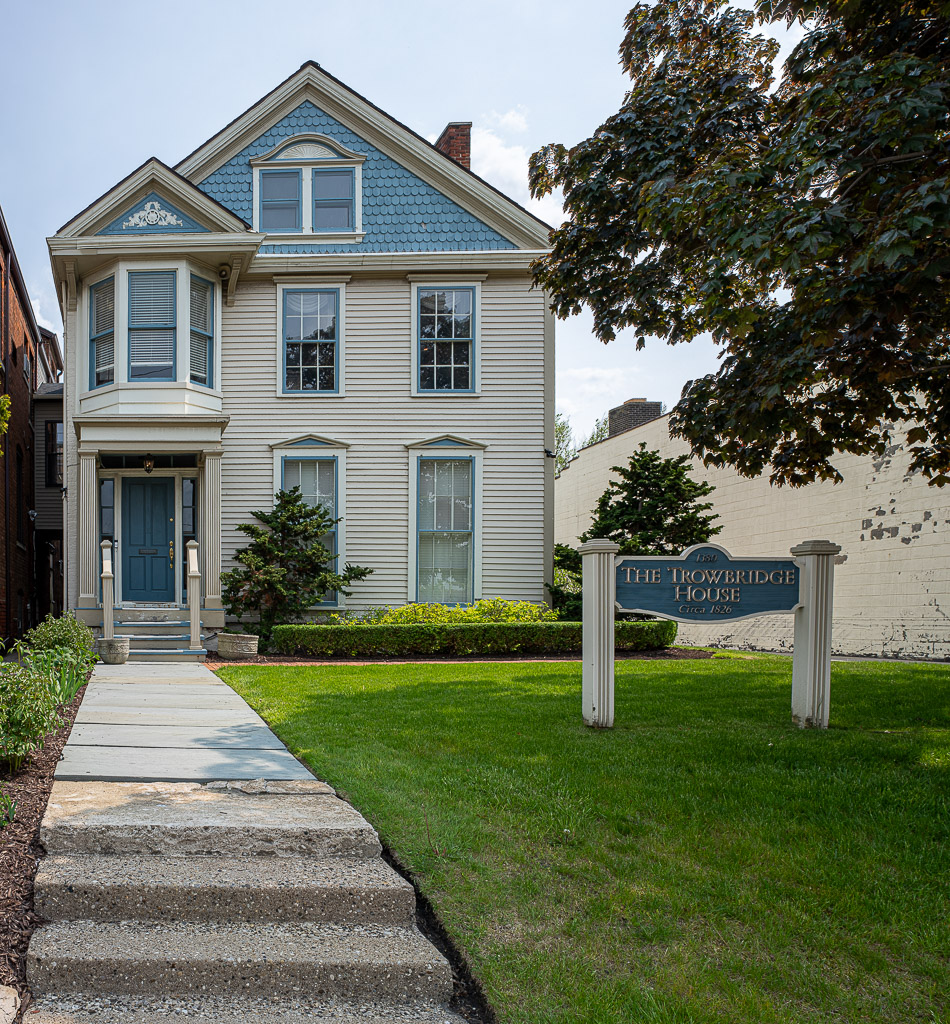
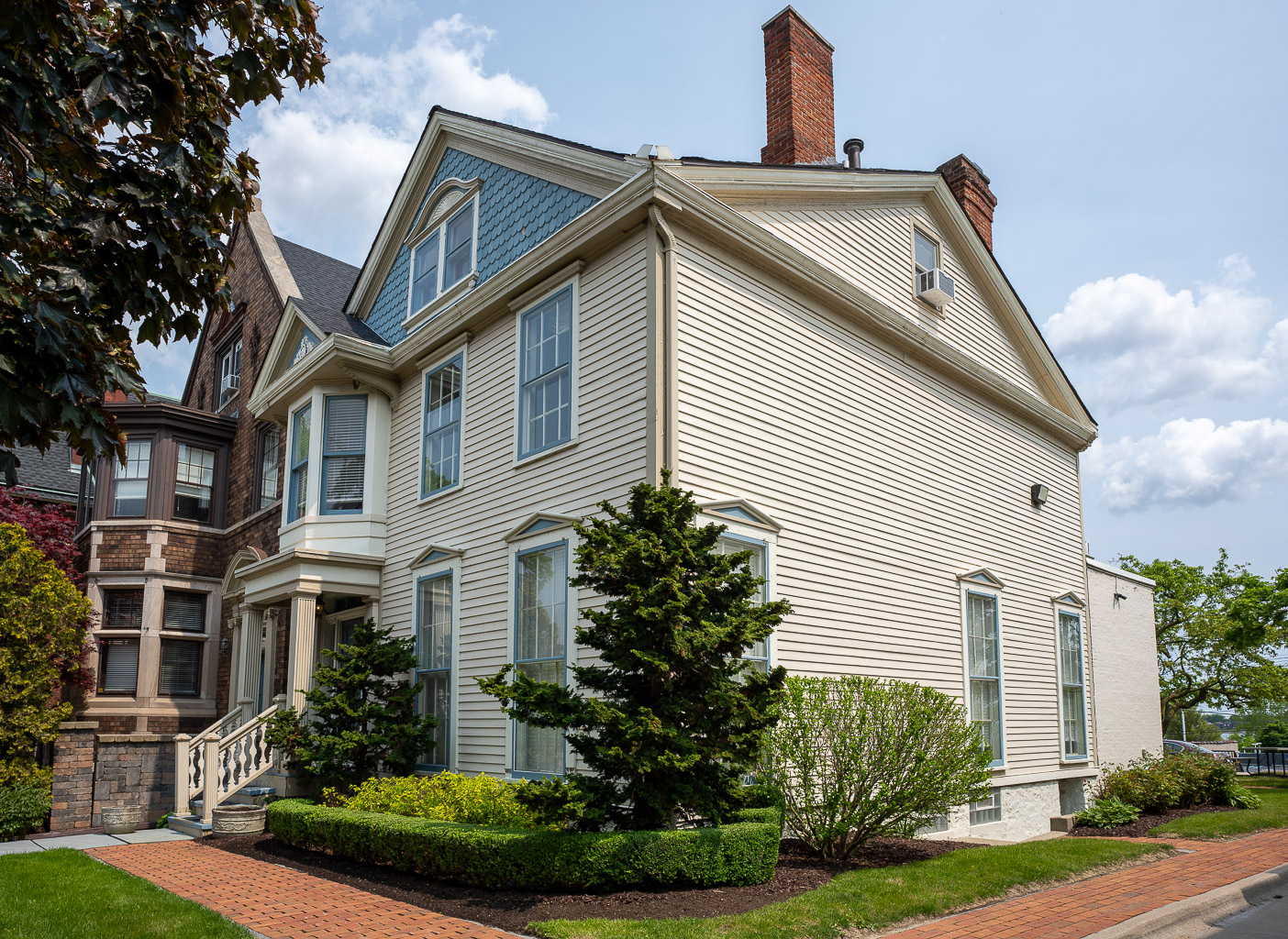
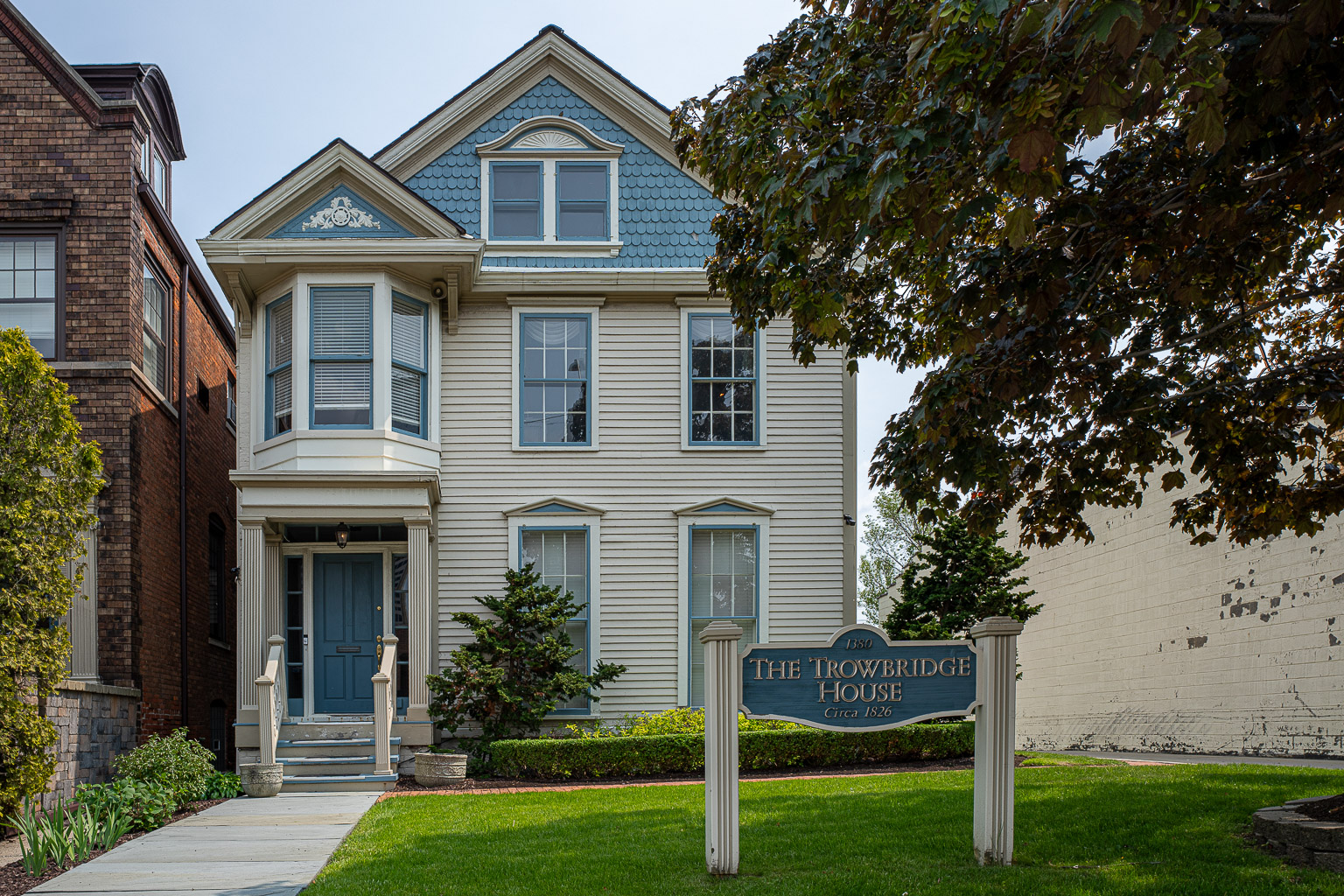
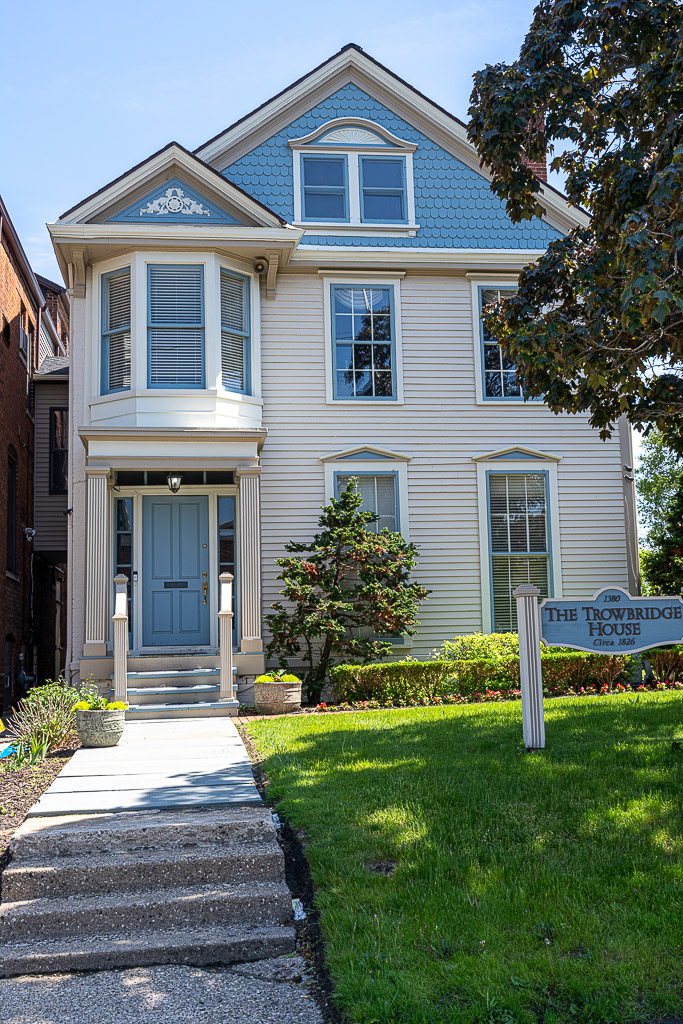
PHYSICAL DESCRIPTION: Originally, the Trowbridge House (1826) at 1380 East Jefferson was likely somewhat similar to the Sibley House (1848) adjacent to Christ Church a block west. The Trowbridge House, like the Sibley House, was built as a five-bay, two-story, frame Federal style house and was modernized extensively throughout the nineteenth century with modest Victorian gingerbread, a full-length porch with Italianate brackets, a brick addition to the rear (south side) which nearly doubled the original 35 foot depth, and the raising of the roof to accomodate a third story. The Victorian Trowbridge carriage house was constructed on the eastern portion of the Trowbridge property soon after Woodbridge Avenue was opened in 1866.
The eastern two bays of the Trowbridge House were removed sometime between 1888 and 1895 to permit the construction of the house next door; erected in 1899, it is now occupied by the Bosquette Insurance Company. That house, at 1384 East Jefferson, was designed by Nettleton and Kahn and cost $9,000. The Trowbridge carriage house is now associated with 1384 East Jefferson.
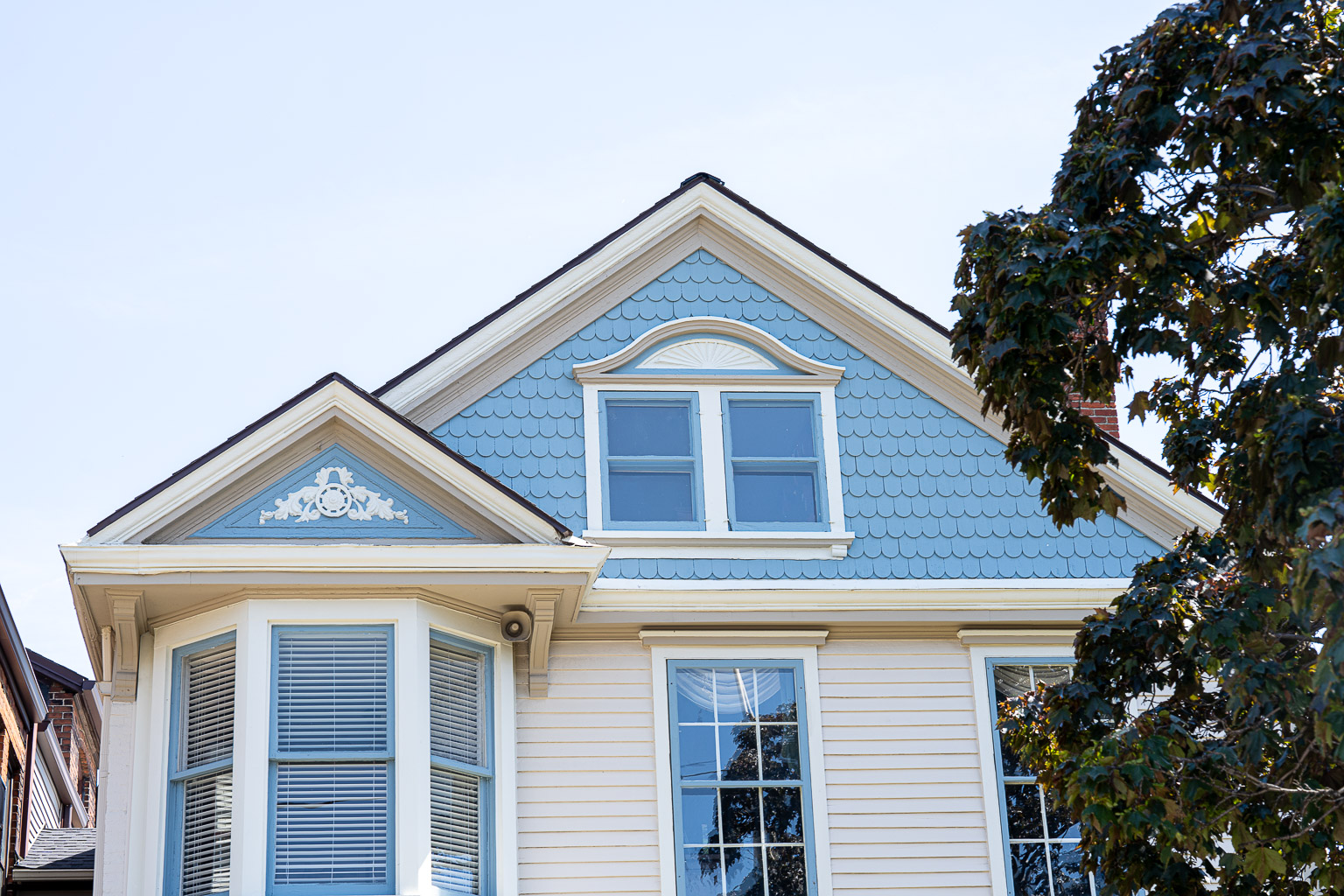
Alterations and additions incurred after the removal of the eastern portion of the Trowbridge House included the erection of the brick wall on the east side, the addition of the bay window and small gable over the entrance, the addition of the entire gable which faces the street, and the removal of additions on the western side. Twentieth century additions were erected to the rear.
The details of the house exhibit a harmonious blend of Federal and Victorian vocabulary. The entrance is surrounded by sidelights and a rectangular transom; the overhang in supported by square Doric columns. The window above the entrance, a three-sided protruding bay and the pediment, is covered with fish scale shingles. In this pedimental gable is a paired window with a segmental arch with flaired ends. The tall windows of the first floor are covered with squat triangular window heads. The house is presently 27 feet wide.
More photos and more description of this building can be found at HistoricDetroit.org.