Women's Exchange Building Local Historic District
You can read details about the Women's Exchange Building Local Historic District in the Women's Exchange Building House Local Historic District Final Report (local copy), which I recommend highly to anyone interested in Detroit's history.
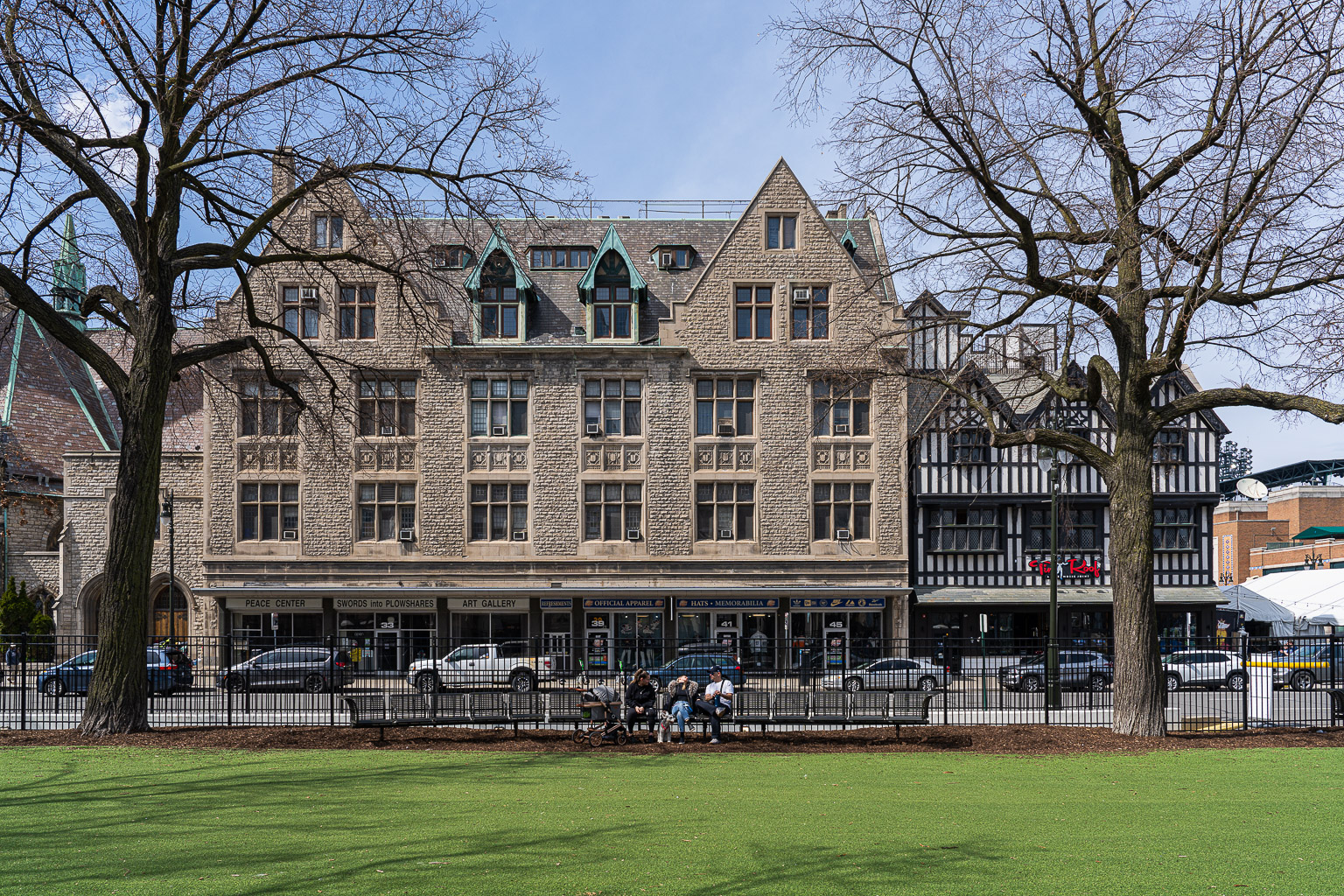
The proposed Women's Exchange Building Historic District at 47 E. Adams faces on the north side of Grand Circus Park. It is east of Central Methodist Church at Woodward and E. Adams and west of the Y.M.C.A. at Witherell and E. Adams. The Women's Exchange Building is located in the Central Business District and is included in the National Register eligible Grand Circus Park district ..
HISTORY: [+ expand]
In the year 1809, forty-one of the Park Lots containing five and ten acres each, were sold at auction. These were part of the 10,000 acres granted by Congress in 1806 and were laid out by order of the Governor and Judges on December 14, 1808. John R. Williams purchased Lots 1, 2, 3, and 4 for $188.75. Williams' activities in the political, military, judicial, and civic arenas covered the period of Detroit history between 1812 and 1850. In 1824 he became the first elected mayor of the city. His property holdings passed on to his nine children after his death in 1854. Mary C. A. Smart, daughter of John R. Williams, retained Lots 10 and 40 of Park Lot 1 until her death in the 1880s, at which time they were sold and first built upon. These two Victorian commercial buildings later became the home of the Women's Exchange.
The Women's Exchange and Decorative Arts Society in Detroit was established in the early 1880's, and then re-established in 1888 at a meeting held in the drawing room of Mrs. T. A. McGraw at the McGraw-Lightner House at 1708 E. Jefferson. Women's Exchange and Decorative Arts Societies were established in large cities all over the United States in the late nineteenth century as places for women to sell their work at a fair price. Members were well-to-do ladies who would sell producers' wares for the best price they could; the Women's Exchange received a 15% commission. The consigners were women who had once been well-off but, due to circumstances, had to face the problems of how to survive. They could bake cookies, do needlework, etc., at home, and have it sold at the Women's Exchange. Shirt waists, lingerie, and exquisite fancy work were among the items produced by women "whose distinctly feminine talents are not of the sort that would make them valuable in offices, shops, or any other places where the self-supporting women had to pit her abilities against those of men. Only women who are obliged to contribute to their support are permitted to sell their work." (From unreferenced article in HDAB files, "Work of the Woman's Exchange" c. 1908) Before becoming a consigner, a woman had to supply references stating that she was in need of help.
The Women's Exchange, as it later became known, was first located at 222 Woodward in one-half of D. C. Jones' florist shop. Mrs. Don M. Dickinson was the organization's first president. From Woodward Avenue the Women's Exchange moved to 24 Grand River Avenue, then to 50 Washington Boulevard, then back to Grand River, then to rooms in the B. Siegel Building, then to 122 Farmer Street for eight years before its final move to East Adams in 1916. As a result of its popular noon lunches and thriving catering service, the Women's Exchange in Detroit was totally self-sufficient. Before its final move it had 385 women consigners and 52 employees.
The money to remodel the building at 47 E. Adams was neither from contributions nor endowments. It was all derived from the Exchange's income from marketing the goods of self-supporting ladies. The building was leased for a term of 99 years and nine months from Frank W. Baumgartner on July 1, 1915 by the Women's Exchange. The architectural firm of Smith, Hinchman and Grylls was hired to redesign the two existing buildings as one to accommodate the Society. Perhaps the position of Mrs. Charles C. Hinchman as first vice-president of the Women's Exchange precipitated the choice, but it is more likely due to the firm's fine reputation and the building's proximity to the Central Methodist Church Activities Building, designed by Smith, Hinchman and Grylls in 1912 to harmonize with Gordon W. Lloyd's (1863) church at the corner of Woodward and E. Adams. Mrs. John B. Ford was the president of the Women's Exchange in 1916.
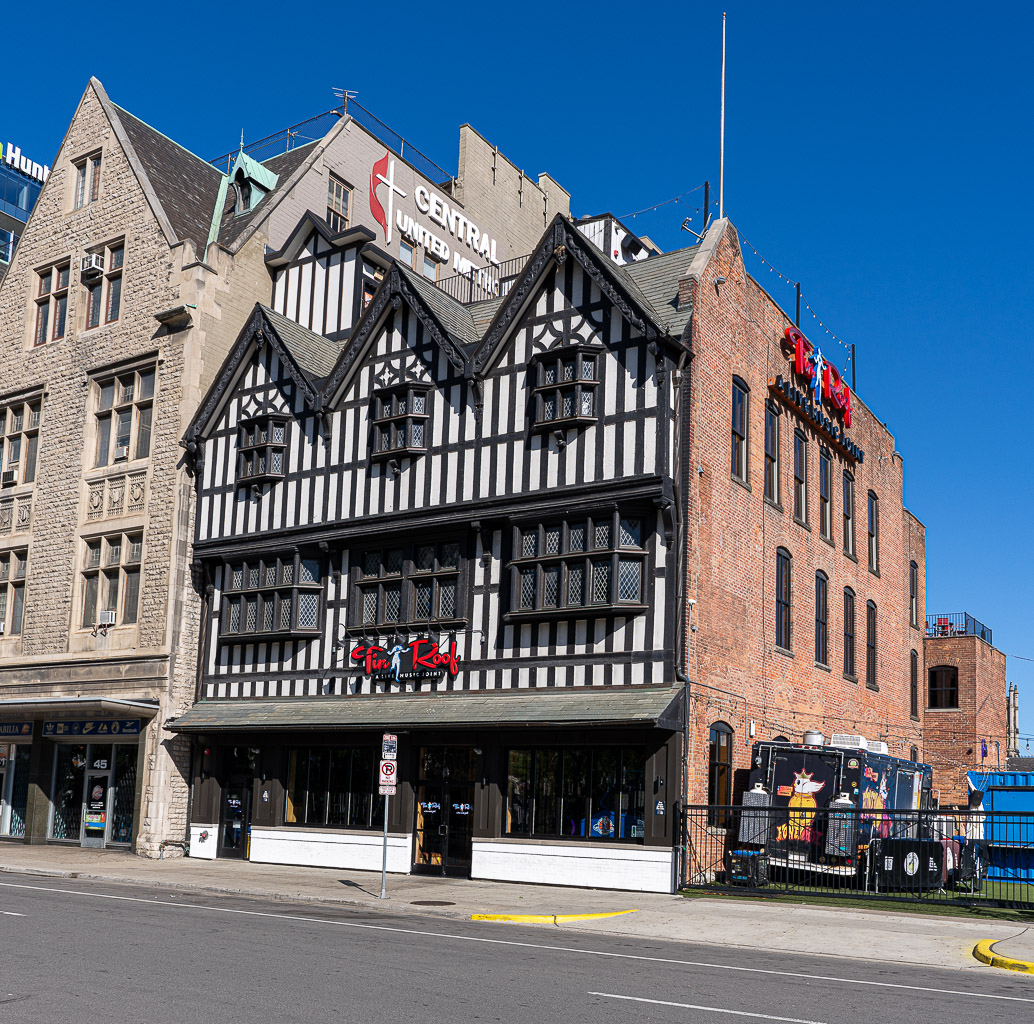
The Women's Exchange Building was completed on February 1, 1916. It was hailed by the newspapers as, " ... the first building of its sort in the city, a pioneer in Old English architecture as applied to business blocks here." (Free Press, 1/30/16) On February 12, 1916, a fire that broke out in a second story storeroom resulted in $15,000 worth of damage to the building. It was, however, rebuilt at once.
The organization ceased its operations in 1942, after 50 years of service, as it felt it had fulfilled its goals. The Women's Exchange was more than a women's social organization -- it was a place where women helped women through periods of financial need.
ARCHITECTURAL DESCRIPTION: The Women's Exchange Building on the north side of Grand Circus Park is, in fact, two three-story brick Victorian buildings with later modifications. City of Detroit permits reveal that the western half of the Women's Exchange Building was constructed as the business and home of T. H. Roberts, an undertaker, in 1886. The eastern half was constructed as an office block for C. J. Lundy, M.D. by A. C. Varney, a local architect, in 1889. The firewall running through the center of the present building and the segmentally arched windows on the exposed east elevation attestto the fact that the Women's Exchange Building was formerly two late-nineteenth century buildings.
In 1915, the Detroit architectural firm of Smith, Hinchman and Grylls designed a unified new facade and remodelled the interior to act as one building suited for occupancy by the Women's Exchange. F. S. Robinson was the contractor. Because the western-most of the two Victorian buildings was set back from the building line, an addition was built to conform with the building line of its eastern adjoining neighbor. The facade itself, completed in 1916, is an exact duplicate of the famous Butcher's Guild in Herefordshire, England, dated 1621. This was a suitable choice of styles, considering the nature of the activities of the Women's Exchange. The picturesque facade exhibits half-timbering on the second and third stories over a white stucco wall surface, carved vergeboards, three evenly spaced frontal gables, and small paned leaded glass windows. The jutting bay windows and gables, positioned one above the other, are the primary features of the facade. Attention to detail is expressed by the carved faces and ornamentation in the vergeboards, pseudo-twisted gutters, and simply decorated collector boxes. The first story, originally intended to be reminiscent of a Tudor shop front, has been altered greatly over the years. A brick rear addition was added in 1915-16.
The new arrangement of the first floor of the Women's Exchange Building housed the main lunchroom with a capacity of 200-250 persons, finished in English oak artistic panelling with a large fireplace; showrooms and needlework rooms. On the mezzanine was the restaurant, kitchen, and superintendent's office. The second floor contained the catering kitchen, three small dining rooms, and employee service rooms; the third floor was to be rented to provide a source of income to the society.
After the Women's Exchange vacated the building in the 1940's, additonal interior alterations and renovations took place to accommodate subsequent uses: a trade school, retail shops, the Grand Circus Exchange (a theatrical group), private offices, and public agencies. Today (2026) it houses the Tin Roof Restaurant.