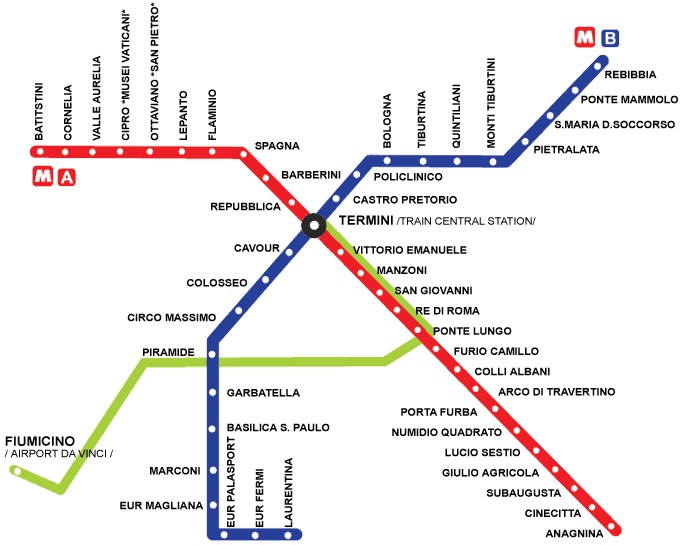
more/rome_metro: Rome Metro map
A Tourist in Rome - Get around Rome
Rome's subway, the Metro (map below), consists of two lines in the shape of the letter 'X'. A third line is under construction but not yet open. The intersection of the two lines is at the Termini train station, the main train station and transportation hub in Rome. There is also a train running between Fiumicino Aiport and Termini, and a few of subway extension lines which go from the main metro lines to the outlying areas (for example, to Ostia Antica).
The Red line, line A, runs northwest and southeast from Termini. Northwest (toward Batistini) are the Baths of Diocletian, the Trevi Fountain, the Spanish Steps, Piazza del Popolo and the Vatican. Southeast (toward Anagnina) are the Trophies of Marius, San Giovanni in Laterano and Aqueduct Park.
The Blue line, line B, runs southwest and northeast from Termini. Southwest (toward Laurentina) is the Colosseum/Roman Forum/Palatine Hill area, Circus Maximus, the Pyramid of Cestius and the E.U.R. Northeast (toward Rebibbia) is the Ponte Mammolo stop, from which buses to Tivoli depart.
When you get onto the Metro, you'll need to select which direction to take the line. The directions are always marked with the name of the last stop on the line. So on the red line, you go toward either Batitstini (northwest) or Anagnina (southeast), and on the blue line, toward Rebibbia (northeast) or Laurentina (southwest).
The Metro is pretty reliable, but like everything in Rome, things are on a loose schedule and sometimes things break. For example, during my first-ever day in Rome, the blue line broke, so I had to walk in the heat for an hour rather than take what would have been a 5 or 10 minute ride. This is when you need to throw your arms up, remember how incredibly fortunate you are to be in the eternal city, and shout out how much you love Rome. By the way, the metro never failed me again on that trip.
You might notice I never mentioned the Pantheon, Piazza Navona, the Borghese Gallery or the Appian Way in my list of metro stops. That's because you can't cover an entire city with only two lines in the shape of an X. The bus and tram lines fill in the rest of area with public transportation.
Luckily, the Metro, bus and tram system is run by one organization, ATAC. This lets you buy individual ride tickets which let you take a metro for several stops then a bus to your destination, or daily, 3-day or weekly passes which let you ride unlimited for that period of time. I find these passes the best way to go because I rely heavily on public transportation when I'm in Rome. A single ride costs €1.50, an all-day pass costs €6.00, a 3-day pass costs €16.50 and a 7-day pass costs €24 (prices are as of October 2013). The 7-day pass costs the same as 16 trips, and I can easily average 3 trips per day on the Metro, so the pass is a good savings for me. With a weekly pass I don't need to worry about taking extra trips, or wasting time buying individual tickets before each ride. I've always gotten my money's worth using a 3-day or 7-day pass. A multiple ride pass always needs to be 'validated' before its first use - this indicates when the pass was first used, therefore when it expires. Validation of the pass is automatic when you use the Metro (the subway). The machine you put your ticket in automatically recognizes its first use and validates it for you. If you use a pass for the first time (or even a single-ride ticket) on a bus, be sure to put it into the yellow machine on the bus to validate it. After that first validation, you don't need to validate the ticket again -- the date / time it was first used is stamped on the ticket, so it is easily to determine when the ticket expires. Security personnel spot-check tickets on buses and trams. If you're caught with an unvalidated ticket, or an expired ticket, there is a hefty fine. So be sure to carry a validated ticket that hasn't yet expired whenever you use public transit in Rome so you can prove you've paid properly for the ride.
Maps of the bus routes can be easily downloaded as PDF files. Just go to www.atac.roma.it, follow the 'linee e mappe' link, and grab the 'centro' and 'citta' maps into your mobile device so you can have them handy. The maps show the bus routes, with the route numbers along the routes. Arrows on the map indicate the direction of the buses; no arrow indicates the bus goes both directions.
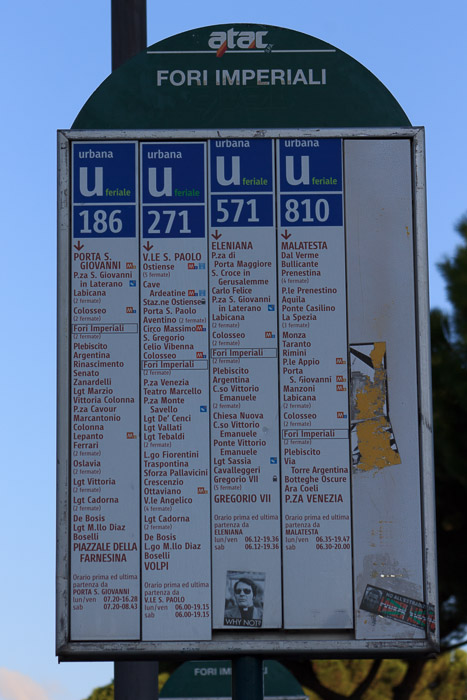
Along the route, at the bus stops (fermata), you'll find a sign like the one below. The name of the stop is shown at the top of the sign (Fori Impariali, in this case). Beneath that are the route numbers that stop here (186, 271, 571 and 810). The stops along the route are listed below the route number with the direction of the bus indicated beside the route number. So the stops listed in the direction of the arrow from the stop where you stand are the remaining stops on this route. For example, from here, Bus 810 will go to Plebiscito, Via Torre Argentina, Botteghe Oscure, Ara Coeli, and end at Piazza Venezia.
More information about public transportation in Rome can be found here.